TESTS · CPU · INTEL
PUBLISHED
READING25 min
Overclocking and testing the Core i5-4670K: a 4-core Haswell in 2024 games and applications
What can a 10-year-old Core i5-4670K (Haswell) still do in 2024? We put the old processor through its paces with testing, overclocking, and tackling its cooling challenges.
It's hard to believe that a decade has passed since the release of Haswell desktop processors and the LGA 1150 platform. It feels like a lifetime ago.
In this article, we'll test the Core i5-4670K, a nominally weak quad-core processor without Hyper-Threading, to see how it performs in 2024 games and applications. We'll also compare it against several CPUs in its price bracket (and beyond), and run some overclocking experiments with this CPU.
Processor | Price |
Ryzen 5 3600 | $75-85 |
Ryzen 5 1600X | $35-45* |
Ryzen 7 1800X | $60-75* |
Core i5-4670K | $12-16* |
Core i3-10100F | $55-60 |
Core i5-10400F | $95-100 |
Core i3-12100F | $95-105 |
Core i5-12400F | $145-155 |
Core i7-11700K | $250-300 |
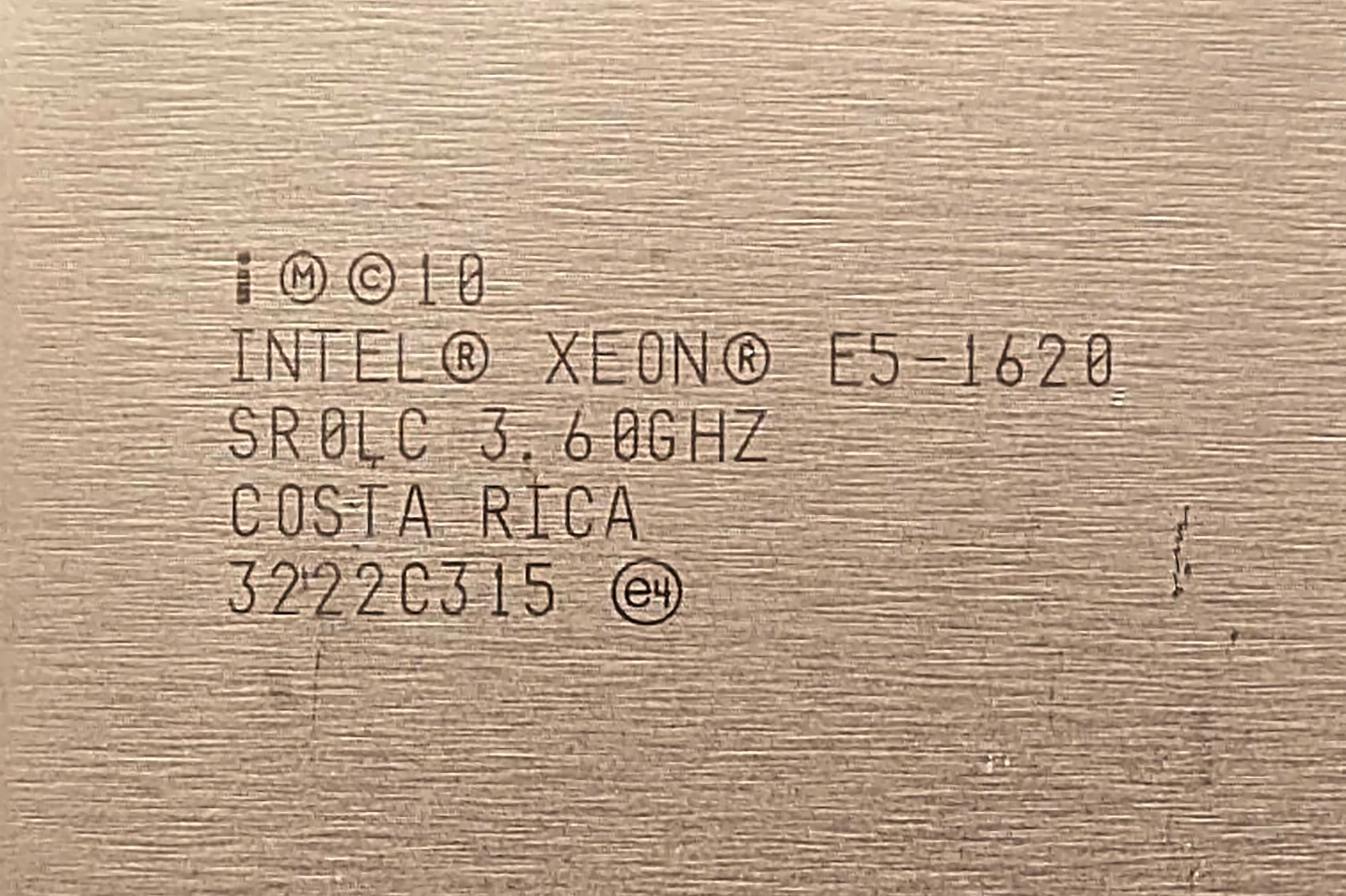
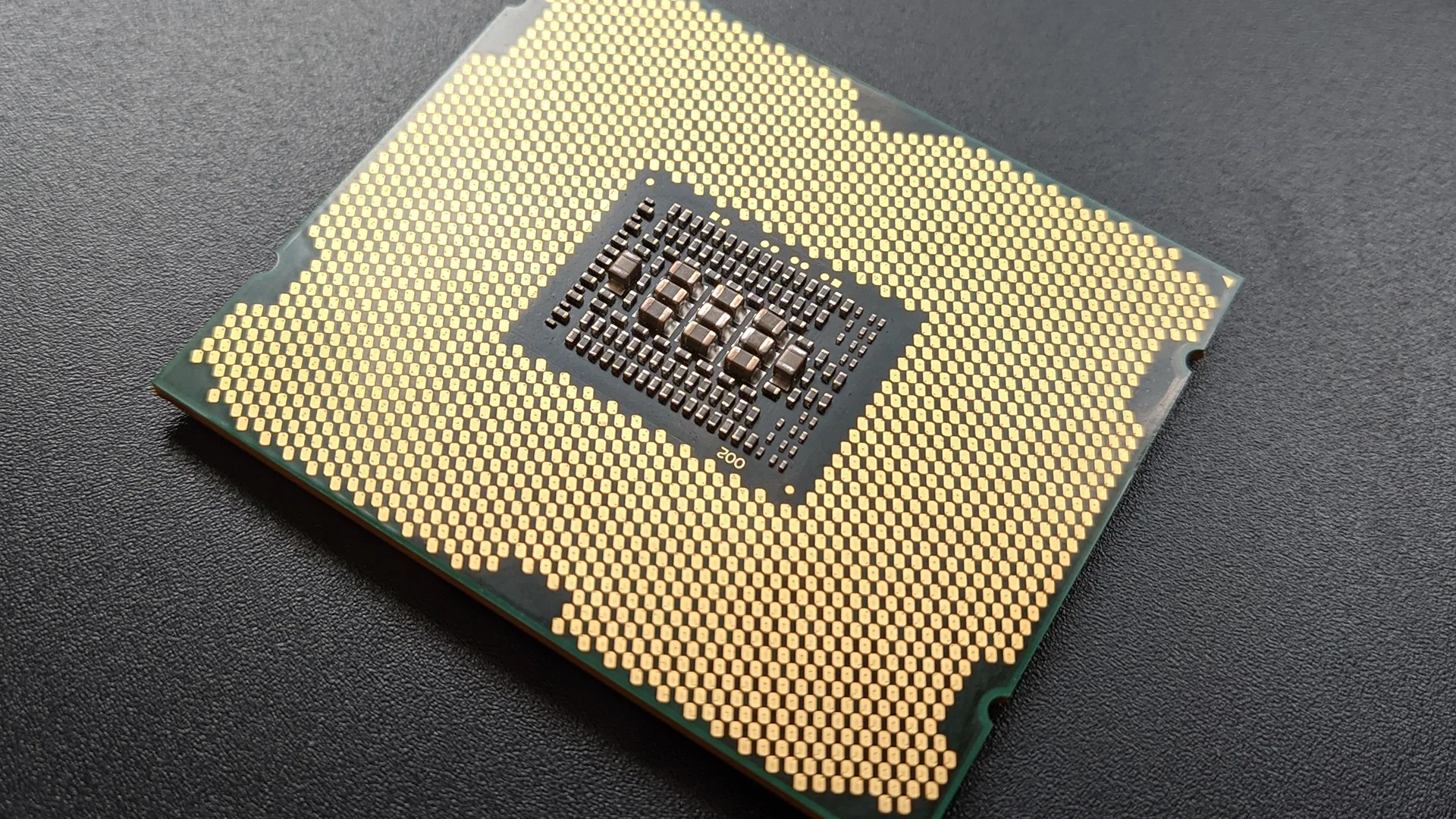
Xeon E5-1620 | $4-5* |
Xeon E5-2690 | $5-7* |
Xeon E5-2630 v3 | $2-5* |
Xeon E5-2670 v3 | $9-12* |
Xeon E5-2640 v4 | $6-8* |
*Since new units are unavailable in stores, we've used secondary market prices as a reference.
Processor
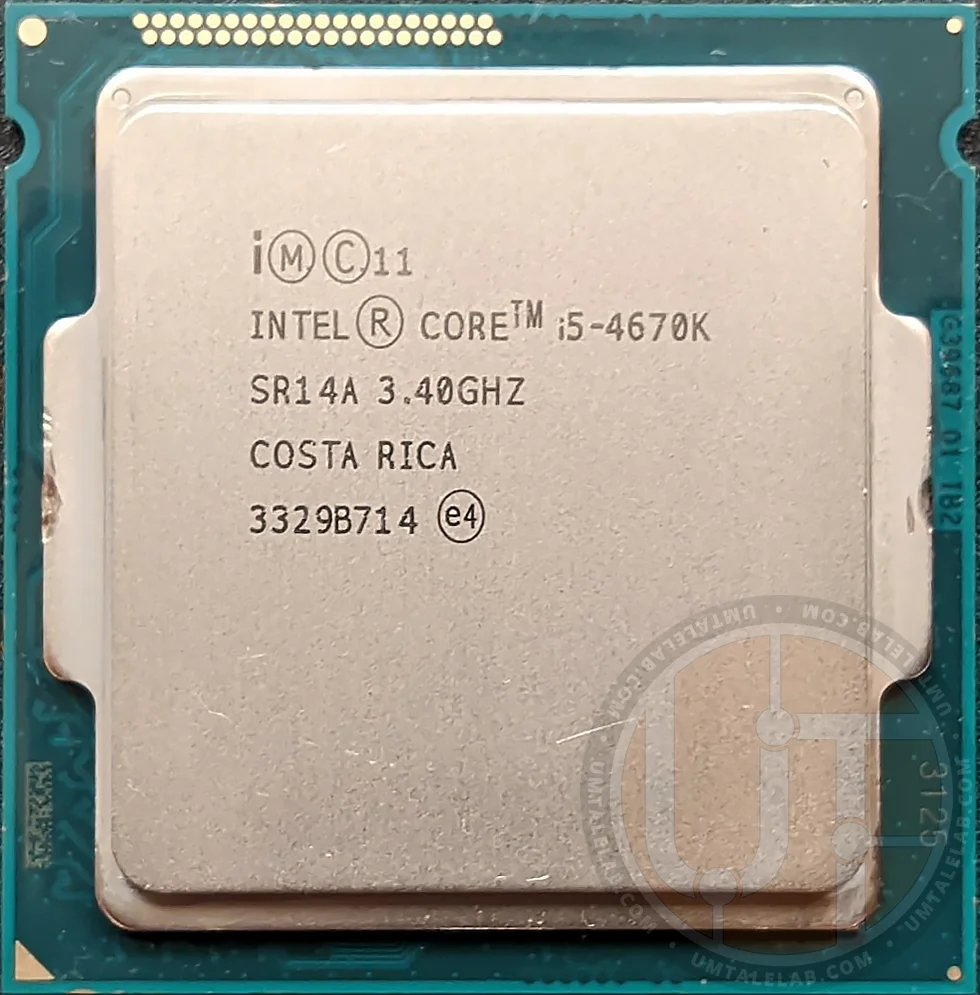

Our test sample is marked SR14A. This is a retail BOX version of the desktop CPU. However, it arrived without its original packaging or stock cooler, which is perfectly normal for a decade-old chip.
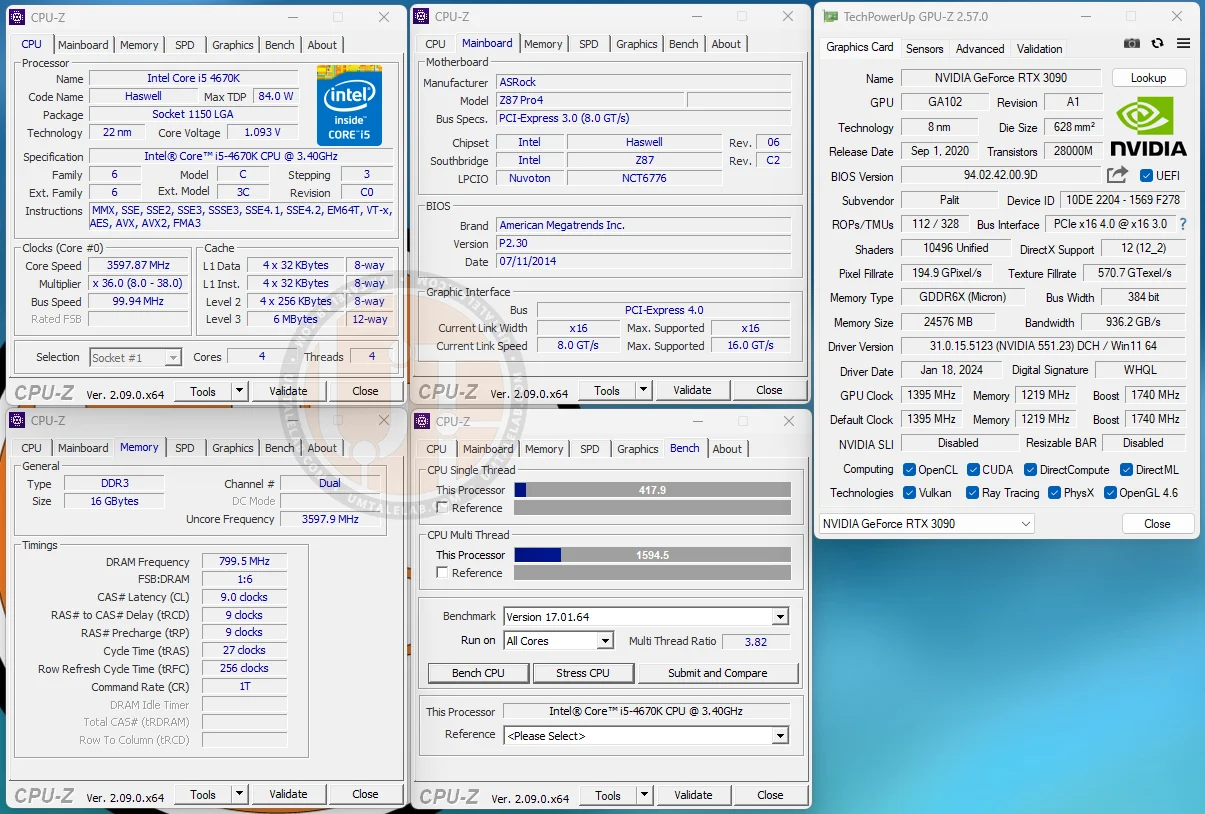
The Core i5-4670K is based on a 4-core, 22nm C0 revision Haswell die. While it lacks Hyper-Threading, its unlocked multiplier allows for overclocking. More on that later.
 ⤢ ВІДКРИТИ
Beyond its four cores, the i5-4670K boasts 256 KB of L2 cache per core and a shared, rather meager by today's standards, 6MB L3 cache. This CPU is designed for LGA 1150 motherboards. Its nominal frequency is 3400 MHz, but Turbo Boost can push it to 3800 MHz for a single core, or 3600 MHz across all four cores.
Notably, the Core i5-4670K supports virtually the full suite of modern processor instructions, including AVX2 and FMA3.
The 4670K's integrated memory controller (IMC) and L3 cache speeds, like all Haswell chips, aren't tied to core frequency, operating on their own dividers. However, with our quad-core model, the IMC and core multipliers often align.
Officially, the 4670K is limited to dual-channel DDR3-1600 MHz RAM. However, overclocking can easily circumvent this limitation. But again, more on that later.
This chip's TDP is rated at 85 watts. In our previous article on the Xeon E5-1620, we criticized Intel for significantly overstating its potential TDP. Here, however, they've hit the nail on the head. Our measurements show that the Core i5-4670K easily hits 85 watts during heavy AVX workloads. In games, it's far better, typically drawing between 45 and 70 watts.
But not everything is as rosy as it seems. The situation here mirrors modern AMD Ryzen chips with their tiny dies, making heat dissipation a significant challenge.
Underneath the i5-4670K's integrated heat spreader (IHS) lies a long yet narrow die that's quite challenging to cool, even under ideal conditions. Adding to this, Intel's notoriously 'high-quality' thermal paste is alsoinvolved, which likely dried out five years ago and now only hinders heat transfer from the die to the IHS.
All these nuances paint a rather grim picture: without modifying the processor's internal structure, finding adequate cooling for the Core i5-4670K in 2024 is extremely difficult, if not outright impossible.
This is no exaggeration. Even at stock frequencies, our sample easily reached 88 degrees Celsius (with an ambient temperature of 19°C) in Cinebench R24. That's hardly the most demanding load for the cores. Running LinX immediately triggered thermal throttling, resulting in a noticeable performance drop. Now, imagine what happens in summer.
Partially, delidding the CPU (removing the integrated heat spreader and replacing the dried-out thermal interface material with fresh paste) can solve this. However, with older CPUs like this, the final result doesn't always meet expectations. You'll understand what we mean in the next section.
CPU overclocking
Since their 2013 release, desktop Haswell processors weren't the top choice for overclocking experiments, but our particular sample certainly managed to surprise us.
First, it's worth reiterating that we couldn't budge from stock frequencies without modifying the processor. The chip instantly throttled, all thanks to the thermal paste that had turned to dust. In such a scenario, there was no choice but to perform a CPU delid.This process is quite risky, and if you're not confident in your abilities, it's best to consult a specialist or simply forget about it, as it can permanently damage your CPU.
Regardless, we didn't have much of a choice, so we proceeded with the delid. That's when we discovered another unpleasant detail: beyond the obviously dried-out thermal paste, we found a deformed IHS. The deformation was internal (at the point of contact with the die), not external. But wait, there's more! Adding insult to injury, the die itself also had a convex shape in the center. At this point, you might wonder, "What on earth?" Did the stars align for us to get such a critically unlucky chip? Actually, not quite. A quick Google search on this issue reveals that our case isn't unique. Something definitely went awry at Intel with the manufacturing of desktop Haswell CPUs.
Well, we can't fix the die, but replacing the chip's IHS is a relatively straightforward task. The problem is, aside from the Core i5-4670K, we simply don't have any other LGA 1150 Haswell chips on hand. While Intel CPU lids for mainstream platforms look visually similar, they often aren't compatible due to differences in die height.
We had to use logical deduction (the die is 22nm, so compatibility with Ivy Bridge chips, built on the same process, should be high) to find the most suitable IHS. It turned out that the Core i3-3220, which we tested several years ago, has a similar heat spreader. After some minor modifications, the result was generally satisfactory. Achieving better contact with the Core i5-4670K's existing convex die would be extremely difficult (at least under our conditions).
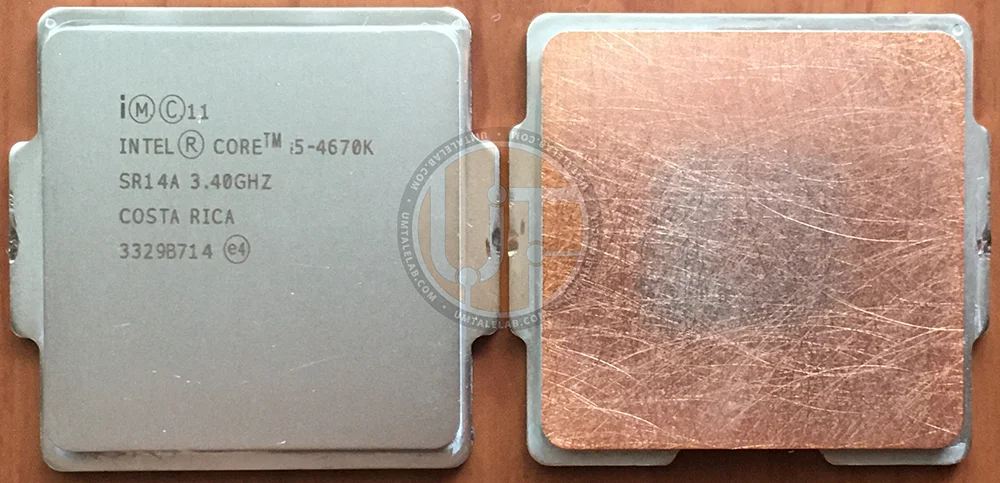
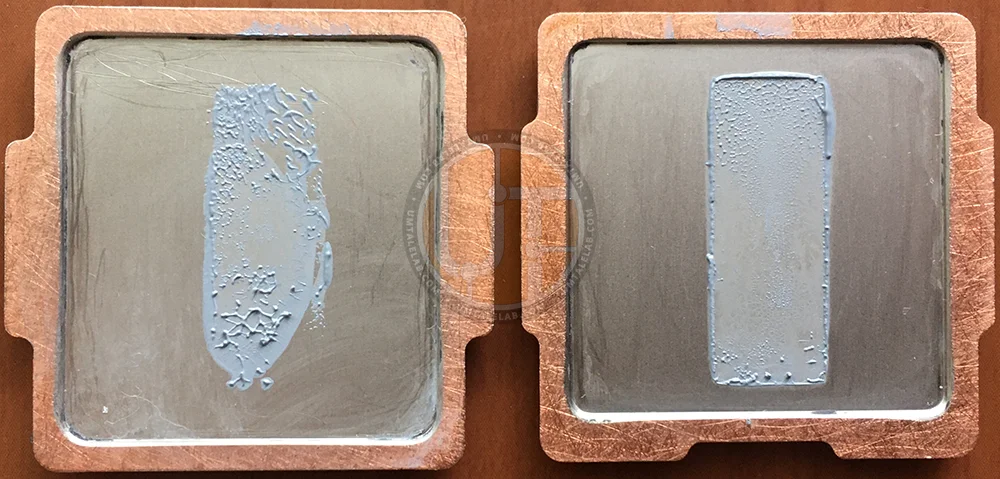
Based on the above and the accompanying photos, many of our readers have probably already guessed that expecting record overclocks from such a processor is futile. And you'd be absolutely right. After years of poor die-to-IHS contact and dried-out thermal paste, any processor experiences a degradation of its frequency potential. Our sample is no exception.
To start, as always, we set the voltage to a nominal 1.1 volts and then tried to pass a stability test at 3800 MHz for all cores. However, the Core i5-4670K couldn't manage it. Only by increasing the voltage to 1.175v was the processor able to complete a 60-minute LinX AVX stress test.
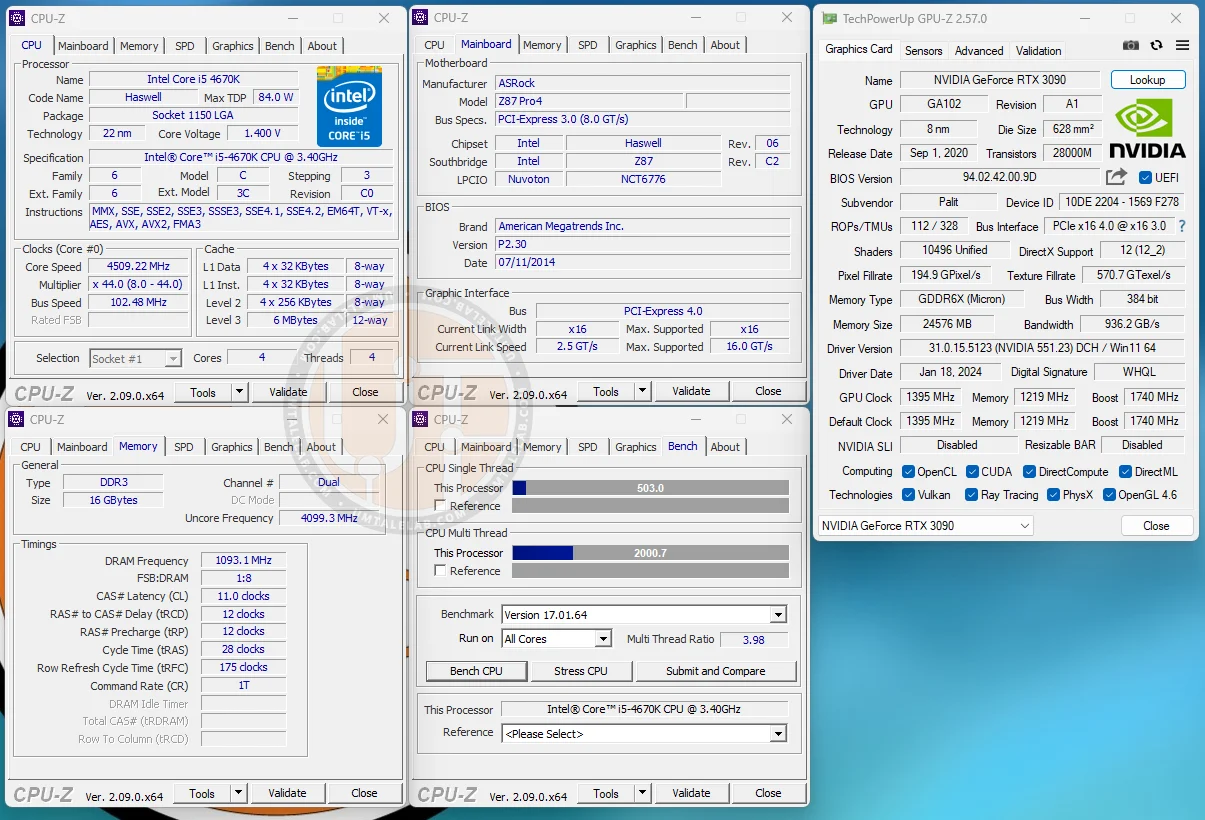
Given the chip's specific issues, there's no point in boring you with a long narrative of how we achieved the final result. The outcome of overclockingour Core i5-4670K sample was a core frequency of 4500 MHz, 4100 MHz for the memory controller/L3 cache, and 2133 MHz for DDR3:
 ⤢ ВІДКРИТИ
Even for such a modest frequency, our sample required a significant over-voltage (yes, not just an increase, but an actual over-voltage) for core power: a terrifying 1.4 volts for the cores, 1.32v for the cache, and 1.9v for the CPU input voltage (never confuse this with vCore! VCCIN/VRIN is a unique feature of Haswell chips, referring to the integrated voltage regulator or iVR).
Never attempt to set similar voltages on your system! Doing so can permanently damage your CPU!
Just to be clear, we conducted a huge number of experiments, including pushing VCCIN/VRIN up to 2.2 volts, and conversely, lowering it to 1.5-1.6v. We also significantly reduced all other frequencies, voltages, and multipliers to ensure they didn't impede core overclocking. But our attempts were in vain — no manipulation allowed us to push past the previously stated frequency limit.
It's also worth clarifying that with such a high voltage, a LinX AVX stress test was out of the question. The chip immediately reached 100 degrees Celsius, at which point the system shut down. Nevertheless, the Core i5-4670K passed AIDA64 with active AVX without issues, as well as other tests like Cinebench R24 or Blender. During these, it heated up to 96 degrees Celsius, but there wasn't even a hint of throttling. It's a good thing this CPU's maximum temperature is set at 100°C.
What more can we say: 4500 MHz isn't particularly impressive. But that's the reality for a 10-year-old processor with thermal paste under the lid.
Test setup, software, and CPU settings
Resizable BAR was enabled on platforms with BIOS support.
Test setup
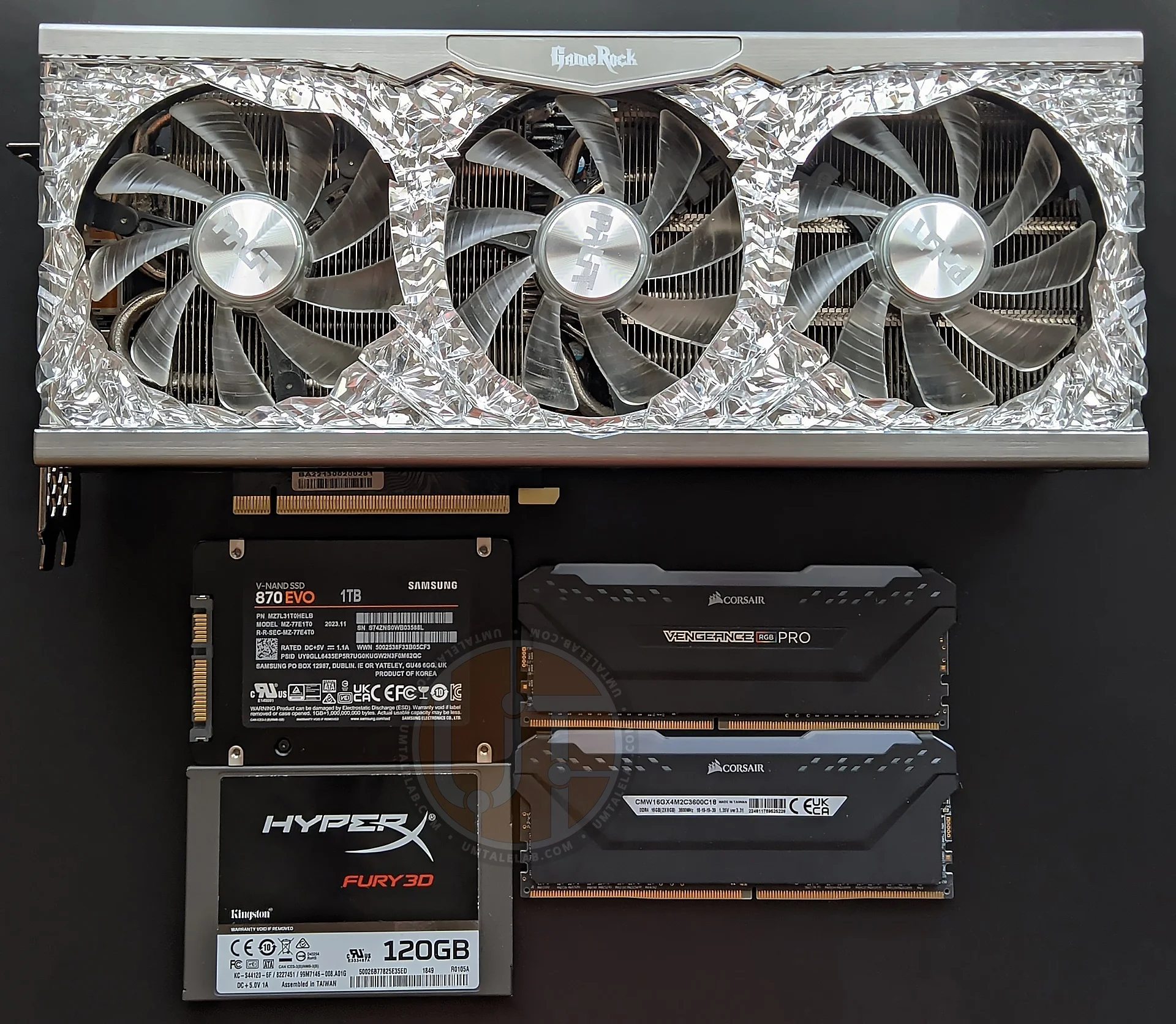
Intel CPUs: Core i5-4670K, Core i3-10100F, Core i5-10400F, Core i7-11700K, Core i3-12100F, Core i5-12400F, Xeon E5-1620, Xeon E5-2690, Xeon E5-2630 v3, Xeon E5-2670 v3, Xeon E5-2640 v4;
AMD CPUs: Ryzen 5 1600X, Ryzen 7 1800X, Ryzen 5 3600;
CPU cooler: Cooler Master Hyper 212 Black Edition (RR-212S-20PK-R1);
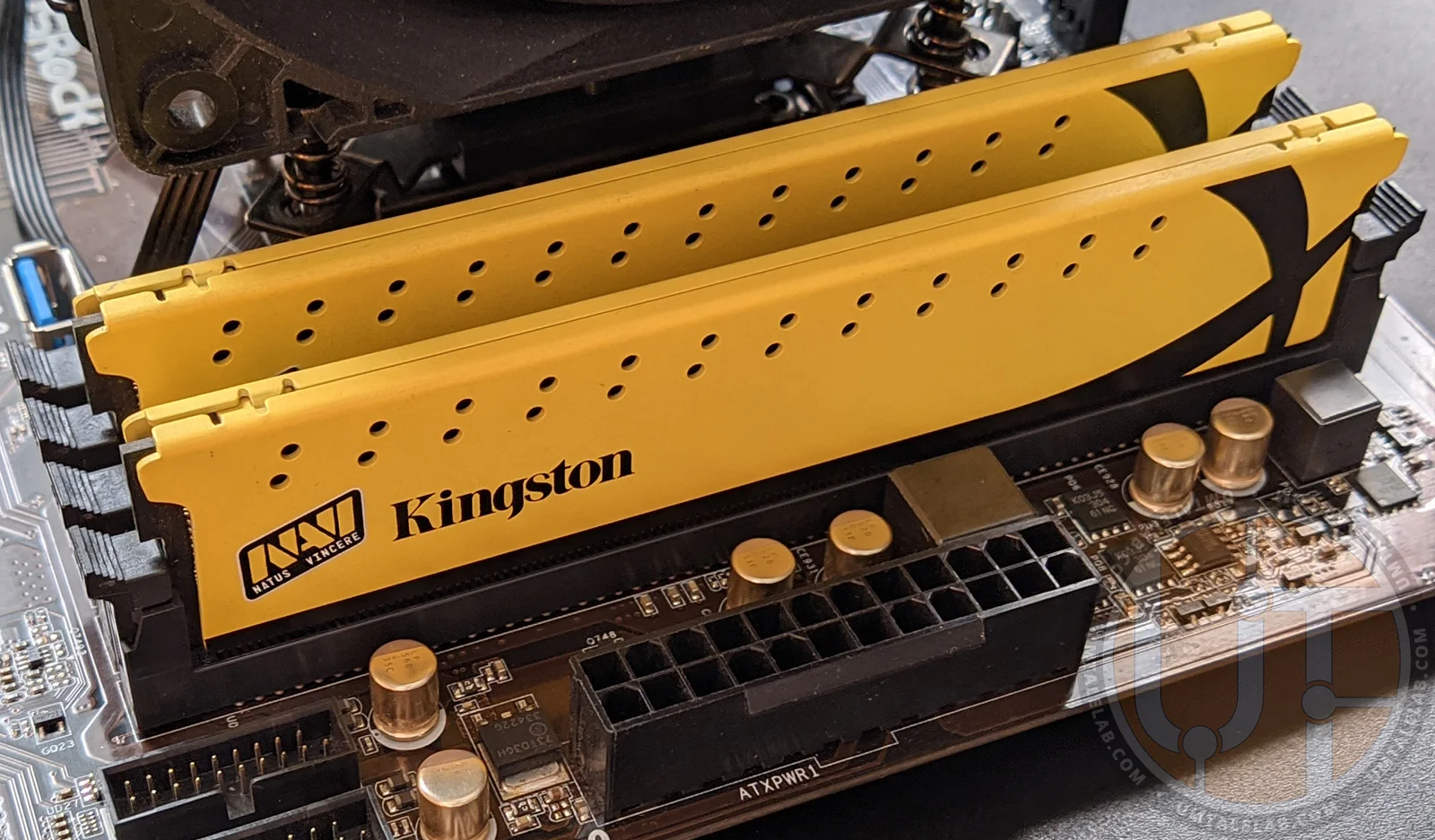
RAM for LGA 1150: 2x 8 GB HyperX Genesis Na’Vi Edition (KHX16C9C2K2/8), 16 GB total;
RAM for LGA 1200, LGA 1700, and AM4: 2x 8 GB Corsair Vengeance RGB PRO (CMW16GX4M2C3600C18), 16 GB total (Micron E-Die chips);
RAM for LGA 2011: 4x 8 GB Micron MT18KSF1G72PZ-1G6E1HI, 32 GB total (Micron D9PQL chips);
RAM for LGA 2011 v3: 4x 4 GB G.SKILL DDR4 F4-2400C15S-4GNT, 16 GB total (Hynix MFR chips);
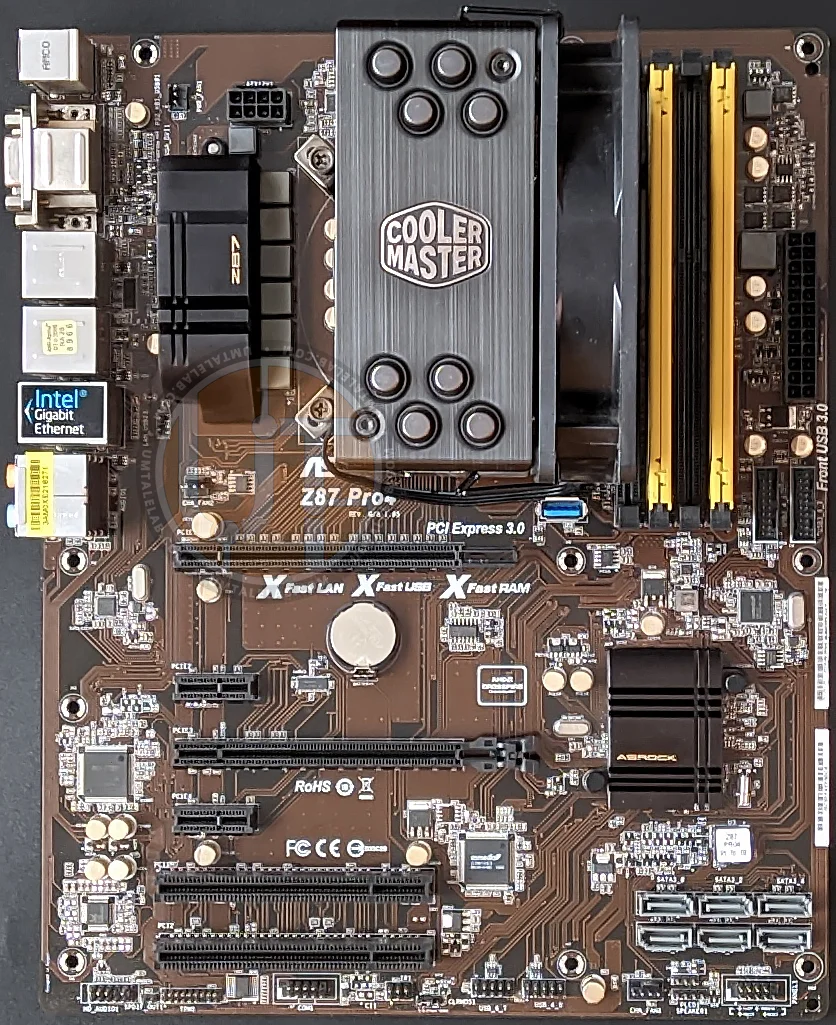
LGA 1150 motherboard: ASRock Z87 Pro4;
LGA 1200 motherboard: GIGABYTE Z490 AORUS ELITE AC for Core i7-11700K, ASUS PRIME B560M-A for Core i3-10100F and Core i5-10400F;
LGA 1700 motherboard: MSI PRO Z690-A DDR4 (MS-7D25);
LGA 2011 motherboard: DELL T3610 (09M8Y8);
LGA 2011 v3 motherboard: Kllisre X99-D8 (AD12) with a modified BIOS (Unlock Turbo Boost, Undervolt, and unlocked timing control);
AM4 motherboard: ASUS TUF GAMING B450M-PRO II;
Graphics card: PALIT GAMEROCK GeForce RTX 3090 24 GB (~1900/19000 MHz, Power Limit 113%);
SSDs: 2x KINGSTON SUV400S37120G 120 GB (AMD/Intel Windows 11), SAMSUNG 870 EVO 1 TB (Games/Applications);
Power supply: Chieftec GPS-1250C.
Software
Operating system: Windows 11 Pro x64 with the latest updates as of February 2024. Core Isolation/Memory Integrity disabled;
Graphics card drivers: NVIDIA GeForce 551.23 WHQL;
FPS monitoring software: MSI Afterburner 4.6.5;
Games: Testing was performed on the latest game versions as of February 2024;
Game settings: Testing was performed at maximum graphics settings at 1080p resolution.
Tested CPU settings
Intel processors:Core i5-4670K@3400-3800MHz, Dual Channel DDR3@1600MHz (motherboard auto: 9-9-9-27);
Core i5-4670K@4500MHz, UnCore@4100 MHz, Dual Channel DDR3@2133MHz (11-12-12-28), vCore voltage – 1.4v, VCCIN/VRIN voltage - 1.9v, CPU Cache – 1.32v, SA voltage – 1.25v, DDR3 voltage – 1.69v;
Core i3-10100F@3600-4300 MHz, Dual Channel DDR4@2667 MHz (motherboard auto: 16-18-18-36);
Core i3-10100F@3600-4300 MHz, Dual Channel DDR4@4000 MHz (16-21-21-42), IO voltage – 1,2v, SA voltage – 1.2v, DDR4 voltage — 1.420v;
Core i5-10400F@2900-4300 MHz, Dual Channel DDR4@2667 MHz (motherboard auto: 16-18-18-36);
Core i5-10400F@2900-4300 MHz, Dual Channel DDR4@4000 MHz (16-21-21-42), IO voltage – 1,2v, SA voltage – 1.2v, DDR4 voltage — 1.420v;
Core i7-11700K@3600-5000 MHz, Dual Channel DDR4@3200 MHz (motherboard auto: 16-18-18-36);
Core i7-11700K@4800 MHz, UnCore@4400 MHz, Dual Channel DDR4@3600 MHz (16-19-19-38) GEAR 1, vCore voltage – 1.33v, mem-IO voltage – 1.2v, SA voltage – 1.23v, DDR4 voltage – 1.36v;
Core i3-12100F@3300-4300 MHz, Dual Channel DDR4@3200 MHz (motherboard auto: 18-19-19-39) GEAR 1;
Core i3-12100F@3300-4300 MHz, Dual Channel DDR4@3600 MHz (16-19-19-38) GEAR 1;
Core i5-12400F@2500-4400 MHz, Dual Channel DDR4@3200 MHz (motherboard auto:18-19-19-39) GEAR 1;
Core i5-12400F@2500-4400 MHz, Dual Channel DDR4@3600 MHz (16-19-19-38) GEAR 1;
Xeon E5-1620@3600-3800 MHz, Quad-Channel DDR3@1600 MHz (motherboard auto: 11-11-11-28);
Xeon E5-2690@2900-3800 MHz, Quad-Channel DDR3@1600 MHz (motherboard auto: 11-11-11-28);
Xeon E5-2630 v3@3200 MHz (Unlock Turbo Boost in UTB charts), vCore -60mv, UnCore -50mv, SA -50mv, Quad-Channel DDR4@1866 MHz (10-10-10-24);
Xeon E5-2670 v3@3100 MHz (Unlock Turbo Boost in UTB charts), vCore -50mv, UnCore -50mv, SA -50mv, Quad-Channel DDR4@2133 MHz (12-12-12-35).
Xeon E5-2640 v4@2400-3400 MHz, Quad-Channel DDR4@2133 MHz (12-12-12-28).
AMD processors: Ryzen 5 1600X@3600-4000 MHz, Dual Chanel DDR4@2667 MHz (motherboard auto: 18-18-18-44);
Ryzen 5 1600X@4000 MHz, Dual Chanel DDR4@3600 MHz (16-19-16-38), vCore voltage – 1.42v, SOC voltage — 1.075v, cLDO VDDP voltage – 0.975v, DDR4 voltage — 1.350v;
Ryzen 7 1800X@3600-4000 MHz, Dual Chanel DDR4@2667 MHz (motherboard auto: 18-18-18-44);
Ryzen 7 1800X@3900 MHz, Dual Chanel DDR4@3600 MHz (16-19-16-38), vCore voltage – 1.4v, SOC voltage — 1.1v, cLDO VDDP voltage – 1.025v, DDR4 voltage — 1.350v;
Ryzen 5 3600@3600-4200 MHz, Dual Chanel DDR4@3200 MHz (motherboard auto: 22-22-22-53) Infinity Fabric@1600 MHz (1:1);
Ryzen 5 3600@4325 MHz, Dual Chanel DDR4@3733 MHz (16-19-16-38) Infinity Fabric@ 1866 MHz (1:1), vCore voltage – 1.39v, SOC voltage — 1.125v, cLDO VDDP voltage – 1.075v, VDDG CCD voltage – 1.025v, VDDG IOD voltage – 1.025v, DDR4 voltage — 1.380v;
You can find more detailed information on almost all the tested components in our full reviews, or by checking out the blog section for shorter notes.
As a reminder, our processor testing methodology involves running each benchmark, application, or game five times. We then calculate the average of these five runs for the final result. Crucially, all games and applications were installed on an SSD.
Test results
Data archiving
7-Zip
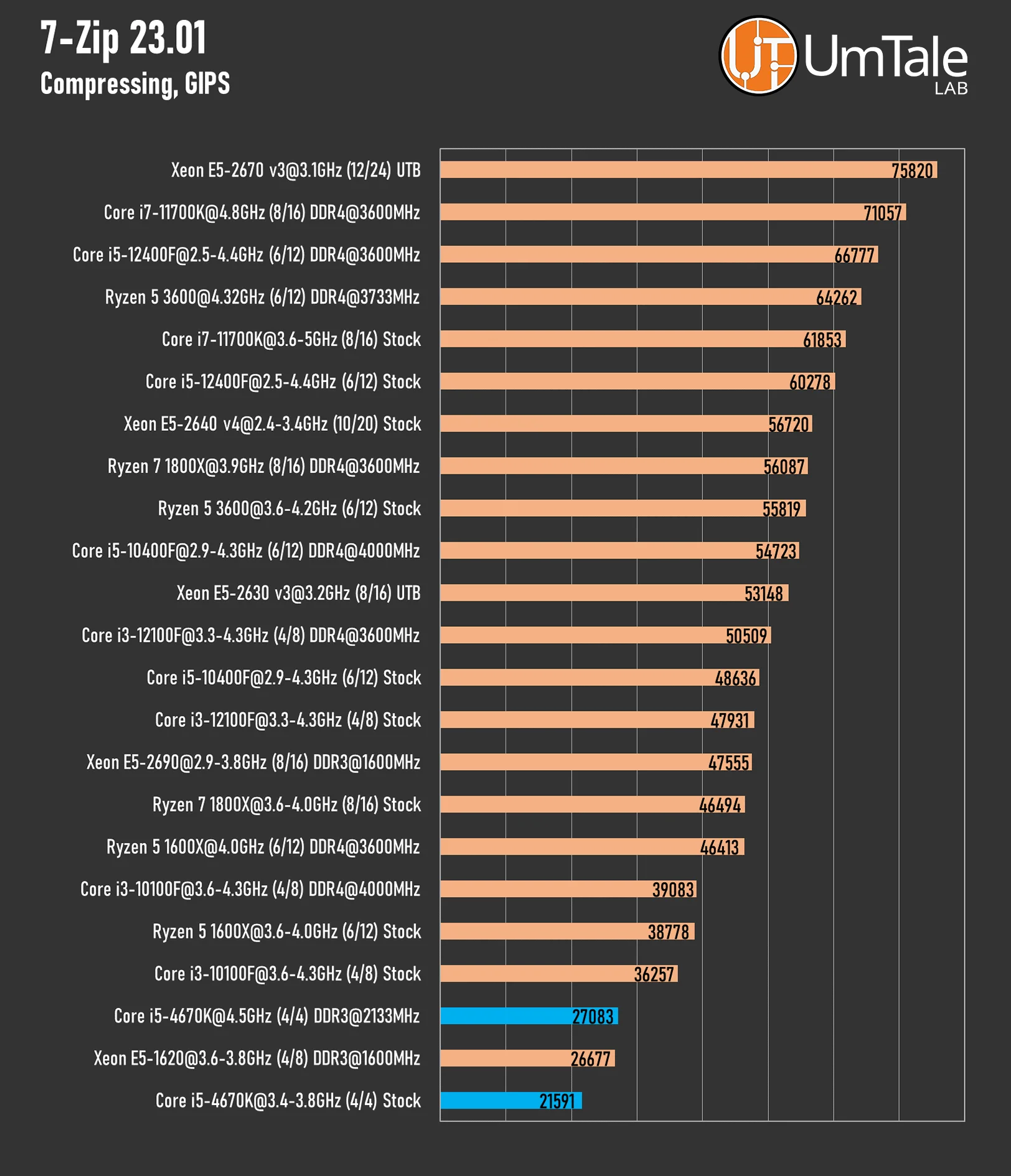
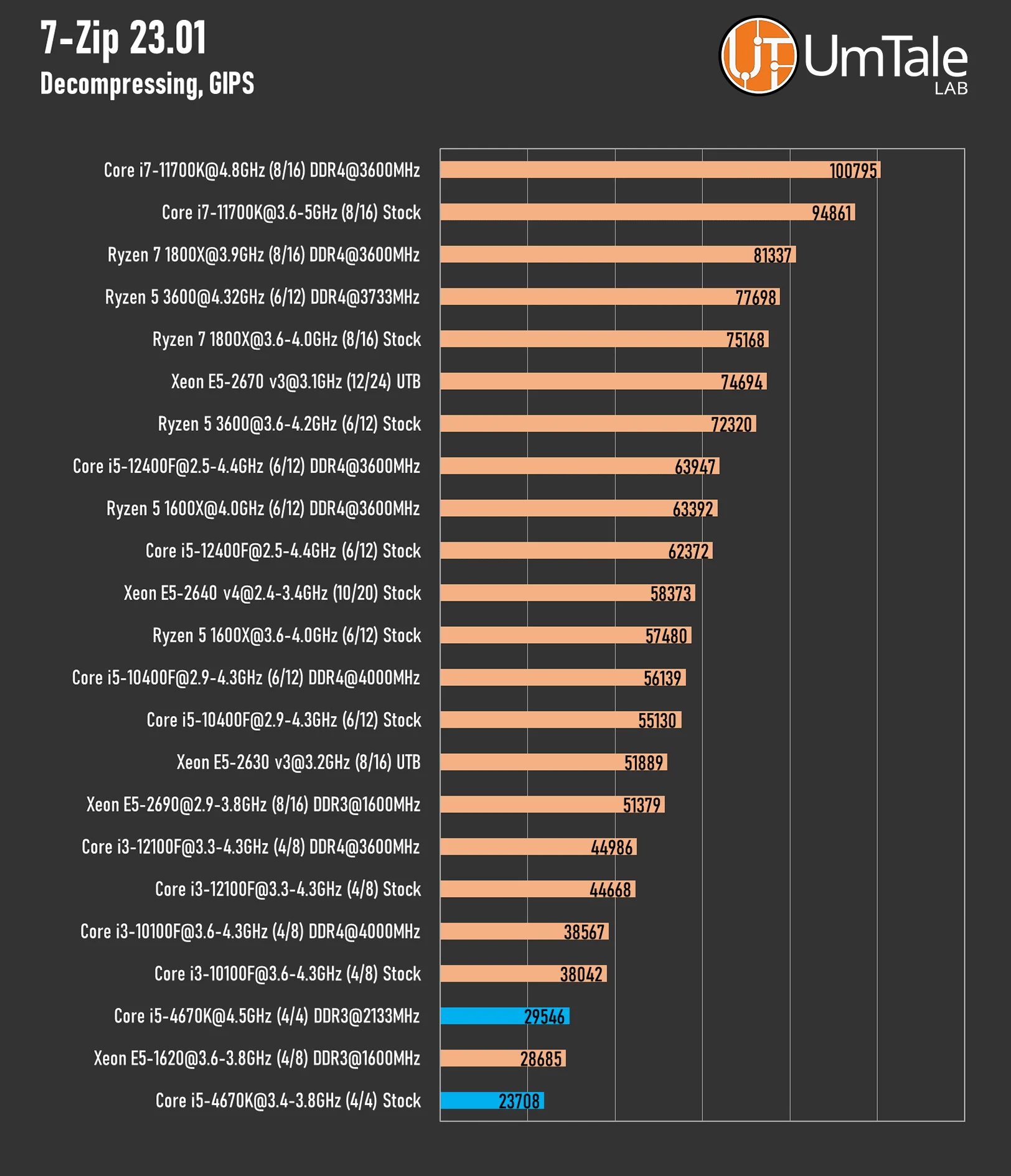
The popular free file archiver 7-Zip supports multiple compression algorithms and numerous data formats, including its proprietary 7z format featuring the highly efficient LZMA algorithm. It's known for its ability to utilize a large number of CPU threads and responds well to increased RAM frequencies.
File compression
 ⤢ ВІДКРИТИ
Unpacking files
 ⤢ ВІДКРИТИ
3D rendering
Blender
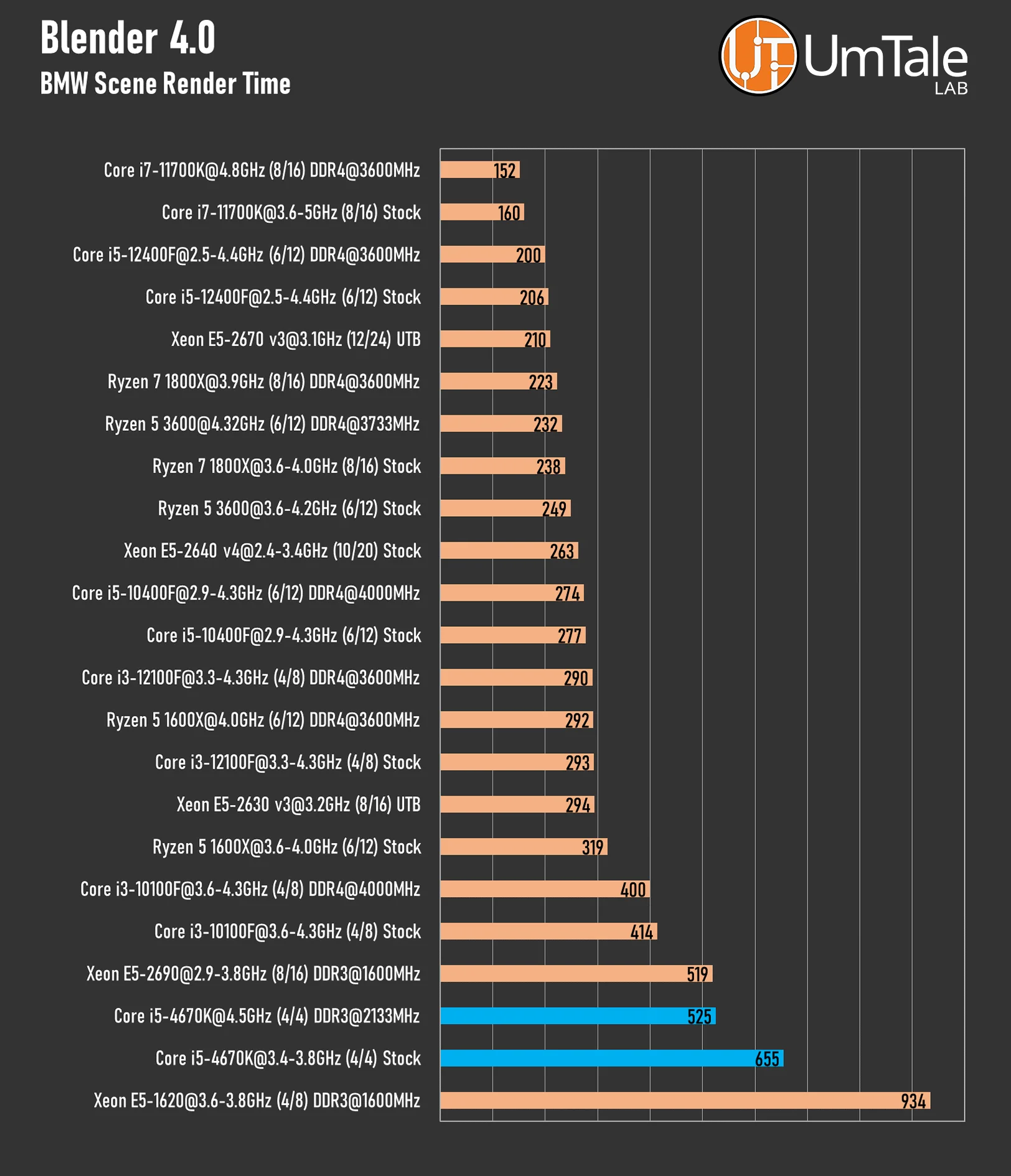
Blender is a versatile, free, and open-source software suite for 3D content creation. It supports the entire 3D modeling pipeline, from rigging, animation, simulation, and rendering to compositing, motion tracking, video editing, and game creation.
We test CPU rendering speed using Blender's built-in Cycles engine and the BMW scene.
 ⤢ ВІДКРИТИ
Corona 10 Benchmark
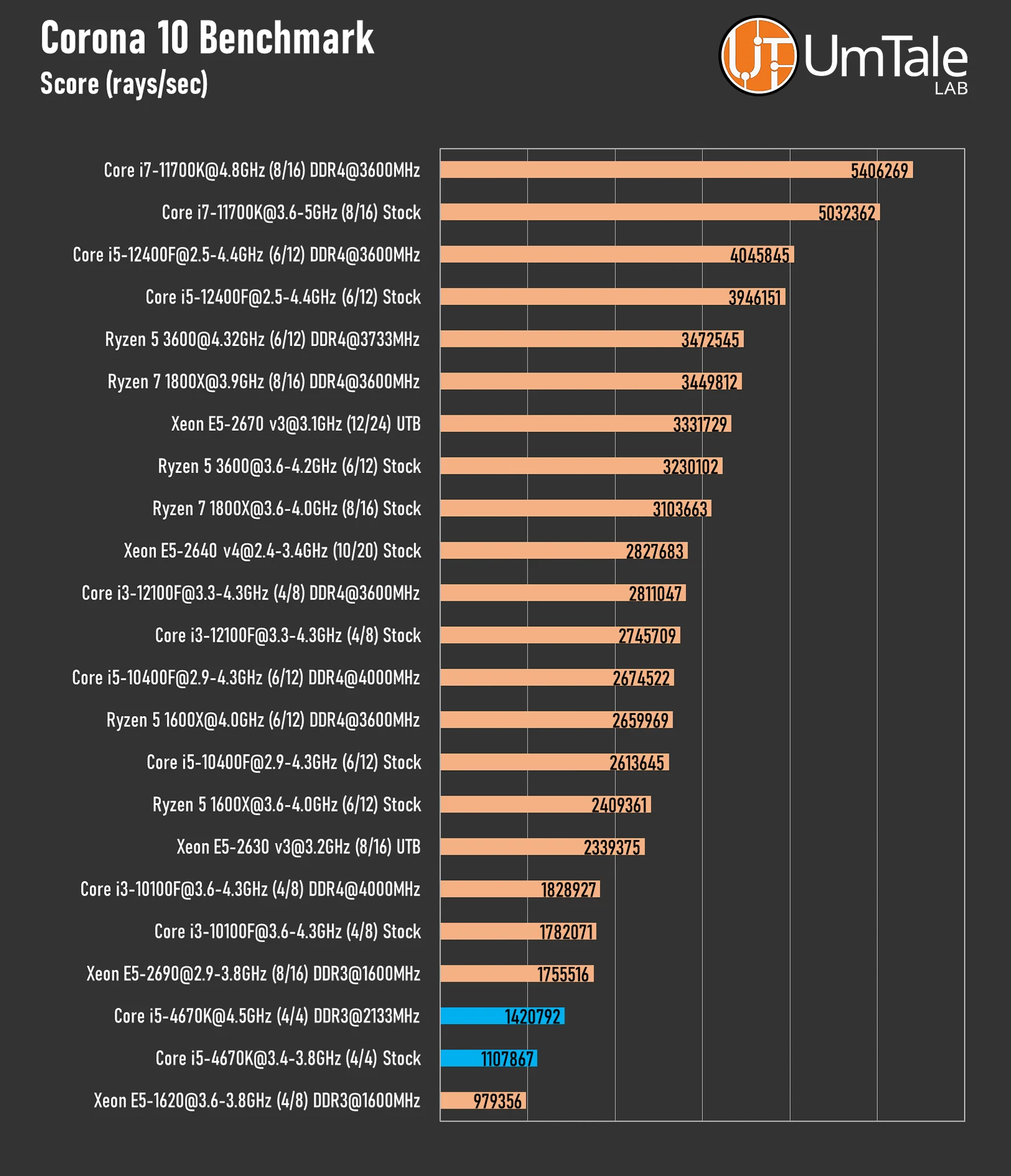
The Corona 10 Benchmark uses the Corona 10 render engine, a popular choice among professionals. This engine is available for scene visualization in 3ds Max and Cinema 4D. The benchmark evaluates CPU rendering speed with its proprietary technologies.
 ⤢ ВІДКРИТИ
Cinebench R23
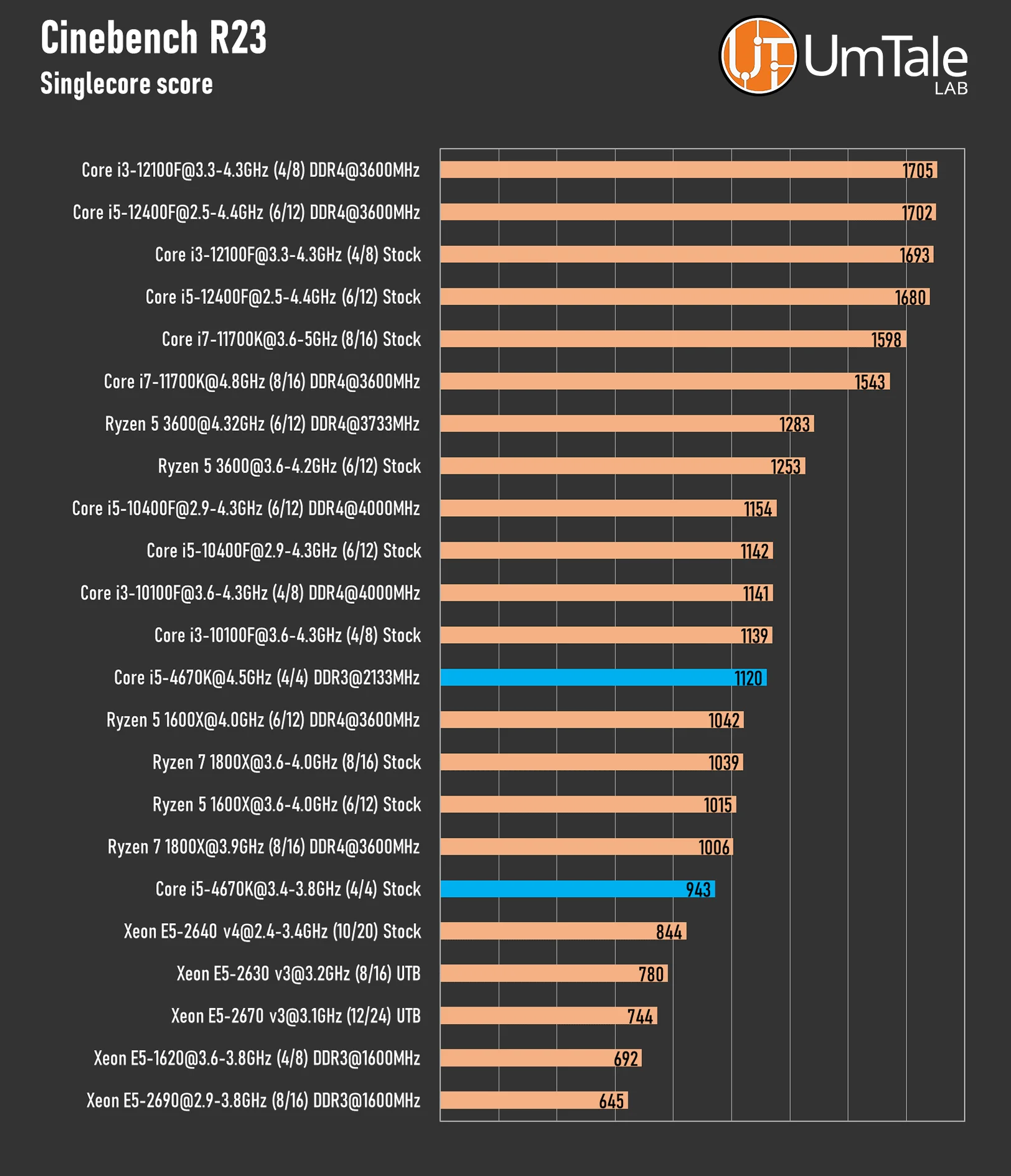
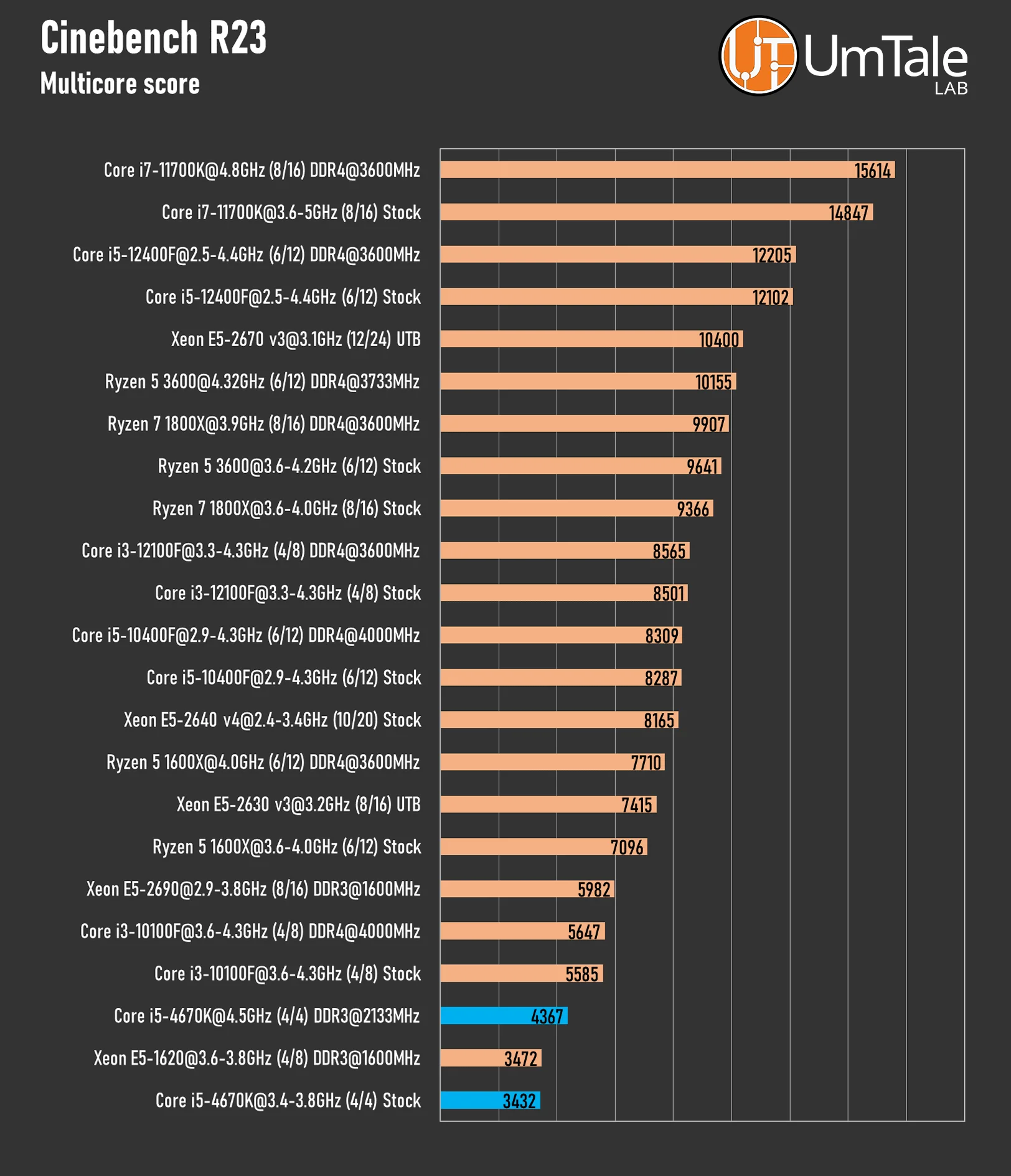
This is a somewhat outdated, but still relevant, benchmark version for the highly popular 3D computer animation, modeling, simulation, and rendering editor, Cinema 4D.
Single-core test result
 ⤢ ВІДКРИТИ
Multi-core test result
 ⤢ ВІДКРИТИ
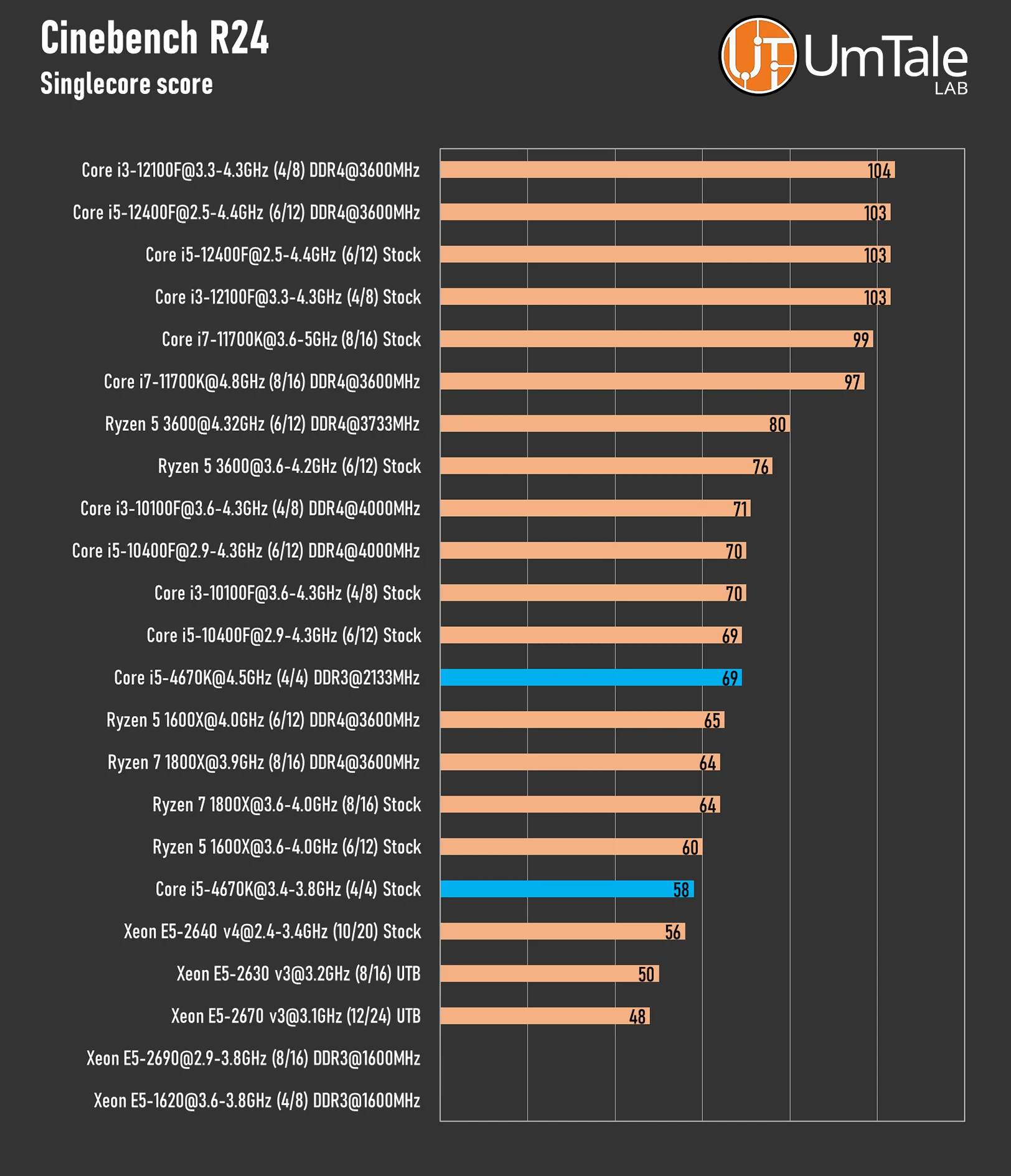
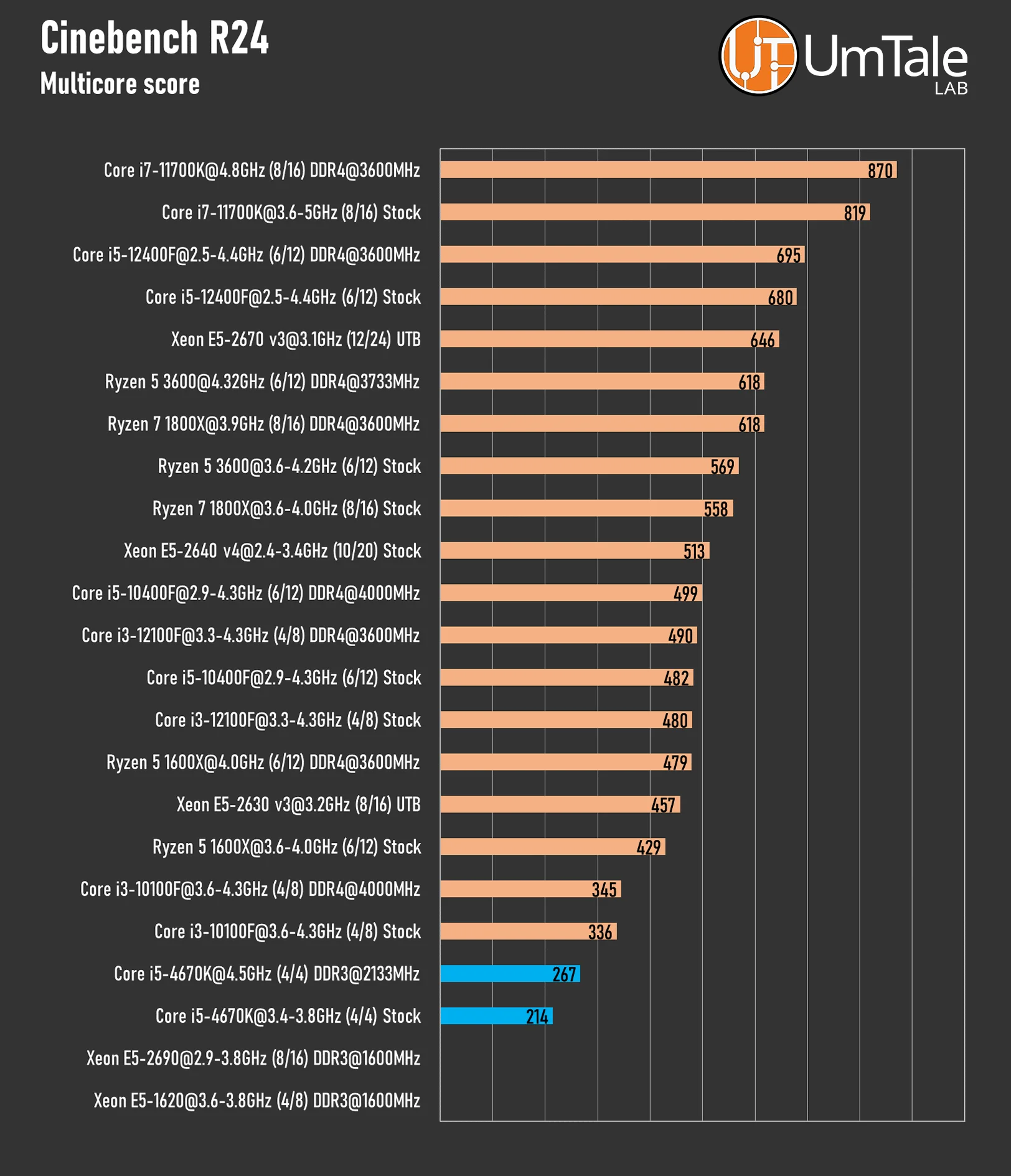
Cinebench R24
This is the latest version of the benchmark for Cinema 4D, a very popular editor for computer 3D animation, modeling, simulation, and rendering. Starting with this release, the main CPU test requires processors to support the AVX2 instruction set.
Single-core test result
 ⤢ ВІДКРИТИ
Multi-core test result
 ⤢ ВІДКРИТИ
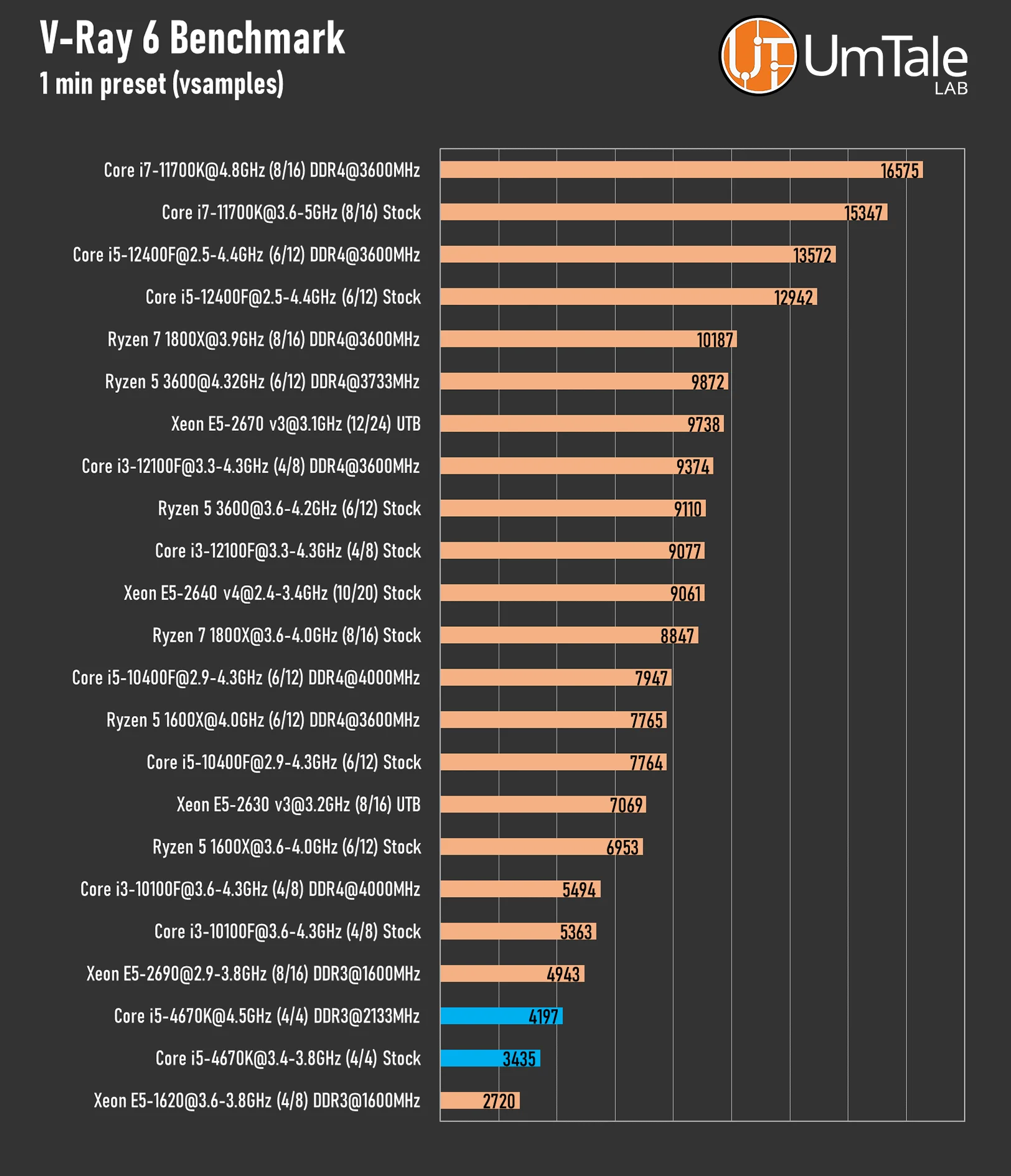
V-Ray 6 Benchmark
This is the current benchmark version of the V-Ray render engine. Various versions of V-Ray are available for a multitude of solutions, including 3DS Max, Maya, Cinema 4D, Blender, and Unreal Engine.
 ⤢ ВІДКРИТИ
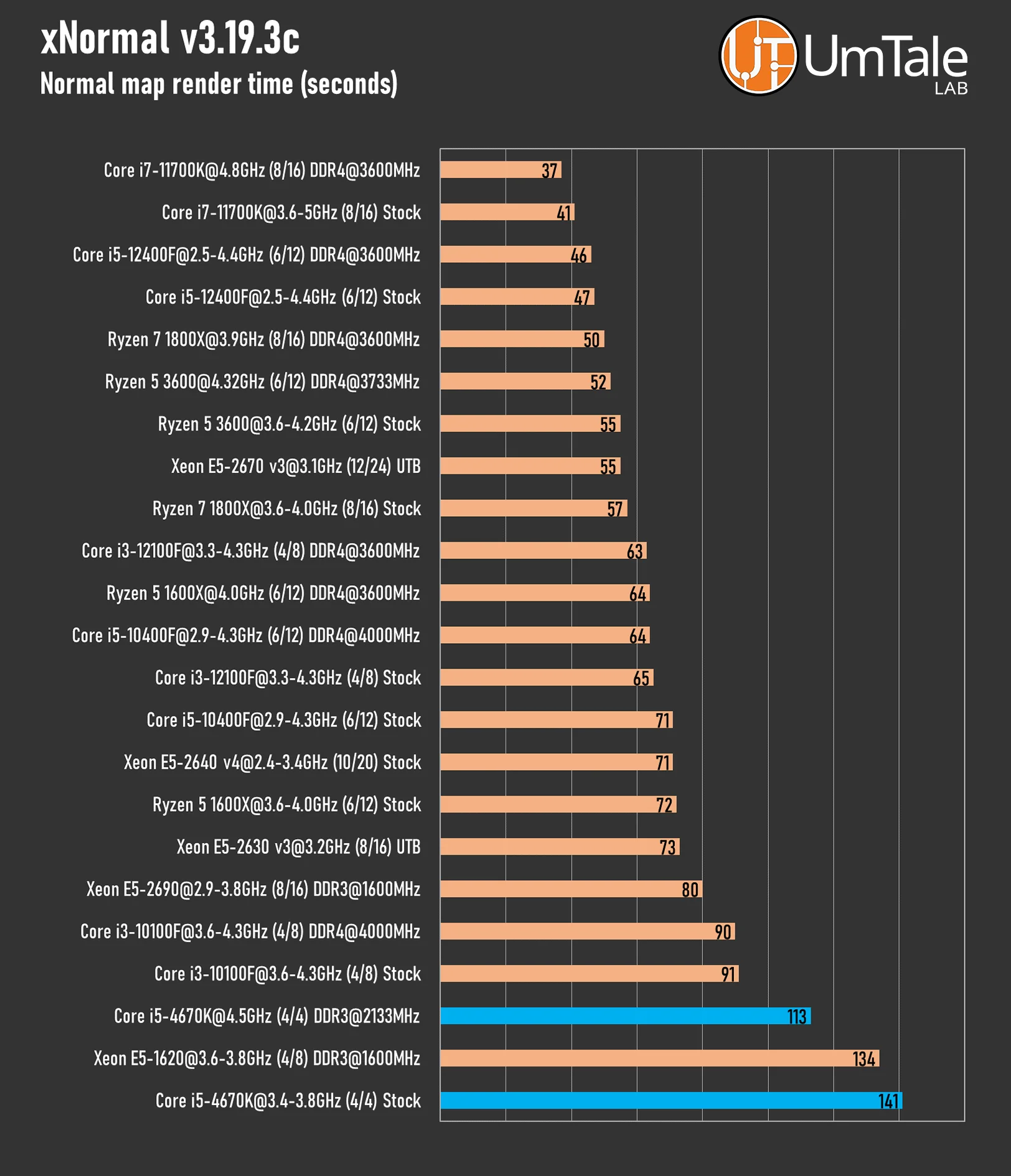
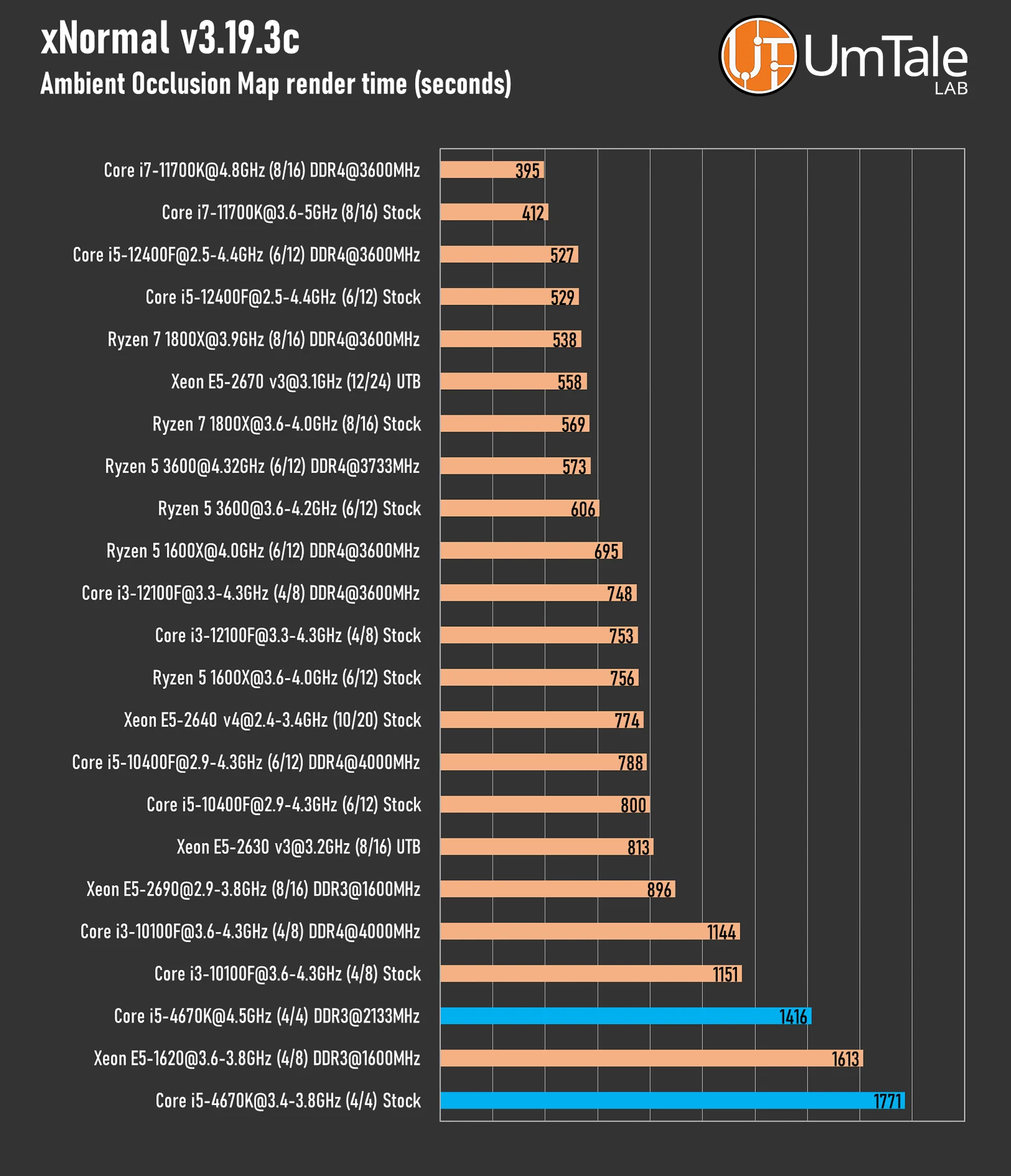
xNormal – texture baking
While external texture baking applications aren't as popular as they once were, tens of thousands of game developers still use xNormal. That's largely due to its user-friendly interface and numerous helpful features.
Normal map rendering
 ⤢ ВІДКРИТИ
Ambient occlusion rendering
 ⤢ ВІДКРИТИ
Overall performance
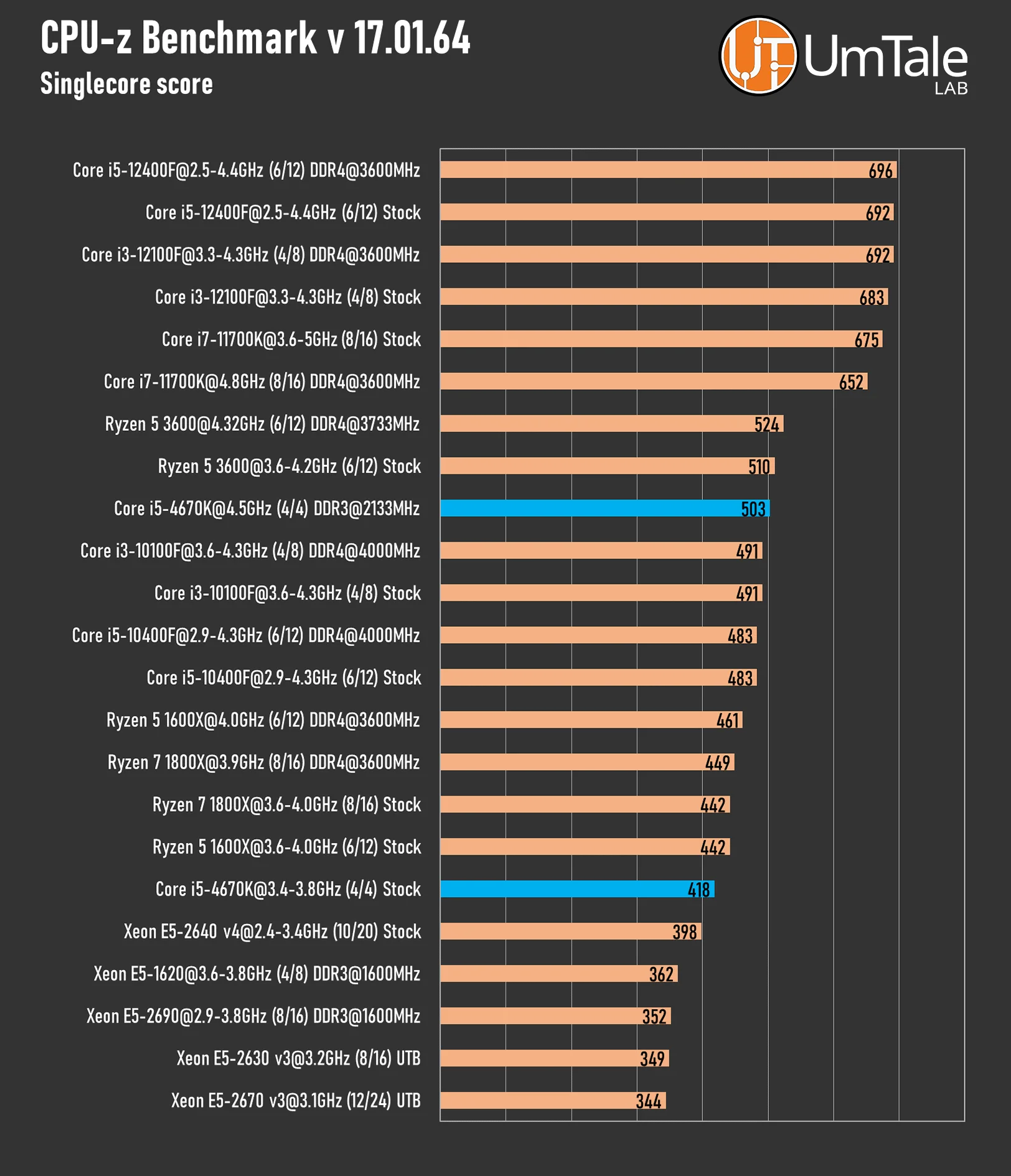
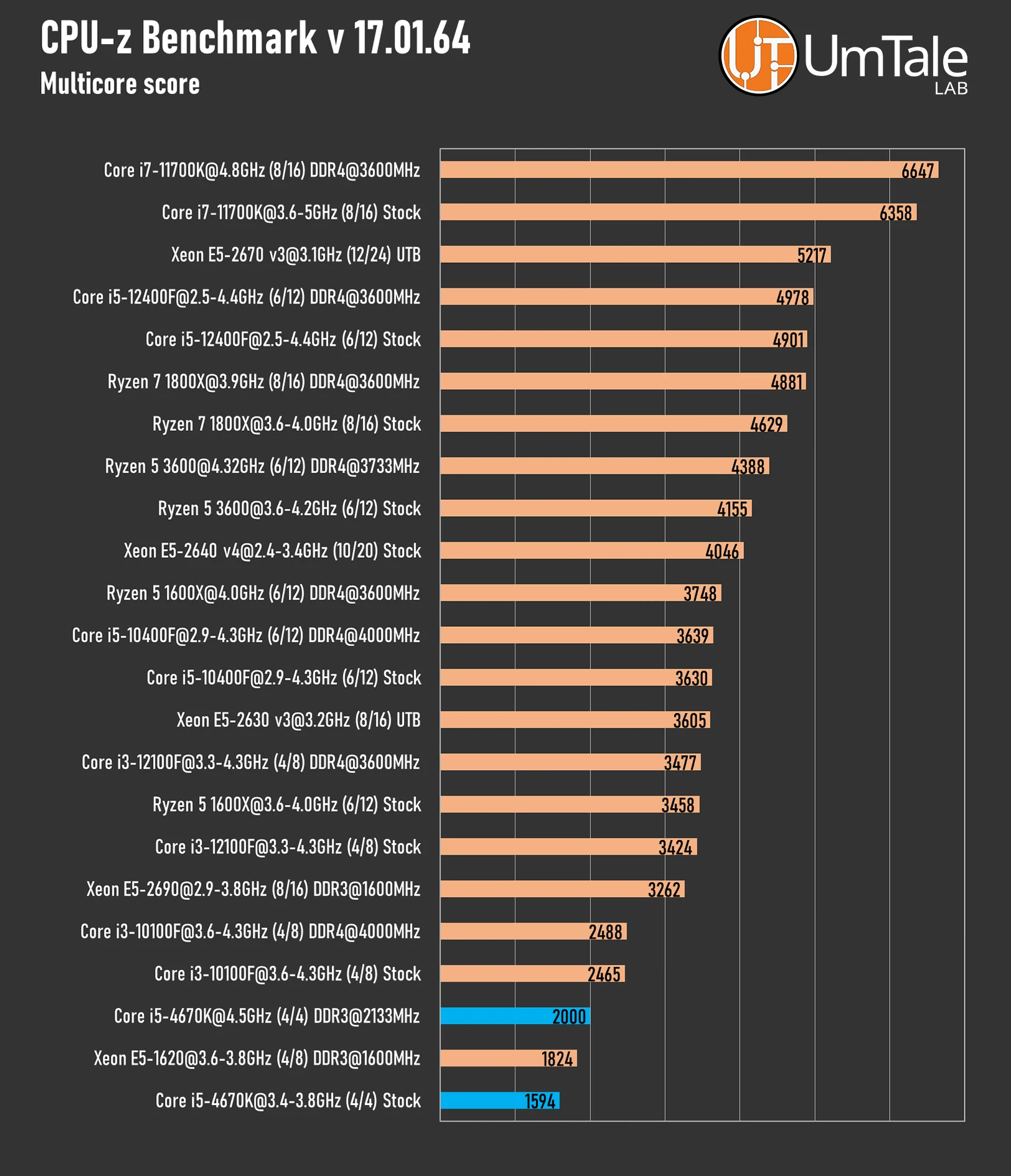
CPU-Z benchmark
While the CPU-Z benchmark, an informational utility, doesn't reveal much about a CPU's real-world performance and is arguably optional, we still conduct tests in this category out of tradition.
Single-core test result
 ⤢ ВІДКРИТИ
Multicore test result
 ⤢ ВІДКРИТИ
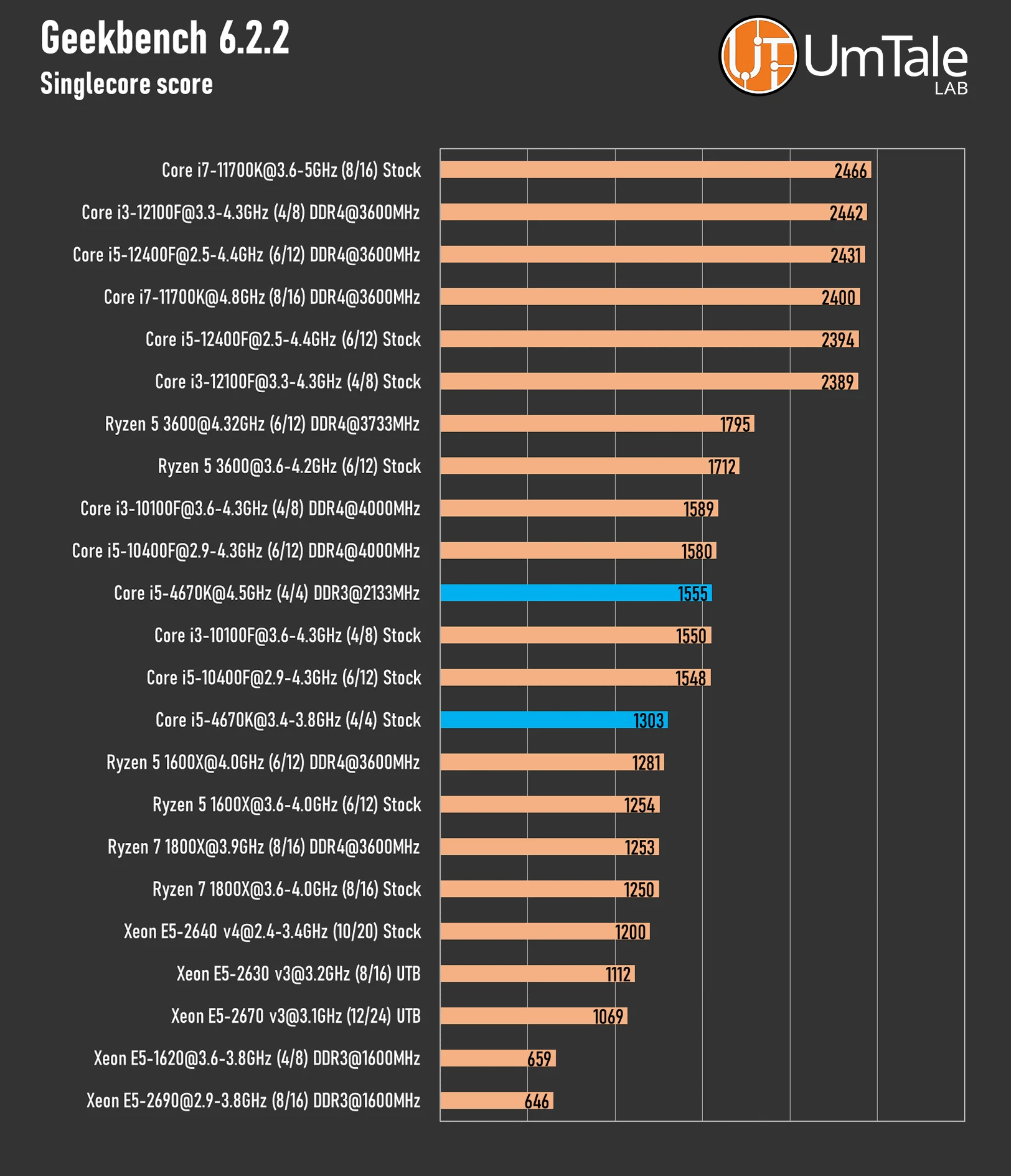
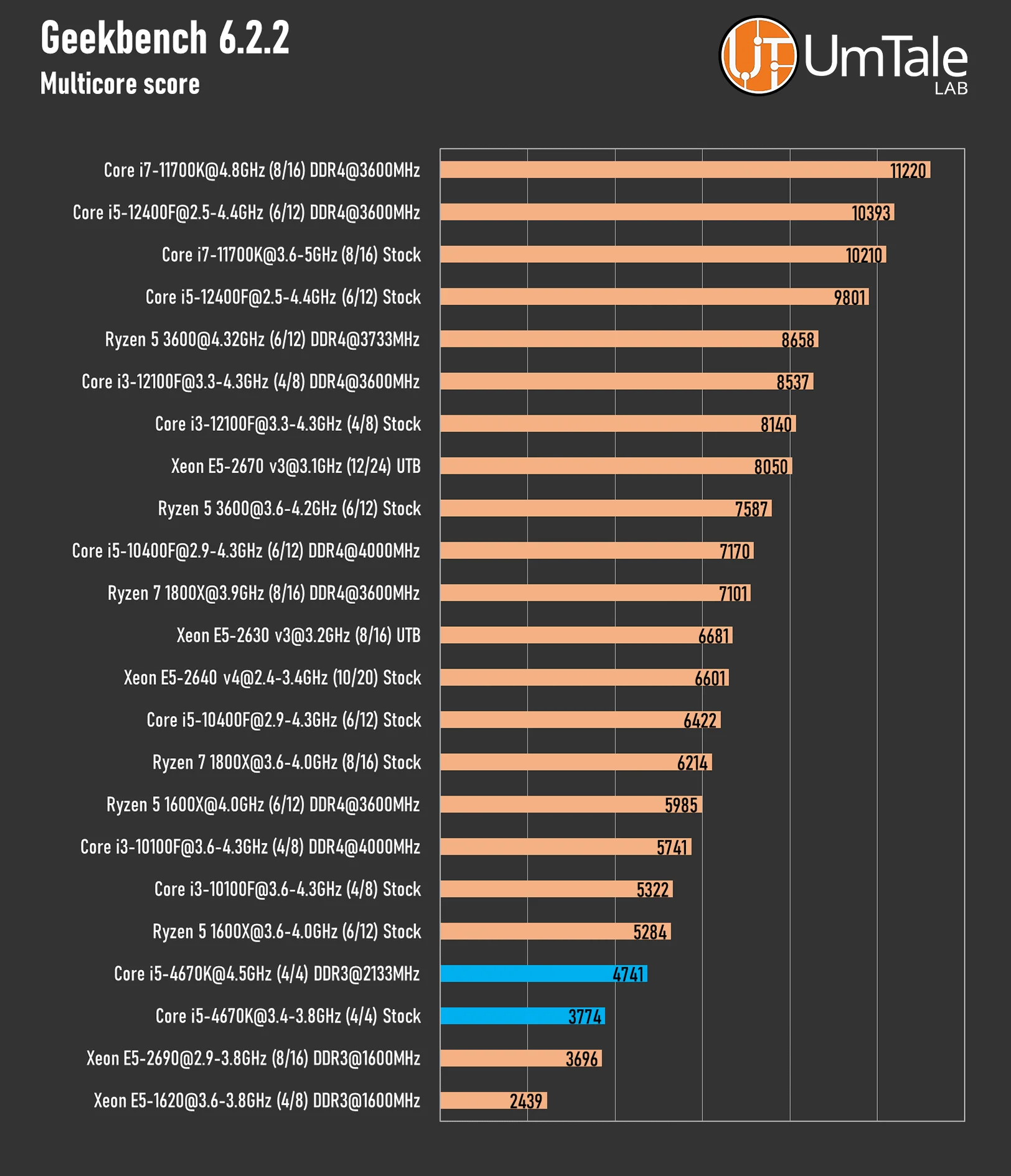
Geekbench 6
Geekbench 6 measures a CPU's single-core and multi-core performance across a wide array of tasks. These range from basic functions like checking email, photo editing, and music playback, to handling all of them simultaneously. Furthermore, it assesses performance in newer CPU applications, including augmented reality and machine learning.
Singlecore score
 ⤢ ВІДКРИТИ
Multicore score
 ⤢ ВІДКРИТИ
Video encoding
HandBrake
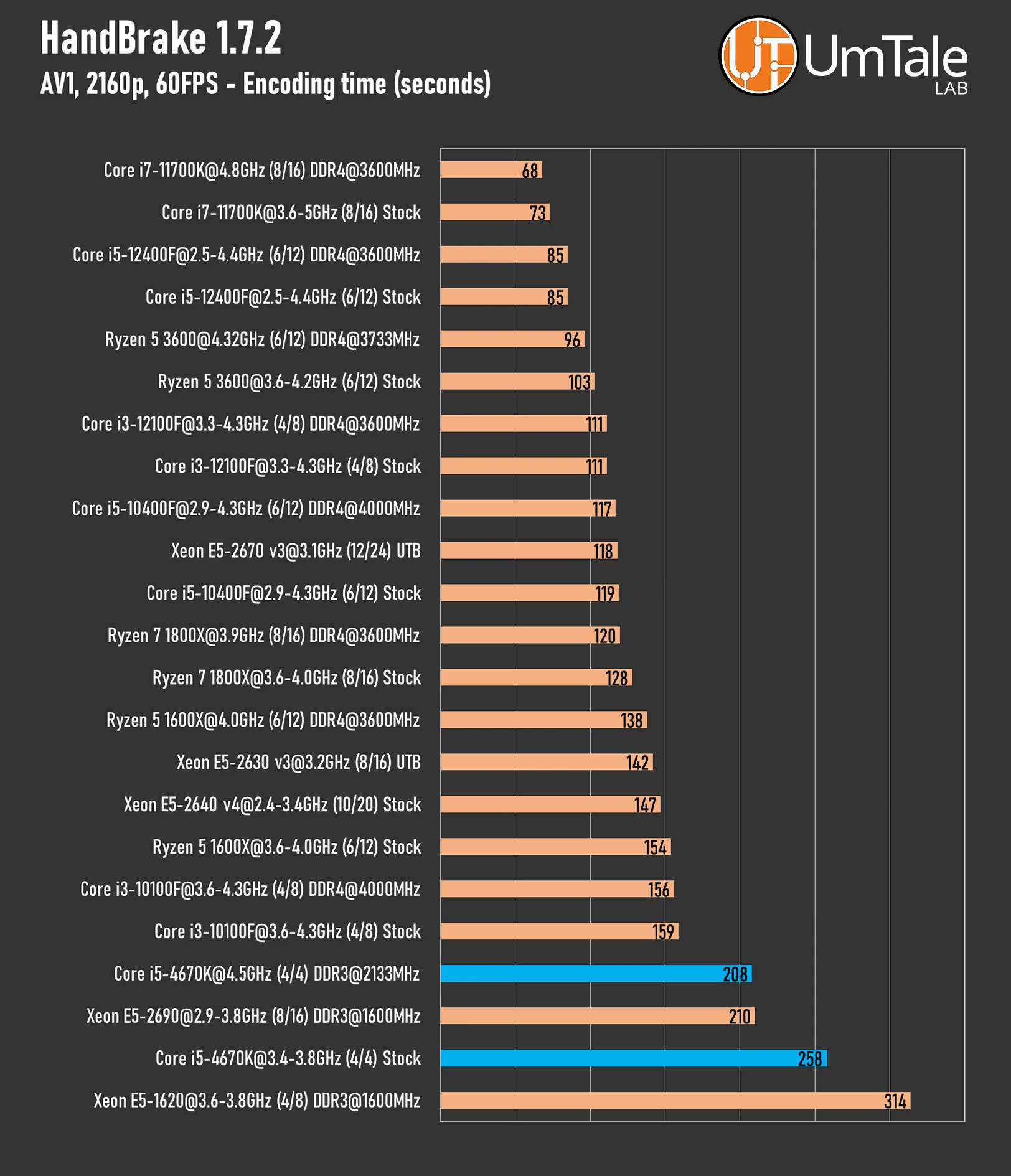
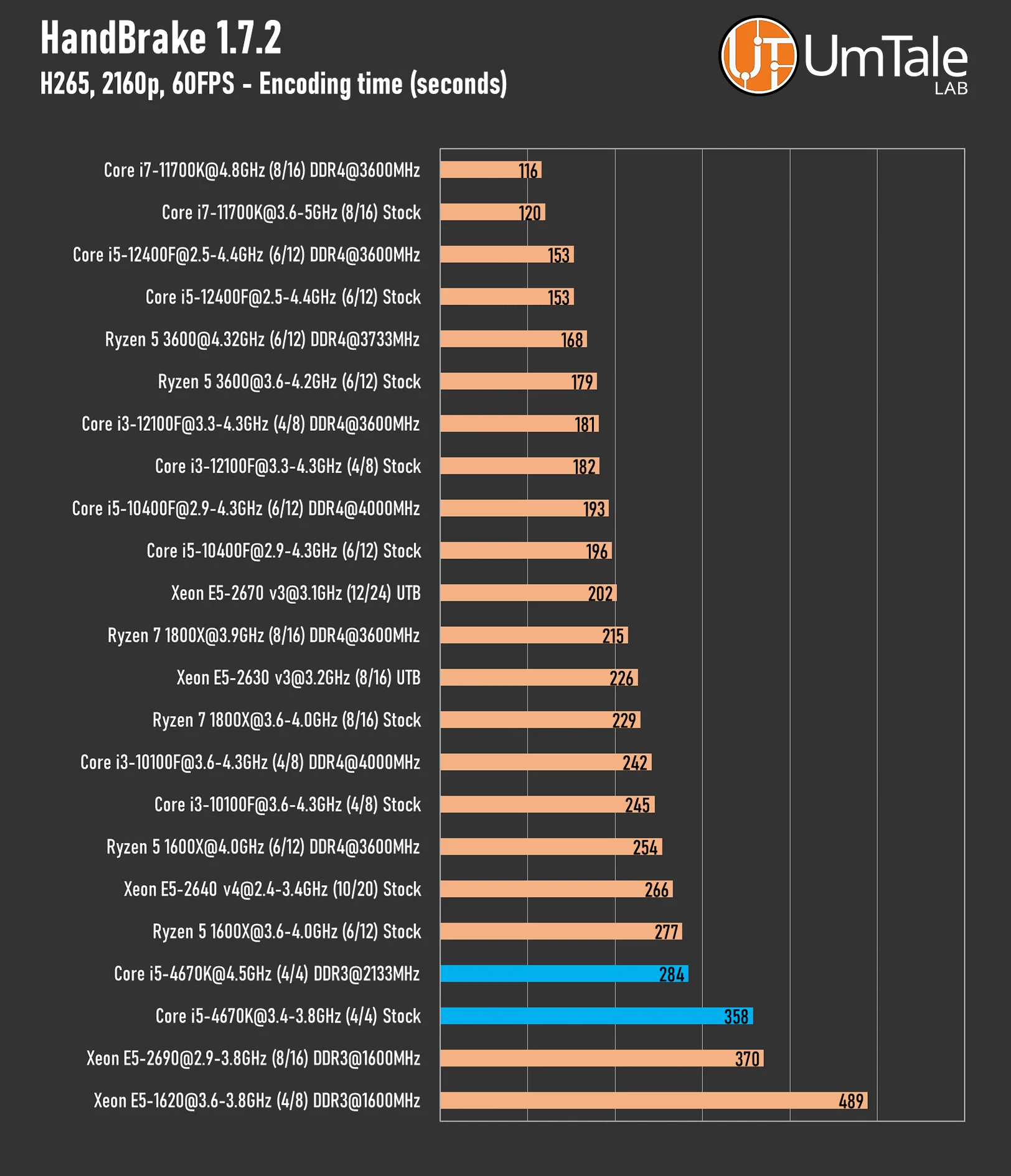
HandBrake is a free, open-source application designed to convert video from virtually any format into a range of modern, widely supported codecs, including AV1, H265, H264, and many others.
Codec – AV1
 ⤢ ВІДКРИТИ
Codec – H265
 ⤢ ВІДКРИТИ
Web browsing
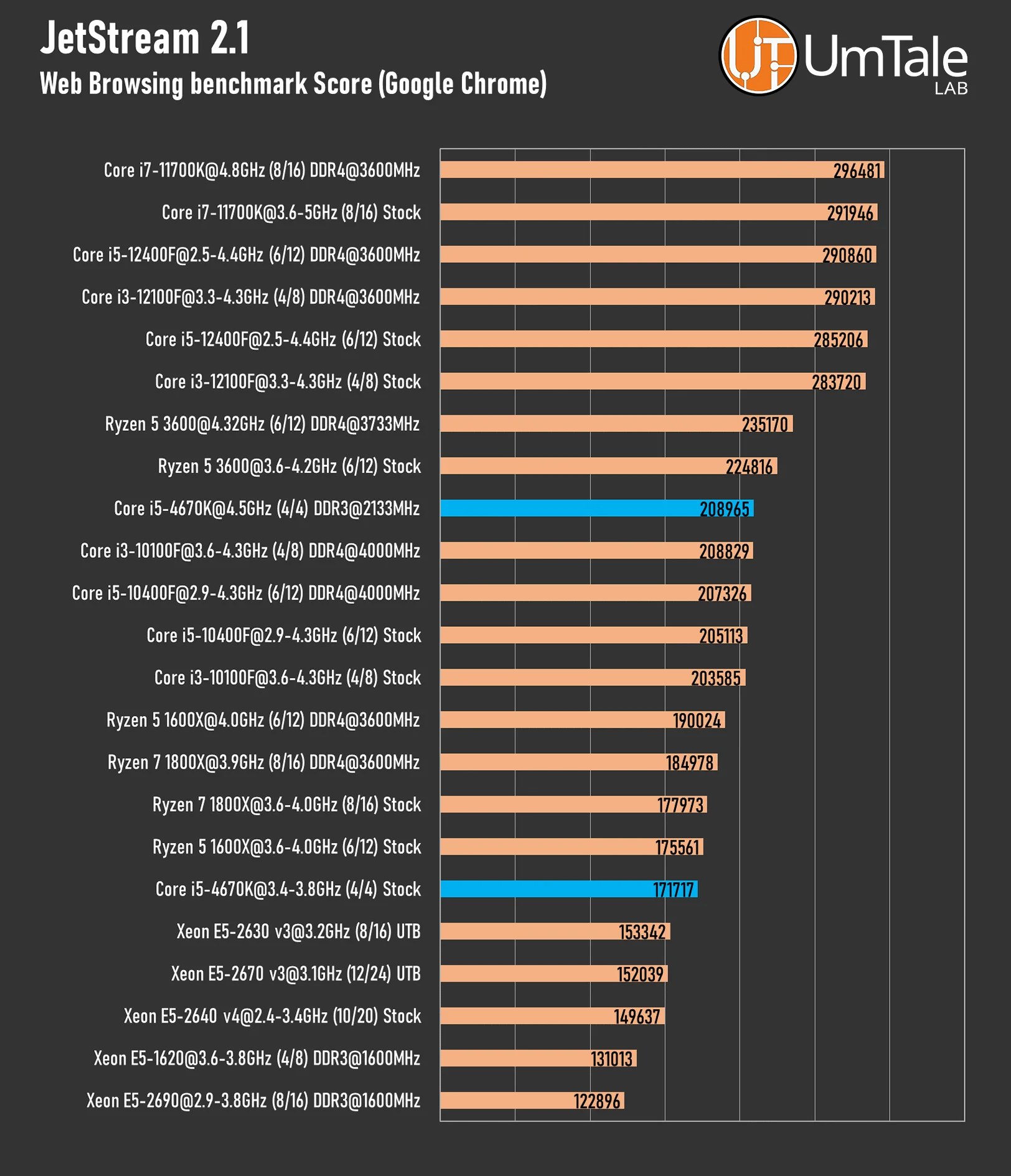
JetStream 2.1
JetStream 2.1 is a benchmark suite for JavaScript and WebAssembly, designed to target modern browsers and web applications. We've observed that most subtests within the benchmark can utilize up to four threads, which is quite typical for general web browsing.
 ⤢ ВІДКРИТИ
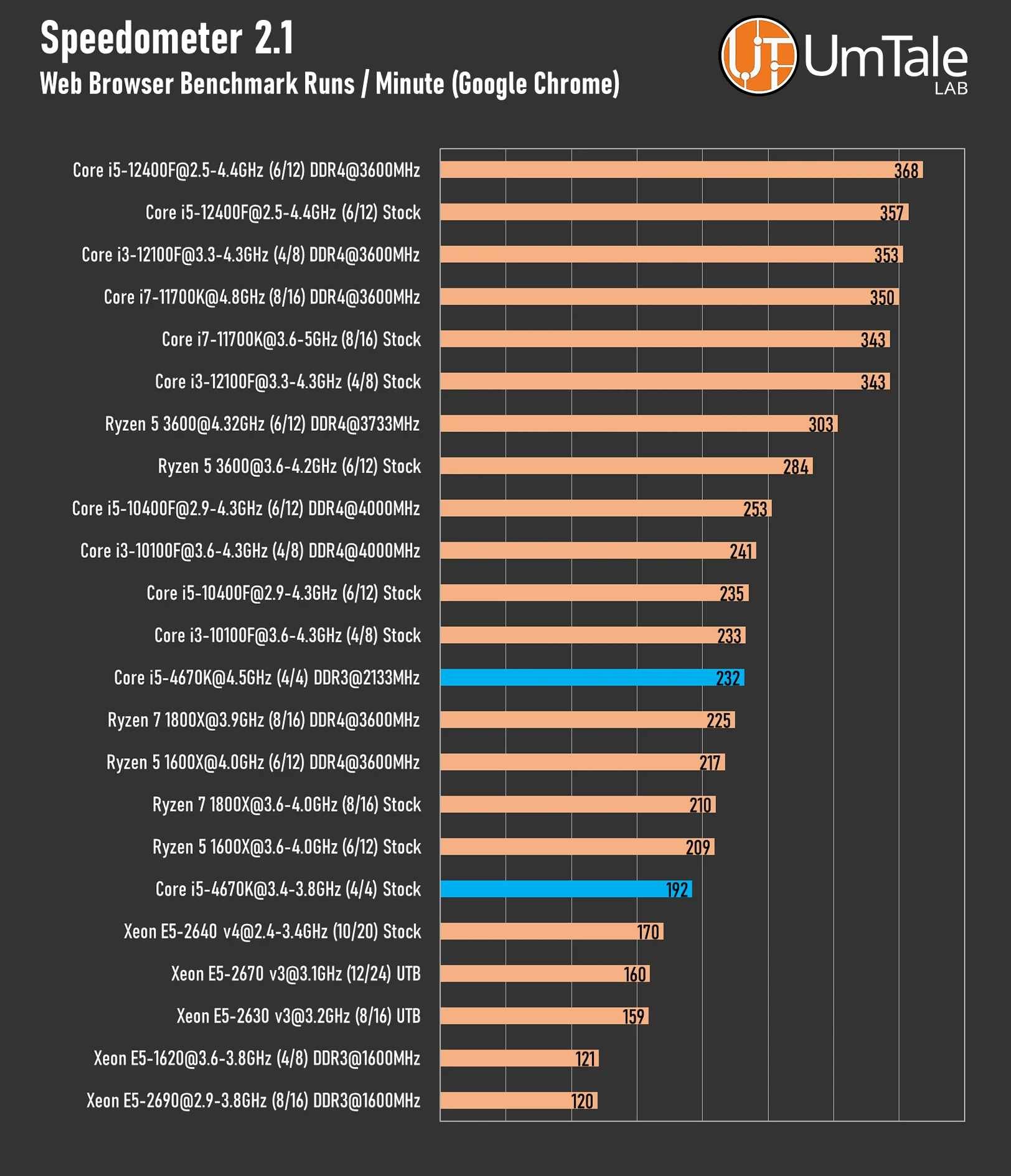
Speedometer 2.1
Speedometer tests the responsiveness of web applications within a browser. The benchmark simulates user actions like adding, completing, and removing items in a to-do list, using several TodoMVC examples. Some examples directly call the DOM API from ECMAScript 5 (ES5), ECMAScript 2015 (ES6), ES6 transpiled to ES5, and Elm transpiled to ES5. Others employ one of eleven popular JavaScript frameworks: React, React with Redux, Ember.js, Backbone.js, AngularJS, (new) Angular, Vue.js, jQuery, Preact, Inferno, and Flight.
 ⤢ ВІДКРИТИ
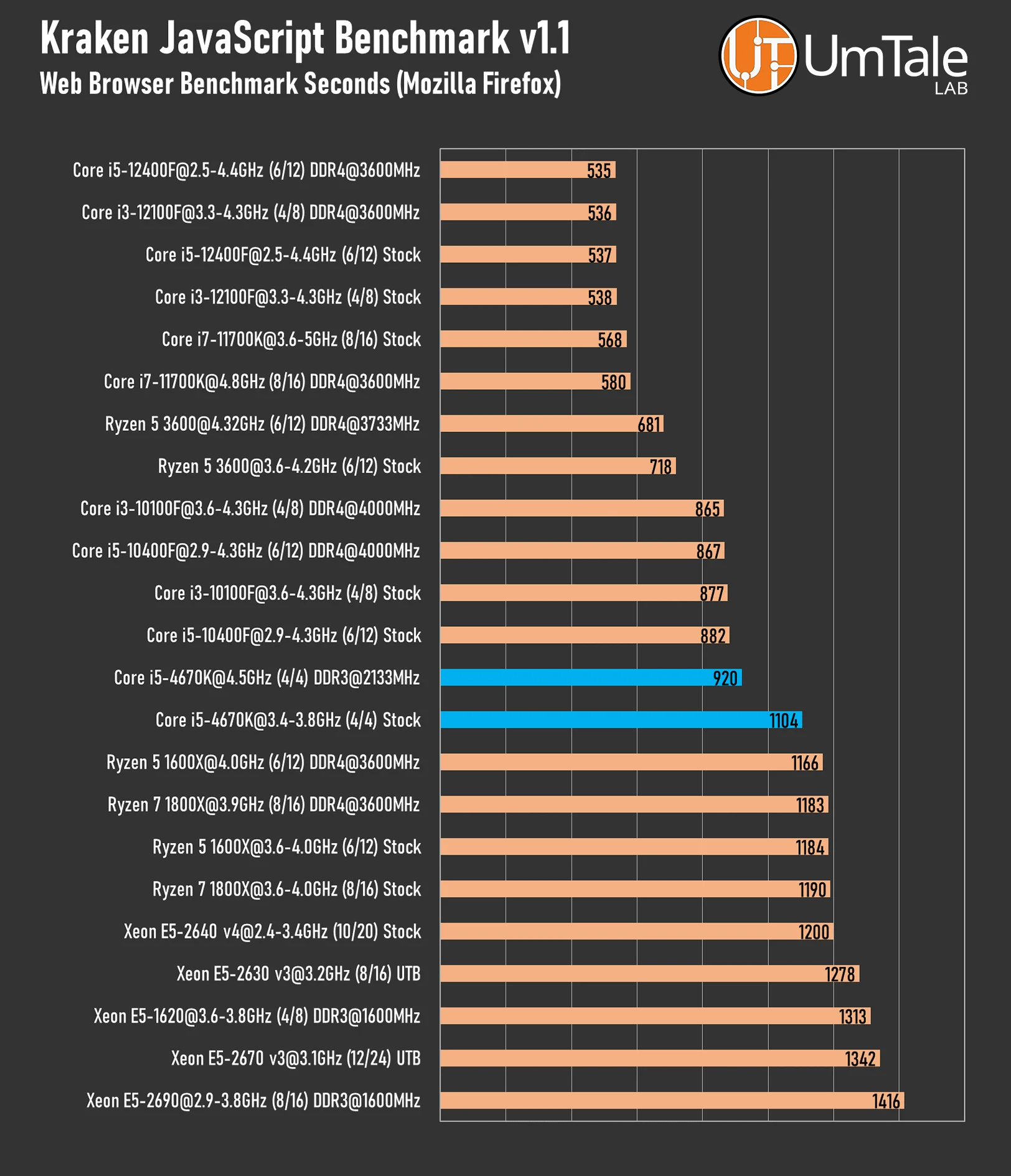
Kraken 1.1
Kraken is a JavaScript performance benchmark developed by Mozilla. It measures the execution speed of several different test cases derived from real-world applications and libraries. Its subtests include audio processing with the DSP.js library, image filtering operations, JSON parsing, and cryptographic operations.
 ⤢ ВІДКРИТИ
Surprisingly, the 4-core Haswell isn't as weak in software as we initially assumed. At stock frequencies, the Core i5-4670K easily competes with the 8-thread E5-1620, occasionally even surpassing it. Once overclocked, our test CPU demonstrates a clear lead over the 4-core Sandy Bridge and, in some benchmarks, even catches up to the 8-core, 16-thread E5-2690. So much for those AVX2/FMA3 instructions! It's worth remembering that when the 22nm chips first launched, many argued there was no point upgrading from the legendary Core i5-2500K and 2600K. Time has certainly put things into perspective.
Beyond that, the Core i5-4670K performs remarkably well in everyday tasks like video playback, photo editing, and web browsing. In fact, when navigating the internet, the 4-core Haswell actually performs on par with the Core i3-10100F, which is a seriously respectable showing.
Gaming, synthetics
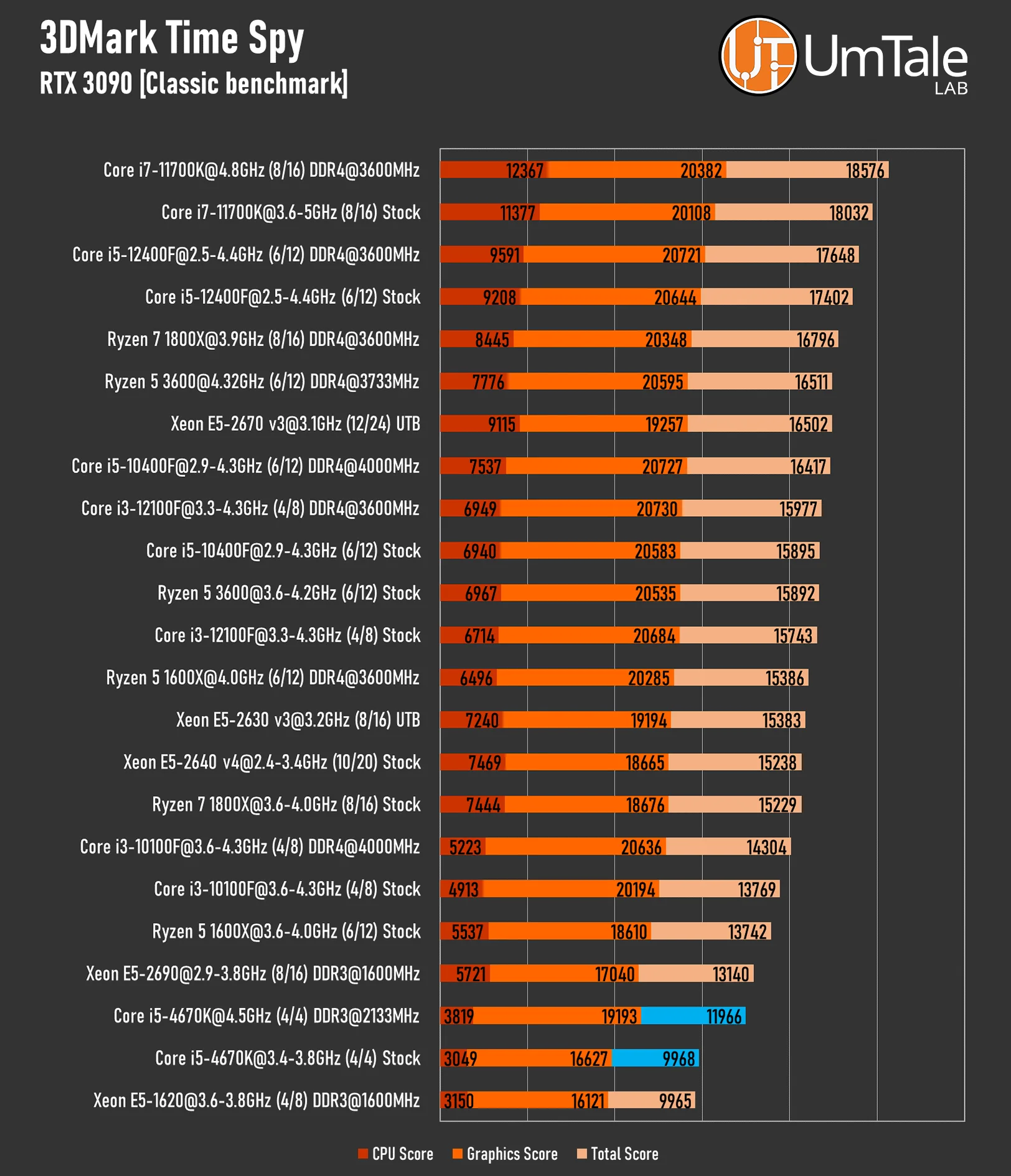
3DMark Time Spy
Time Spy is a DirectX 12 benchmark designed for gaming PCs running Windows 10/11. Built from the ground up, Time Spy supports all the latest DirectX 12 API features, including asynchronous compute, AMD Crossfire and NVIDIA SLI, and multi-threading.
 ⤢ ВІДКРИТИ
Games
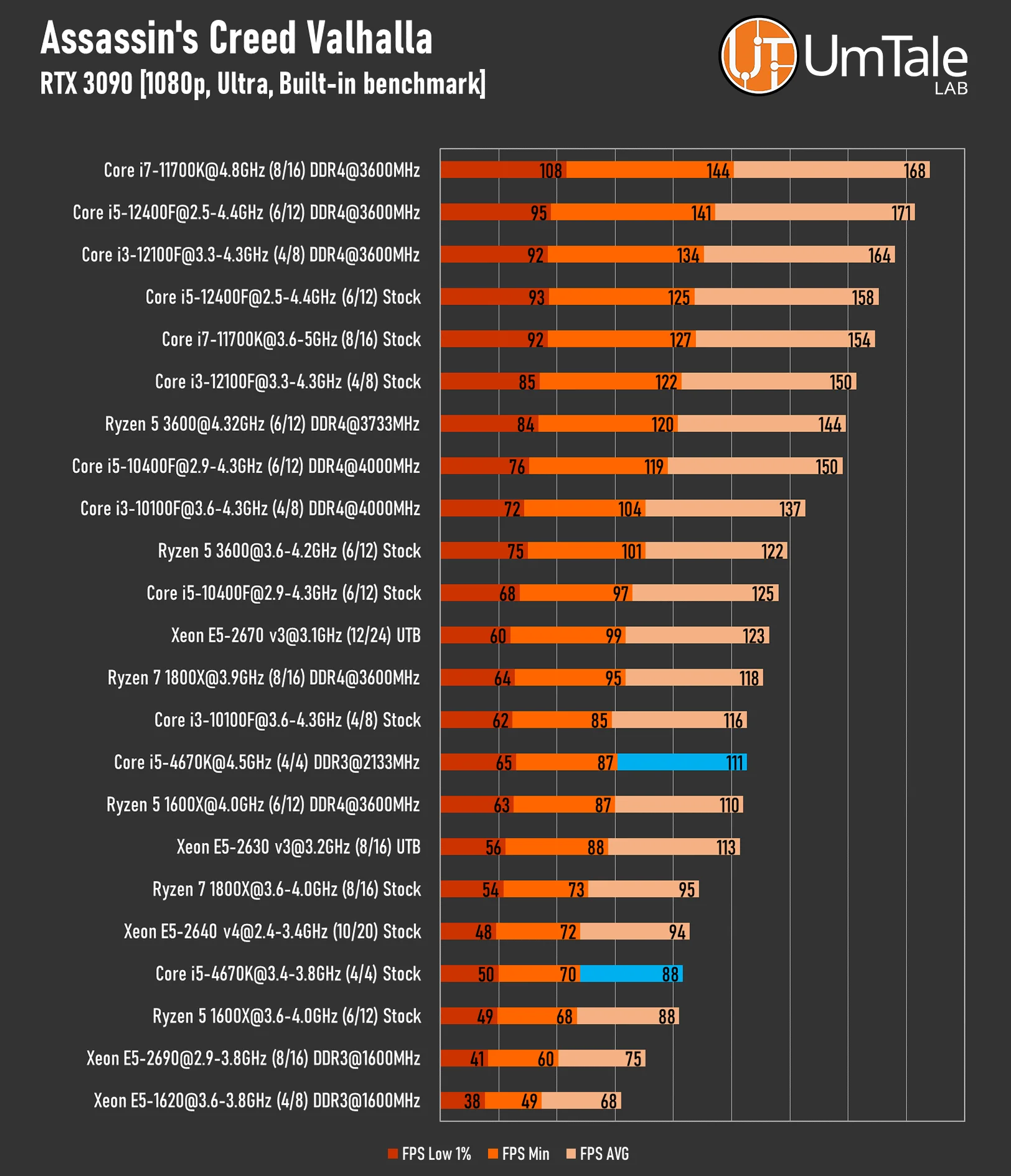
Assassin’s Creed Valhalla
This is the current major installment of the Assassin's Creed franchise. Built on the Ubisoft Anvil engine, the game can fully utilize up to 12 computing threads and partially supports 16-24 threads.
 ⤢ ВІДКРИТИ
Baldur’s Gate 3
Baldur's Gate 3, one of the best turn-based RPGs of modern times, was also the best game of last year. It runs on the Divinity 4.0 Engine, which can utilize up to 16 threads, though it performs best with 12-thread CPUs. Furthermore, the game features extremely high detail, leading to frequent RAM access. As a result, Baldur's Gate 3 benefits significantly from a spacious L3 cache and high-frequency RAM.
Our test scene is set in the city of Baldur's Gate, which is the third act of the game.
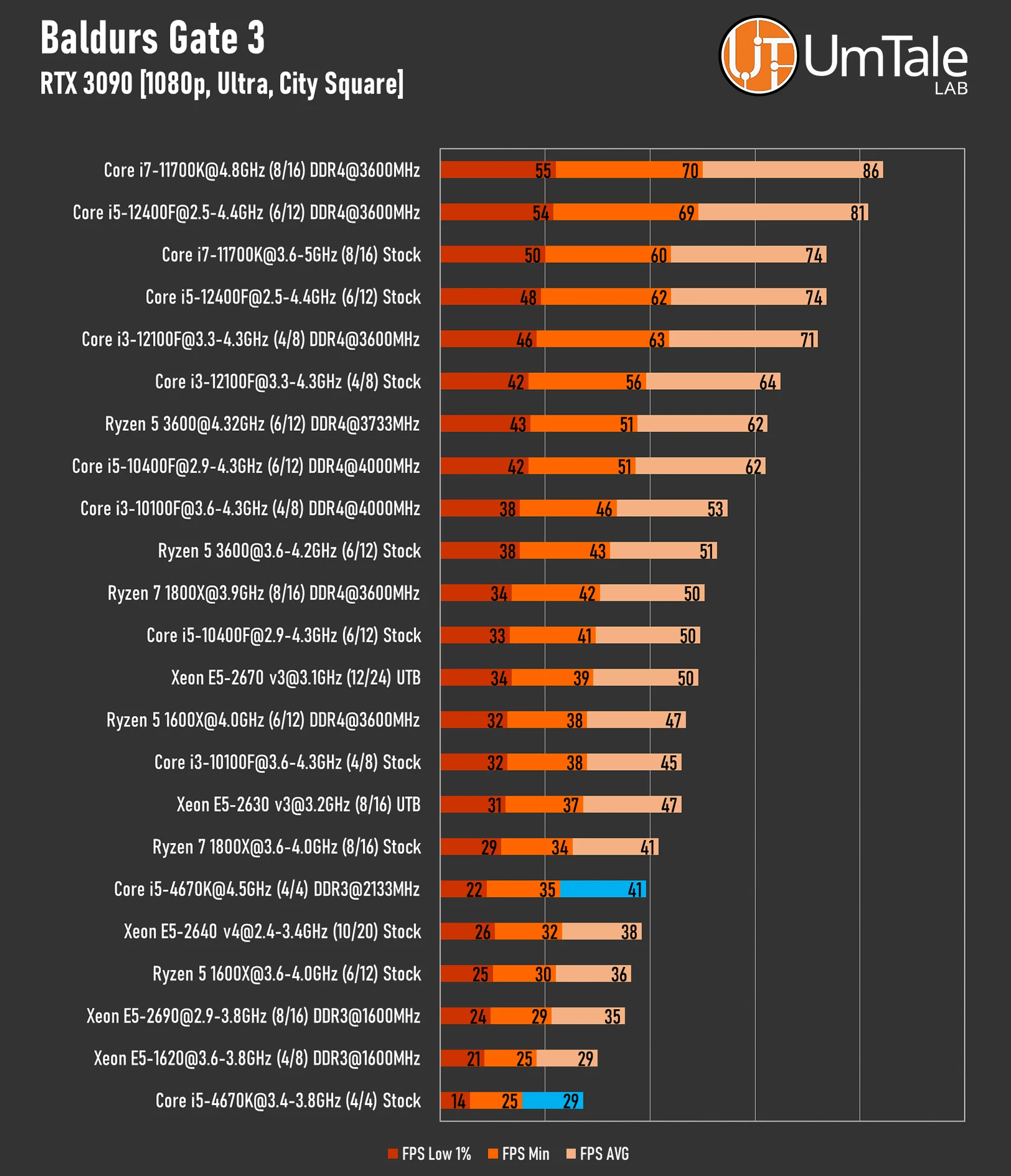 ⤢ ВІДКРИТИ
Cyberpunk 2077
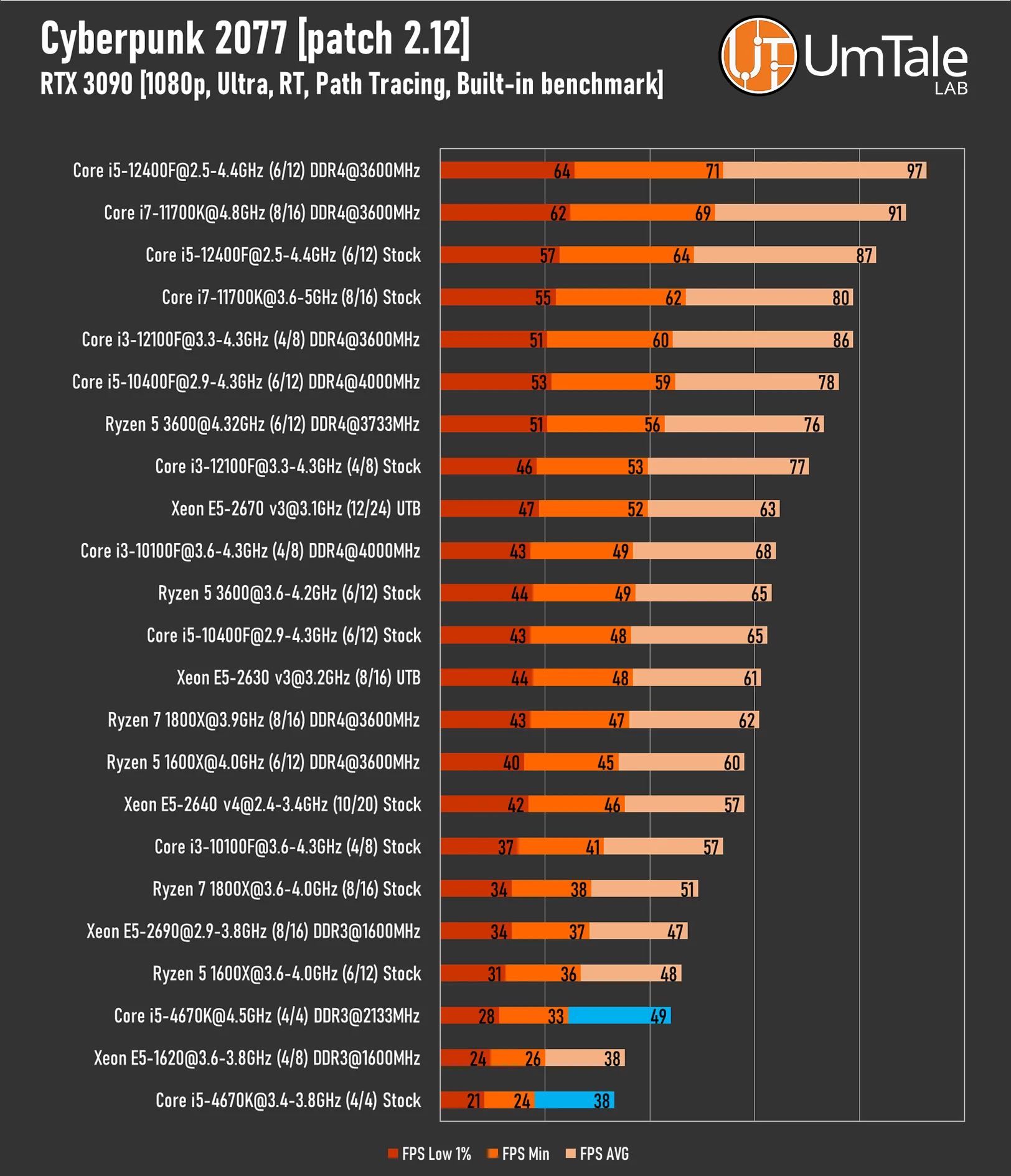
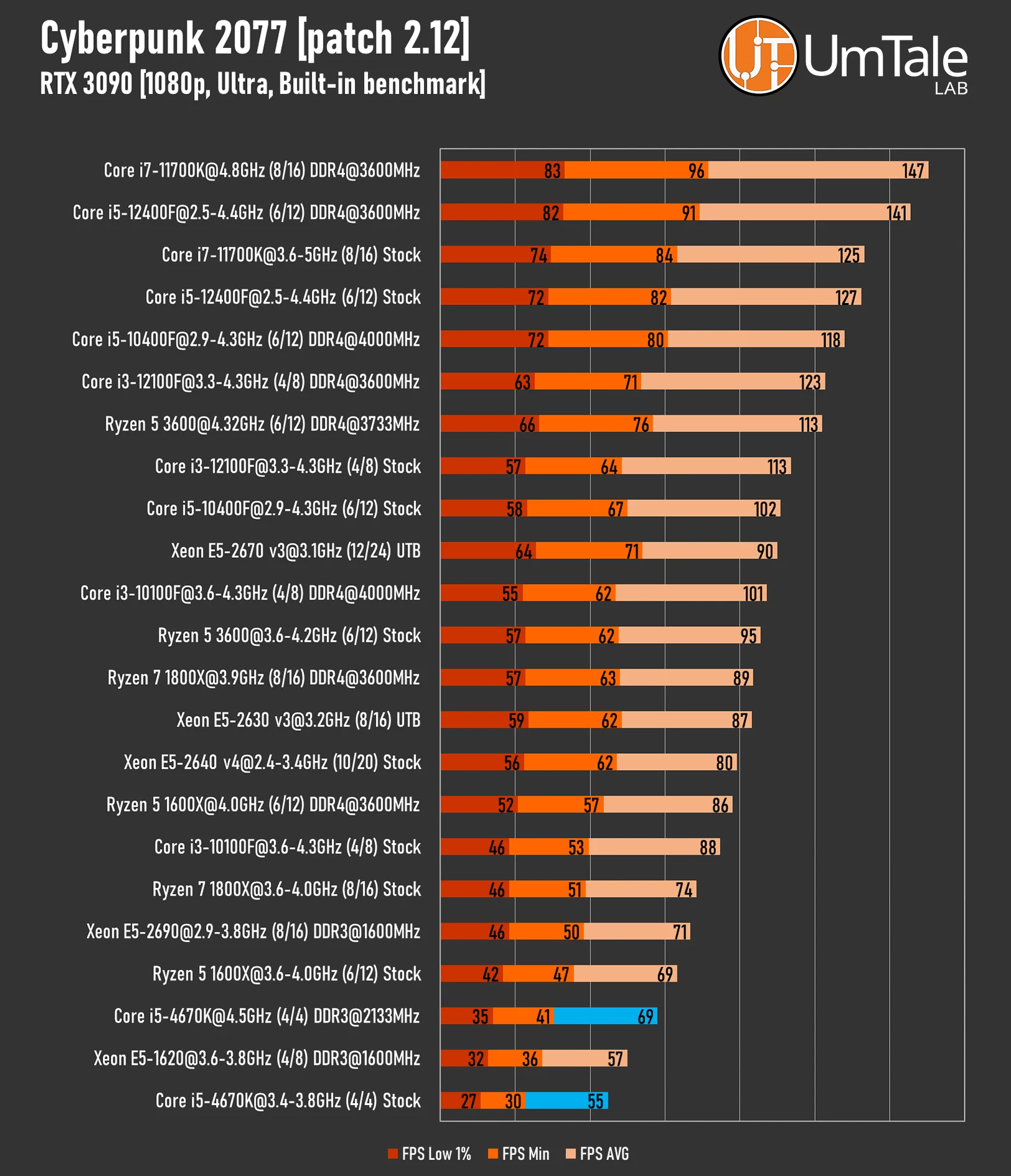
CD Projekt RED's latest creation, Cyberpunk 2077, runs on the REDengine 4 and can utilize over 16 CPU threads. The game also responds very positively to increased RAM frequency and reduced memory latencies.
Ray tracing – ON, path tracing – ON
 ⤢ ВІДКРИТИ
Ray tracing – OFF, path tracing – OFF
 ⤢ ВІДКРИТИ
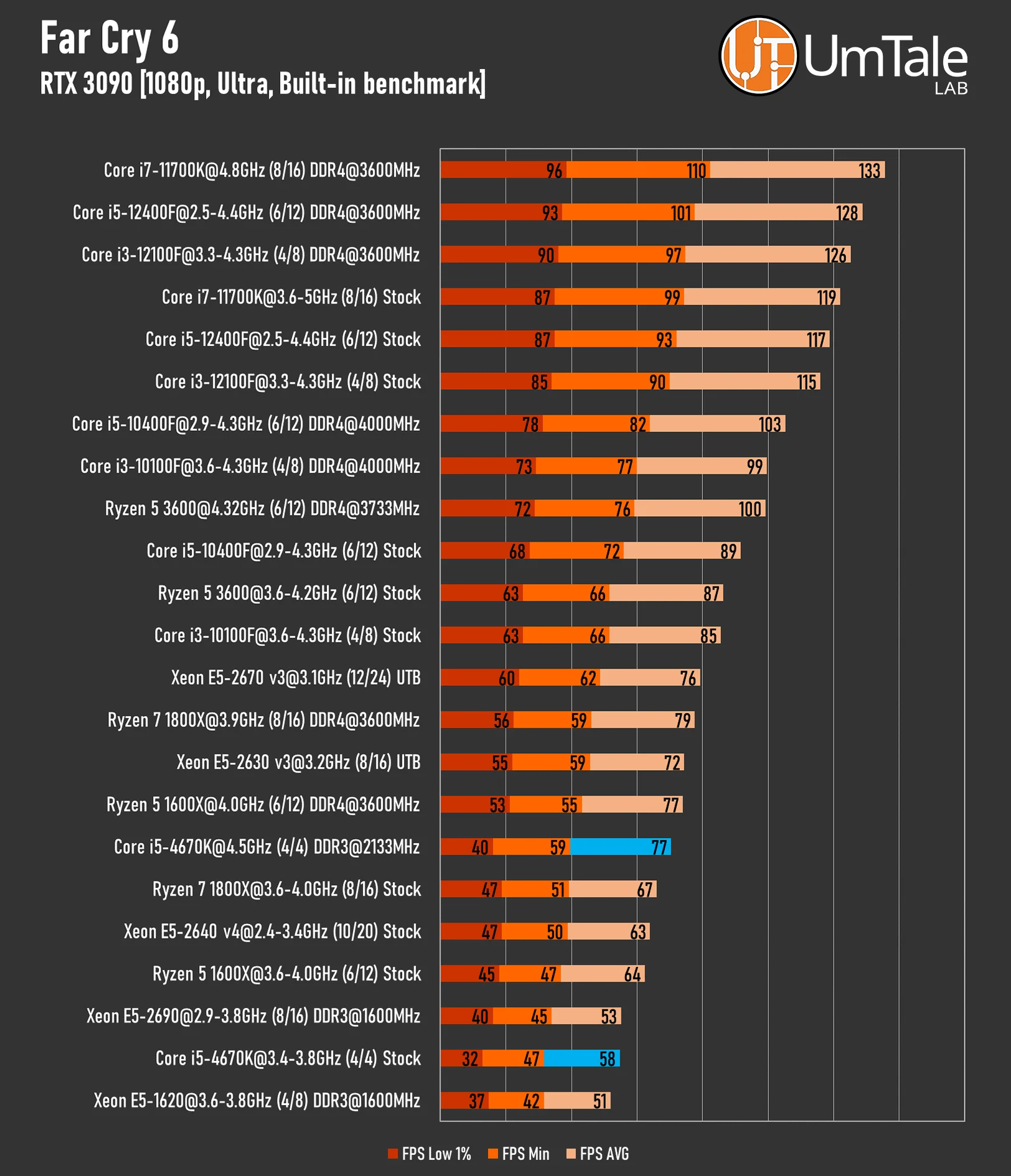
Far Cry 6
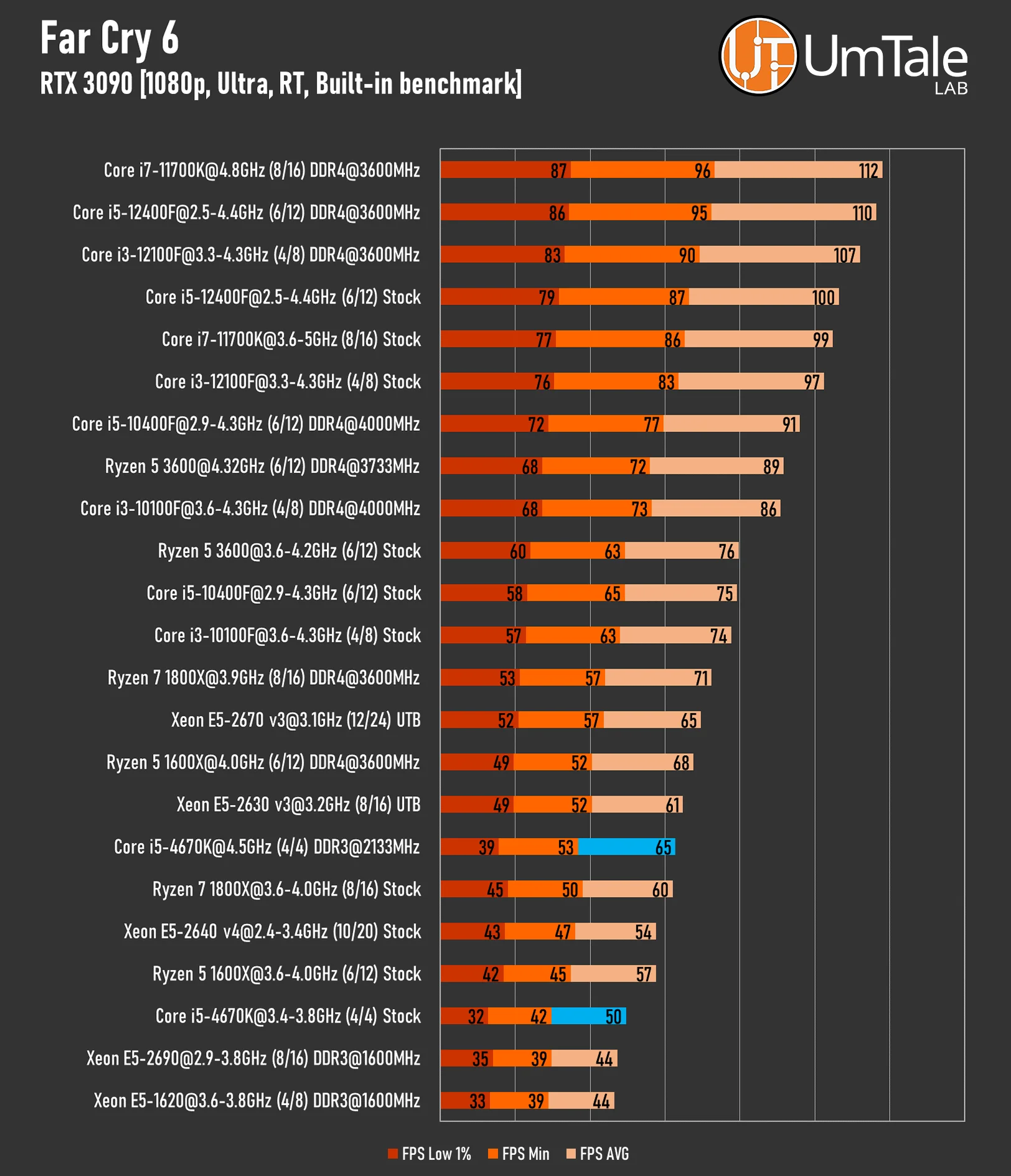
Far Cry 6 uses the Dunia Engine v2. Throughout its long history, dating back to Far Cry 2, this engine has been notorious for its poor optimization for multi-threaded CPUs. Our observations indicate the game performs reasonably well with eight threads. However, some CPUs with more than 10 cores and SMT/HT technology (simultaneous processing of two or more threads per core) might actually see a performance decrease in this game. It's worth noting this doesn't apply to all available CPUs.
Ray tracing – ON
 ⤢ ВІДКРИТИ
Ray tracing – OFF
 ⤢ ВІДКРИТИ
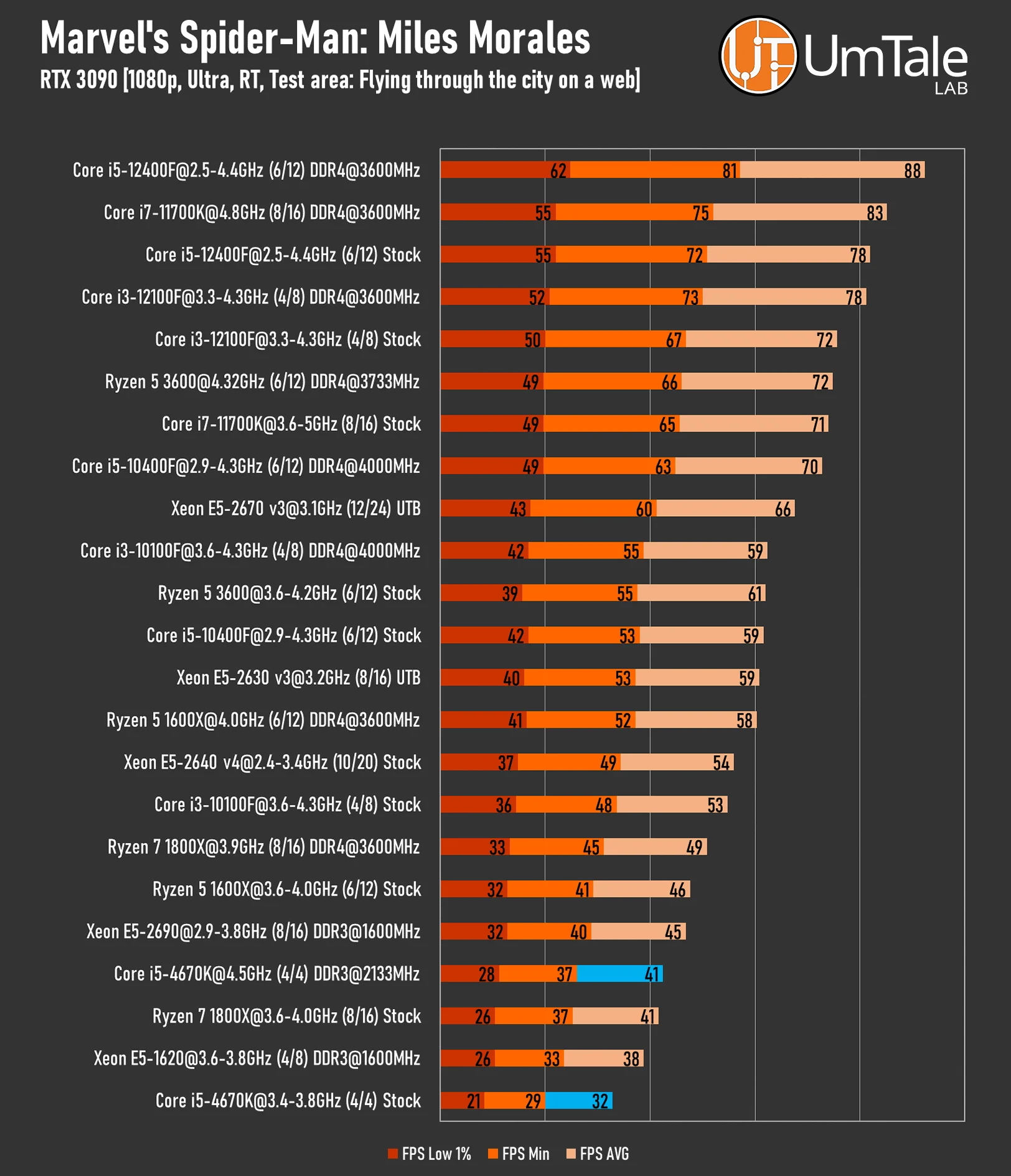
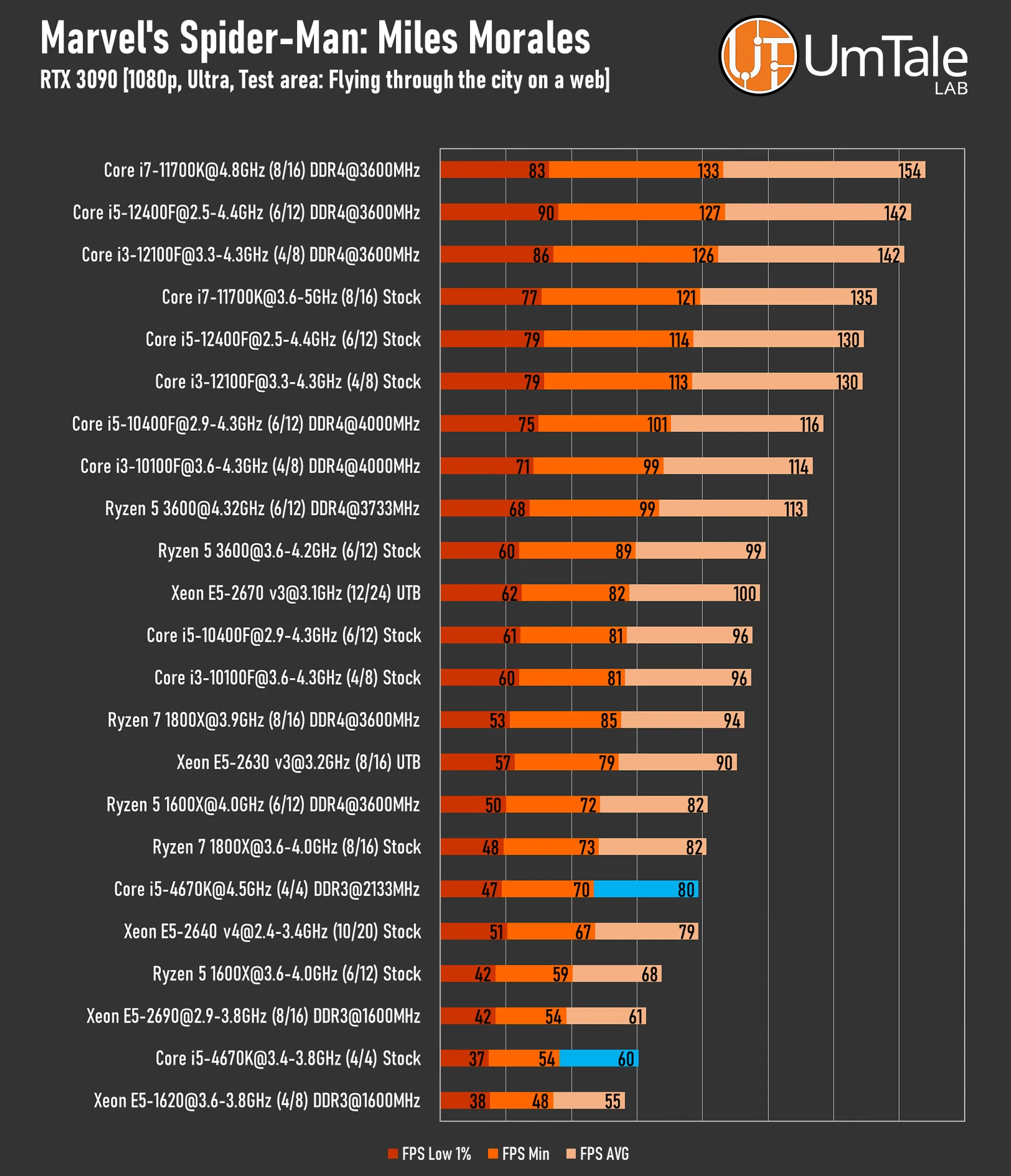
Marvel’s Spider-Man Miles Morales
Marvel's Spider-Man Miles Morales, a former PlayStation exclusive, is a relatively well-executed PC port. While Insomniac Games' proprietary engine is capable of utilizing multi-core CPUs effectively, the overall stability of games built on it often leaves much to be desired.
Ray tracing – ON
 ⤢ ВІДКРИТИ
Ray tracing – OFF
 ⤢ ВІДКРИТИ
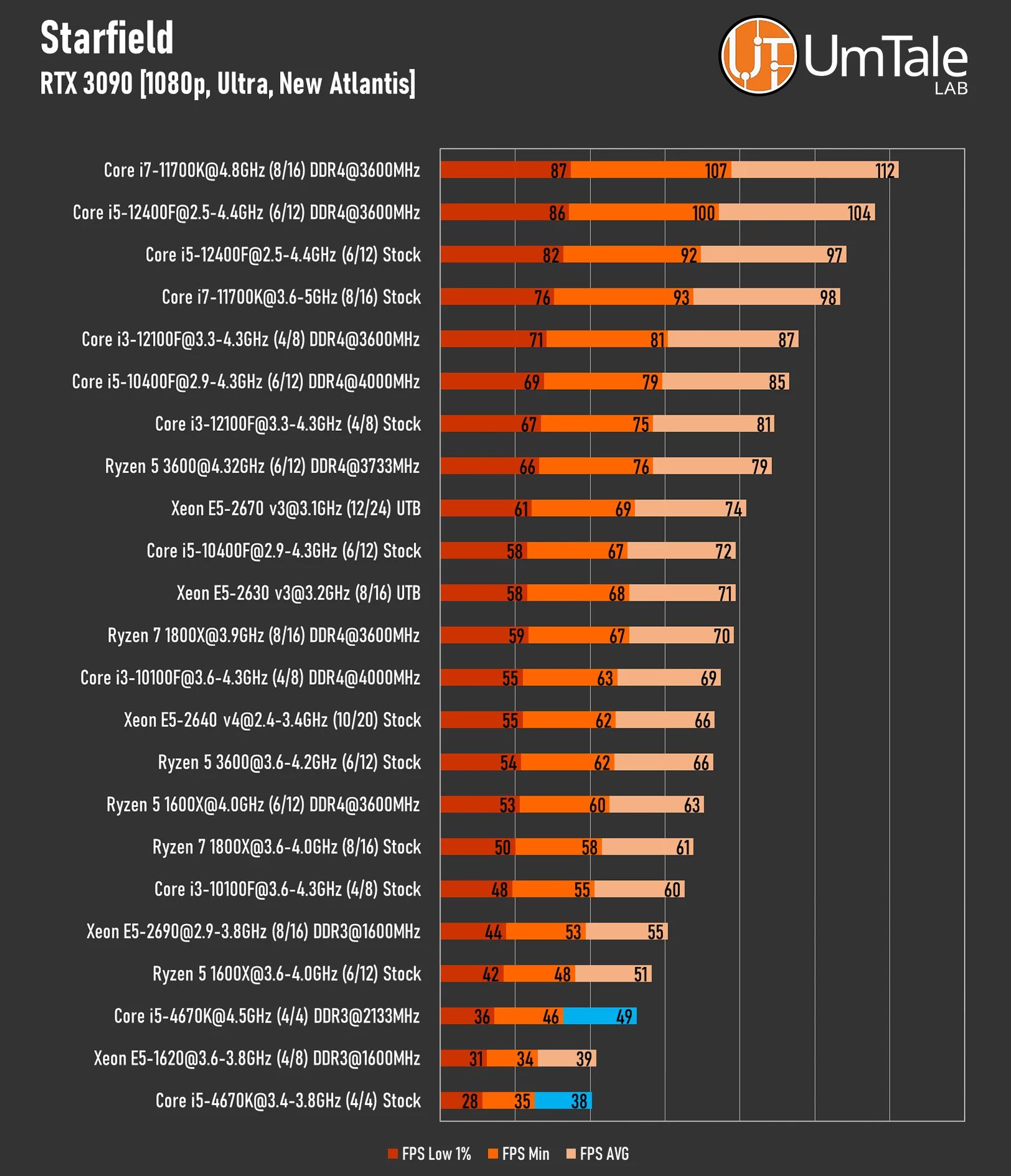
Starfield
Starfield is the new, highly anticipated game from the esteemed guru Todd Howard. It's built on an updated version of the Creation Engine 2, which was previously used in Fallout 4. The keyword here is 'updated.' Bethesda's statements weren't false. While the current Creation Engine still has many flaws (like awful storage performance and poor optimization for modern graphics cards), the developers have significantly optimized its code for multi-threaded processors.
Our test scene is located in the center of New Atlantis. To measure FPS, we use a segment from the landing pad to the central square.
 ⤢ ВІДКРИТИ
The Witcher 3 Next-Gen Update 4.04
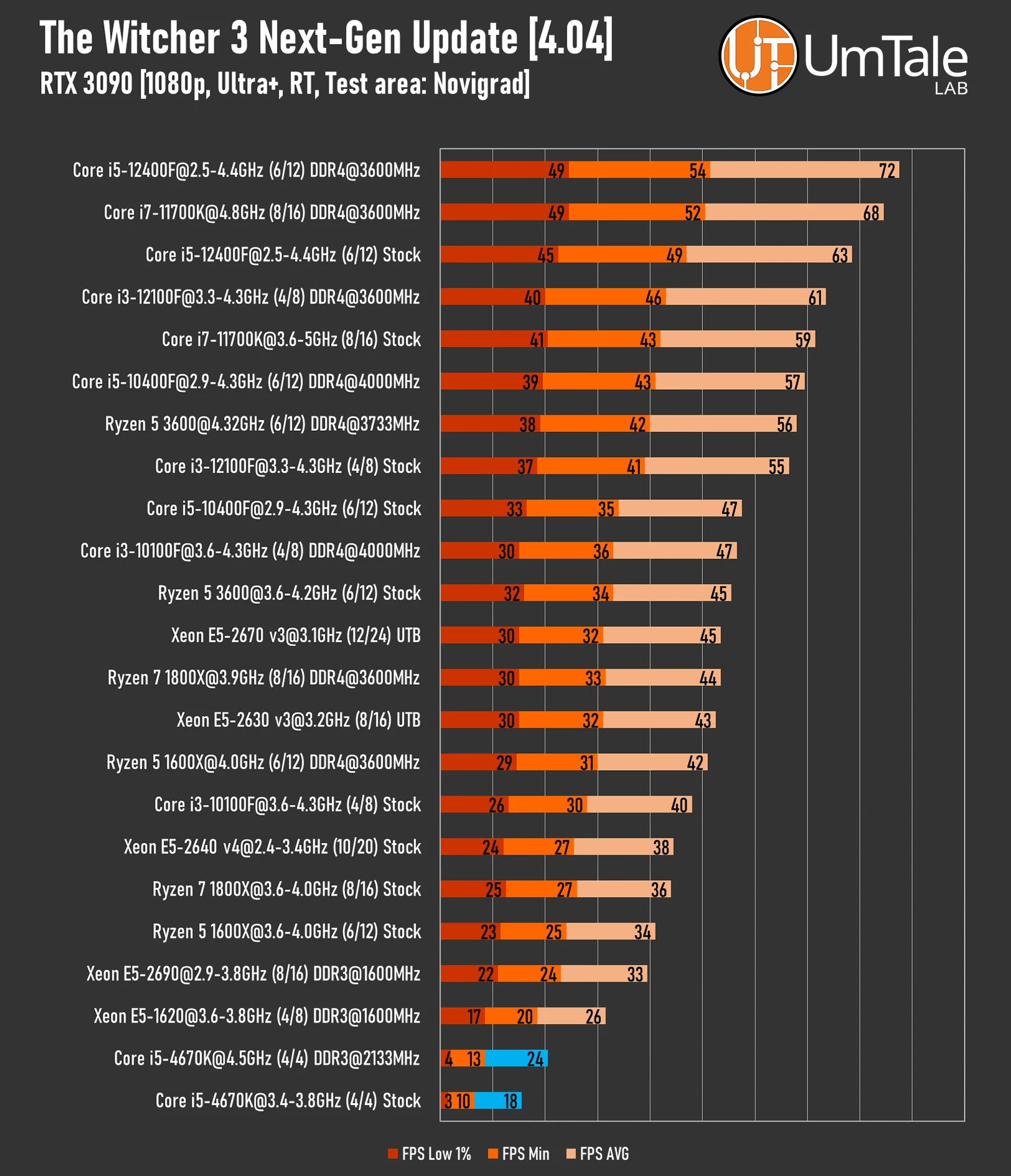
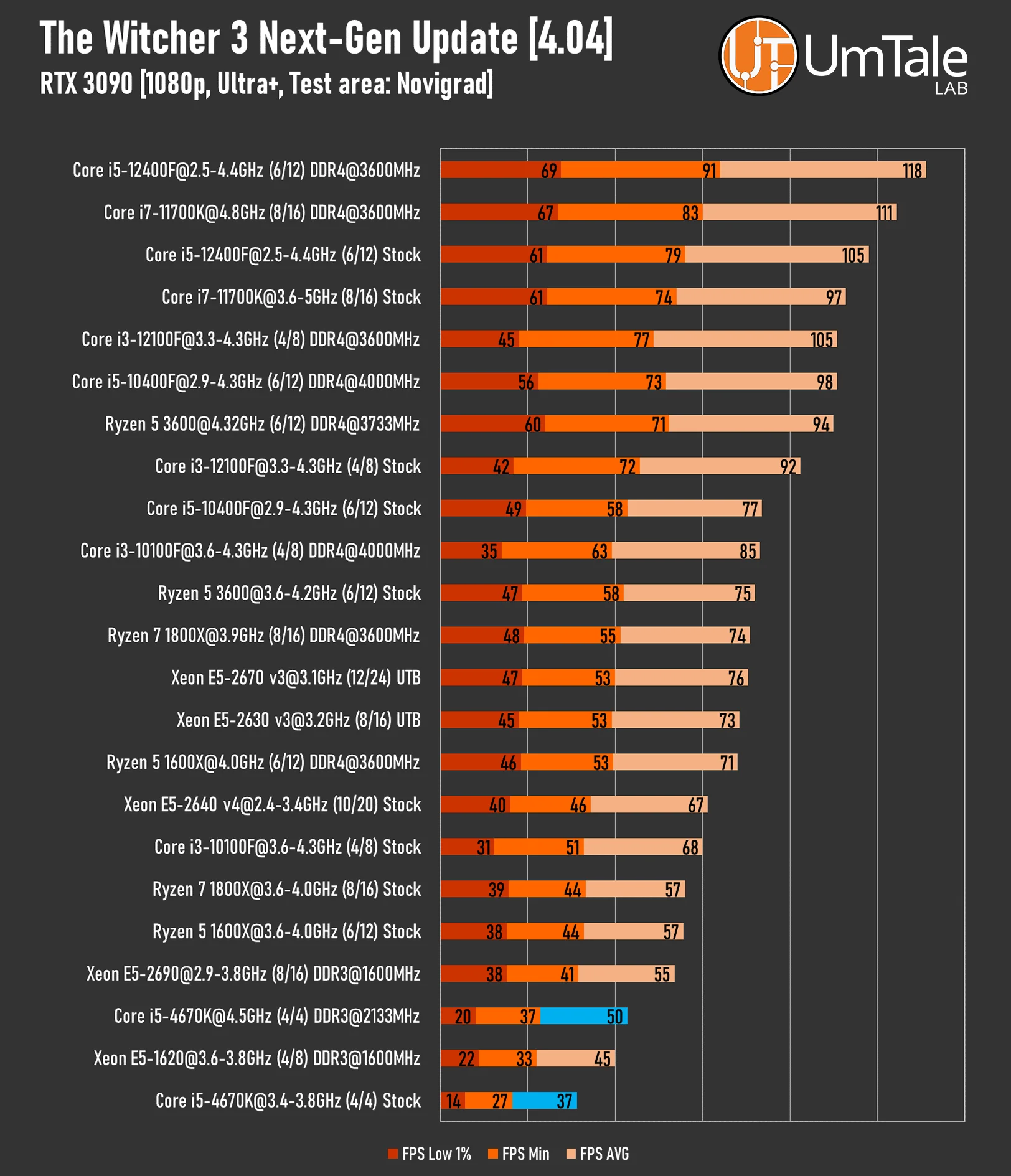
The updated version of The Witcher 3 transitioned to an improved REDengine 3 with Ray Tracing support. However, the project wasn't ready for such complex changes, resulting in a game that's significantly more demanding than even Cyberpunk 2077.
The Next-Gen Update is extremely CPU-dependent, yet it struggles to adequately utilize powerful CPUs with eight or more cores. The Witcher 3 performs most efficiently on 6-core, 12-thread chips. Additionally, REDengine 3 responds quite well to high-frequency RAM.
Ray Tracing – ON
 ⤢ ВІДКРИТИ
Ray Tracing – OFF
 ⤢ ВІДКРИТИ
Watch Dogs Legion
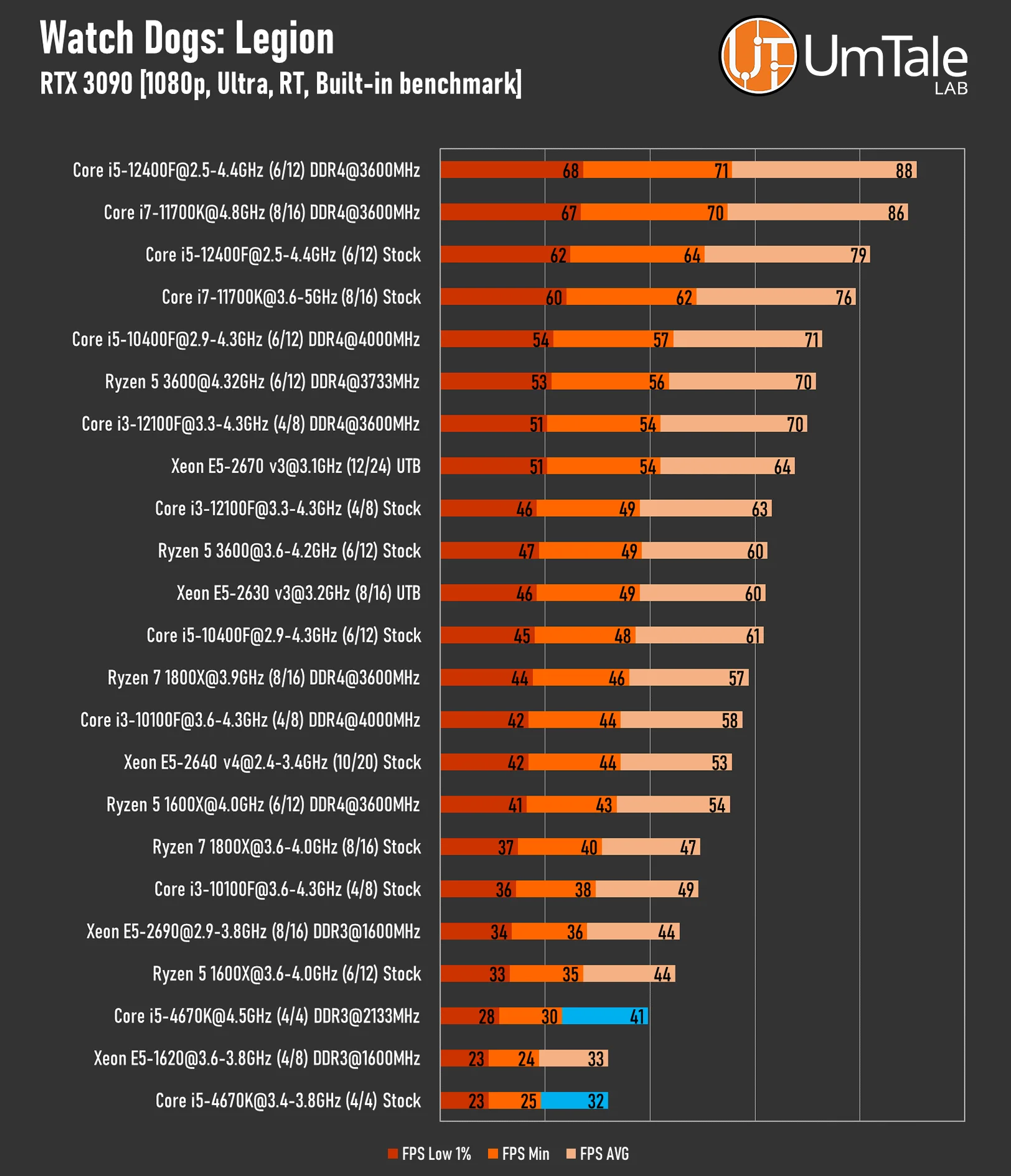
The third installment in the Watch Dogs franchise is likely based on the improved Disrupt 2 engine. Since the first game's release, titles in this series have performed quite well with multi-core CPUs, and Legion is no exception. The game can easily utilize over 20 threads and also responds positively to high-frequency memory.
Ray Tracing – ON
 ⤢ ВІДКРИТИ
Ray Tracing – OFF
 ⤢ ВІДКРИТИ
RPCS3, Red Dead Redemption
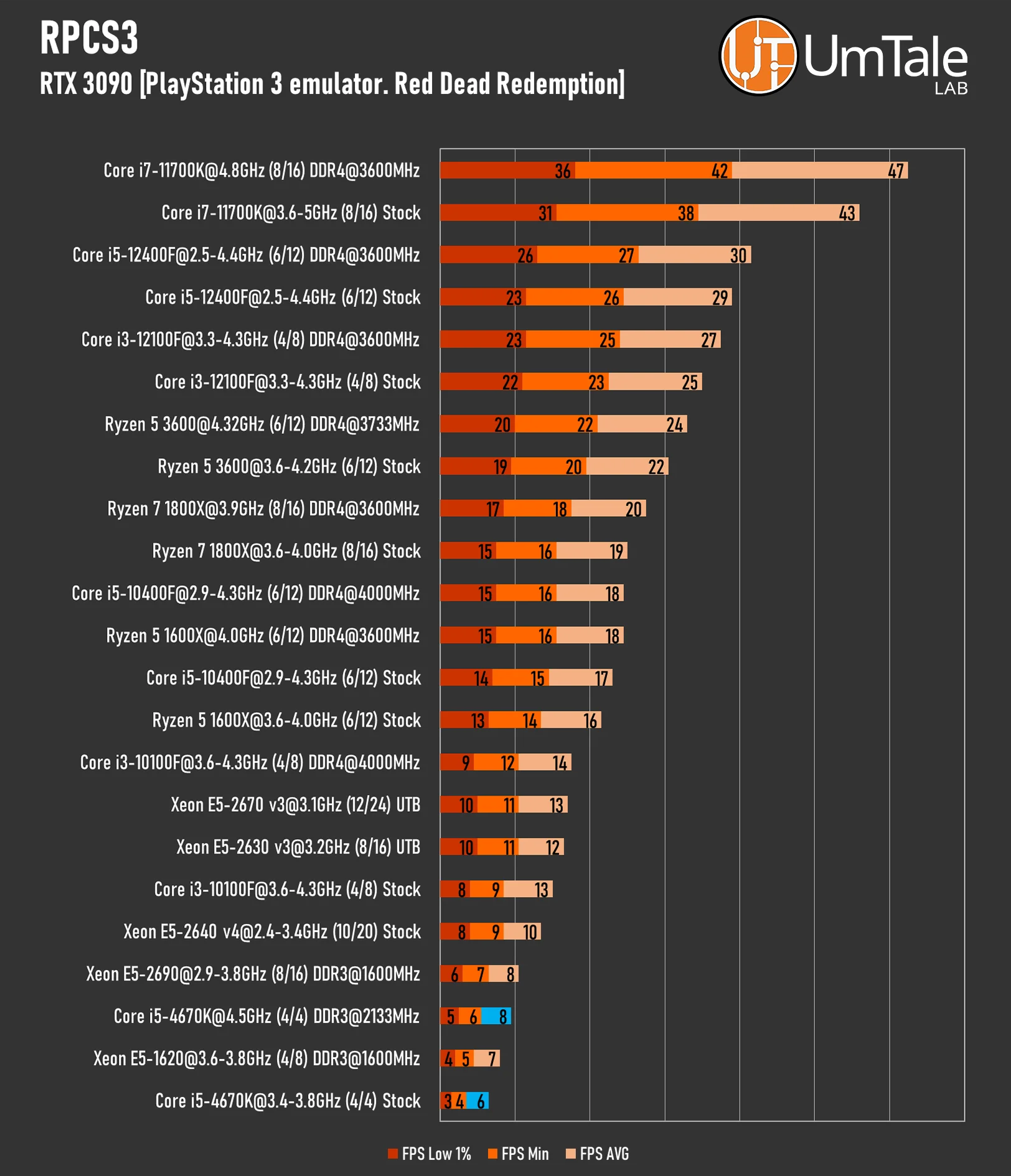
RPCS3 is the most popular PlayStation 3 console emulator. While the software excels at parallelizing shader compilation across a large number of threads, the load distribution quality significantly drops when it comes to actual game emulation. Naturally, performance varies by game, but our observations indicate that current 6-8 core CPUs with high clock speeds deliver the best results.
Additionally, significant performance gains can be achieved from instruction sets like AVX-512 and TSX. However, with TSX, some projects occasionally exhibit unstable behavior.
Emulator settings for Red Dead Redemption: SPU block size – Mega, ZCULL accuracy – Relaxed, Write color buffers – On, Sleep timers accuracy – As Host, RSX FIFO accuracy – Atomic, resolution 1080p.
 ⤢ ВІДКРИТИ
The Core i5-4670K also performs quite well in games. With the exception of the RPCS3 emulator and The Witcher 3 Next-Gen Update with active RT, where the 4-core chip's results are dismal, other projects run surprisingly tolerably on the i5-4670K. However, we must point out the extremely low minimum FPS recorded in most games. Four cores without Hyper-Threading are simply critically insufficient today. This means running a background application like Discord or YouTube could lead to catastrophic FPS drops, making gameplay completely unplayable.
Conclusion
The Core i5-4670K processor managed to both severely disappoint (with its questionable CPU build quality and, consequently, terrible overclocking potential) and pleasantly surprise (with decent results in both games and applications, especially given its modest specifications).
Furthermore, upgrading from a Core i5-4670K to a hypothetical Core i7-4770K is an option. Perhaps in a parallel universe, this idea would make sense, but unfortunately, we live in a different reality. This neatly brings us to the question of the LGA 1150 platform's viability in 2024.
In our opinion, the aforementioned socket is entirely dead, and Intel isn't to blame here. For some reason, the more-or-less adequate and relevant CPUs for this platform (Core i7-4770/4790K) command exorbitant prices. On local second-hand markets, a 4770K is valued at $50-70, and a 4790K at $60-80! Just consider this: a 10-year-old processor with only 4 cores and 8 threads costs as much as relatively modern chips like the Core i3-10100F or Ryzen 5 3600, which are significantly better and, crucially, more economical than the outdated Haswell architecture solutions.
Inevitably, some will argue that 'a one-time platform change isn't cost-effective' or 'it requires a significant extra payment.' But does it, really? Decent Z87 chipset motherboards still fetch good money, meaning selling yours bundled with the CPU and RAM could cover more than half the budget for a new kit. Of course, depending on what you manage to sell your old setup for, you might still need to pay 30-40% of the new hardware's price. However, based on our tests, it's clearly worth it.