TESTS · CPU · INTEL
PUBLISHED
READING34 min
Core i5-10400F review: Is this budget Comet Lake-S still viable in 2024?
Is Intel's Core i5-10400F still a smart buy in 2024? We dive into this budget 10th-gen CPU, compare it to modern rivals, and check out its RAM overclocking potential.
Intel's 10th generation Core chips marked the last iteration of processors based on a slightly refined version of the Skylake architecture. Comet Lake-S gained support for high-frequency RAM, shifted to a more advanced 14nm process, and saw minor clock speed boosts. However, at its core, it was still the same old Intel Skylake.
Once, the 6-core, 12-thread Core i5-10400F was one of the most popular CPUs in the Comet Lake-S family. It was virtually unrivaled in price-to-performance, making it a common choice for countless user builds. However, with the arrival of budget-friendly solutions based on Intel Alder Lake and AMD Zen 2 architectures, things have shifted somewhat.
In this article, we'll find out what the once-popular Core i5-10400F can still do in 2024. We'll also compare it to relatively recent chips like the Core i3-12100F, Ryzen 5 3600, and the ultra-budget Xeon E5-2670 v3.
Nevertheless, in our opinion, the Ryzen 5 3600 stands as the primary competitor to the i5-10400F in this material. Consider this: both processors are still sold in most online and offline stores and, judging by reviews, maintain considerable popularity among consumers.
Processor | Price |
Ryzen 5 3600 | 75-85$ |
Ryzen 5 1600X | 35-45$* |
Ryzen 7 1800X | 60-75$* |
Core i3-10100F | 55-60$ |
Core i5-10400F | 95-100$ |
Core i3-12100F | 95-105$ |
Core i5-12400F | 145-155$ |
Xeon E5-2630 v3 | 5-7$* |
Xeon E5-2670 v3 | 9-12$* |
According to price statistics from several major retailers, the AMD chip ($75-80) costs significantly less than Intel's 6-core offering ($95-100), as does the price of a complete system build based on it (as of February 2024). Therefore, we think it will be quite interesting to
The processor

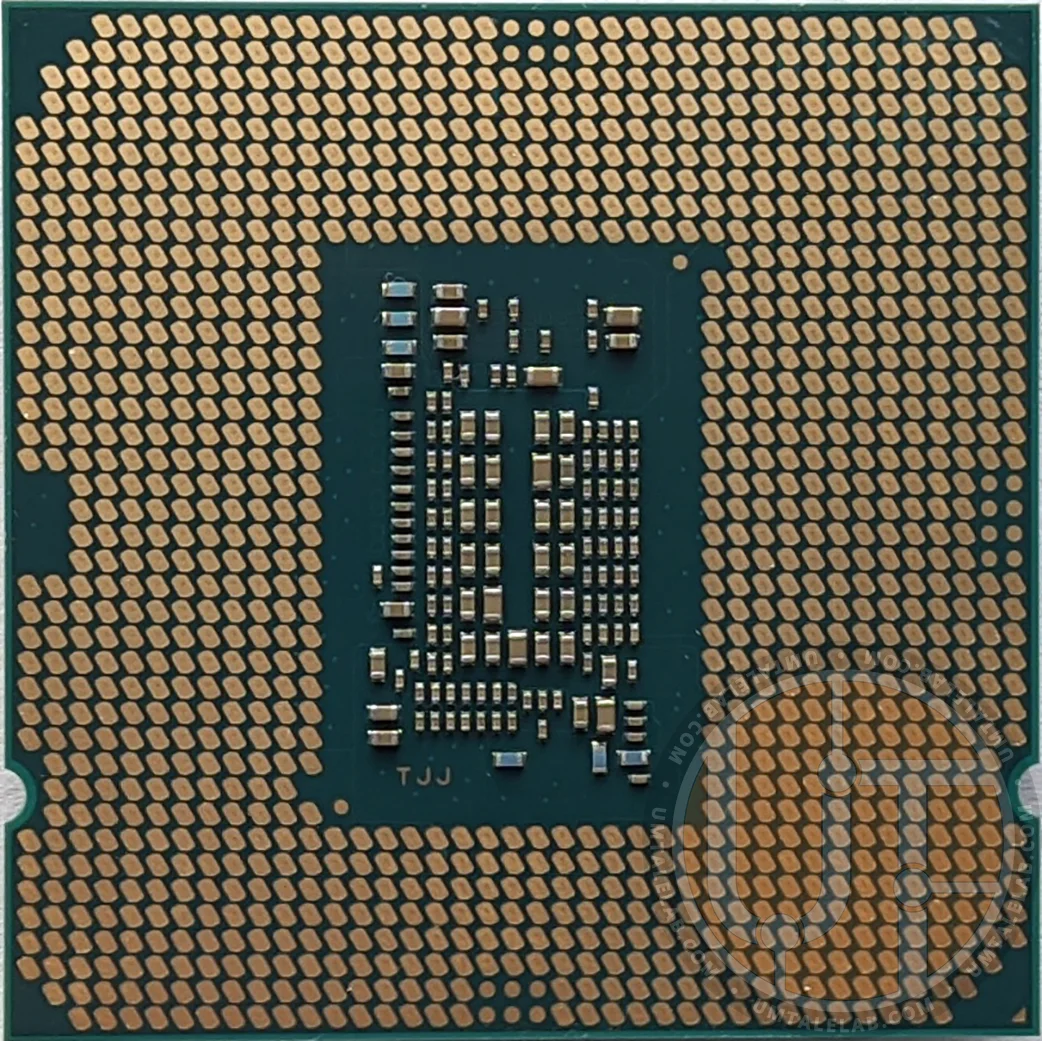
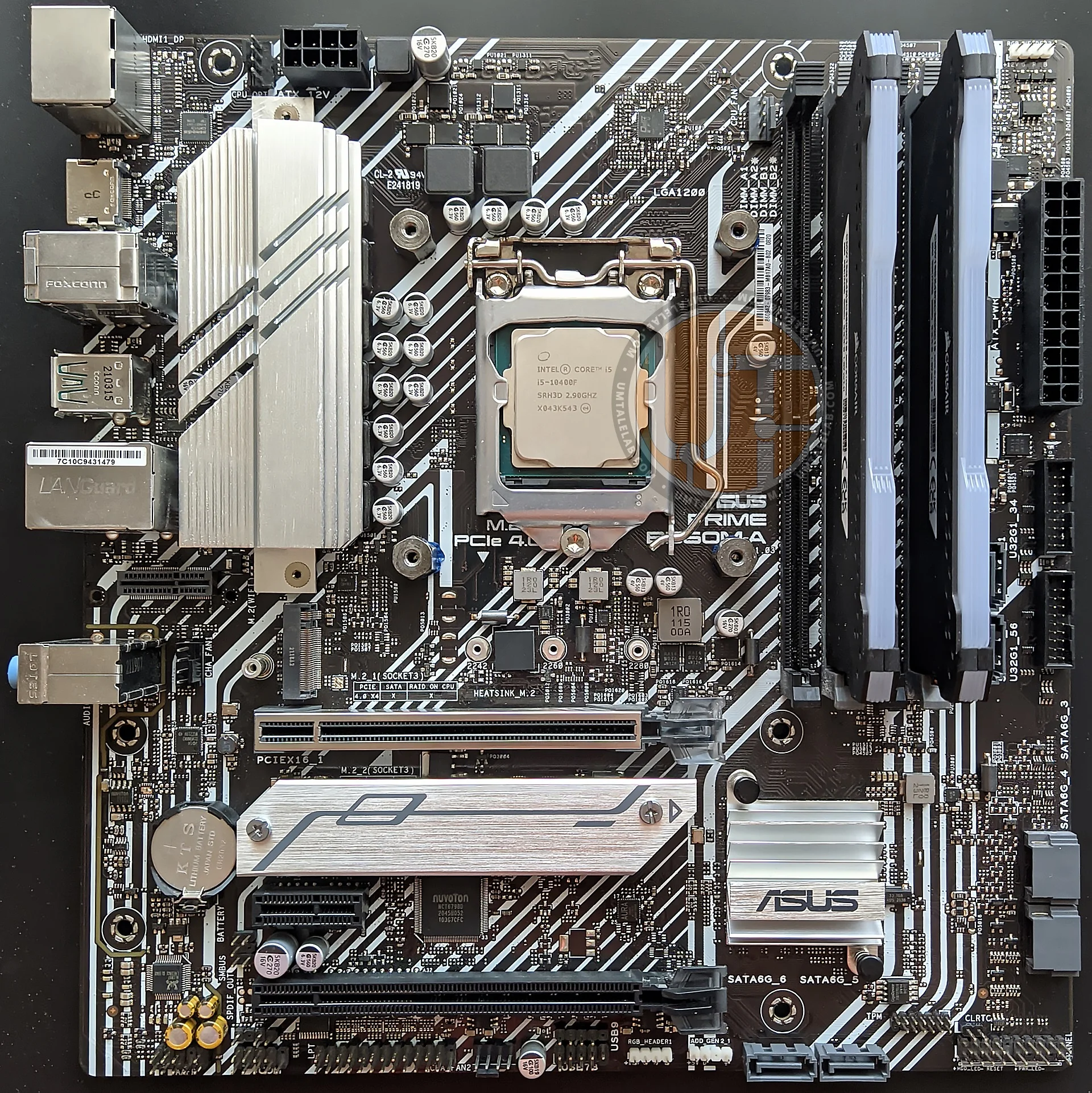
The test sample is marked SRH3D. This is the retail box version of the CPU.
At its core, the Intel Core i5-10400F uses a 6-core, 14nm G1 revision die based on the Intel Comet Lake-S architecture, which is essentially the fifth iteration of the aging (but not useless) Skylake. The chip features 256KB of L2 cache per core and a relatively small 12MB of L3 cache, by modern standards. This CPU is designed for LGA 1200 motherboards. Its modest base clock speed is 2900 MHz, but Turbo Boost can push it up to 4300 MHz for a single core, or 4000 MHz across all 6 cores and 12 threads. The chip's TDP is rated at 65 watts.
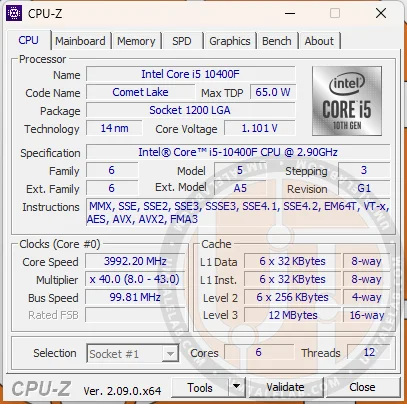
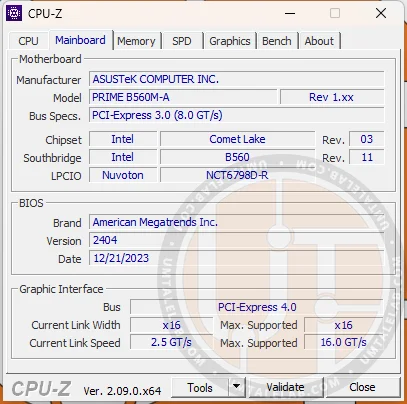
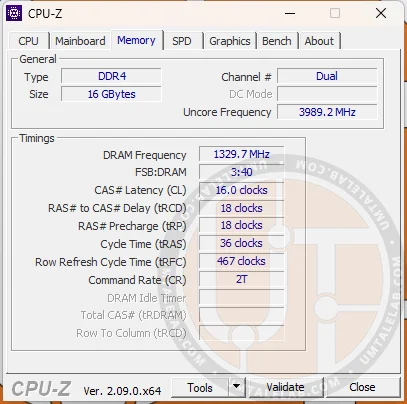
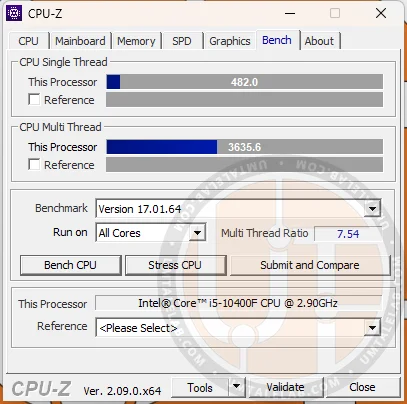
The i5-10400F's integrated memory controller doesn't use dividers like GEAR 1/GEAR 2, unlike current Intel solutions. Its speed ranges from 3600 to 4000 MHz, depending on the load placed on the CPU's execution units.
Officially, the Core i5-10400F supports a maximum memory speed of dual-channel DDR4-2667 MHz. However, XMP profiles typically work without issues. We easily got our Corsair Vengeance RGB PRO test sticks running at an effective DDR4-3600 frequency. Pushing RAM frequencies further, though, requires manual overclocking.
Memory overclocking and optimization
Thanks to the "generosity" of the blue giant, Intel's 500-series chipsets made RAM overclocking available even on budget-friendly B560 motherboards. This means even if you're not an enthusiast or an overclocker, buying a mid-range motherboard is now fully justifiable.
Since the i5-10400F lacks CPU core overclocking support, boosting RAM speed is the only way to increase the chip's ultimate performance. Fortunately, the Comet Lake architecture retained all the advantages of its Skylake predecessor, while not adopting the features of its successor, Rocket Lake.
As we mentioned earlier, the processor has no issues with XMP profiles. However, it's important to understand that not everyone can afford memory kits above 3600MHz. Frankly, users are unlikely to choose expensive RAM for a chip like the i5-10400F, so overclocking lower-frequency RAM is a very sensible solution.
To overclock RAM on the LGA 1200 platform, you only need to adjust two voltages (besides the obvious vDDR): IO voltage and SA voltage. While 1.25-1.30 volts are generally considered relatively safe limits for these voltages, we wouldn't recommend exceeding 1.25v.
It's also critically important: never leave IO and SA voltage on AUTO! Motherboards tend to significantly overvolt these settings when overclocking RAM. For instance, our test ASUS PRIME B560M-A already set 1.35 volts at 3600MHz, which is, to put it mildly, excessive. At 3600MHz, you can easily stick to 1.1-1.15 volts.
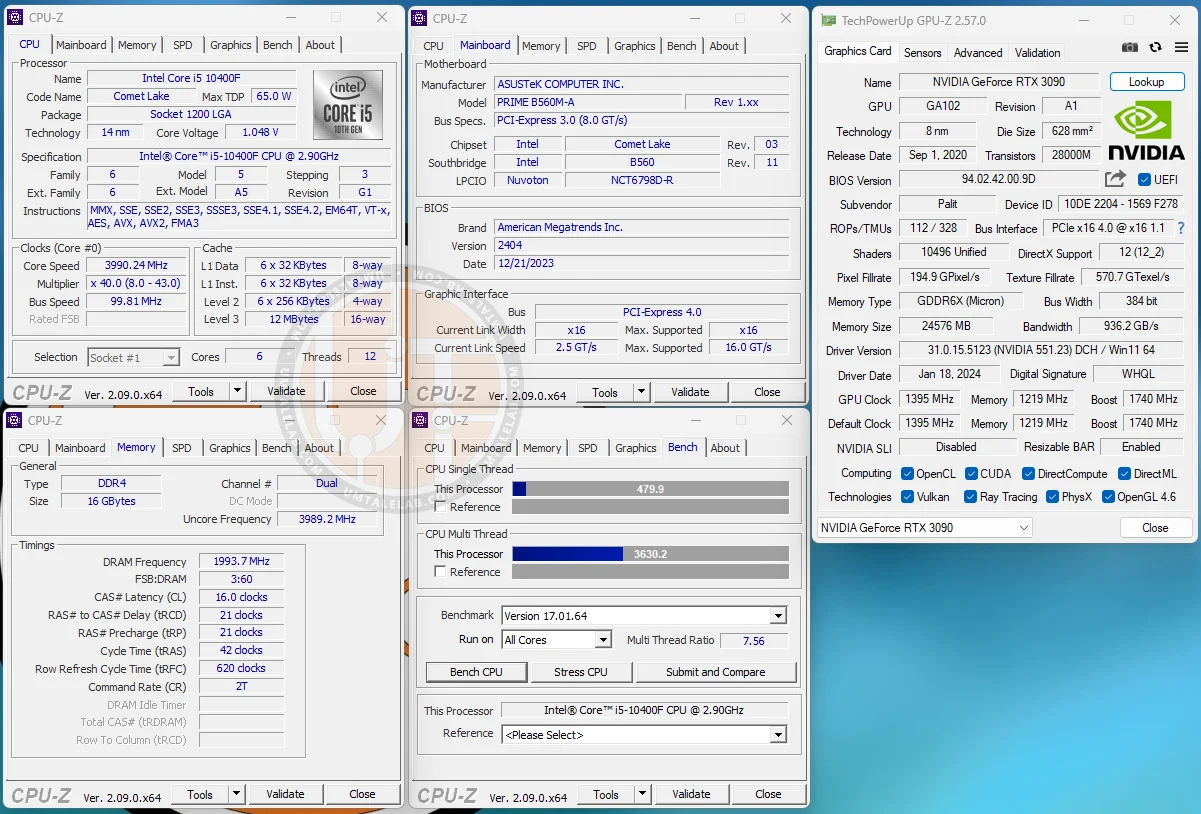
Our RAM overclocking experiments resulted in a frequency of 4000 MHz, with 16-21-21-42 timings:
 ⤢ ВІДКРИТИ
BIOS settings:
IO voltage - 1.2v;
SA voltage - 1.2v;
DDR4 voltage - 1.42v
It's worth noting here that we hit the frequency limit of our Corsair Vengeance RGB PRO sticks. While Comet Lake's memory controller is capable of much higher frequencies, 4000 MHz is a fairly typical overclock for relatively inexpensive DDR4.
Test bench, software, and CPU settings
Resizable BAR was activated on platforms with BIOS support.
Test bench
Intel processors: Core i3-10100F, Core i5-10400F, Core i3-12100F, Core i5-12400F, Xeon E5-2630 v3, Xeon E5-2670 v3;
AMD processors: Ryzen 5 1600X, Ryzen 7 1800X, Ryzen 5 3600;
CPU cooling: Cooler Master Hyper 212 Black Edition (RR-212S-20PK-R1);
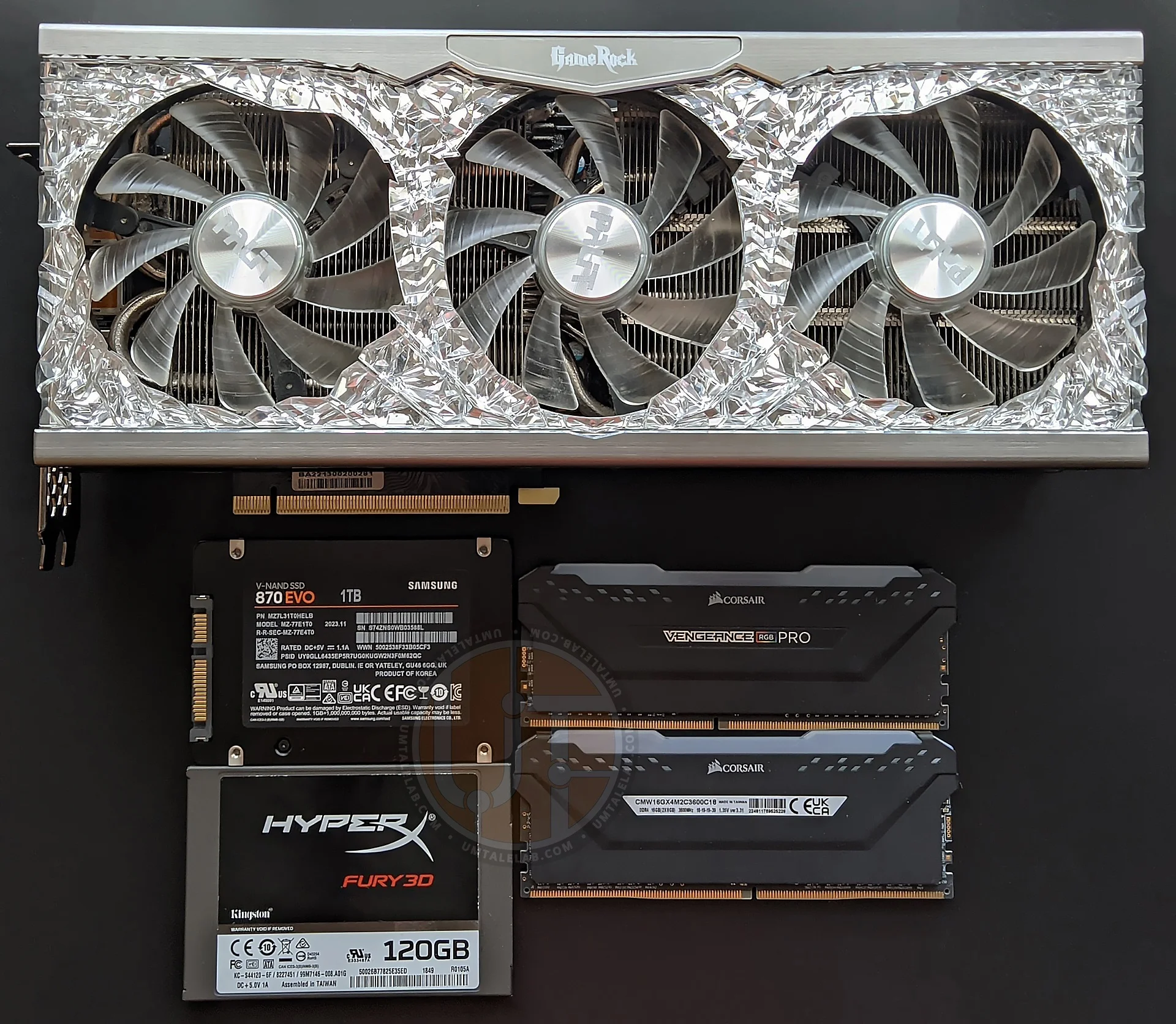
RAM for LGA 1200, LGA 1700, and AM4: 2 x 8 GB Corsair Vengeance RGB PRO (CMW16GX4M2C3600C18) for a total of 16 GB (Micron E-Die chips);
RAM for LGA 2011 v3: 4 x 4 GB G.SKILL DDR4 F4-2400C15S-4GNT for a total of 16 GB (Hynix MFR chips);
LGA 1200 motherboard: ASUS PRIME B560M-A;
LGA 1700 motherboard: MSI PRO Z690-A DDR4 (MS-7D25);
LGA 2011 v3 motherboard: Kllisre X99-D8 (AD12) with modified BIOS (Unlock Turbo Boost, Undervolt, and unlocked timing control);
AM4 motherboard: ASUS TUF GAMING B450M-PRO II;
Graphics card: PALIT GAMEROCK GeForce RTX 3090 24 GB (~1900/19000 MHz, Power Limit 113%);
Solid-state drives: 2 x KINGSTON SUV400S37120G 120 GB (AMD/Intel Windows 11), SAMSUNG 870 EVO 1 TB (Games/Applications);
Power supply unit: Chieftec GPS-1250C.
Software
Operating system: Windows 11 Pro x64 with the latest updates as of February 2024. Core isolation/memory integrity disabled;
Graphics card drivers: NVIDIA GeForce 551.23 WHQL;
FPS measurement software: MSI Afterburner 4.6.5;
Games: testing was conducted on current game versions as of February 2024;
Game settings: testing was conducted at maximum graphics settings in 1080p resolution.
Tested CPU settings
Intel processors:Core i5-10400F@2900-4300 MHz, Dual Channel DDR4@2667 MHz (motherboard auto: 16-18-18-36);
Core i5-10400F@2900-4300 MHz, Dual Channel DDR4@4000 MHz (16-21-21-42), IO voltage - 1,2v, SA voltage - 1.2v, DDR4 voltage — 1.420v;
Core i3-10100F@3600-4300 MHz, Dual Channel DDR4@2667 MHz (motherboard auto: 16-18-18-36);
Core i3-10100F@3600-4300 MHz, Dual Channel DDR4@4000 MHz (16-21-21-42), IO voltage - 1,2v, SA voltage - 1.2v, DDR4 voltage — 1.420v;
Core i5-12400F@2500-4400 MHz, Dual Channel DDR4@3200 MHz (motherboard auto:18-19-19-39) GEAR 1;
Core i5-12400F@2500-4400 MHz, Dual Channel DDR4@3600 MHz (16-19-19-38) GEAR 1;
Core i3-12100F@3300-4300 MHz, Dual Channel DDR4@3200 MHz (motherboard auto: 18-19-19-39) GEAR 1;
Core i3-12100F@3300-4300 MHz, Dual Channel DDR4@3600 MHz (16-19-19-38) GEAR 1;
Xeon E5-2630 v3@3200 MHz (Unlock Turbo Boost in UTB charts), vCore -60mv, UnCore -50mv, SA -50mv, Quad-Channel DDR4@1866 MHz (10-10-10-24);
Xeon E5-2670 v3@3100 MHz (Unlock Turbo Boost in UTB charts), vCore -50mv, UnCore -50mv, SA -50mv, Quad-Channel DDR4@2133 MHz (12-12-12-35).
AMD Processors: Ryzen 5 1600X@3600-4000 MHz, Dual Channel DDR4@2667 MHz (motherboard auto: 18-18-18-44);
Ryzen 5 1600X@4000 MHz, Dual Channel DDR4@3600 MHz (16-19-16-38), vCore voltage - 1.42v, SOC voltage — 1.075v, cLDO VDDP voltage – 0.975v, DDR4 voltage — 1.350v;
Ryzen 7 1800X@3600-4000 MHz, Dual Channel DDR4@2667 MHz (motherboard auto: 18-18-18-44);
Ryzen 7 1800X@3900 MHz, Dual Channel DDR4@3600 MHz (16-19-16-38), vCore voltage - 1.4v, SOC voltage — 1.1v, cLDO VDDP voltage – 1.025v, DDR4 voltage — 1.350v;
Ryzen 5 3600@3600-4200 MHz, Dual Channel DDR4@3200 MHz (motherboard auto: 22-22-22-53) Infinity Fabric@1600 MHz (1:1);
Ryzen 5 3600@4325 MHz, Dual Channel DDR4@3733 MHz (16-19-16-38) Infinity Fabric@ 1866 MHz (1:1), vCore voltage - 1.39v, SOC voltage - 1.125v, cLDO VDDP voltage - 1.075v, VDDG CCD voltage - 1.025v, VDDG IOD voltage - 1.025v, DDR4 voltage - 1.380v;
You can learn more about virtually all tested processors in our full reviews, or by checking out the blog section, where we post shorter notes.
A quick reminder about our CPU testing methodology: each benchmark, application, or game was run five times. We then calculated the average of these five runs and recorded it as the final result. All games and applications were installed on an SSD.
Test results
Data archiving
7-Zip
The popular free file archiver 7-Zip supports multiple compression algorithms and numerous data formats, including its proprietary 7z format with the highly efficient LZMA compression algorithm. This archiver can utilize a large number of CPU threads and responds well to increased RAM frequencies.
 ⤢ ВІДКРИТИ
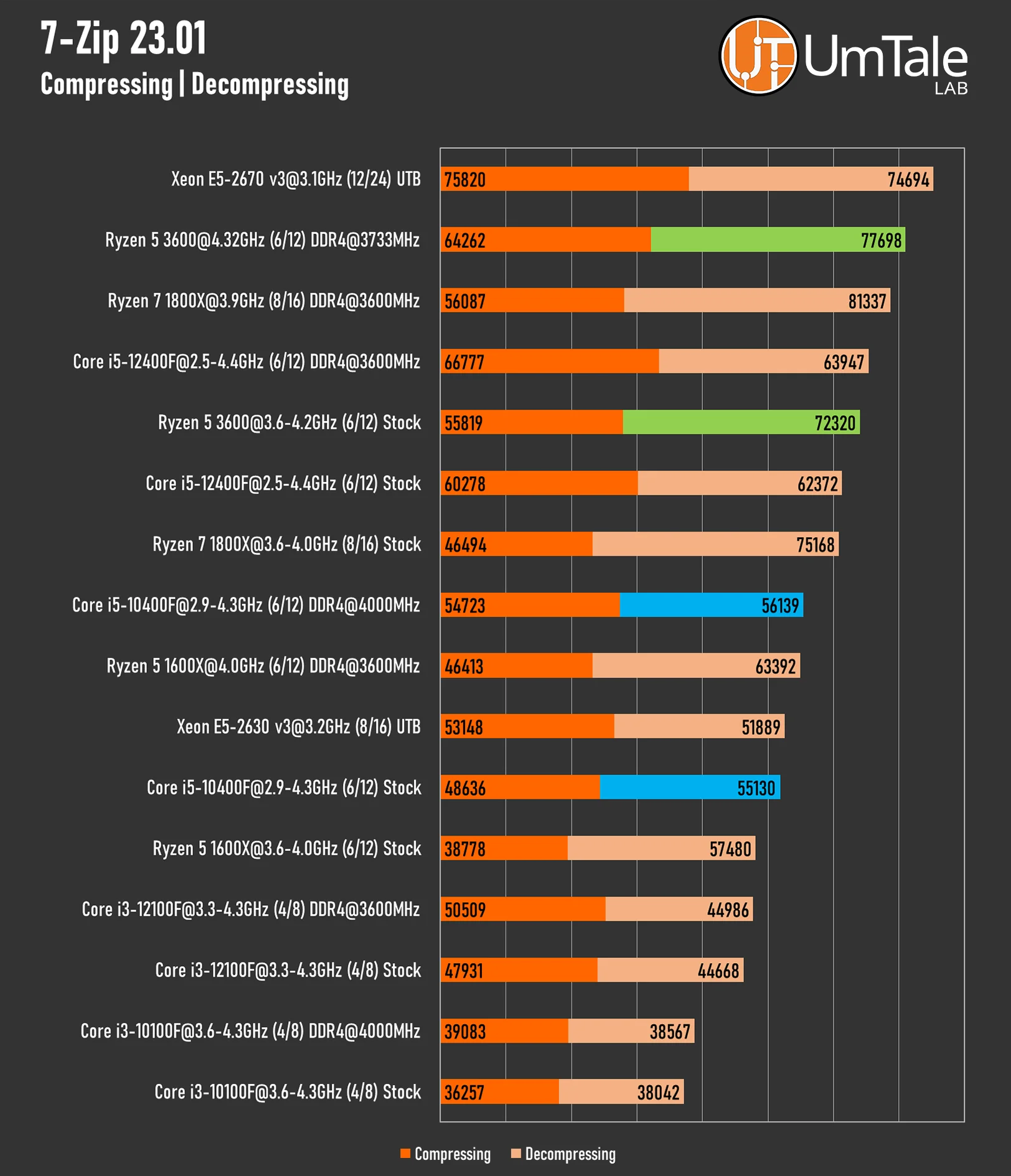
Traditionally, 7-Zip kicks off our test suite. At base RAM frequencies, the i5-10400F chip falls behind the E5-2630 v3 by 9% in file compression. It also trails the Ryzen 5 3600 quite significantly, by about 15% in compression and 31% in decompression.
Overclocking the RAM allows the 6-core Comet Lake to surpass the 8-core Haswell. However, it still can't quite catch the stock R5 3600, let alone an overclocked one.
Nonetheless, in this test, the ultra-budget 12-core Xeon E5-2670 v3 proves unattainable for all tested processors, including the Core i5-12400F.
3D rendering
Blender
Blender is a versatile, free, open-source software suite for creating 3D images. It supports the entire 3D modeling pipeline, from rigging, animation, simulation, rendering, compositing, and motion tracking, all the way to video editing and game creation.
We test CPU rendering speed using Blender's built-in Cycles engine and the BMW scene.
 ⤢ ВІДКРИТИ
The Core i5-10400F's final Blender render speed clearly falls short of the stock Ryzen 5 3600. Even with an RAM overclock, the Intel 6-core gains practically nothing, unlike its competitor. In contrast, an overclocked 6-core Zen 2 proves slightly faster than a stock R7 1800X and widens its lead over the i5-10400F by 15%.
The E5-2670 v3 once again outperforms both 6-core processors, showcasing an impressive level of performance for its modest price.
Corona 10 benchmark
The Corona 10 benchmark utilizes the popular Corona 10 rendering engine, a favorite among professionals. This engine is available for scene visualization in 3ds Max and Cinema 4D. The benchmark evaluates CPU rendering speed, leveraging its own proprietary technologies.
 ⤢ ВІДКРИТИ
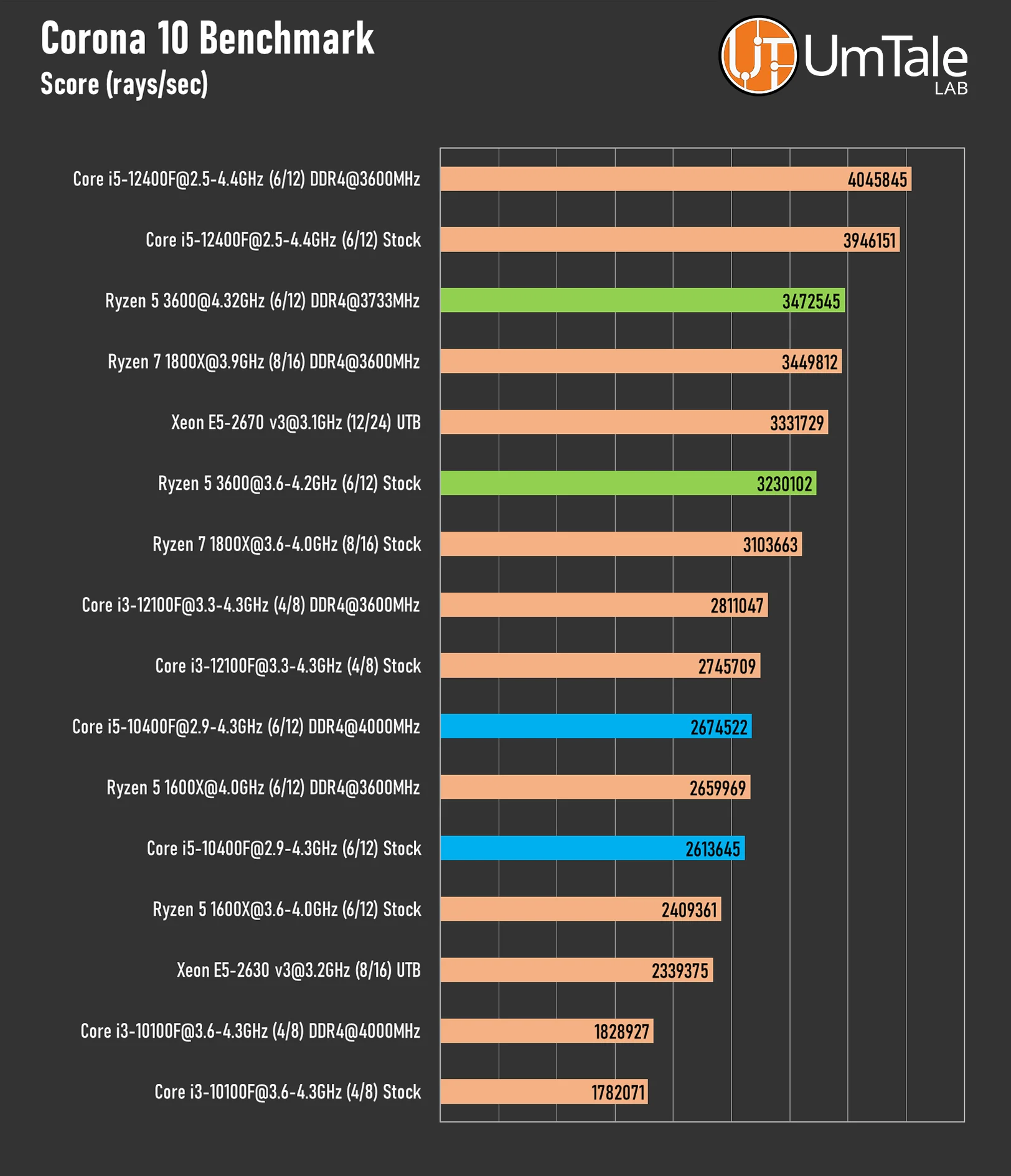
Once again, the Core i5-10400F struggles to compete with the Ryzen 5 3600. The AMD chip leads by 21% at stock speeds, a gap that expands to a substantial 30% after overclocking. Disappointingly, both Comet Lake versions perform at the level of an overclocked R5 1600X and the Core i3-12100F. Unfortunately, RAM overclocking rarely delivers tangible gains in rendering.
The Corona 10 benchmark did, however, provide a few surprises. An overclocked R5 3600 actually managed to slightly edge out the E5-2670 v3, a result unseen in Blender or 7-Zip. For the 10400F, though, the 12-core Haswell is simply unattainable.
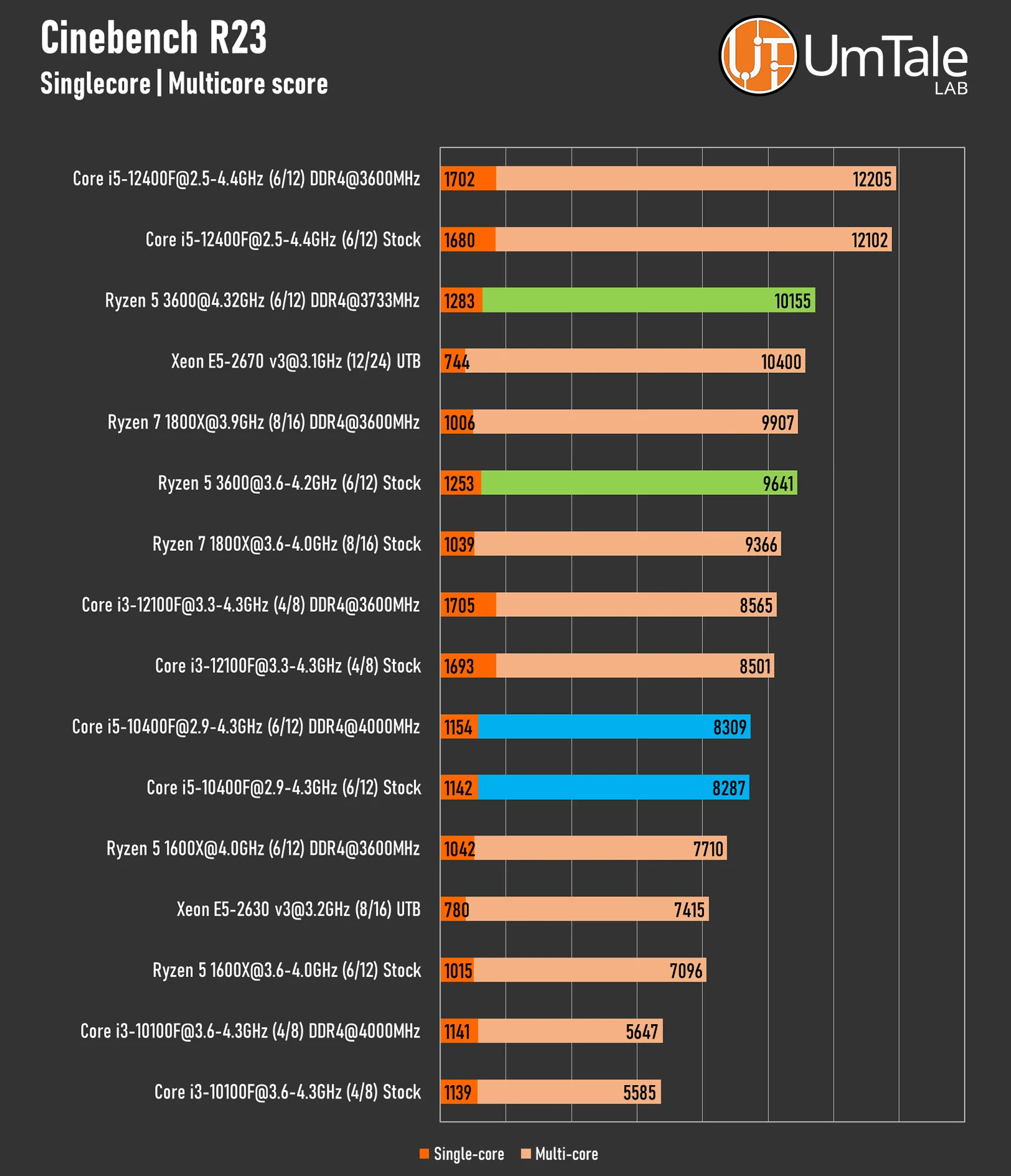
Cinebench R23
This is an outdated, but still relevant, benchmark version of the highly popular Cinema 4D software, a renowned editor for computer 3D animation, modeling, simulation, and rendering.
 ⤢ ВІДКРИТИ
At stock speeds, the 10400F lags behind the R5 3600 by 16% in multi-threaded performance and 10% in single-threaded tasks. While RAM overclocking yields virtually no benefit for the Intel chip, the AMD processor, boosted to 4325 MHz, extends its lead to 22%, simultaneously matching the performance of the 12-core E5-2670 v3.
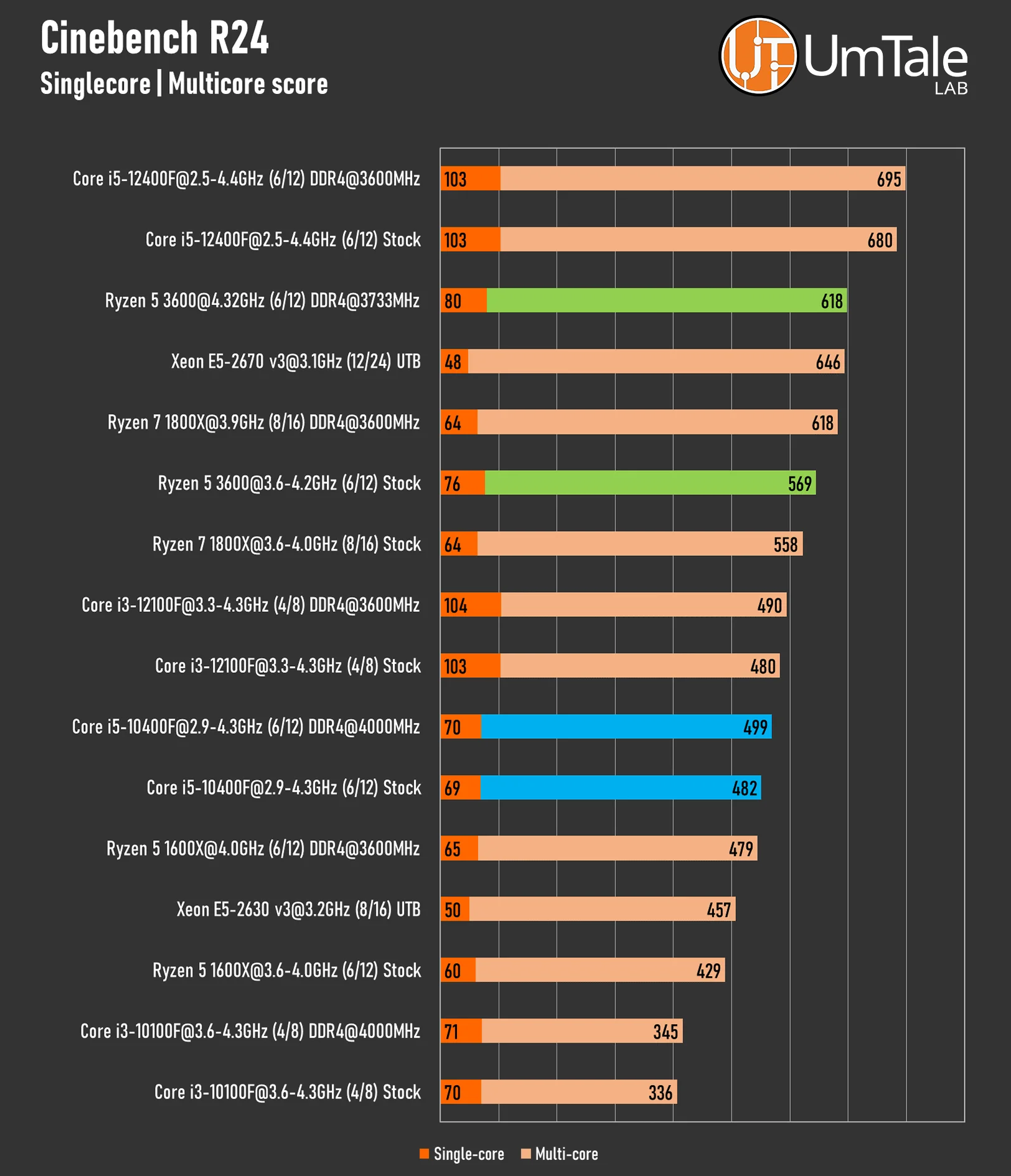
Cinebench R24
This is the latest benchmark version of the highly popular Cinema 4D editor, a renowned tool for computer 3D animation, modeling, simulation, and rendering. As of this release, running the main CPU test requires the processor to support the AVX2 instruction set.
 ⤢ ВІДКРИТИ
In Cinebench R24, the stock 6-core Comet Lake trails Zen 2 by 19% in multi-threaded rendering and 9% in single-threaded performance. Boosting RAM to 4GHz again brings no noticeable benefits for the 10400F, which allows the overclocked R5 3600's lead to widen to 24%.
The E5-2670 v3 once again demonstrates a significant advantage, only losing out to the overclocked Zen 2 in overall performance. However, strictly based on multi-threaded performance, the 12-core Haswell is just 5% behind the much more expensive 12400F.
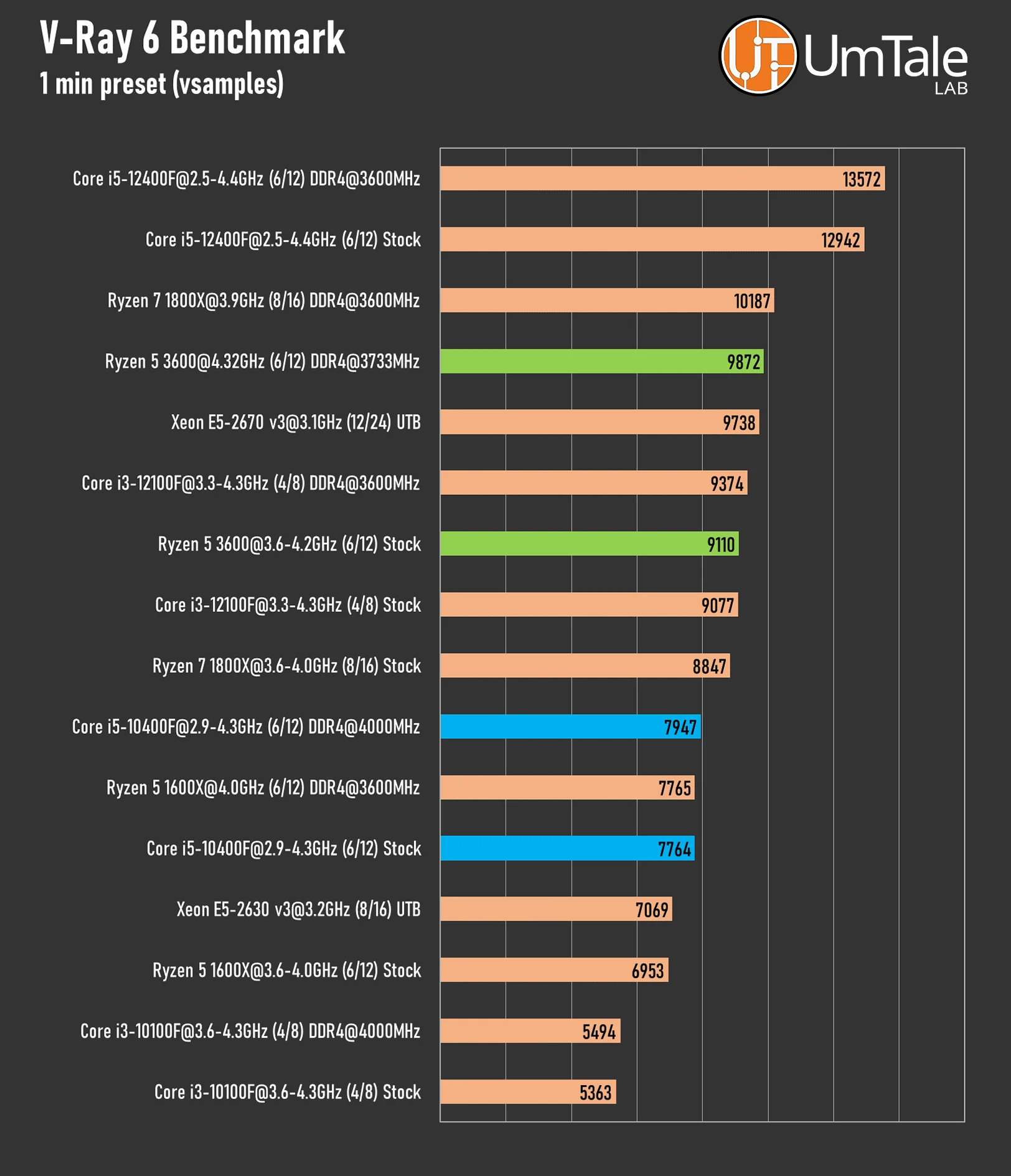
V-Ray 6 benchmark
This is the current benchmark version for the V-Ray render engine. Different iterations of this product are available for a multitude of solutions, including 3ds Max, Maya, Cinema 4D, Blender, and Unreal Engine.
 ⤢ ВІДКРИТИ
V-Ray presents no surprises: the 10400F continues to trail the R5 3600 by approximately 17% at stock and around 24% after overclocking. Overclocking the AMD 6-core allows it to confidently go head-to-head with the 1800X and slightly outperform the budget 12-core Xeon E5-2670 v3. The i5-10400F, for its part, can only keep pace with an overclocked 1600X.
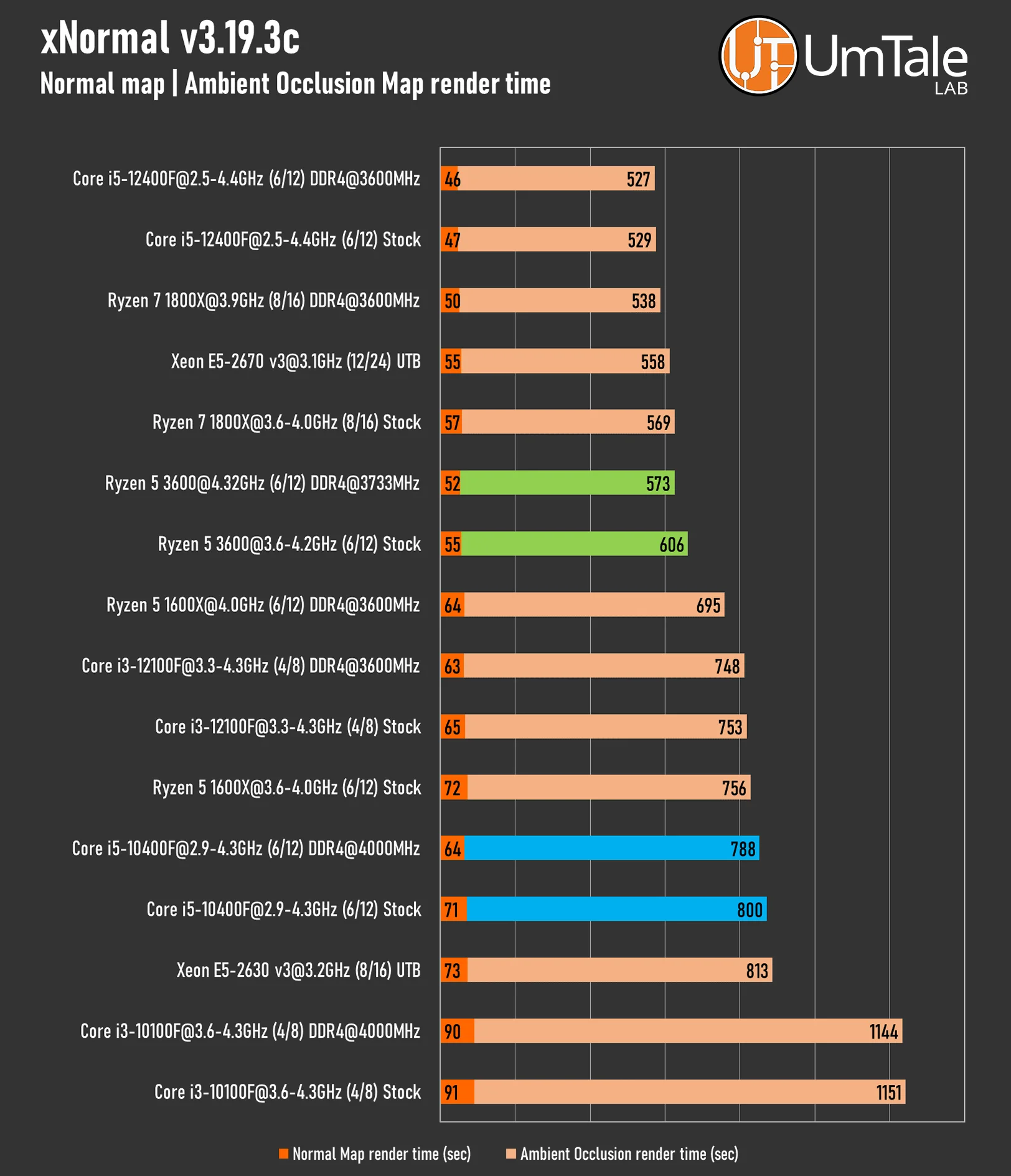
xNormal, AO & NM map render - baking texture maps
While dedicated texture baking applications aren't as widely used as they once were, xNormal remains a go-to for tens of thousands of game developers. Its popularity stems from a very user-friendly interface and a wealth of useful features.
 ⤢ ВІДКРИТИ
At stock, the Core i5-10400F's texture baking speed is on par with the 8-core E5-2630 v3; with an RAM overclock, it gets closer to the 1600X. It trails its primary competitor, the R5 3600, by 25% at base frequencies and 27% after both CPUs are overclocked.
The Xeon E5-2670 v3 once again leaves the 6-core Comet Lake in the dust, performing at the level of an overclocked 1800X and just slightly behind the 12400F.
Overall performance
CPU-z benchmark
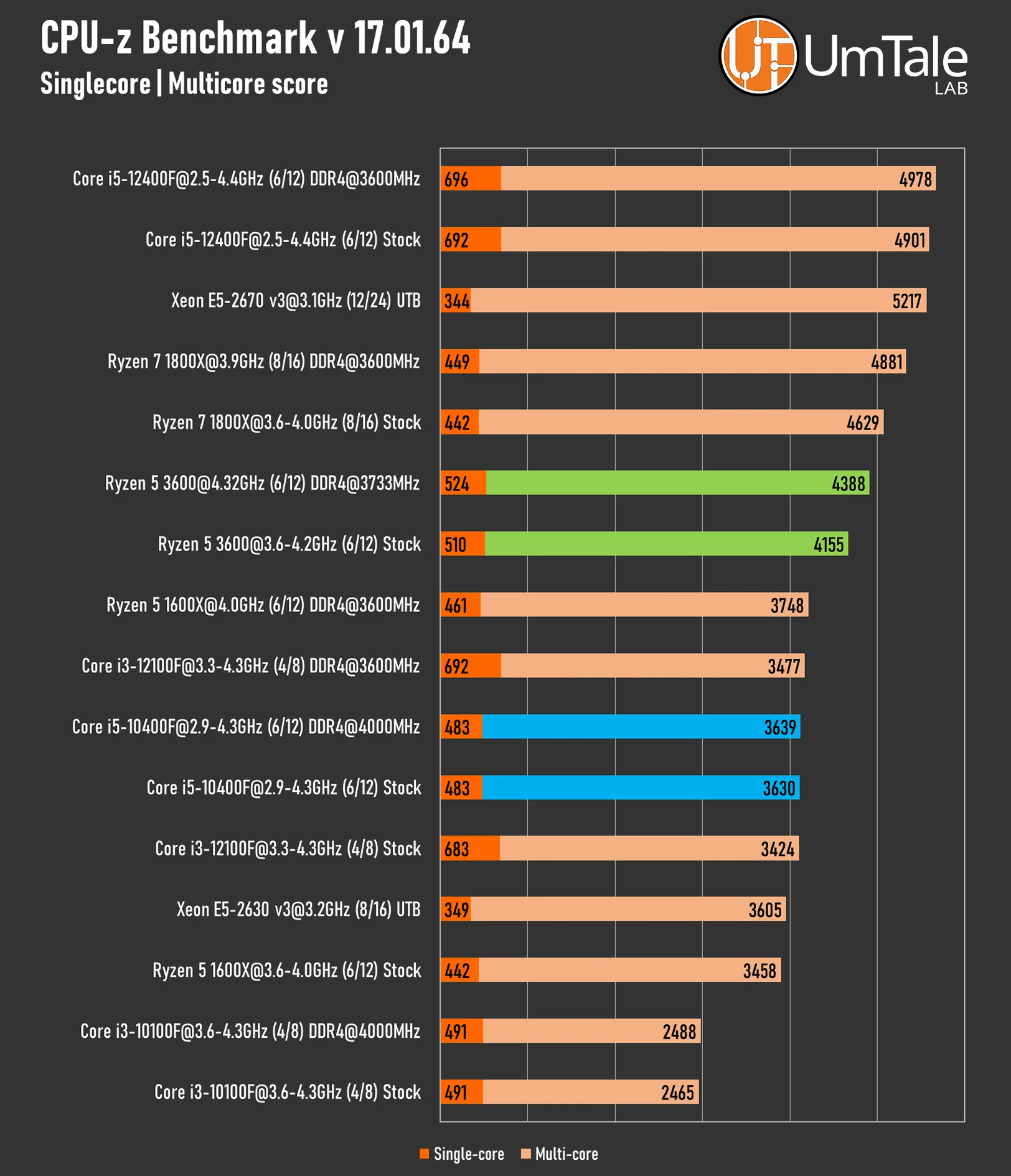
The CPU-z information utility's benchmark offers little insight into a CPU's real-world performance, and at this point, it's largely optional. However, we've traditionally included tests in this discipline.
 ⤢ ВІДКРИТИ
In the classic CPU-z benchmark, the Core i5-10400F's single-threaded performance falls short of the Ryzen 5 3600's, by 5% at stock and 8% after overclocking. The multi-threaded test showed the AMD 6-core holding a 14% advantage at base frequencies and a 20% lead when overclocked.
Geekbench 6
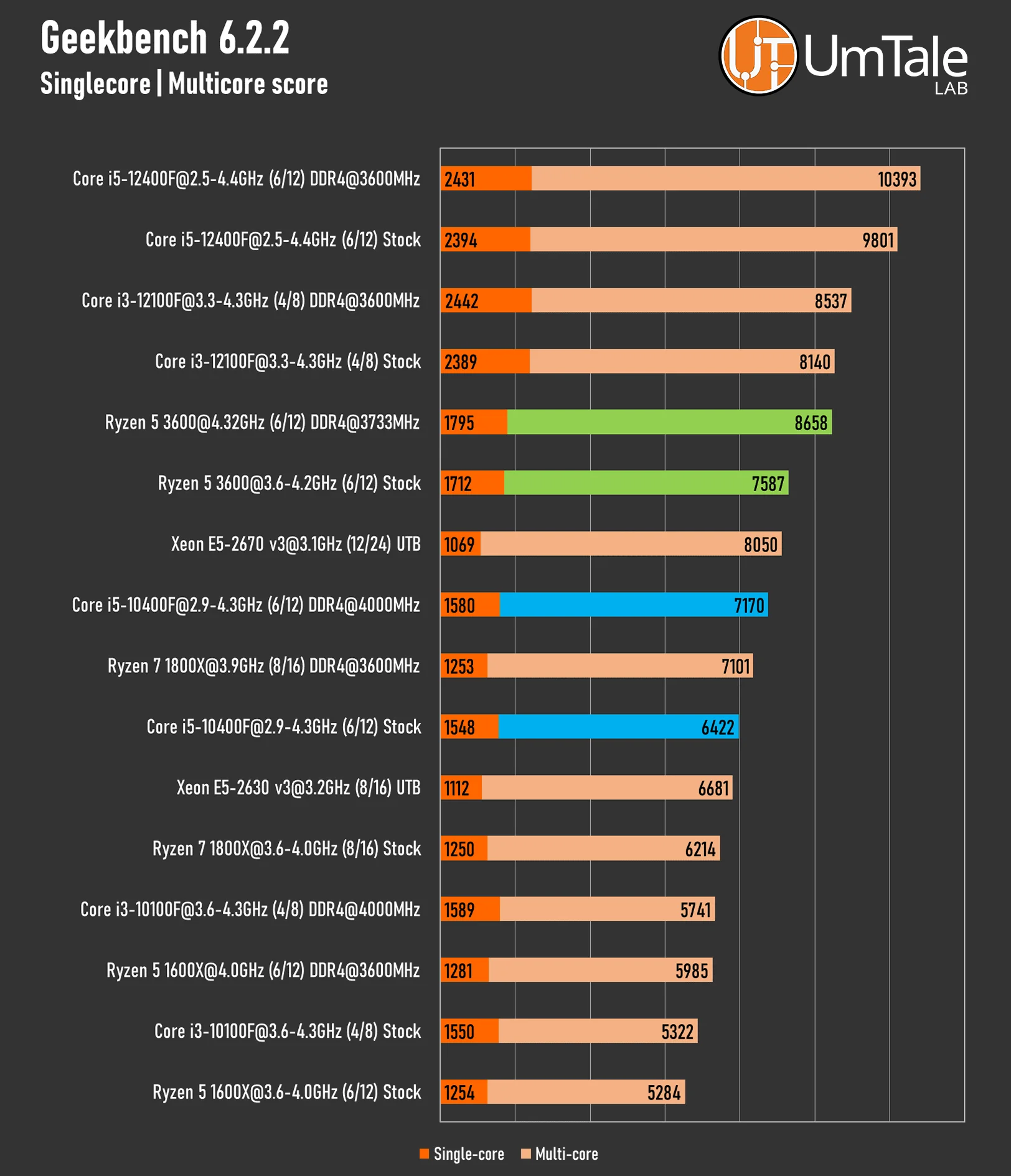
Geekbench 6 measures a CPU's single and multi-core performance across a wide range of tasks. These include everything from checking email, photo editing, and music playback, to more demanding workloads like augmented reality and machine learning.
 ⤢ ВІДКРИТИ
On stock clocks, the 10400F trails the Ryzen 5 3600 by just 10% in Geekbench 6's single-threaded tests. However, the AMD chip pulls ahead by 18% in multi-threaded workloads. With both CPUs overclocked, these gaps widen to 13% and 21%, respectively.
The 2670 v3 isn't as formidable in this benchmark. While its multi-threaded scores still surpass the 10400F, the gap has shrunk considerably: it's now 25% faster than a stock Comet Lake, but only 12% ahead of an overclocked one.
Video Encoding
HandBrake
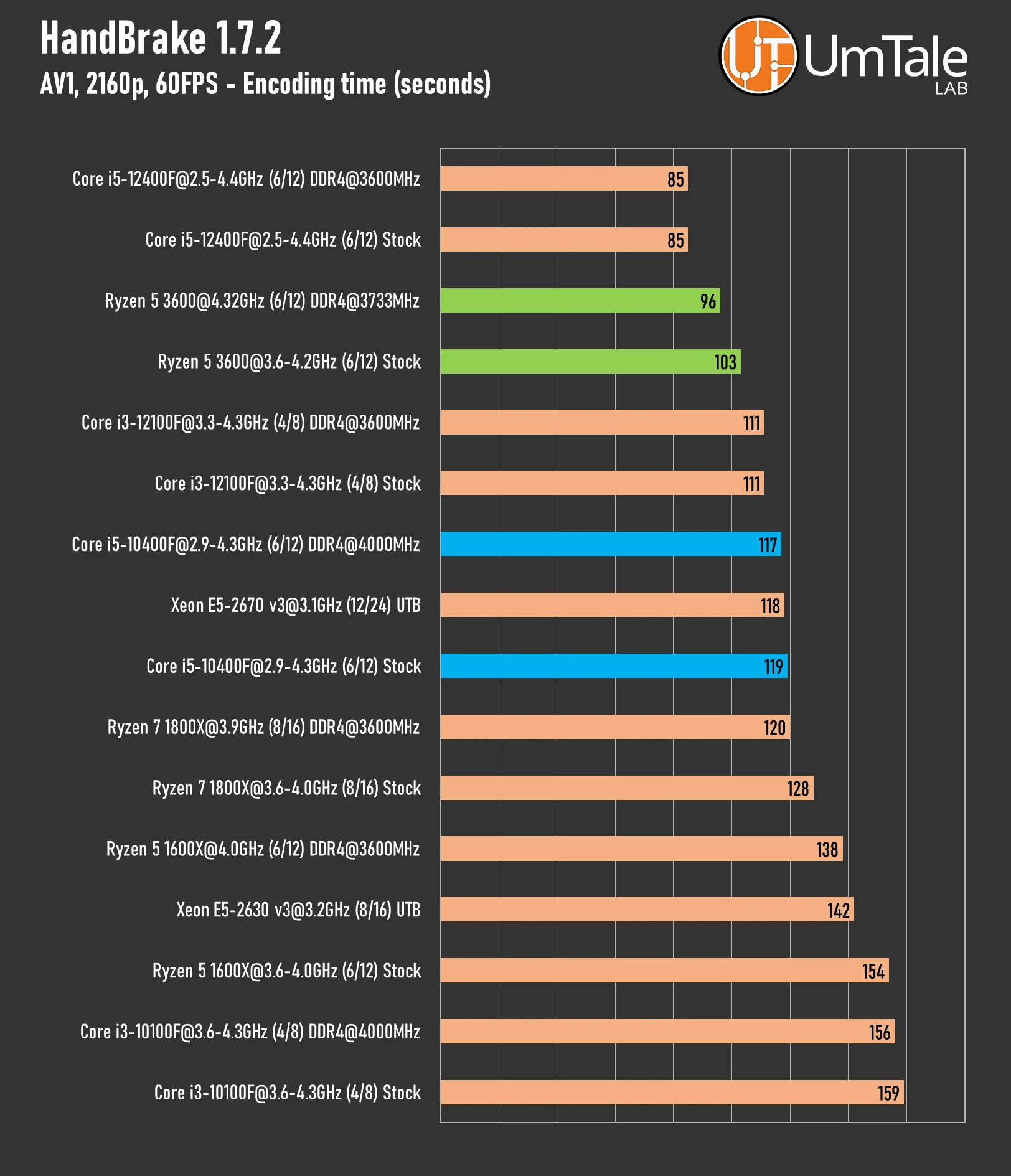
HandBrake is a free, open-source application designed to convert video from almost any format into a wide array of modern, widely supported codecs, including AV1, H265, and H264.
Codec: AV1
 ⤢ ВІДКРИТИ
When re-encoding 4K, 60FPS video to AV1 using HandBrake, the 10400F falls behind the R5 3600 by 13% at stock speeds, and 18% when both CPUs are overclocked. Interestingly, the 10400F shows identical performance to the E5-2670 v3. Considering the pricing of these processors, this puts the 10400F in an unfavorable position.
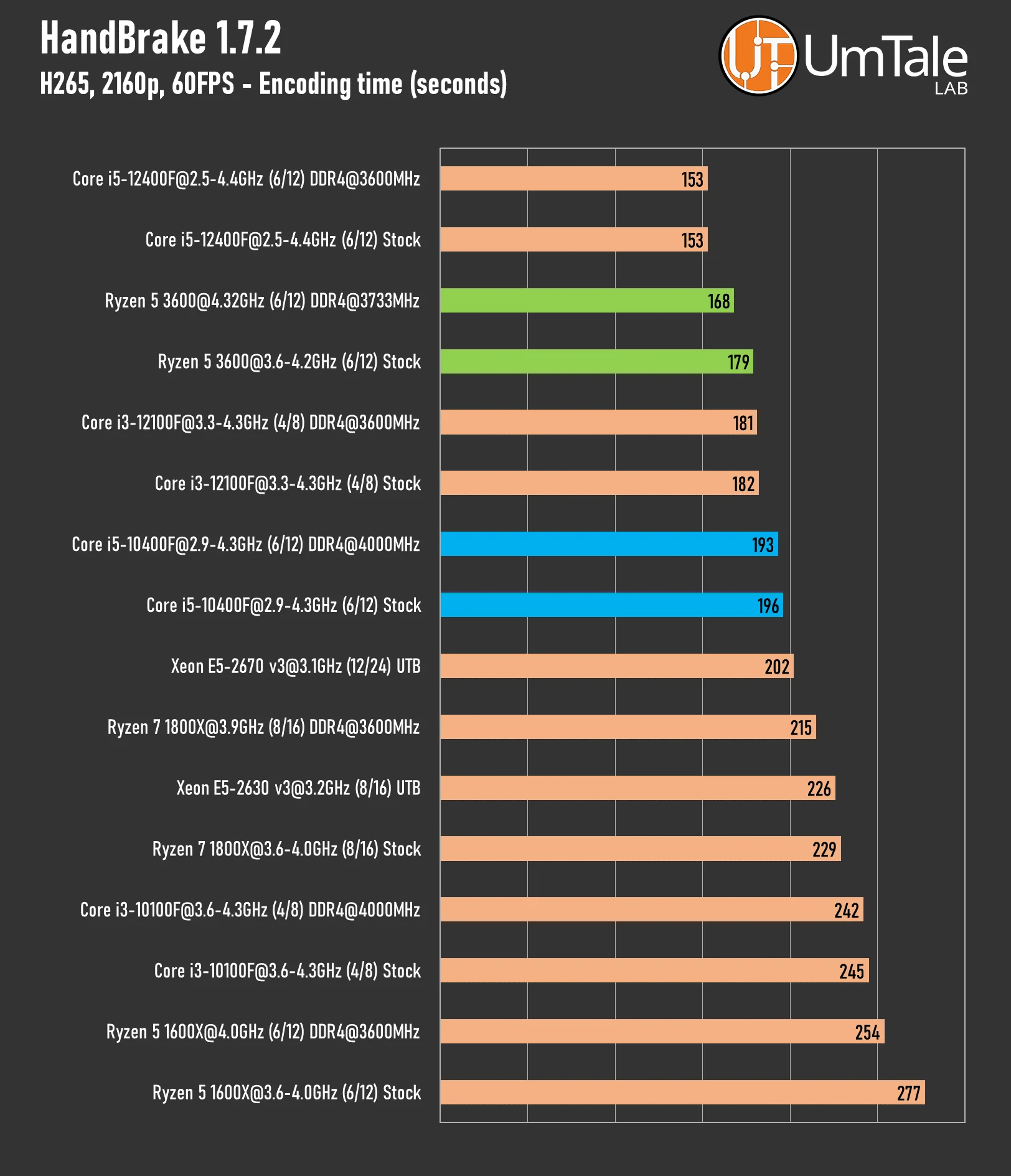
Codec: H265
 ⤢ ВІДКРИТИ
Switching to the H265 codec (4K, 60FPS) paints a slightly better picture for our main contender. The 10400F now trails the Ryzen 5 3600 by 9% at stock clocks, increasing to 13% once both are overclocked.
The 2670 v3 matchup doesn't end well for the 10400F here either. The 12-core chip delivers nearly identical results, making it a much more attractive option given its price.
Web Browsing
JetStream 2.1
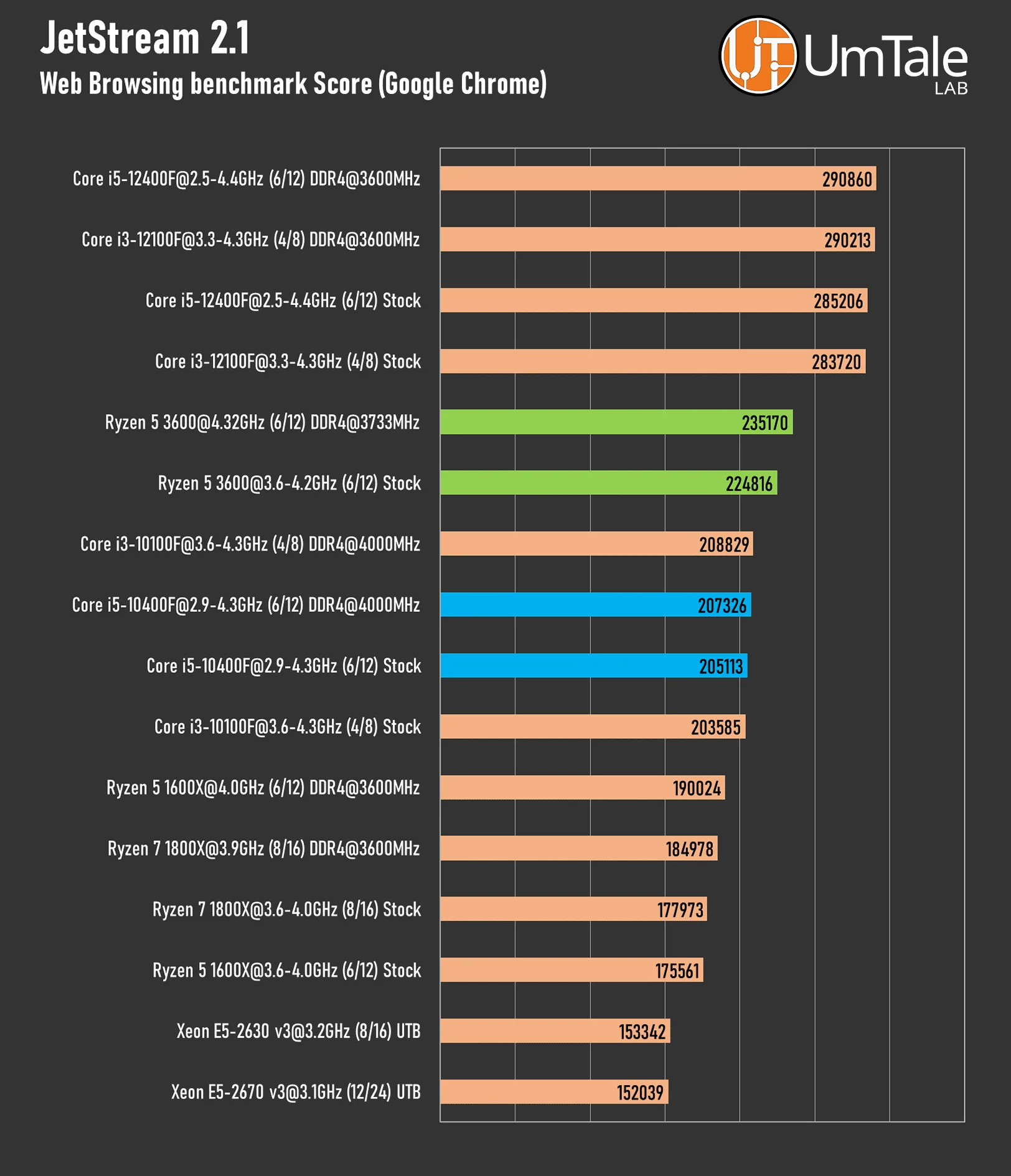
JetStream 2.1 is a suite of JavaScript and WebAssembly benchmarks designed for modern browsers and web applications. We've observed that most subtests within the benchmark can leverage up to four threads, which is typical for web browsing scenarios.
 ⤢ ВІДКРИТИ
Intel chips traditionally perform well in web browsing. At stock frequencies, the Core i5-10400F is only 9% slower than its direct competitor, which is quite respectable given its previous results. However, after both CPUs are overclocked, the Ryzen chip sees a more significant performance boost than Intel's 6-core, extending its lead to 13%.
The 2670 v3, on the other hand, can't deliver high per-core processing speeds, leading to results even lower than the 8-core E5-2630 v3. Competition with the 10400F is out of the question here. Unfortunately, the 12-core Haswell isn't a good choice if your work involves frequent browsing of various (especially heavy) websites.
Speedometer 2.1
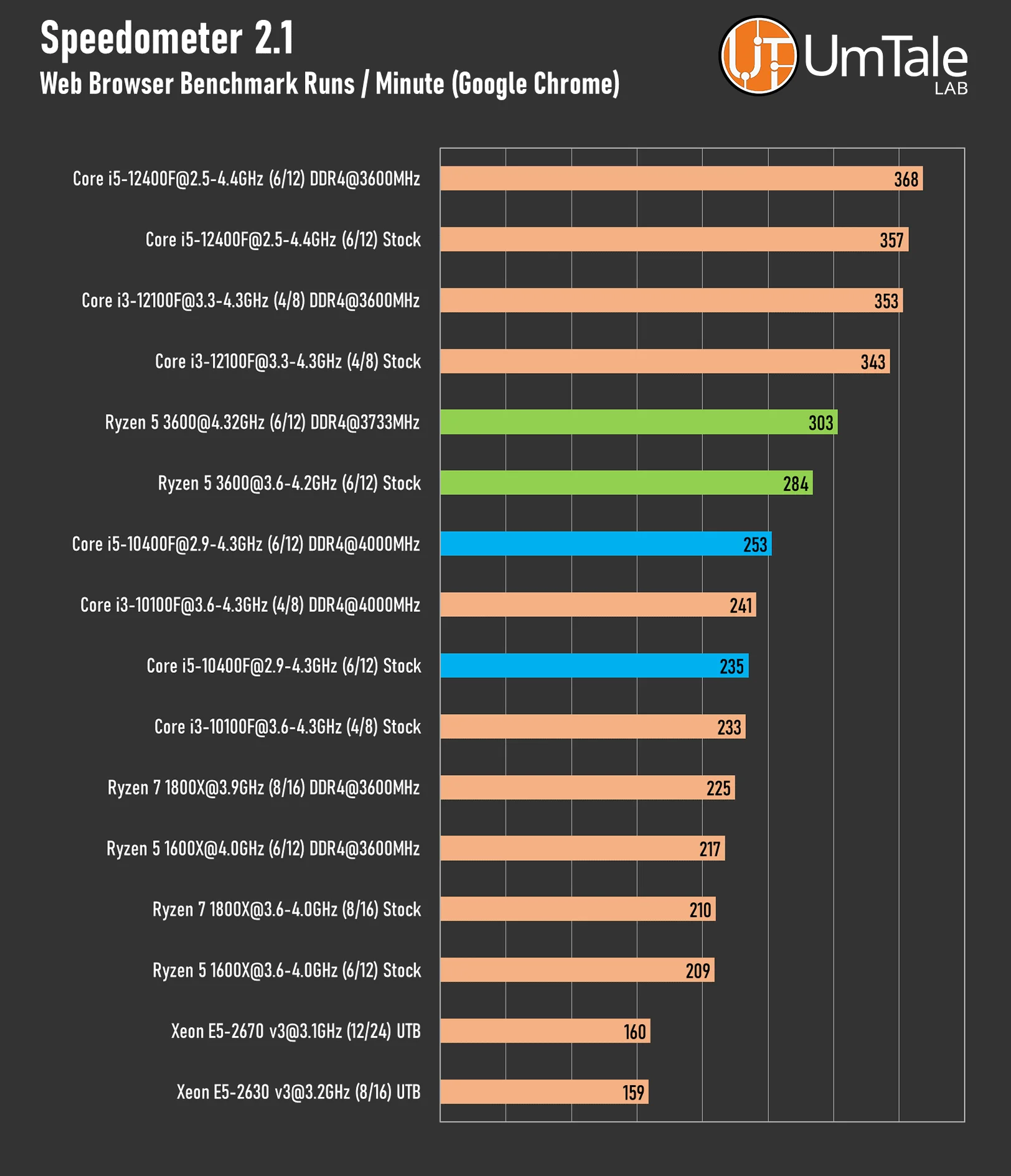
Speedometer tests the responsiveness of web applications within a browser. The benchmark simulates common user interactions like adding, completing, and deleting items in a to-do list, using various TodoMVC examples. Some of these directly call the DOM API from ECMAScript 5 (ES5), ECMAScript 2015 (ES6), ES6 transpiled to ES5, and Elm transpiled to ES5. Others leverage one of eleven popular JavaScript frameworks, including React, React with Redux, Ember.js, Backbone.js, AngularJS, (new) Angular, Vue.js, jQuery, Preact, Inferno, and Flight.
 ⤢ ВІДКРИТИ
Speedometer 2.1 isn't as kind to the Core i5-10400F. At stock speeds, the budget Comet Lake trails the Ryzen 5 3600 by about 20%. When both CPUs are overclocked, that gap narrows slightly to 19%.
Notably, RAM overclocking provided a significant 8% boost to the i5-10400F in Speedometer, a gain not seen in JetStream 2.1.
Similar to the previous benchmark, the low-frequency 12-core Haswell simply can't compete with the high-frequency 6-core i5-10400F.
Kraken 1.1
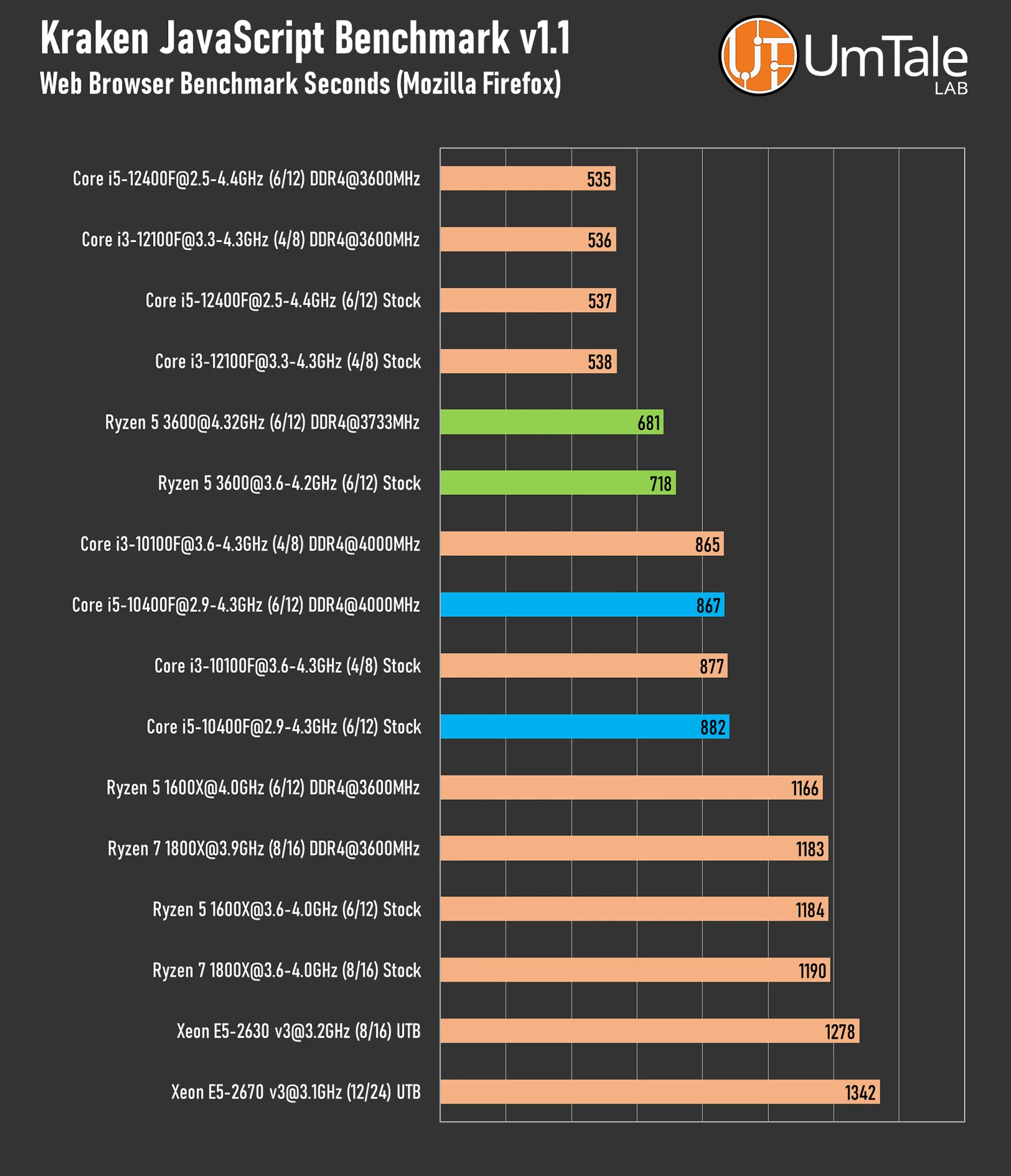
Kraken is a JavaScript performance benchmark developed by Mozilla. It measures execution speed across various real-world application and library test cases. Its subtests cover audio processing via the DSP.js library, image filtering, JSON parsing, and cryptographic operations.
 ⤢ ВІДКРИТИ
The Core i5-10400F's performance in Kraken 1.1 isn't particularly impressive either. At stock frequencies, it lags behind the Ryzen 5 3600 by 18%; this gap widens to 21% when overclocked.
The E5-2670 v3 shows rather weak results for the third time. Unlike multithreaded 3D rendering and video encoding, web browsing is clearly not the 12-core Haswell's strongest suit.
Gaming, synthetic benchmarks
3DMark Time Spy
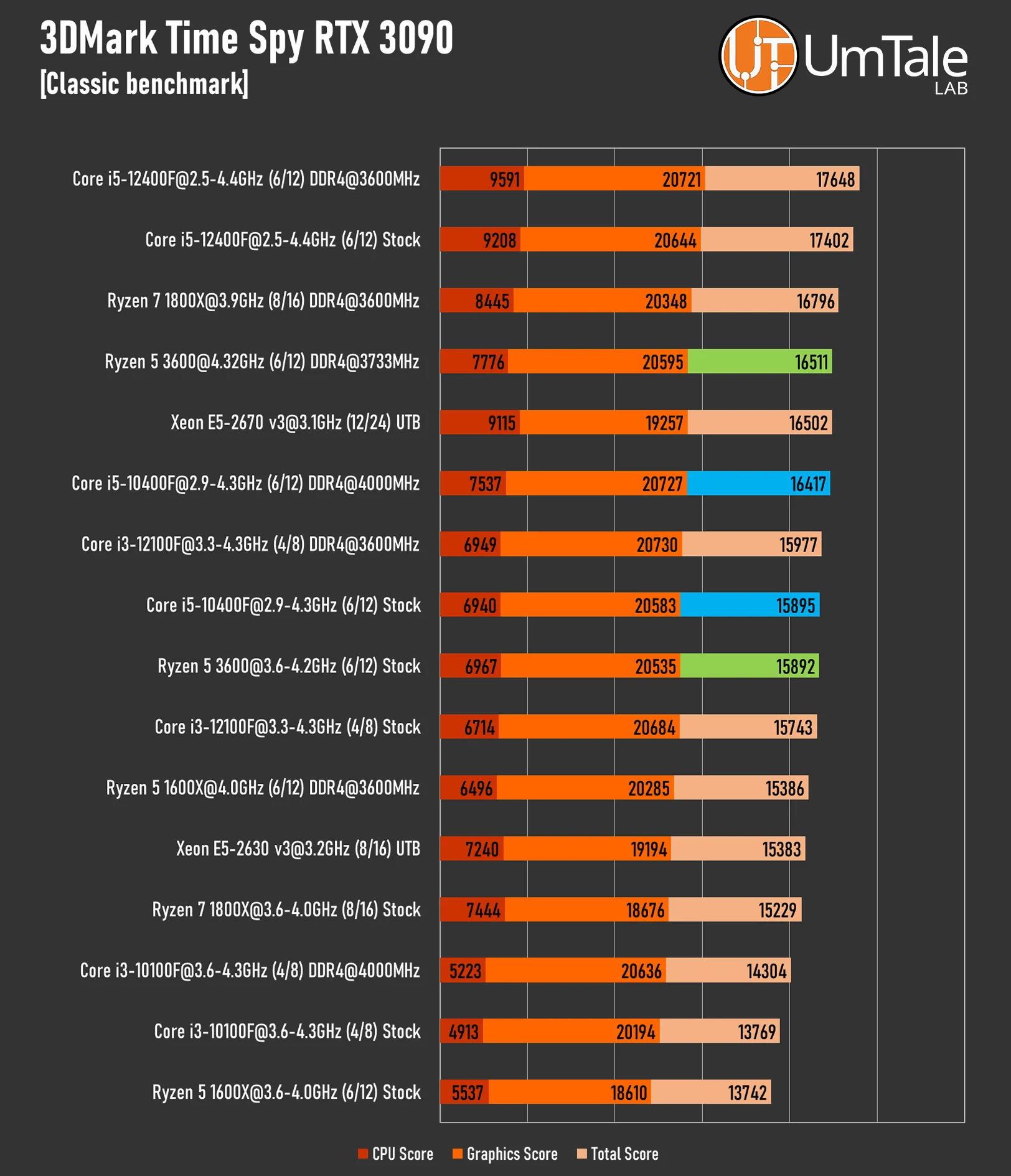
Time Spy is a DirectX 12 benchmark designed for gaming PCs running Windows 10/11. Its engine, built from the ground up, supports all new DirectX 12 API features, including asynchronous compute, AMD Crossfire, NVIDIA SLI, and multithreading.
 ⤢ ВІДКРИТИ
In this first gaming performance benchmark, the Core i5-10400F performs significantly better than it did in all previous software benchmarks. While the 6-core Comet Lake slightly lags behind the Ryzen 5 3600 in the CPU subtest, it actually pulls ahead in the graphics subtest, albeit by a small margin.
With the RAM overclocked to 4000 MHz, the 10400F's results in the graphics subtest are comparable to the 12400F's; however, this isn't particularly noteworthy. The RTX 3090 graphics card is the bottleneck here. Its performance is no longer sufficient for these CPUs to score above 20,700 points.
Looking at the E5-2670 v3's figures, it's clear even to the naked eye that the 12-core Haswell is quite strong in the CPU test. However, its performance suffers significantly in the GPU test due to its extremely low frequency.
Gaming
Assassin's Creed Valhalla
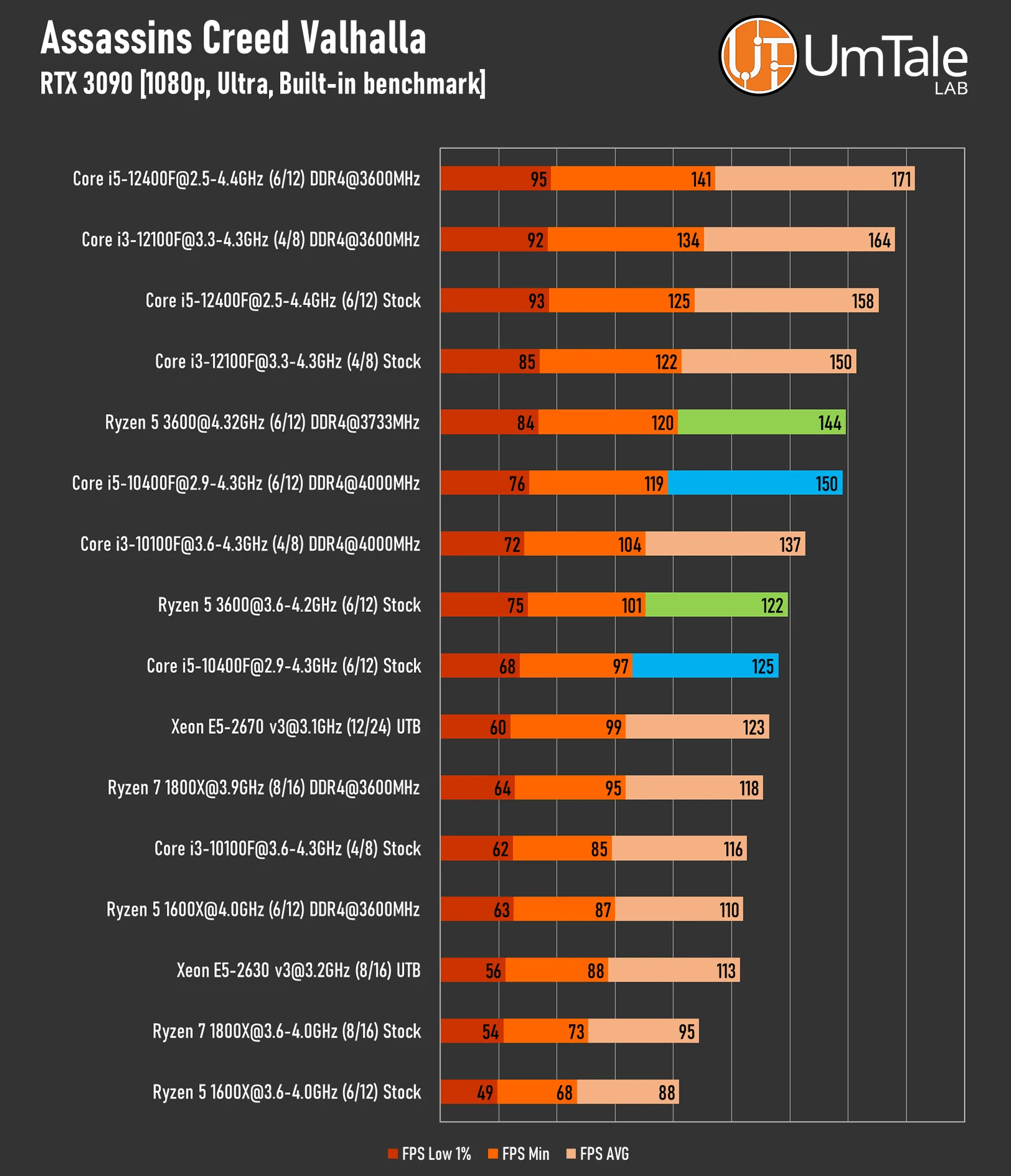
Assassin's Creed Valhalla is a significant installment in the Assassin's Creed franchise. Built on the Ubisoft Anvil engine, the game can fully utilize up to 12 threads, with partial utilization of 16-24 threads.
 ⤢ ВІДКРИТИ
In Assassin's Creed Valhalla, the first real-world gaming benchmark, the stock 10400F doesn't quite match the Ryzen 5 3600, which operates in a similar mode. However, we observed some highly interesting results: the Intel 6-core clearly shows a slightly higher average frame rate, while the AMD chip significantly outperforms it in minimum FPS and rare dips.
This trend continues even after overclocking both CPUs. The 10400F achieves a higher average FPS, but the R5 3600 maintains better minimum and 1% low FPS.
The E5-2670 v3's performance is very close to that of the stock i5-10400F, which is an excellent result.
Baldur's Gate 3
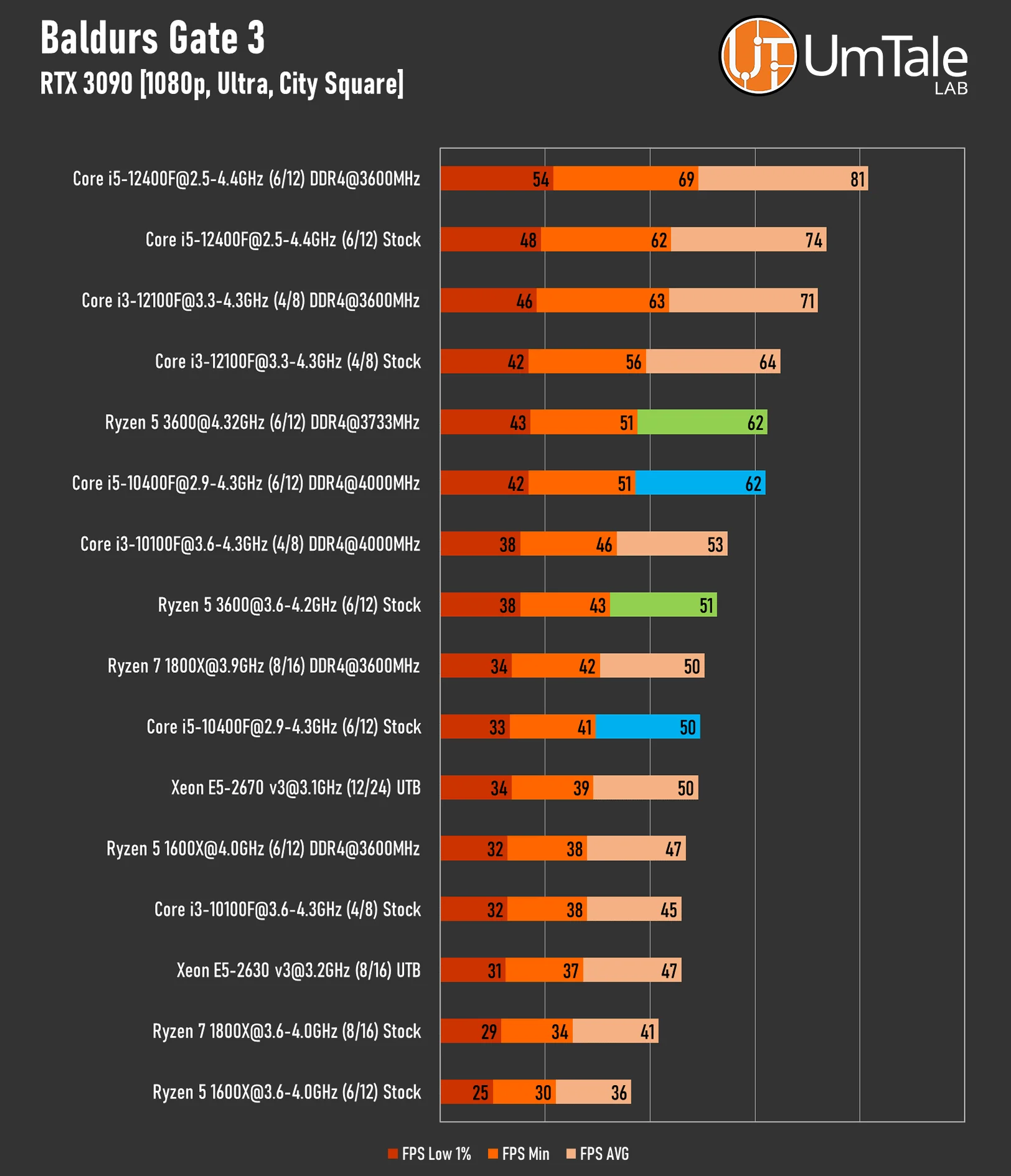
One of the best modern turn-based RPGs and last year's top game, Baldur's Gate 3 runs on the Divinity 4.0 Engine. This engine can utilize up to 16 threads, though it performs best with 12-thread CPUs. It's also worth noting that the game features extremely high detail, leading to frequent RAM access. Consequently, Baldur's Gate 3 benefits from a large L3 cache and high-frequency RAM.
Our test scene is set in the city of Baldur's Gate, which is the game's third act.
 ⤢ ВІДКРИТИ
The undisputed masterpiece, Baldur's Gate 3, performs better on the AMD processor at stock speeds, but after overclocking, the results for both CPUs are virtually identical. The Xeon E5-2670 v3 once again shows performance similar to the stock 10400F.
Cyberpunk 2077
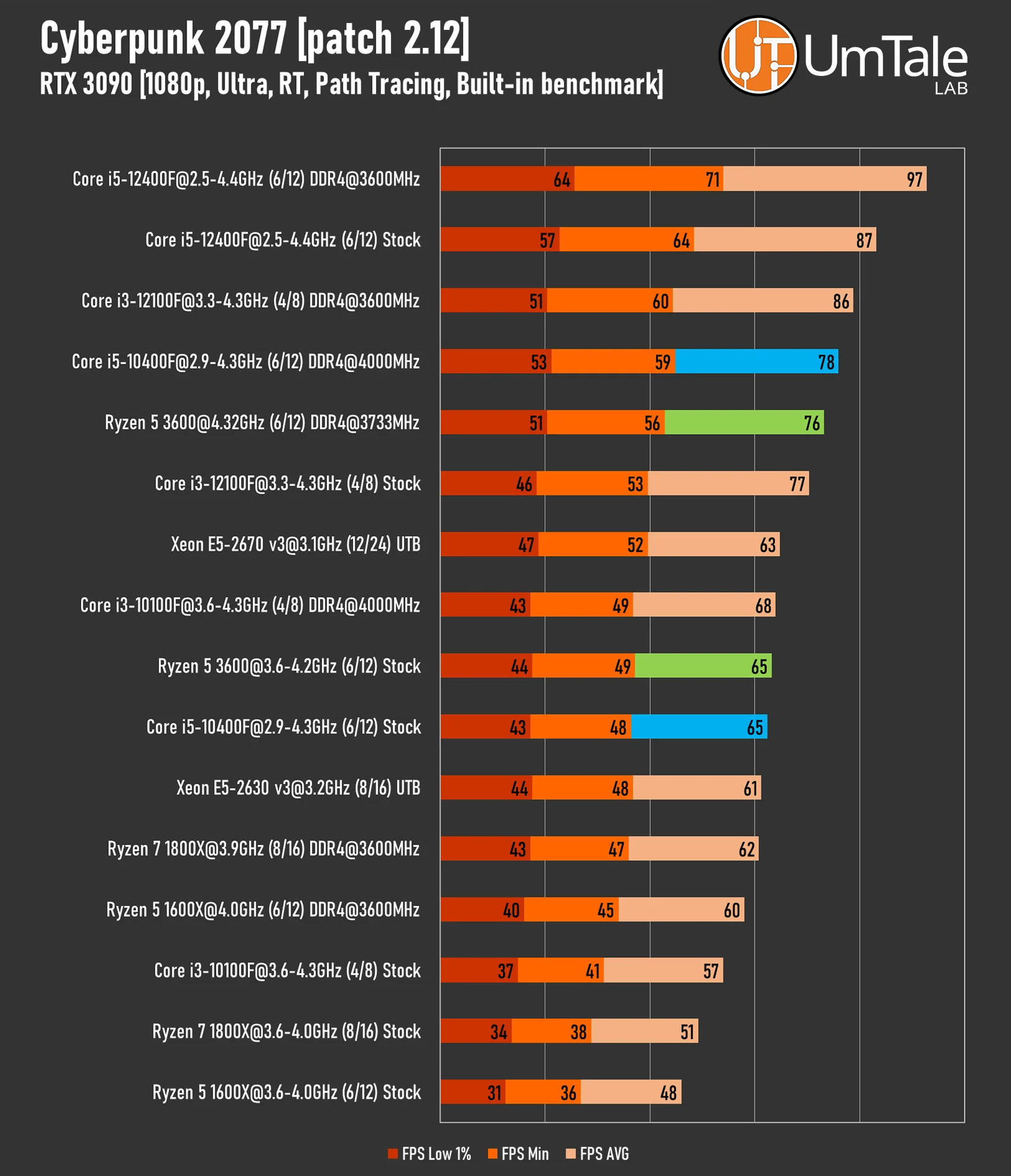
CD Projekt RED's latest creation, Cyberpunk 2077, is built on the REDengine 4 and can utilize over 16 CPU threads. The game also responds very positively to increased RAM frequency and reduced latencies.
Ray Tracing – ON, Path Tracing – ON
 ⤢ ВІДКРИТИ
With ray tracing and path tracing enabled, the stock Core i5-10400F's scores fall between the Xeon E5-2630 v3 and the Ryzen 5 3600. Overclocking the 6-core Comet Lake's RAM not only allows it to noticeably surpass its direct competitor for the first time (by 4% in rare events, 5% in minimum, and 2% in average FPS), but also to catch up to the boosted Core i3-12100F.
However, something else is interesting here. Thanks to the REDengine's decent optimization, the Xeon E5-2670 v3 shows a significant advantage over both the stock Core i5-10400F and Ryzen 5 3600 in terms of minimum FPS and rare event performance.
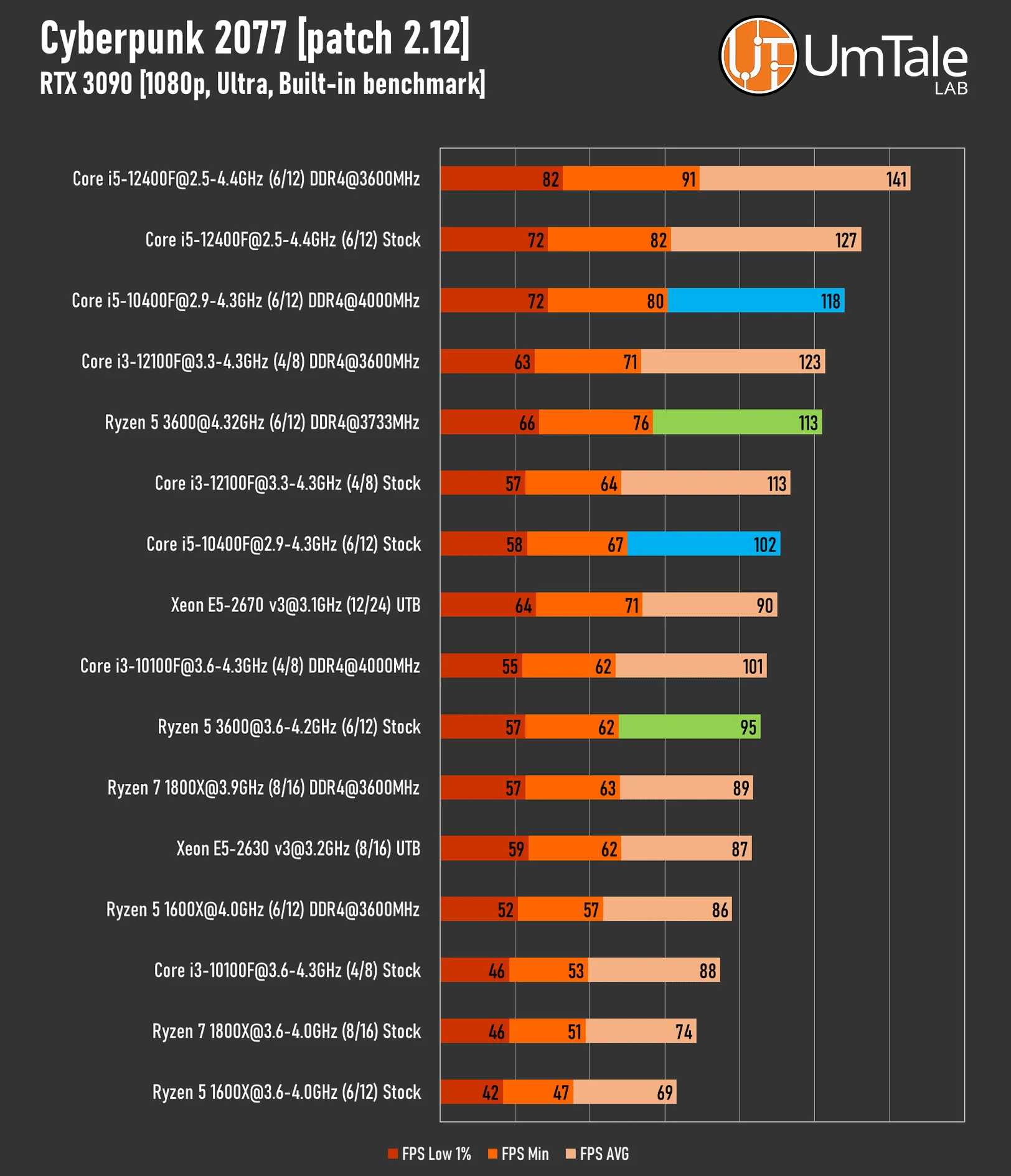
Ray Tracing – OFF, Path Tracing – OFF
 ⤢ ВІДКРИТИ
Without the notorious Ray Tracing and Path Tracing, the picture changes quite significantly. At stock frequencies, the Core i5-10400F now takes the lead. While its advantage over the Ryzen 5 3600 isn't large (2%, 7%, 7%), it is consistent.
After overclocking, the 6-core Comet Lake further solidifies its position, almost matching the performance of a stock Core i5-12400F. This puts it ahead of the overclocked R5 3600 by up to 9% in 1% lows, 5% in minimum, and 5% in average FPS.
However, the 12-core Haswell spoils the picture here again. While the E5-2670 v3 can't boast high average frame rates, its minimum FPS and 1% lows are simply impressive.
Far Cry 6
This project uses the Dunia Engine v2. Since Far Cry 2, this engine has been notorious for its poor multi-threaded CPU optimization. We've observed the game performing reasonably well with up to eight threads. Interestingly, some CPUs with over 10 cores and SMT/HT (simultaneous multi-threading/hyper-threading) can actually lose performance in this title. However, this isn't true for all existing CPUs.
Ray tracing – ON
 ⤢ ВІДКРИТИ
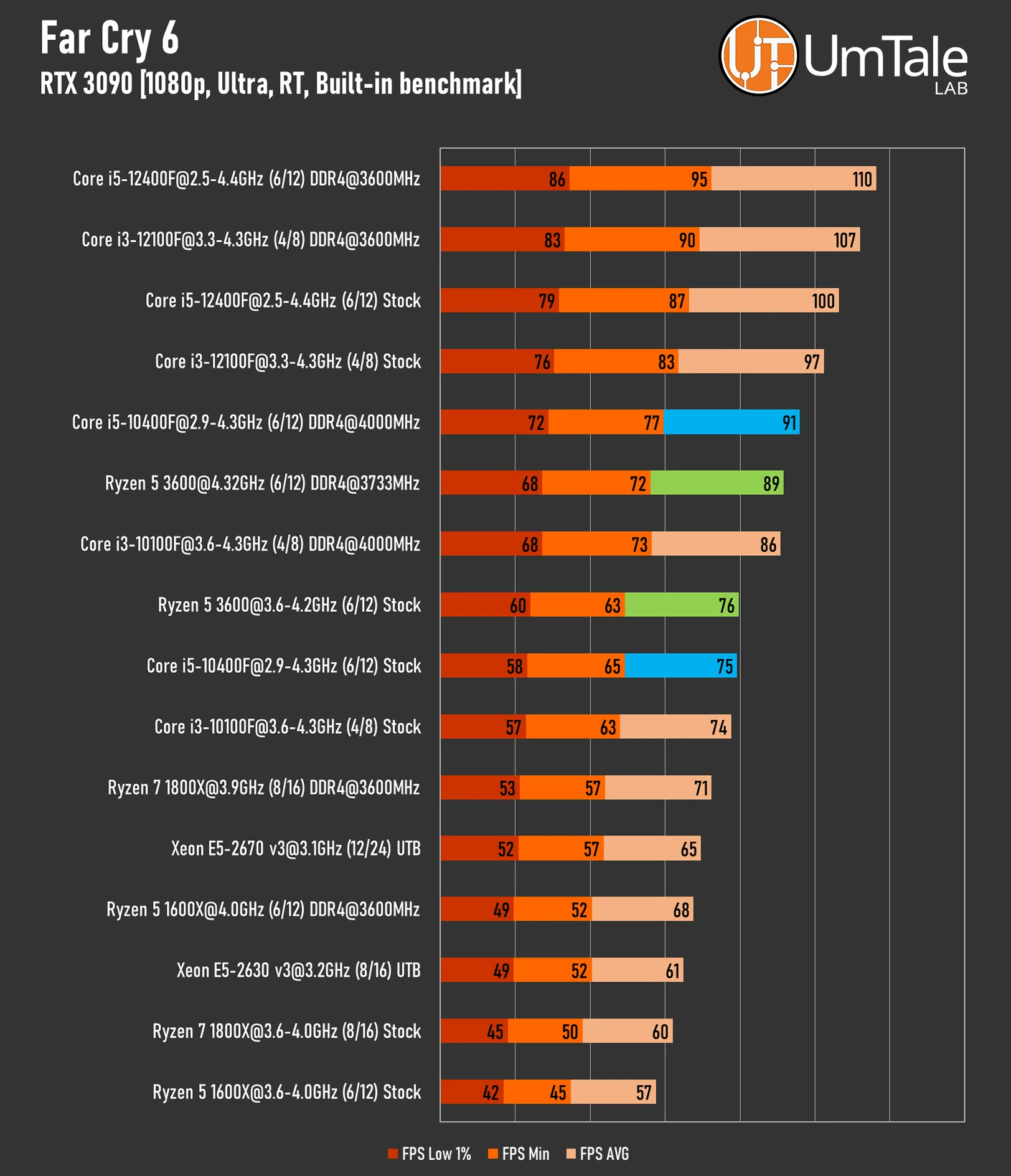
With ray tracing enabled in Far Cry 6, the 10400F and R5 3600 are practically identical at stock frequencies. Once overclocked, the Intel chip pulls ahead by 5%.
The E5-2670 v3 doesn't impress in this game; its performance lands between the overclocked Ryzen 5 1600X and 1800X. While not bad overall, it can't even match a stock i3-10100F.
Ray tracing – OFF
 ⤢ ВІДКРИТИ
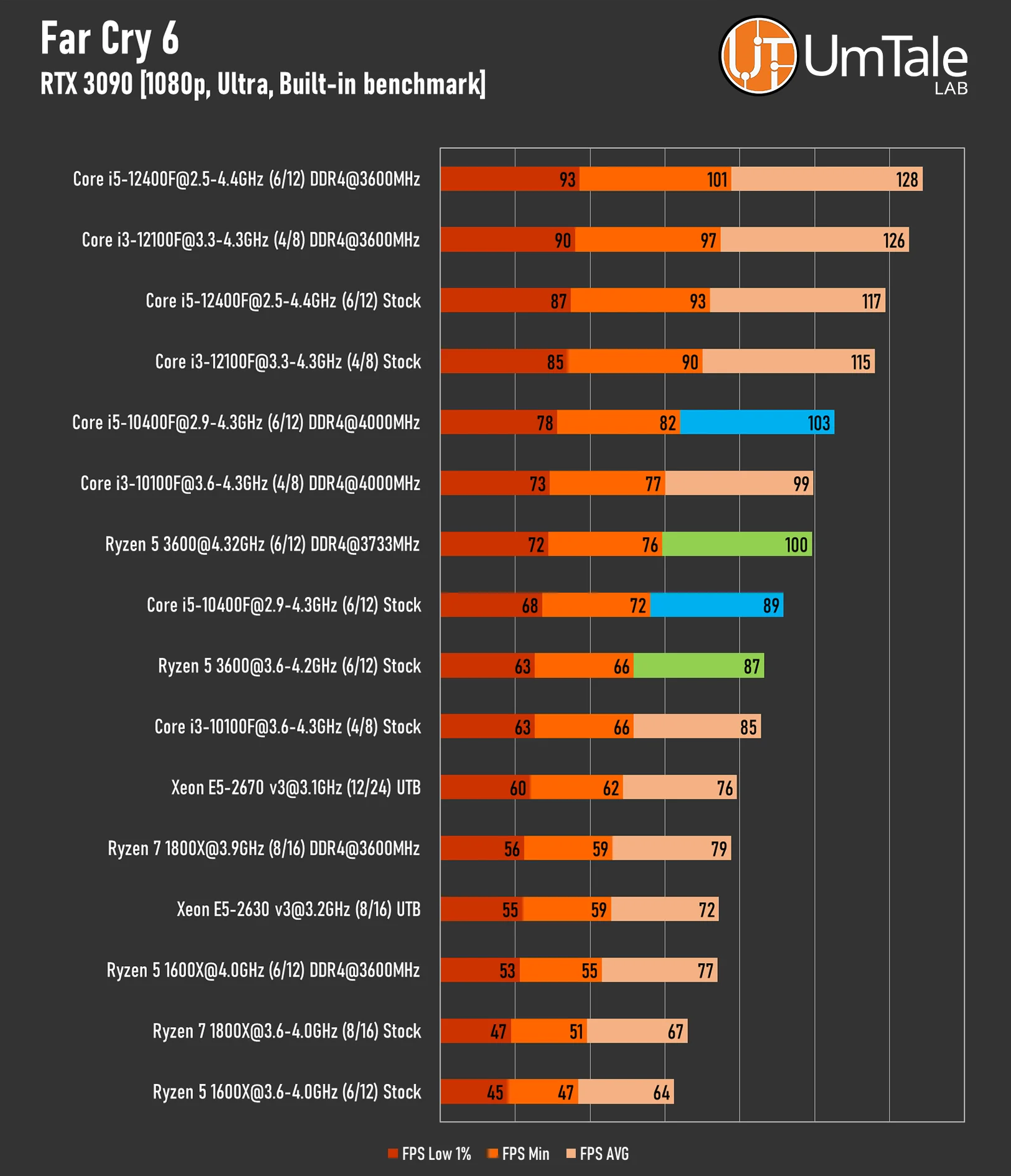
Without ray tracing, the i5-10400F is 8% faster than the R5 3600 even at stock frequencies, and it maintains that 8% lead after both CPUs are overclocked.
Disabling RT also benefited the E5-2670 v3; the 12-core Haswell surpassed the overclocked Ryzen 7 1800X in minimum frame rates and came very close to the stock i3-10100F.
Marvel’s Spider-Man Miles Morales
Marvel’s Spider-Man Miles Morales, a former PlayStation console exclusive, is a relatively decent PC port. Insomniac Games' proprietary engine generally utilizes multi-core CPUs effectively, but the stability of games built on it often suffers and leaves much to be desired.
Ray tracing – ON
 ⤢ ВІДКРИТИ
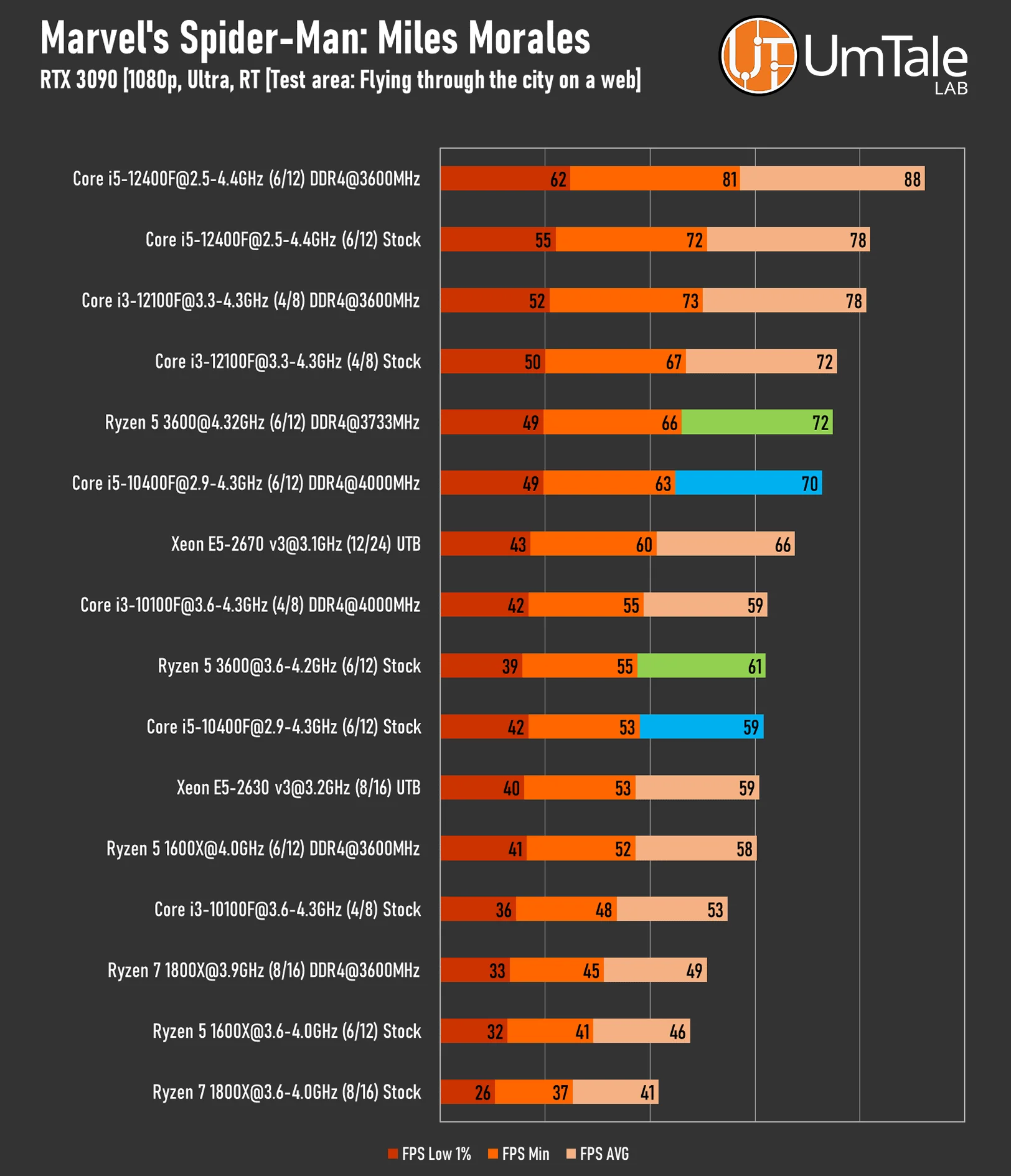
We've finally moved on to the current installment of Sony's Spider-Man franchise, and the initial results in this game were somewhat perplexing. Let's break it down.
First off, with ray tracing active, the stock Ryzen 5 3600 and Core i5-10400F generally show similar results. However, rare frame rate drops are more noticeable on the AMD chip, giving the 10400F a 7% advantage in 1% lows.
After overclocking both CPUs, the Ryzen 5 3600 takes the lead. However, as the charts show, the 1% lows for both processors are identical. This strongly suggests that memory latencies are extremely critical for Marvel’s Spider-Man Miles Morales, and current AMD chips exhibit significantly higher (worse) latencies than Intel.
The E5-2670 v3 significantly outperforms the stock Ryzen 5 3600 and Core i5-10400F, but falls short against their overclocked counterparts.
Additionally, we'd like to highlight the abysmal performance of the Ryzen 7 1800X, both at stock and overclocked frequencies. The 8-core chip's metrics are significantly worse than its 6-core sibling, the 1600X.
We can only speculate why this is the case. We spent hours trying to figure out what might have caused such results, attempting everything from swapping drives with different OS versions and drivers to changing motherboards—from an ASUS TUF B450-PRO GAMING to an ASUS PRIME B350-PLUS, and even an ASRock B450M-HDV. Yet, the results were consistent every time. If you know what might be going on, please let us know in the comments.
However, this scenario only occurs with ray tracing enabled. After disabling it, the Ryzen 7 1800X demonstrated adequate frame rates and outperformed the 1600X at stock and overclocked speeds, as it should. But more on that below.
Ray tracing – OFF
 ⤢ ВІДКРИТИ
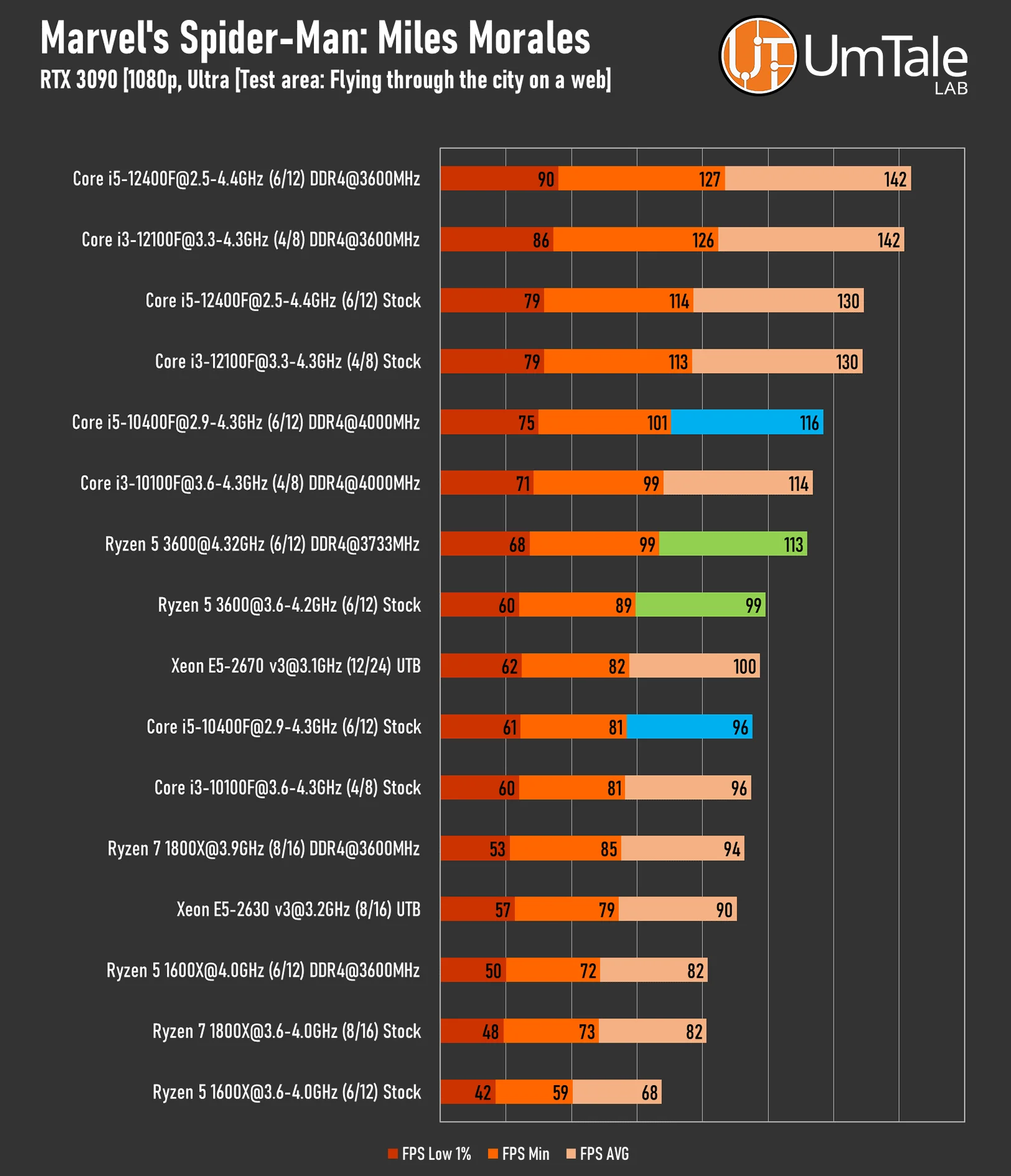
Without ray tracing, the Ryzen 5 3600 performs slightly better at stock speeds, while the Core i5-10400F pulls ahead when overclocked. The E5-2670 v3, in turn, sits between the stock 6-core Intel and AMD processors.
As for the 1800X, its performance with RT disabled returned to a logical pattern. The 8-core chip now surpasses its younger 6-core sibling, both at stock and after overclocking.
Starfield
Starfield is the much-hyped new game from revered guru Todd Howard. It's built on a modified version of the Creation Engine 2, previously seen in Fallout 4. The key word here is 'modified,' and Bethesda didn't lie in its statements. While the current Creation Engine certainly has its flaws—like terrible storage performance and poor optimization for modern graphics cards—the developers have made serious strides in optimizing its code for multi-threaded processors.
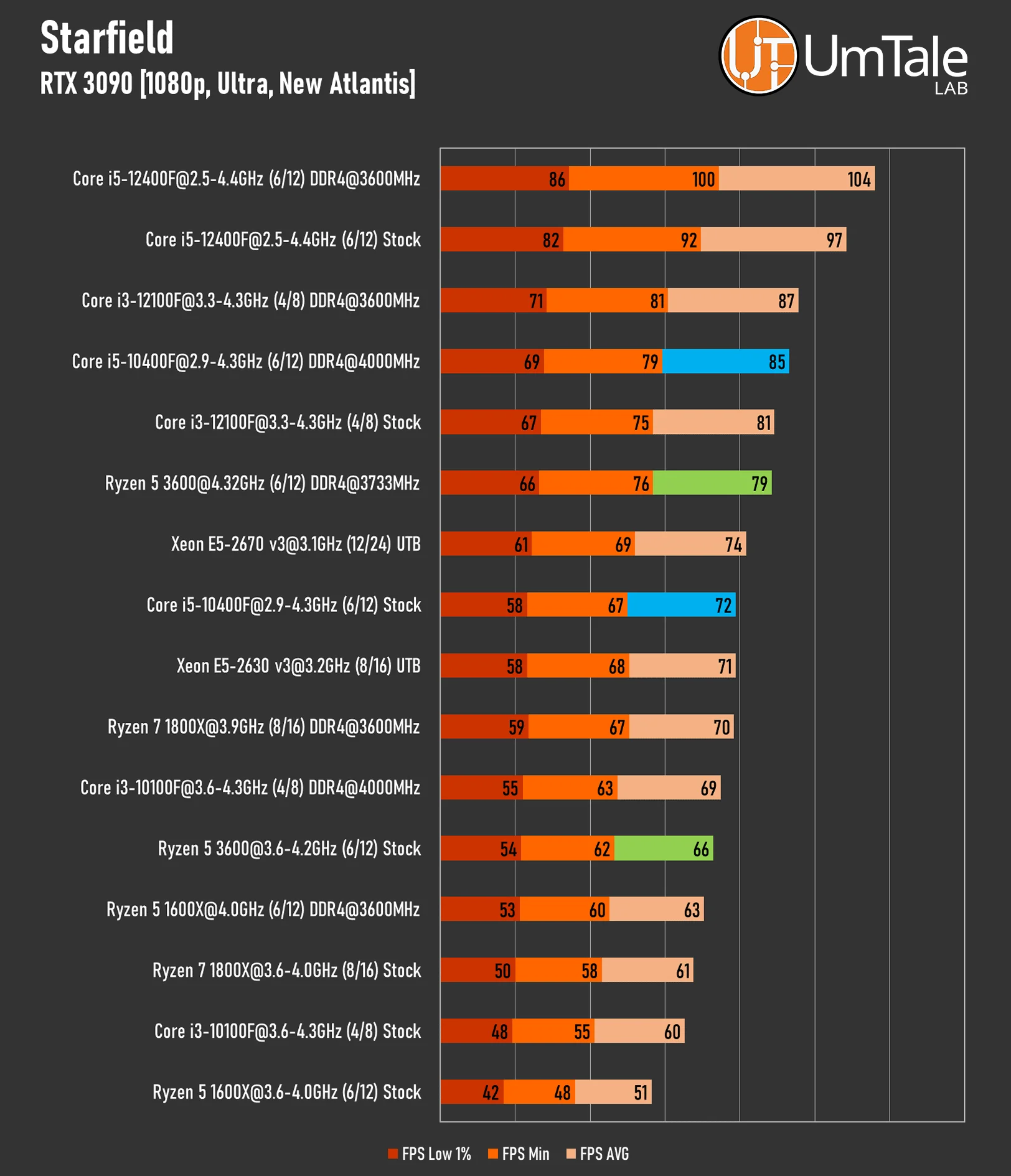
Our test scene is set in the heart of New Atlantis (or Nova Atlantis, if you prefer). We measure FPS along the stretch from the landing pad to the central plaza.
 ⤢ ВІДКРИТИ
Just look at these results! Frankly, we never thought we'd say this, but Bethesda's game is incredibly well-optimized for multi-core CPUs. Let's dive deeper into this.
For the first time ever, the stock Ryzen 5 3600 fell behind an overclocked 8-core Ryzen 7 1800X. Overall, the top-tier Zen 1 chip feels right at home in Starfield, delivering performance on par with a stock Core i5-10400F and Xeon E5-2630 v3.
While an overclocked R5 3600 does manage to pull ahead of the 1800X, it still can't quite catch the 10400F with tuned memory. The 6-core Comet Lake, paired with 4GHz RAM, even surpasses the stock Core i3-12100F and can match results from its 3600 MHz DDR4 counterpart.
Like the 1800X, the E5-2670 v3 holds its own surprisingly well. This 12-core chip comfortably outperforms the base R5 3600 and 10400F, showcasing excellent performance—especially given its price, low clock speed, and aging architecture.
Beyond just core/thread count, our observations indicate that Starfield's frame rate heavily relies on both memory controller quality and RAM frequency. Even a Core i3-10100F sees a significant boost when overclocking DDR4 to 4GHz.
The Witcher 3 next-gen update 4.04
The updated version of The Witcher 3 moved to an improved REDengine 3 with Ray Tracing support. However, the project wasn't quite ready for such complex changes, resulting in a game that's now significantly more demanding than even Cyberpunk 2077.
The Next-Gen Update is extremely CPU-bound, but it struggles to effectively utilize powerful CPUs with eight or more cores. The Witcher 3 runs most efficiently on 6-core, 12-thread CPUs. Furthermore, REDengine 3 responds quite favorably to high-frequency RAM.
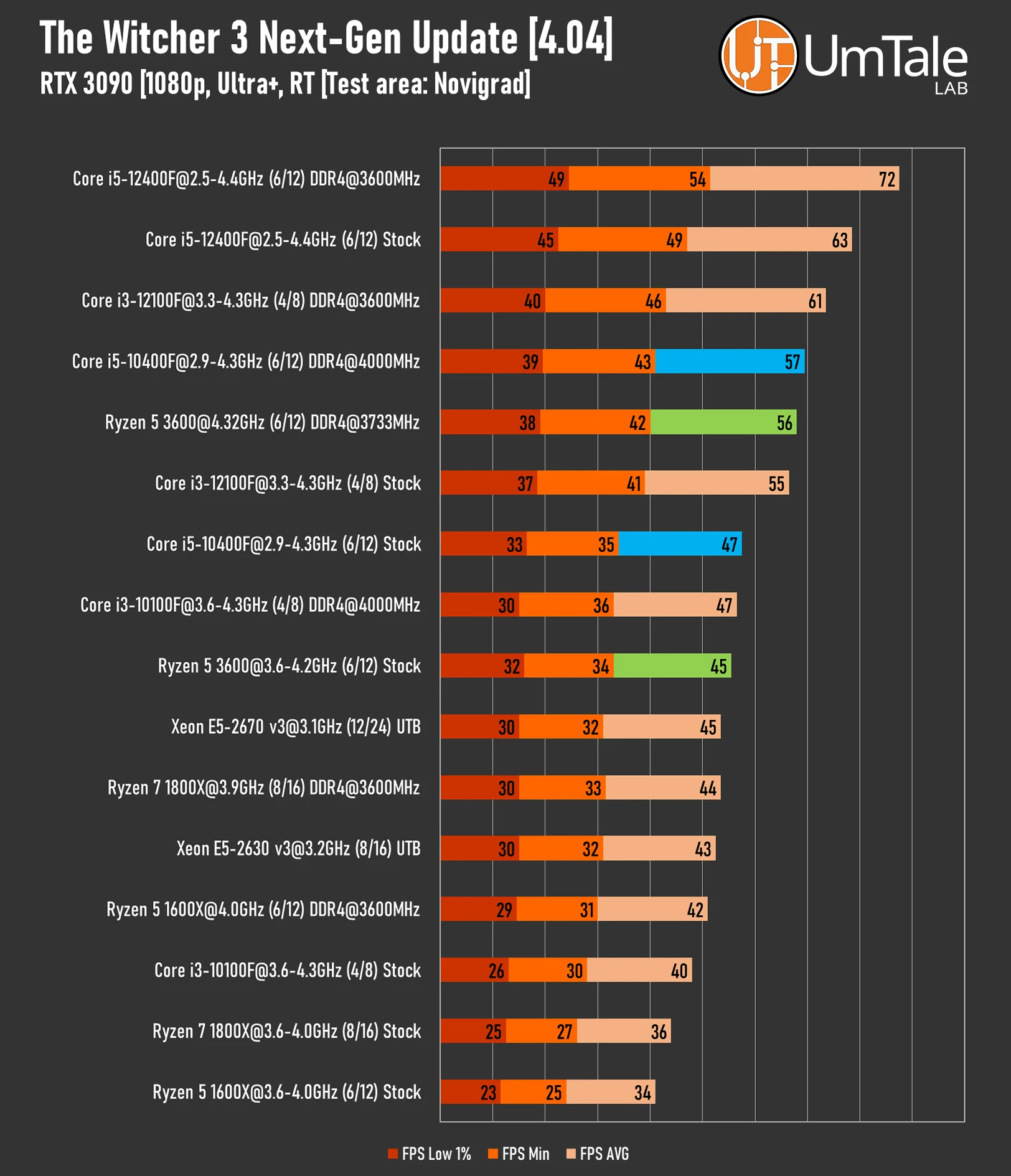
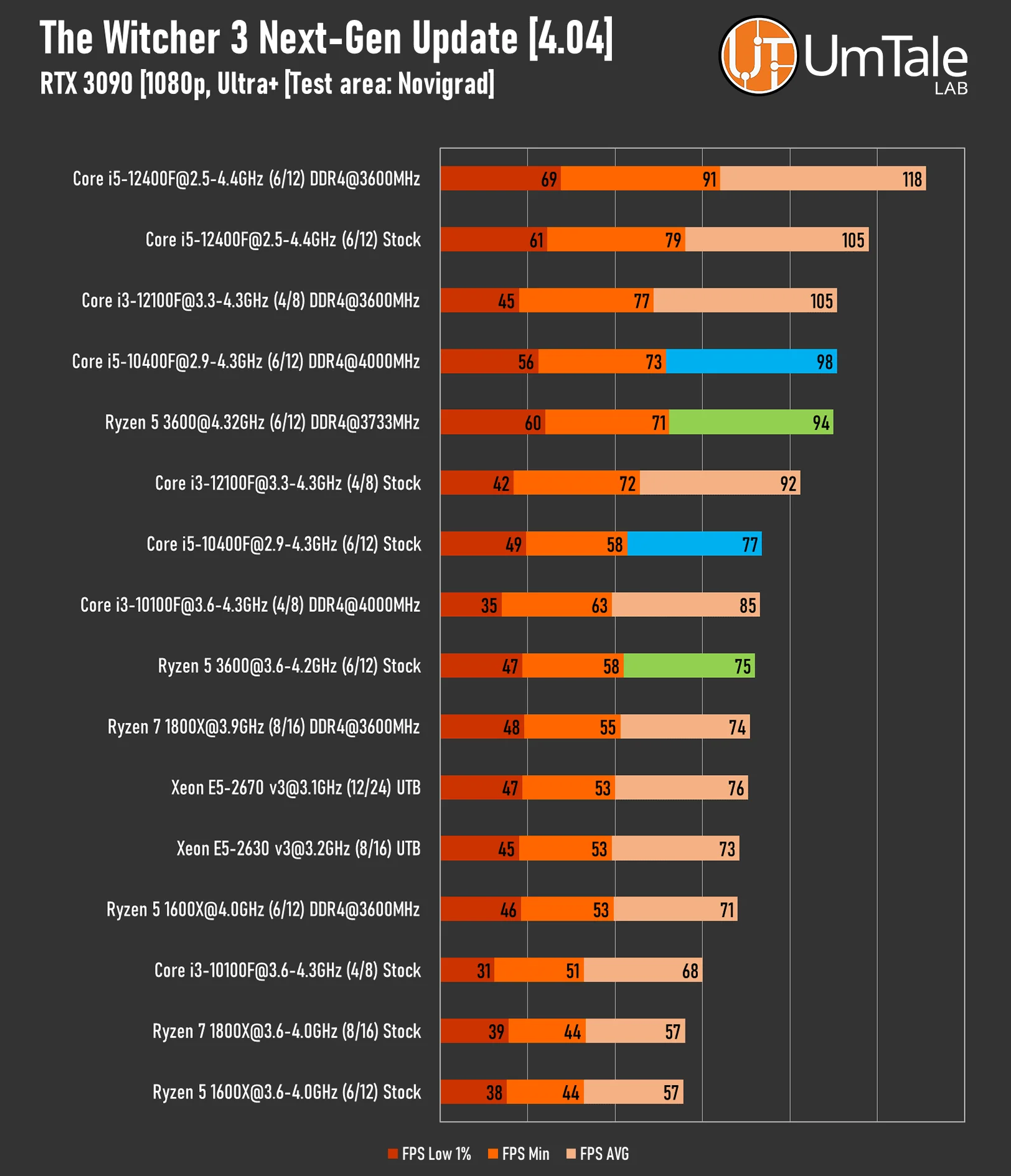
Our test scene is located in the city of Novigrad. We measure FPS along the path from the city entrance to the central plaza.
Ray tracing – on
 ⤢ ВІДКРИТИ
With ray tracing enabled, the Core i5-10400F performs better, both at stock frequencies and when overclocked. However, the difference between the CPUs is quite minor: a 4% lead at stock, narrowing to 2% after overclocking, favoring the Intel chip.
It's worth noting that only after overclocking do the 10400F and R5 3600 deliver a relatively comfortable frame rate.
The 2670 v3 trails both CPUs by about 6% and delivers a low level of performance that, unfortunately, can't be improved.
Ray tracing – off
 ⤢ ВІДКРИТИ
Without ray tracing, both CPUs manage the game well, even at stock speeds. The Core i5-10400F again holds a slight lead. However, after overclocking, the situation changes significantly. While the 6-core Comet Lake still leads in average and minimum FPS, the percentage of rare (low) frame times on Zen 2 turns out to be lower.
What's more, in the classic DX12 renderer, 4-core CPUs perform exceptionally poorly with the updated Witcher. Their FPS is unstable and frequently drops below that of their 6-core architectural counterparts.
The E5-2670 v3 slightly improved its standing, essentially matching the stock 10400F and R5 3600.
Watch Dogs Legion
The third installment in the Watch Dogs franchise is likely built on an improved Disrupt 2 engine. Ever since the first game, titles in this series have performed quite well with multi-core CPUs, and Legion is no exception.
The game can easily utilize over 20 threads and responds positively to high-frequency memory.
Ray tracing – on
 ⤢ ВІДКРИТИ
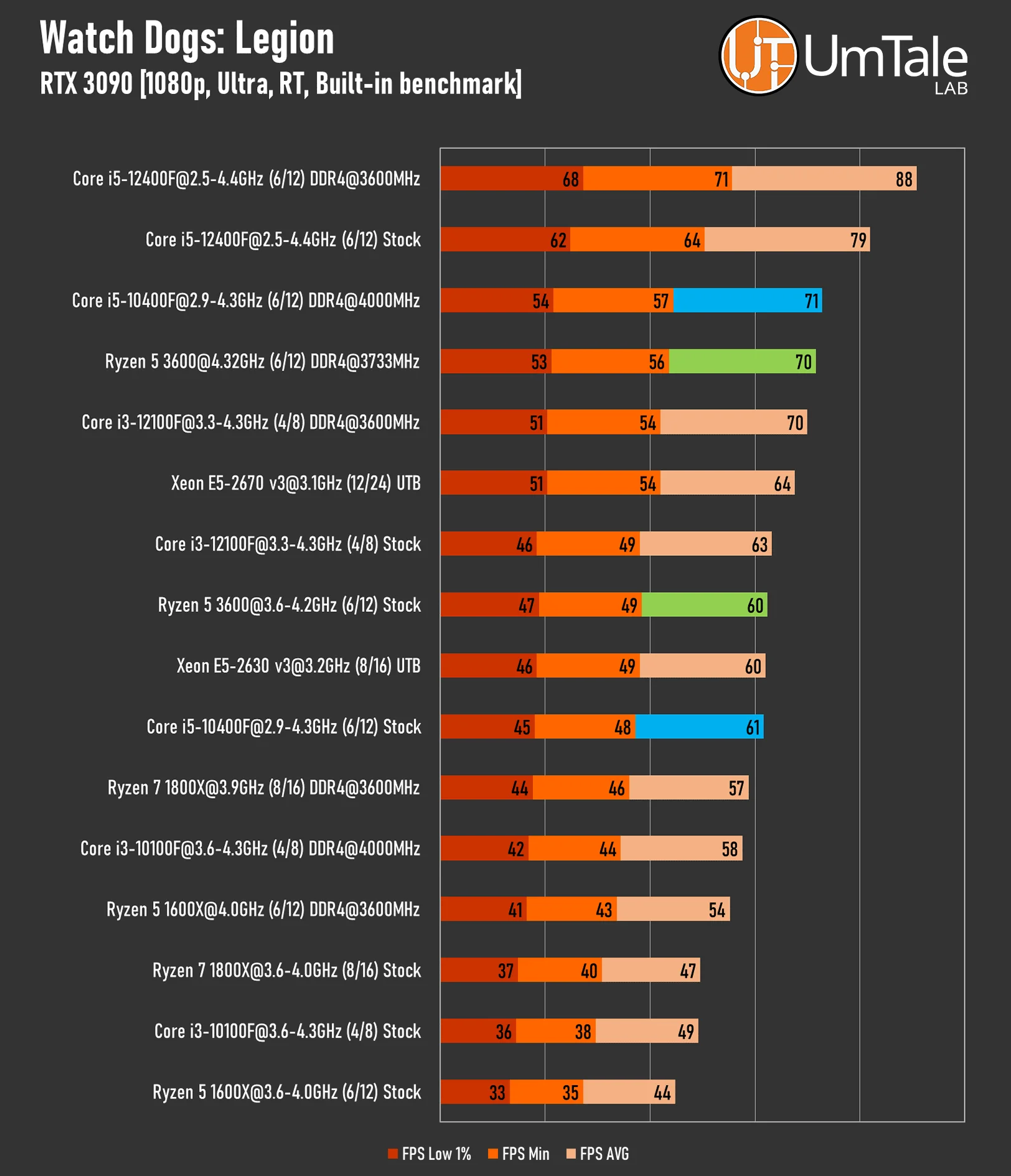
With RT enabled at stock, the 10400F lags slightly behind the Ryzen 5 3600 in minimum FPS (around 4%). However, once overclocked, it actually pulls ahead, albeit by a similarly modest margin of about 2%.
The 2670 v3 significantly outperforms the stock 10400F and R5 3600 by 13% and 8%, respectively. However, once those CPUs are overclocked, the 12-core Haswell can no longer keep pace. Still, the 2670 v3 provides more than enough performance for a comfortable Watch Dogs: Legion experience with ray tracing enabled.
Ray tracing – off
 ⤢ ВІДКРИТИ
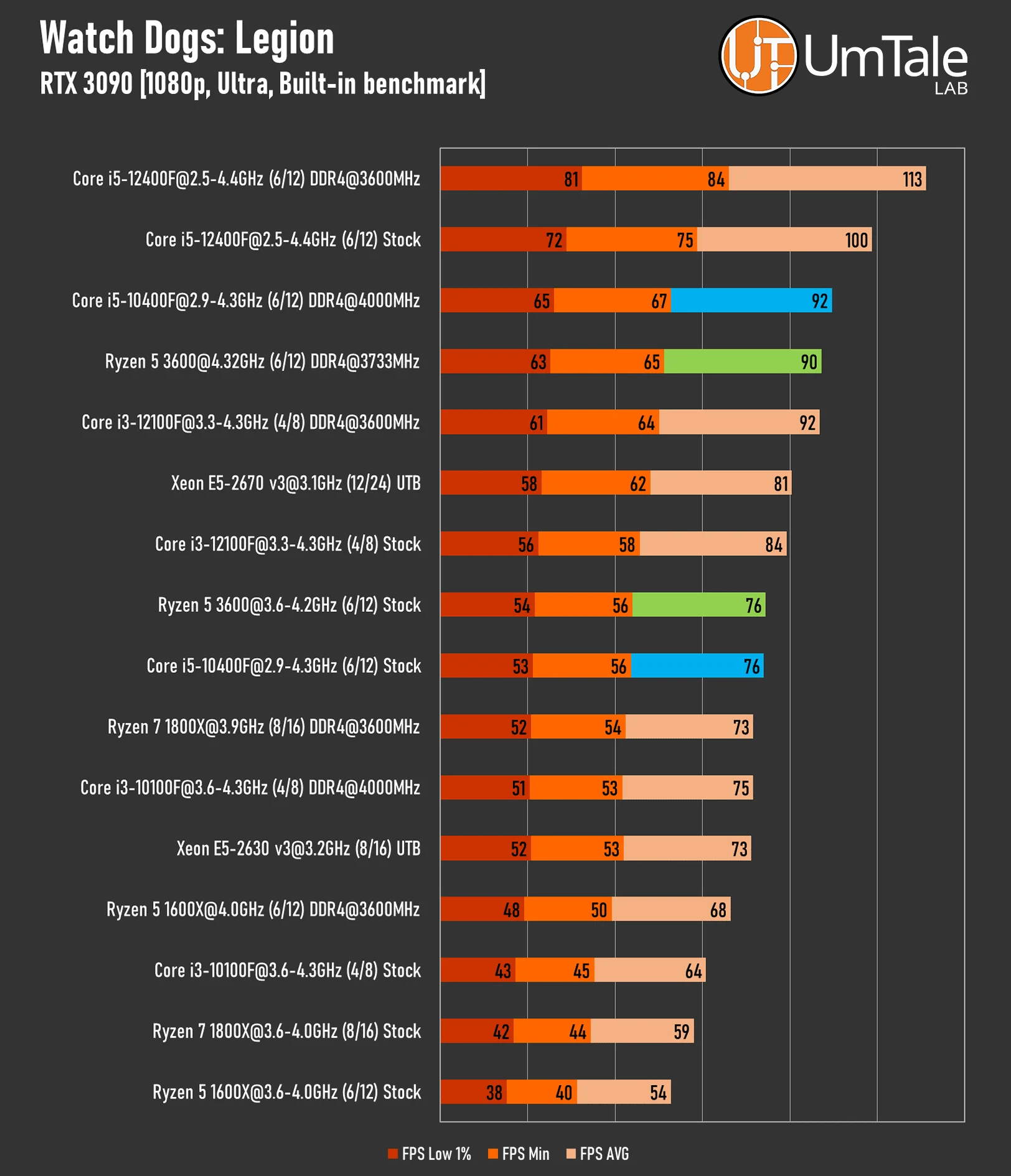
With ray tracing disabled, both stock CPUs deliver virtually identical performance. After overclocking, the 10400F nudges slightly ahead of its opponent.
The 12-core Haswell once again noticeably outperforms the stock 10400F and Ryzen 5 3600, though it falls short of their overclocked versions.
RPCS3, Red Dead Redemption
RPCS3 is the most popular PlayStation 3 emulator available. While the software excels at parallelizing shader compilation across a vast number of threads, its workload distribution significantly degrades during actual game emulation. Performance definitely varies by game, but we've found that modern 6-8 core CPUs with high clock speeds typically deliver the best results.
You can also gain a noticeable performance boost from instruction sets like AVX-512 and TSX. However, TSX can sometimes lead to instability in certain projects.
Recommended emulator settings for Red Dead Redemption are: SPU block size – Mega, ZCULL accuracy – Relaxed, Write color buffers – On, Sleep timers accuracy – As Host, RSX FIFO accuracy – Atomic, and 1080p resolution.
 ⤢ ВІДКРИТИ
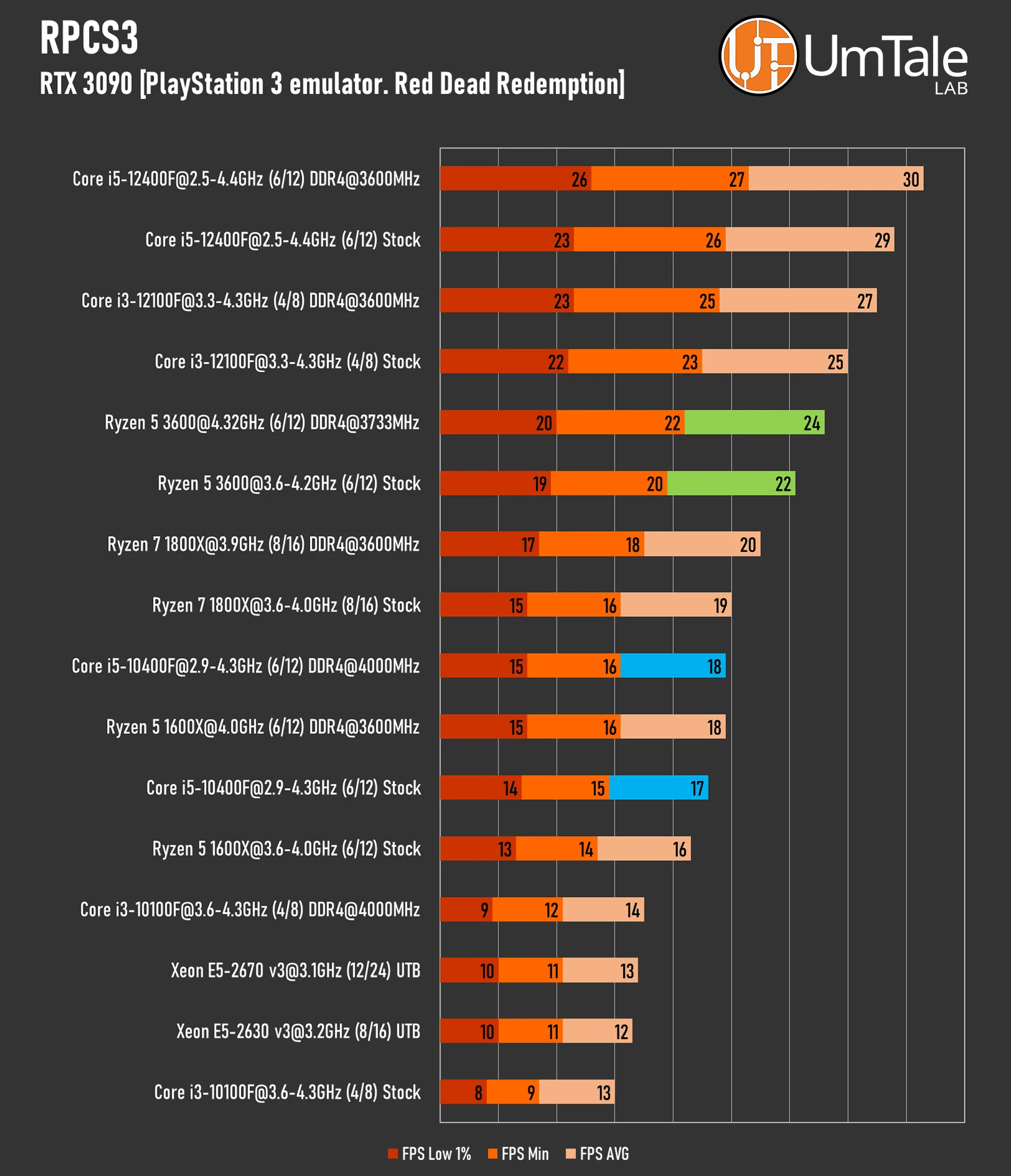
While the Core i5-10400F chip performs quite well in traditional gaming, it's rather mediocre when it comes to PlayStation 3 emulation. Here, a stock 6-core Zen 2 CPU outperforms the 10400F by 30%, and that lead grows to 33% once both CPUs are overclocked.
The 2670 v3 simply can't compete with modern 6-core processors. Its performance is only comparable to a 4-core, high-frequency Core i3-10100F.
Conclusion
Is the Intel Core i5-10400F still relevant in 2024? Absolutely, if you bought it a couple of years ago and use it in an average home PC; it still checks all the boxes. However, in today's market, buying this CPU and building a new system around it makes virtually no sense.
The Core i5-10400F is significantly more expensive than its direct competitor, the Ryzen 5 3600. Furthermore, building a system around the Intel chip will cost you a lot more than an equivalent AMD build, largely due to the relatively high prices of B560 chipset motherboards. Plus, B560 boards are now scarce, unlike the abundant B450-B550 options.
For an entry-level budget workstation, the Core i5-10400F's standing is disastrously weak. Consider this: it fell behind the R5 3600 in all software tests, and even more tellingly, the 6-core Comet Lake lost to the aging 12-core Xeon E5-2670 v3 in most benchmarks.
The only area where the 10400F still holds a relatively strong position is gaming. In most titles, it either slightly edged out the Ryzen 5 3600 at both stock and overclocked speeds, or delivered comparable performance. However, given its weak performance in software tests and the cost of the 10400F itself, not to mention its LGA 1200 platform, this advantage ultimately means little.
We wouldn't recommend buying the Core i5-10400F in 2024. If AMD products aren't appealing for some reason, consider the 4-core Core i3-12100F instead. This chip typically costs about the same as the 10400F but often outperforms it in both software and gaming benchmarks. Additionally, its LGA 1700 platform is still current and offers a future upgrade path, potentially supporting up to a Core i9-14900KS.
If you're on a tight budget and aren't concerned with brand loyalties, the Ryzen 5 3600 remains an excellent choice.