BLOGS · OVERCLOCKING
PUBLISHED
READING9 min
Retro overclocking: Overclocking the AMD Athlon II X3 450 (C3) processor on the AM2+ platform
This article details overclocking the AMD Athlon II X3 450 (C3) on AM2+, showing how this "unlucky" chip still managed a stable 4015 MHz.
As I promised in the blog post about overclocking the AMD Athlon 64 X2 4800+ chip, a whole series of retro CPU overclocking articles for the AM2+ platform awaits you. My package with a handful of "silicon" finally arrived, so I'm ready to dive into the next CPU overclocking adventure. This article will focus on the Athlon II X3 450, a triple-core processor that wasn't particularly popular in its generation. Why wasn't it popular? The answer is simple: at launch, this chip offered an extremely poor price-to-performance ratio, making it an unappealing purchase compared to the existing Athlon II X3 425 and 435 models. Nevertheless, even this less-than-successful CPU sold reasonably well, so I think you'll be interested to see what we can achieve by trying to overclock the Athlon II X3 450.
Just a reminder: this isn't a comprehensive benchmark review. I've included just a couple of tests to visually demonstrate the performance gains from overclocking. If you'd like to see this processor tested in games, let me know in the comments.
The processor
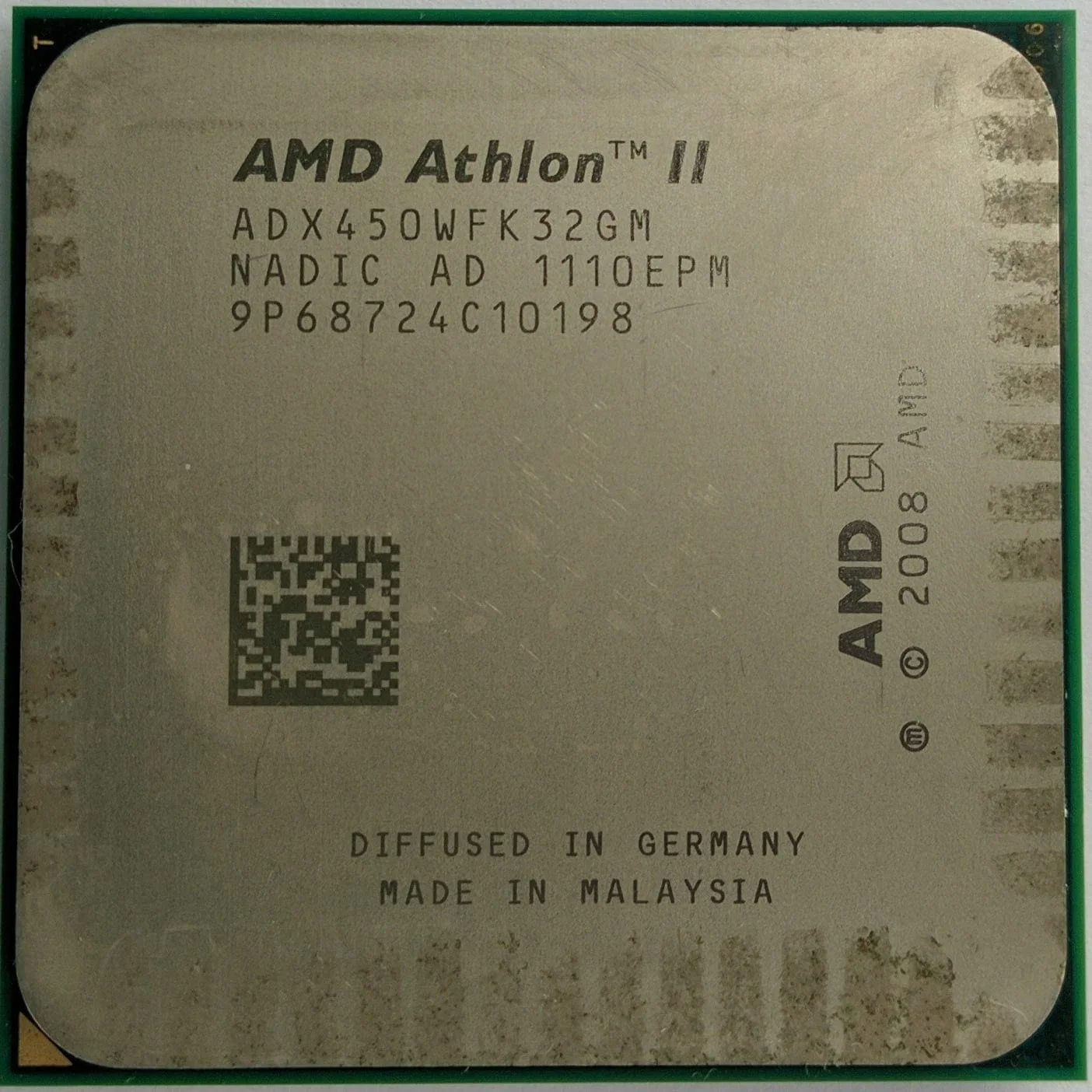
Our test sample's marking is ADX450WFK32GM NADIC. The "NADIC" part tells us it's an Athlon series processor. In other words, there's no physical L3 cache under the integrated heat spreader (IHS), so you won't be able to enable it even on a motherboard with ACC (Advanced Clock Calibration) functionality. However, the GM at the end of the first line (ADX450WFK32GM) indicates the owner is incredibly lucky, as this is the newest and most successful chip revision: C3.
The CPU was manufactured in the 11th week of 2010 (March), suggesting this particular sample is relatively fresh.
 ⤢ ВІДКРИТИ
Just by looking at the chip, it's highly probable it spent its life in a mining farm, most likely in a basement or some industrial facility – generally, a damp environment. The imprint of a stock cooler has permanently etched itself onto the IHS and is practically impossible to clean off. Given the farm's likely inaccessibility, the cooling system was probably clogged, leading to frequent CPU overheating.
My investigations continue, keeping you in the loop, friends :).
As you've probably guessed, I don't know the full history of this particular Athlon II X3 450 sample. I can only speculate on how much its overclocking potential has diminished after 10 years of heavy use in harsh conditions.
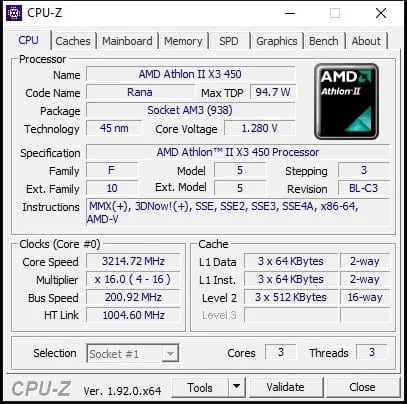
CPU-z screenshot:
 ⤢ ВІДКРИТИ
The Athlon II X3 450 processor is based on the 45nm Rana die, which is derived from the quad-core Propus. The chip operates at a base clock of 3200MHz and features 512KB of L2 cache per core. The Athlon II X3 450's TDP is rated at 95 watts.
 ⤢ ВІДКРИТИ
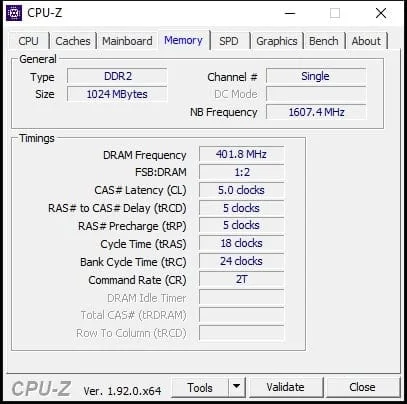
Due to the limitations of the AM2+ platform, the integrated memory controller in our processor runs at 1600MHz, the HT (HyperTransport) bus at 1000MHz, and DDR2 memory at 800MHz.
By the way, for some reason known only to ASUS's engineers, the ASUS M2N-E motherboard sets the stock voltage for the CPU at 1.430 volts. This is completely illogical, as the Athlon II X3 450's base voltage should be 1.350 volts. However, it's easily fixed with fine-tuning in the motherboard's BIOS. I'll go further: this chip actually runs stably at 1.300 volts, though only at its stock 3200MHz frequency.
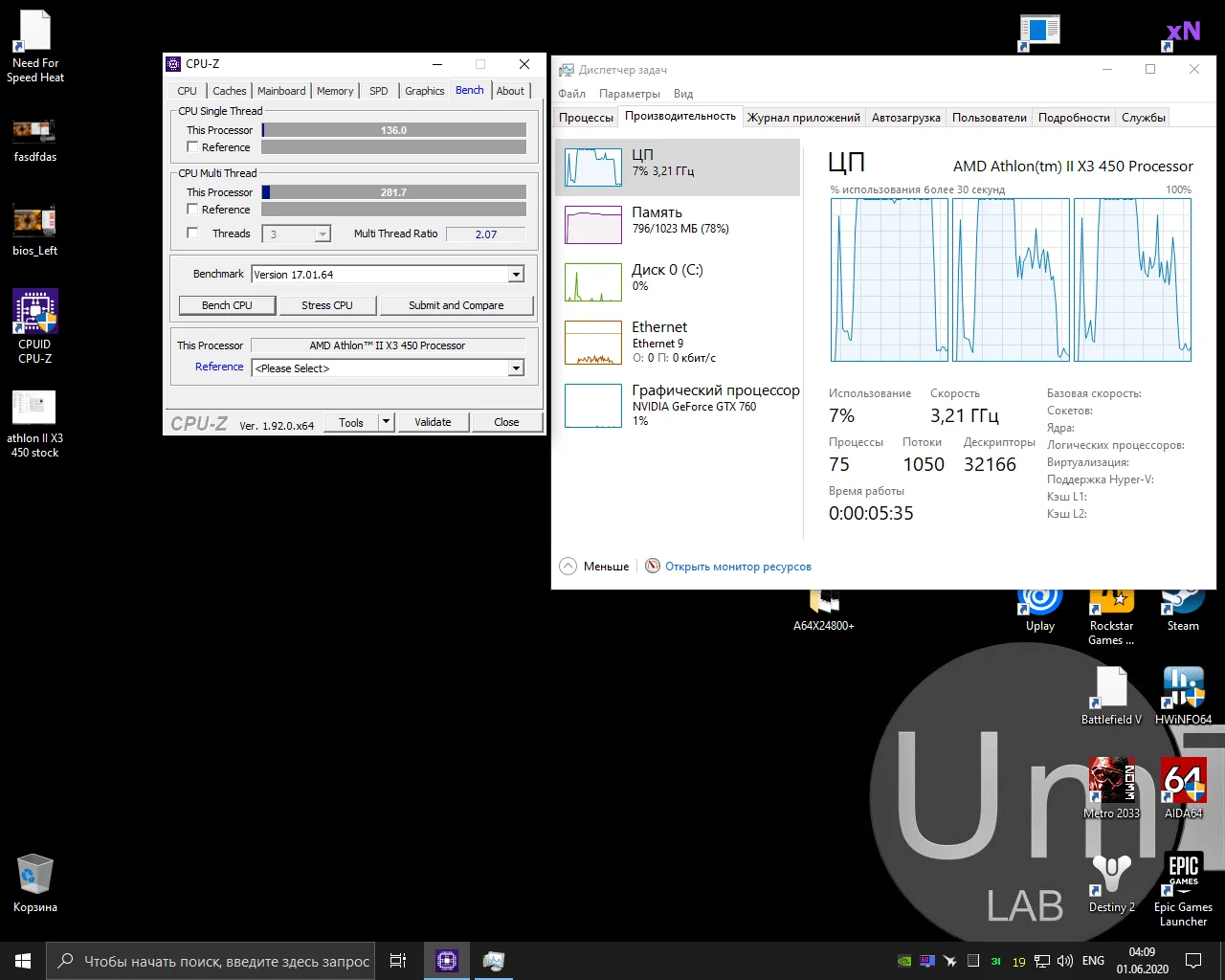
As always, I benchmarked the processor using the CPU-z utility's built-in test. To my surprise, it turns out this benchmark doesn't support triple-core models:
 ⤢ ВІДКРИТИ
On one hand, it's understandable — Athlon II X3 chips haven't been relevant for about six years now. But seriously? A benchmark that can't handle "non-standard" triple threads...
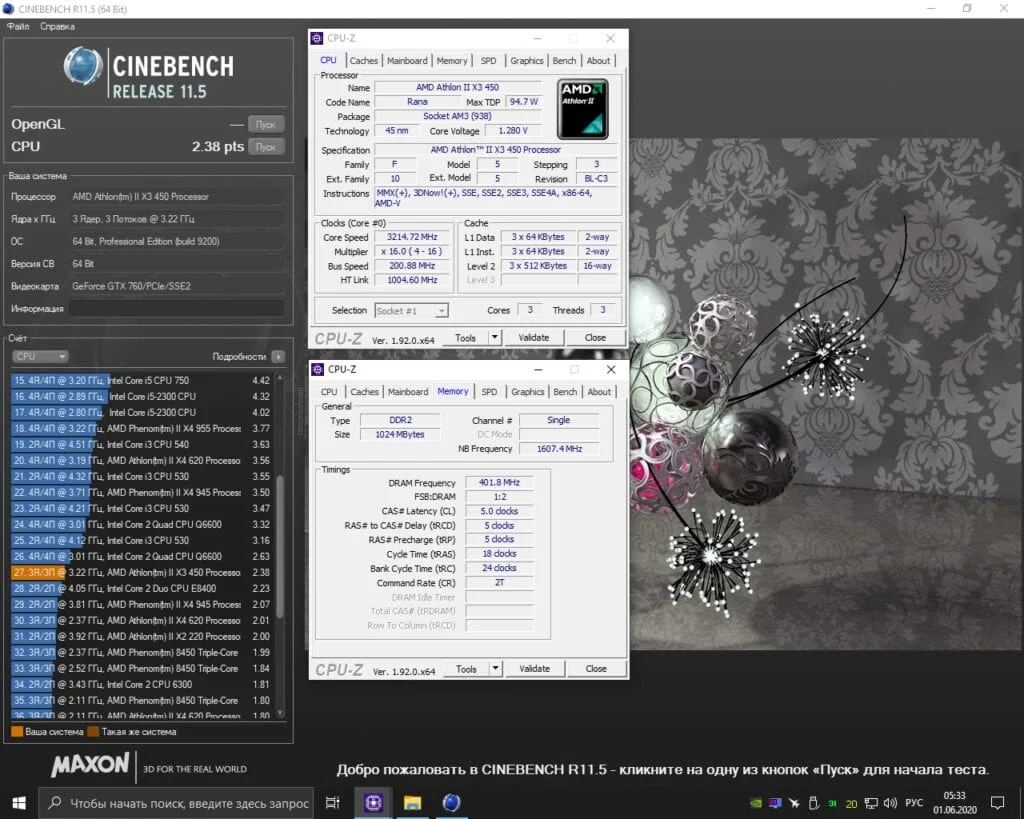
Alright, no big deal. To gauge the performance increase, we'll turn to the slightly more robust, old-faithful Cinebench.
 ⤢ ВІДКРИТИ
 ⤢ ВІДКРИТИ
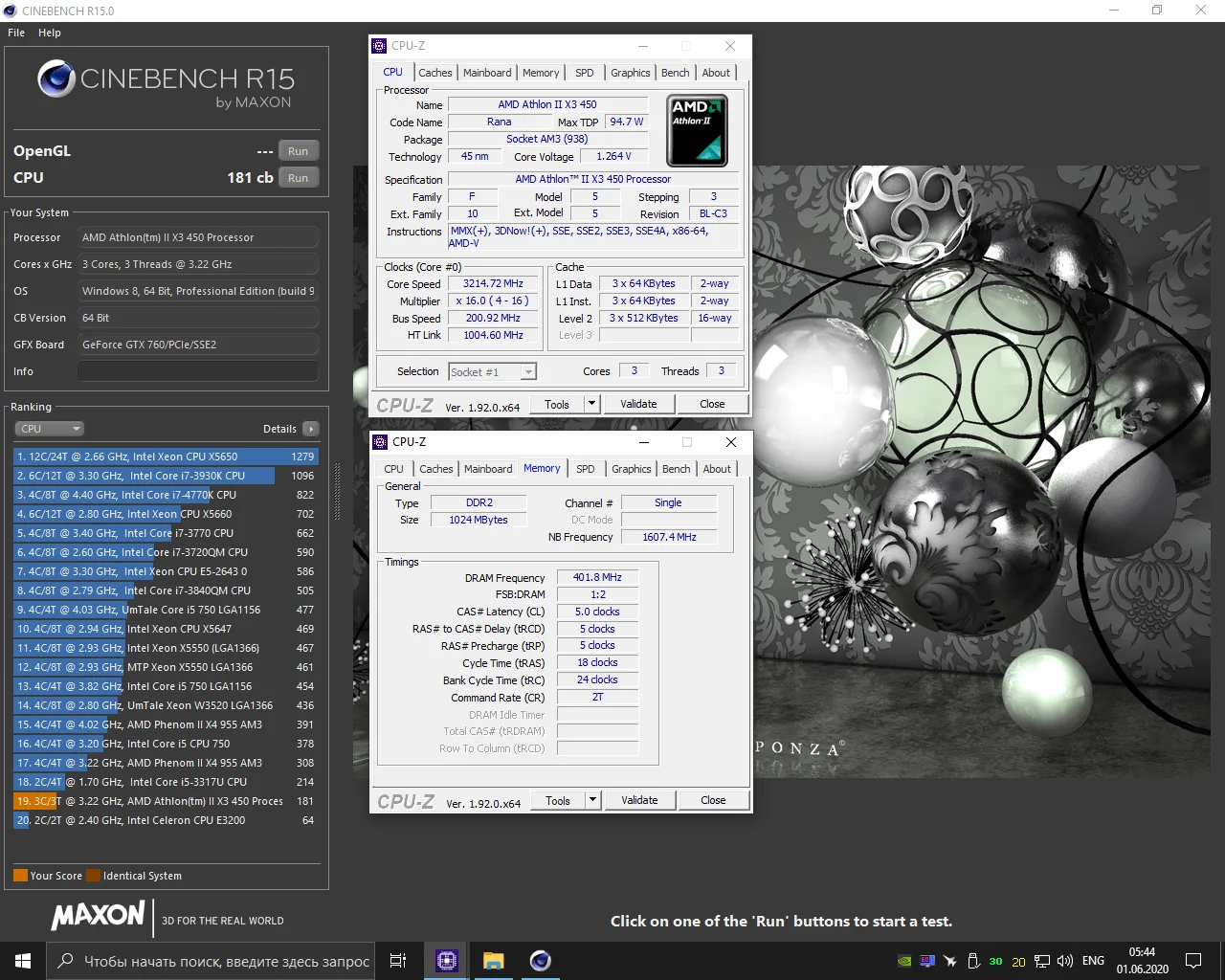
At its stock 3200MHz frequency, the processor scored 2.38 points in Cinebench R11.5 and 181 points in Cinebench R15. Let's see what overclocking the Athlon II X3 450 brings.
Test setup
Motherboard — ASUS M2N-E
Processor — Athlon II X3 450 (rev. C3)
CPU cooler — Cooler Master Hyper 212 EVO
RAM — 1GB DDR2 SK Hynix HYMP512U64CP8-S5
Graphics card — ZOTAC GeForce GTX 760 AMP!
Storage — KINGSTON 120GB SA400S37120G
Power supply — Chieftec GPS-1250C
Operating system — Windows 10 with the latest updates as of May 2020
Overclocking the Athlon II X3 450 processor
AMD didn't put much focus on the overclocking potential of the Propus core (the triple-core Rana die is simply a binned version of the quad-core Propus); their attention was on the flagship Deneb. That's why seemingly similar processors exhibit wildly different overclocking capabilities.
For example, Phenom II X4 chips can often run quite stably at 4000-4100MHz with a relatively low voltage of 1.450 volts. In contrast, Athlon II X4 (and its binned Athlon II X3 variants) can often barely boot into the operating system at that voltage. Trust me, even that's not frequent. In most cases, you'll just get a black screen after saving BIOS settings. But why dwell on the negatives? Rarely, and I emphasize, very rarely, a Propus might achieve overclocking results similar to Deneb, but don't count on it.
Frankly, for me personally, the initial benchmark frequency for any 45nm K10.5 architecture processor is 4000MHz. If the test chip can at least boot into the operating system at a relatively low supply voltage of 1.450 volts, it's a decent sample. If it fails, the CPU is often weak and likely won't hit 4000MHz even with a dangerously high 1.600-volt input.
In our case, the Athlon II X3 450 sample managed to boot at 4000MHz with 1.460 volts. Overall, I got lucky. However, as I suspected, the chip couldn't even pass a light stress test in the CPU-z utility. It was clear it lacked sufficient core voltage for that frequency. After bumping it up to 1.530 volts, the Athlon II X3 450 achieved a respectable half-hour of stability at 4000MHz, but then AIDA64 reported an error.
To say I was disappointed would be an understatement.
Consider this: 1.550 volts is generally the last relatively safe haven; pushing beyond that significantly increases the risk of CPU die degradation. While it largely depends on temperature in relation to voltage, Athlon II chips are notoriously sensitive to high currents. You can find reports online of these processors failing even at low temperatures, and I still have further testing plans for this specific chip.
For this reason, I decided to cap the voltage at 1.574 volts (multimeter measured 1.540 volts, BIOS set to 1.600 volts, and VID was reporting a nonsensical 1.420 volts). If the processor could pass a stress test at that voltage, great. If not, I'd drop the frequency to 3900MHz and retest for stability.
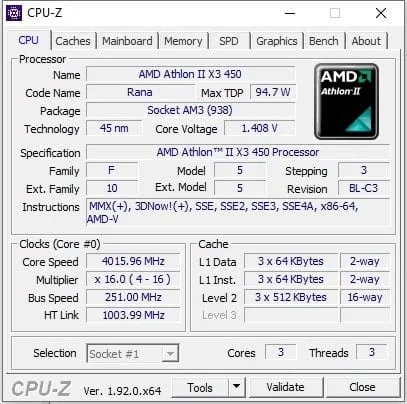
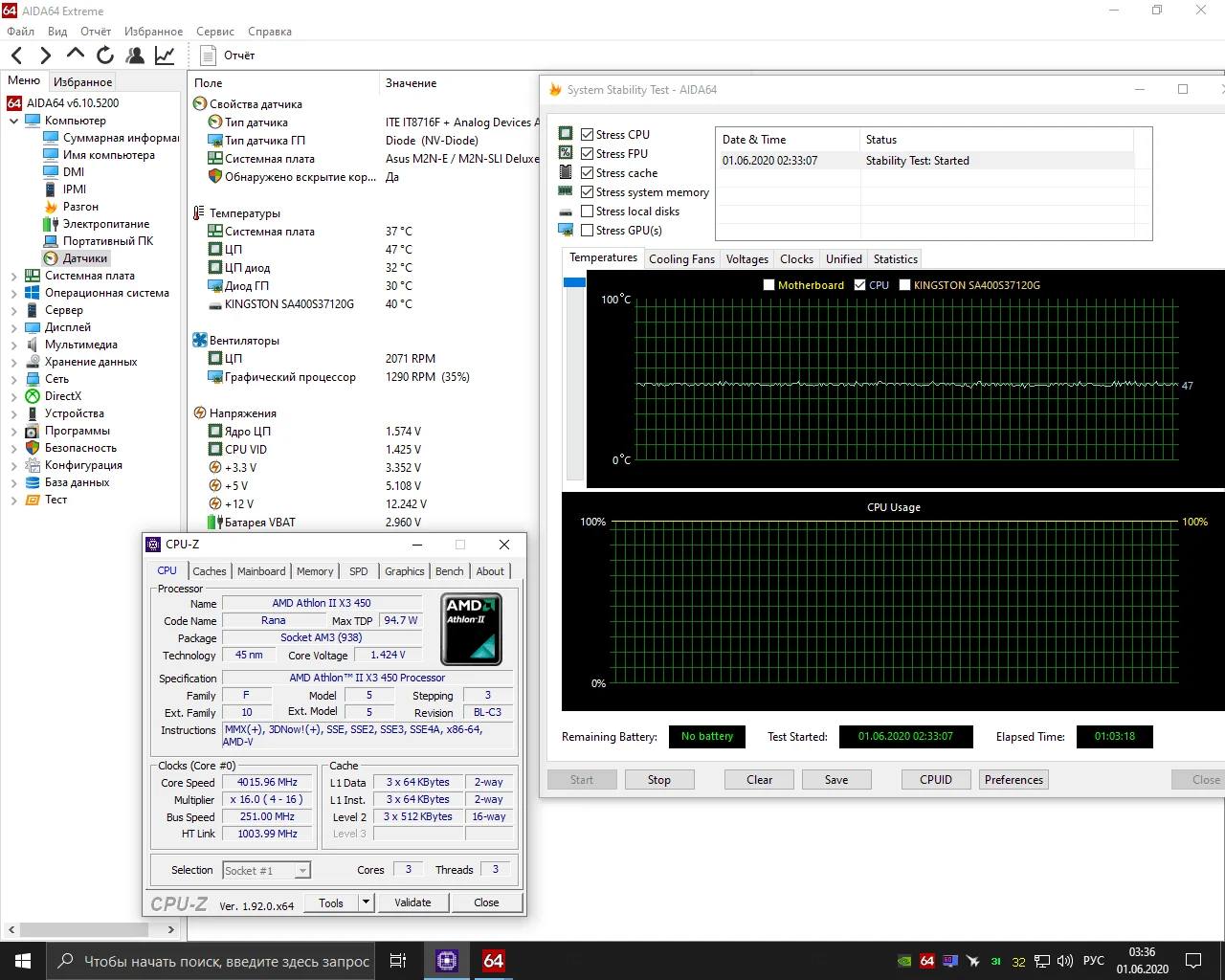
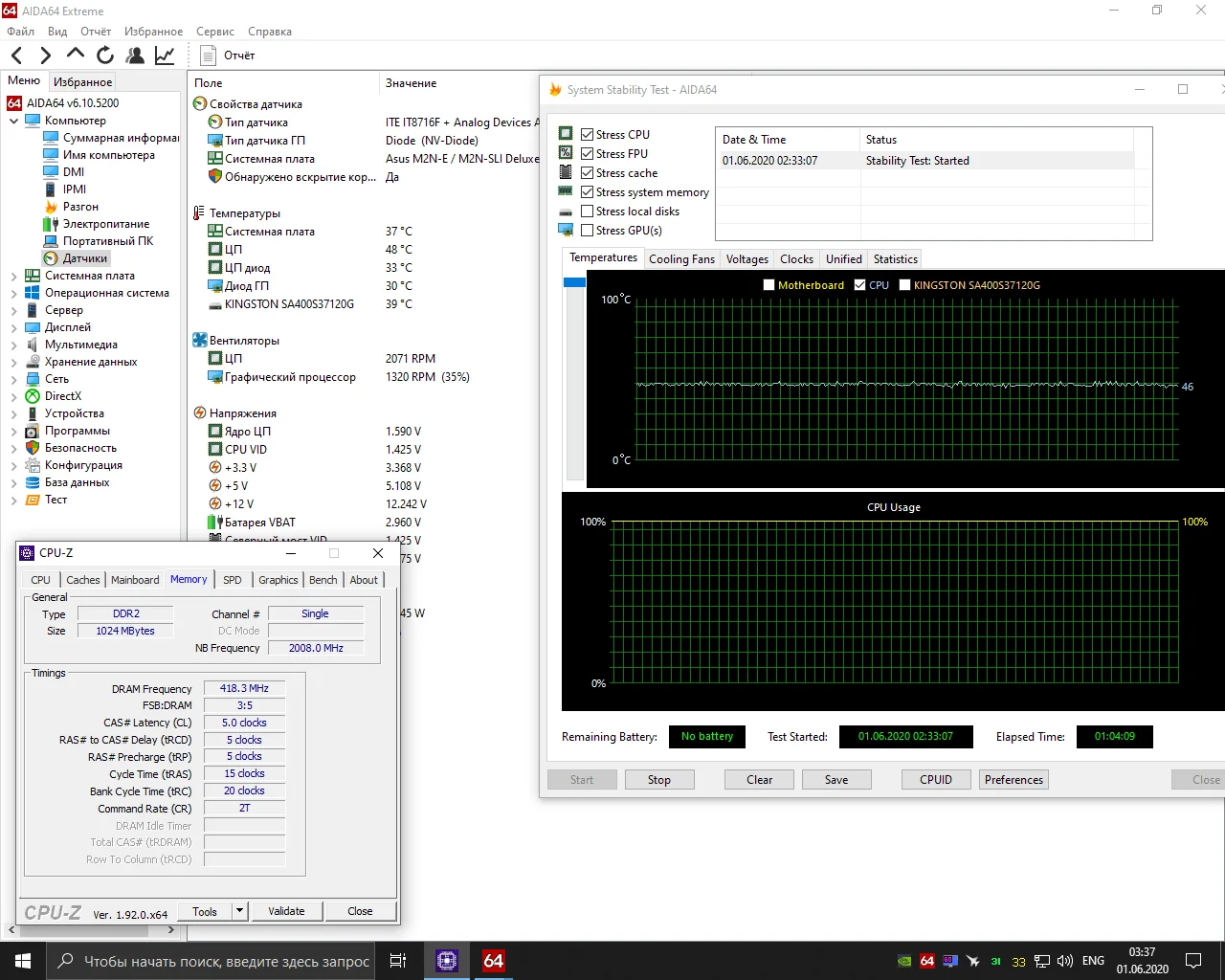
But the processor surprised me and successfully completed an hour-long AIDA64 stress test at 4015MHz:
 ⤢ ВІДКРИТИ
 ⤢ ВІДКРИТИ
 ⤢ ВІДКРИТИ
Below are the ASUS M2N-E motherboard BIOS settings used for this overclock:
It's worth noting that stock cooling won't cut it for this chip frequency, especially at 1.5 volts. At a minimum, you'll need something like a Cooler Master Hyper TX3, or our test Cooler Master Hyper 212 EVO (Chinese equivalents like Snowman would also work). Furthermore, remember that with these settings, the chip consumed well over 150 watts, so make sure to cool your motherboard's VRM. In my case, for example, I had to install a 120mm fan to blow air over the power transistor heatsink. Finally, consider your power supply requirements. A quality 500-700 watt PSU should be sufficient for this overclock (though, of course, you must account for your graphics card's power draw. If you're running something like an R9 290X, you'll need more than a high-quality 500W unit, or your CPU overclocking attempts will likely fail).
Time to compare the stock and overclocked benchmark results:
In Cinebench R11.5, it went from 2.38 points to 2.95 points.
In Cinebench R15, it went from 181 points to 220 points.
Conclusion
We hit 4000MHz, so the benchmarking session was a success. Plus, the results from our few tests are pretty good, even considering it's 2020. The Athlon II X3 450 chip can certainly provide an undemanding user with everything they need: watching YouTube videos in FullHD, playing simple games, and relatively comfortable internet browsing without a ton of tabs open.
It's quite possible that once an AM3+ socket motherboard arrives in the lab, I'll revisit overclocking this processor. If that happens, it will most likely include comprehensive testing in games and applications.
Until the next article, and happy overclocking!