![Overclocking the Intel Xeon X5660 [B1, Westmere-EP]](/_next/image?url=https%3A%2F%2Fumtale-media.s3.eu-central-1.amazonaws.com%2Fimages%2Fcontent%2Fd35329a7-dc3c-4cf5-a51f-04c23021eb95.webp&w=3840&q=75)
BLOGS · OVERCLOCKING
PUBLISHED
READING11 min
Overclocking the Intel Xeon X5660 [B1, Westmere-EP]
We explored the Intel Xeon X5660 (Westmere-EP)'s overclocking potential, but found the results disappointing. It performed worse than the X5650, demanding high voltages and generating significant heat.
In this article, we'll continue exploring the overclocking potential of LGA 1366 platform processors. Next up is the 6-core, 12-thread Xeon X5660 chip.
Early in the 'Chinese' LGA 1366 platform renaissance (2015-2016), this chip wasn't particularly popular due to its excessively high price compared to its younger siblings. However, the X5660's relatively high multiplier did pique the interest of overclockers.
On paper, this seems quite logical: a higher multiplier means a lower BCLK clock speed is needed, which undoubtedly benefits the stability of the final overclock. But how significant is this in practice? Will the X5660's higher multiplier actually help it achieve a higher frequency than its younger sibling, the X5650? Let's find out.
The processor
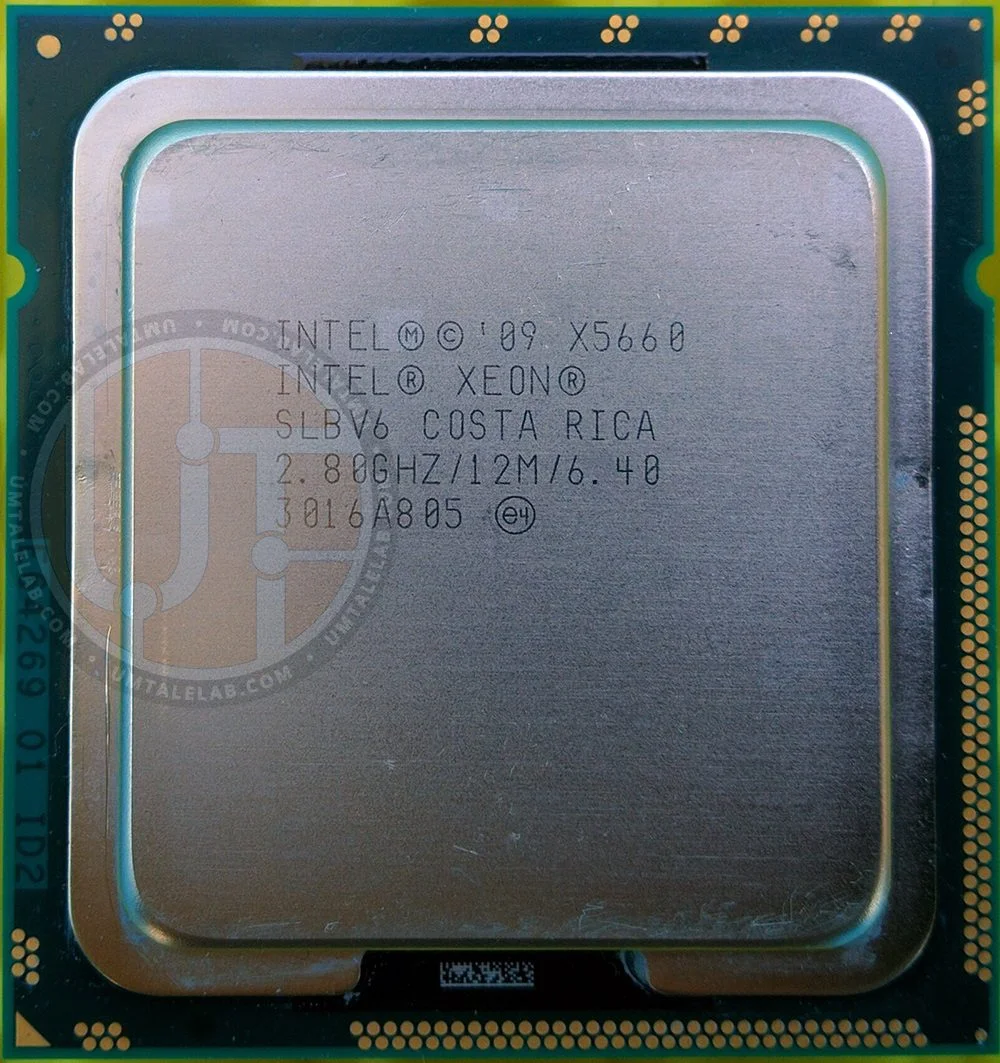
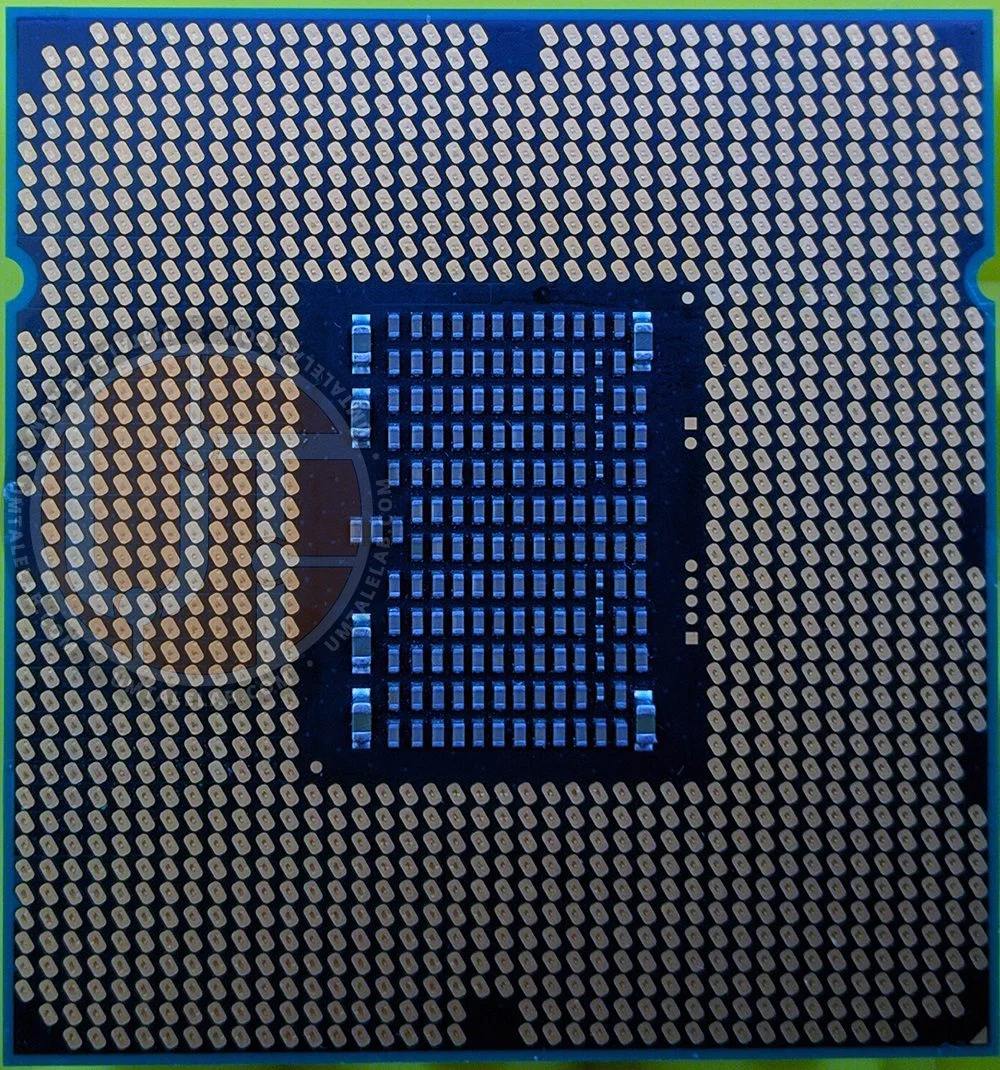
X5650 specifications
Model | Xeon X5660 |
|---|---|
Process tech | 32 nm |
Cores | 6 |
Threads | 12 |
Base clock speed | 2800 MHz |
Max Turbo Boost frequency | 3200 MHz (1 — 2 cores) 3066 MHz (3 — 6 cores) |
Supported technologies | MMX instructions SSE / Streaming SIMD Extensions SSE2 / Streaming SIMD Extensions 2 SSE3 / Streaming SIMD Extensions 3 SSSE3 / Supplemental Streaming SIMD Extensions 3 SSE4 / SSE4.1 + SSE4.2 / Streaming SIMD Extensions 4 AES / Advanced Encryption Standard instructions EM64T / Extended Memory 64 technology / Intel 64 NX / XD / Execute disable bit VT-x / Virtualization technology VT-d / Virtualization for directed I/O TBT / Turbo Boost technology TXT / Trusted Execution technology Enhanced SpeedStep technology |
Integrated graphics | None |
L2 cache (per core) | 256 KB |
L3 cache | 12 MB |
Multiplier | 21 |
TDP | 95 W |
Max IHS/core temp | 81/96 C |
Approximate price |
Of the currently essential technologies, the X5660 only supports the SSE4.2 instruction set. However, the Westmere-EP architecture lacks the vital AVX extension, which further diminishes this CPU's relevance today.
The Intel Xeon X5660 chip's codename is Westmere-EP (the Westmere architecture is a Nehalem die shrink). Beneath this CPU's heat spreader lies a single 32nm 6-core monolithic B1 revision die.
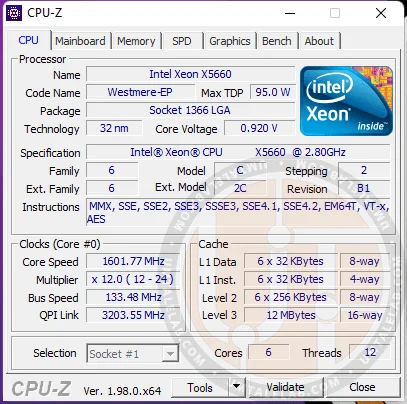
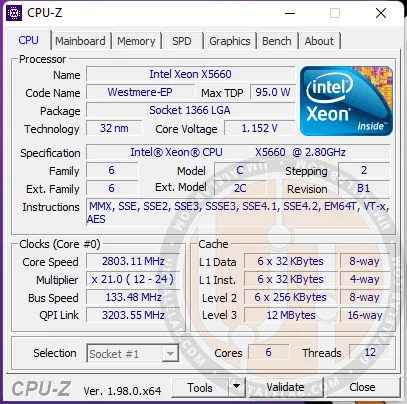
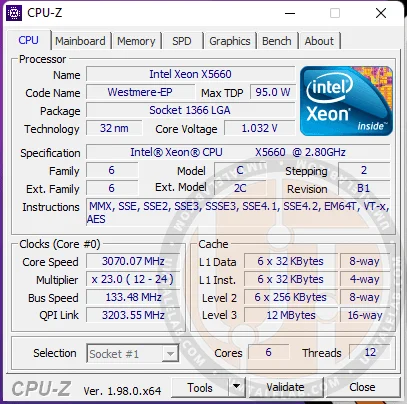
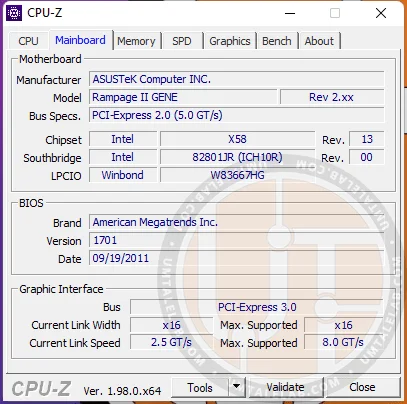
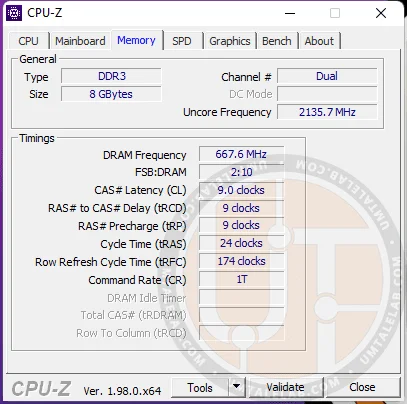
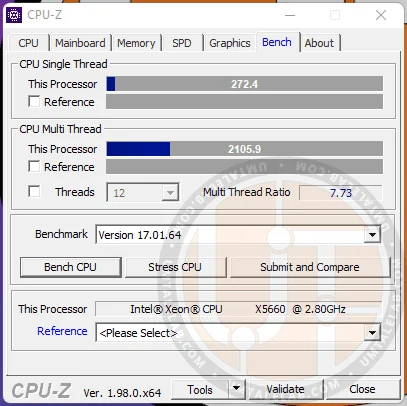
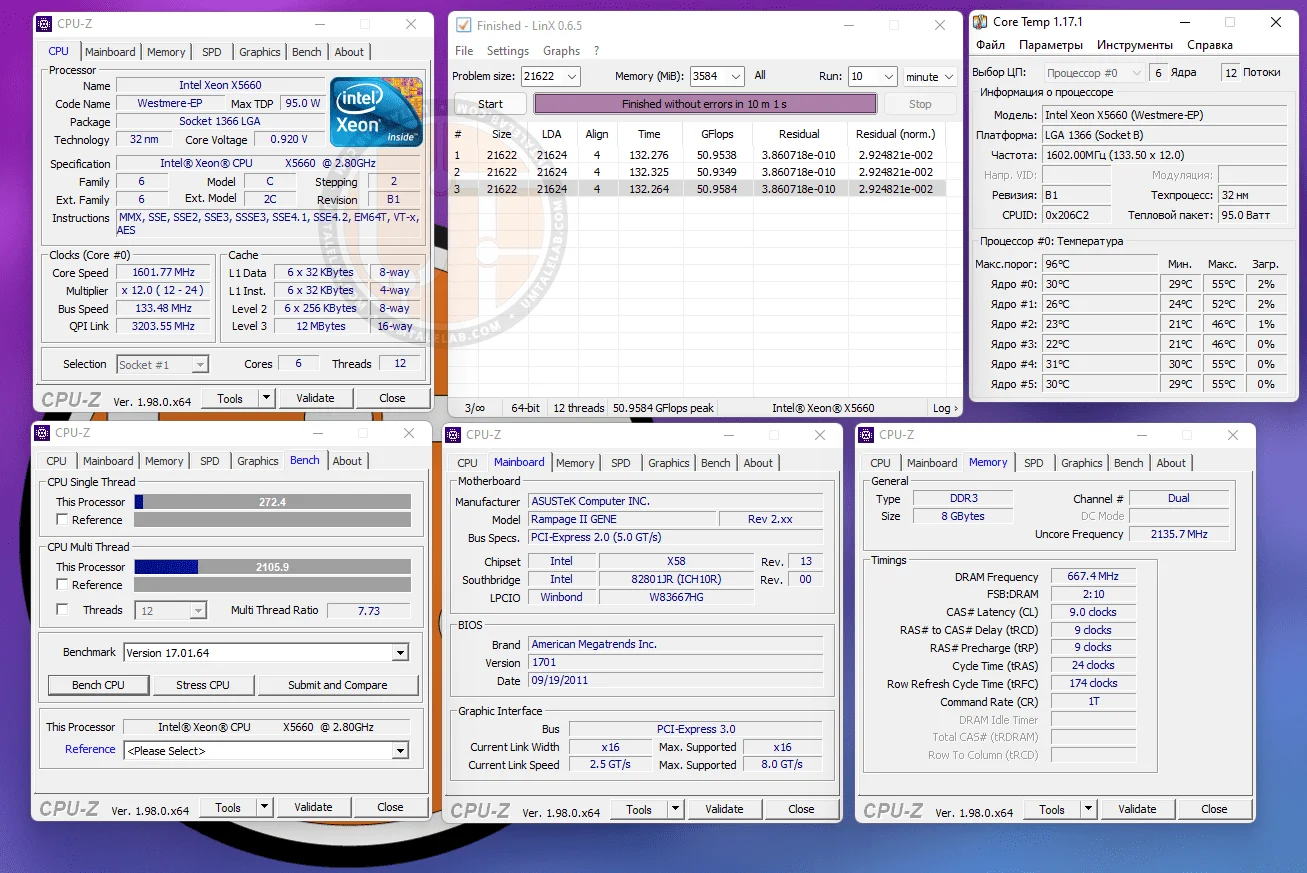
The Xeon X5660 processor features six cores and twelve threads, with a nominal frequency of 2800MHz. Its maximum Turbo Boost frequency is 3200MHz for a single core, and 3066MHz for all six cores. During idle periods, the tested CPU's frequency can drop to 1600MHz, which significantly saves power.
The chip has 256KB of L2 cache per core and a substantial 12MB of shared L3 cache.
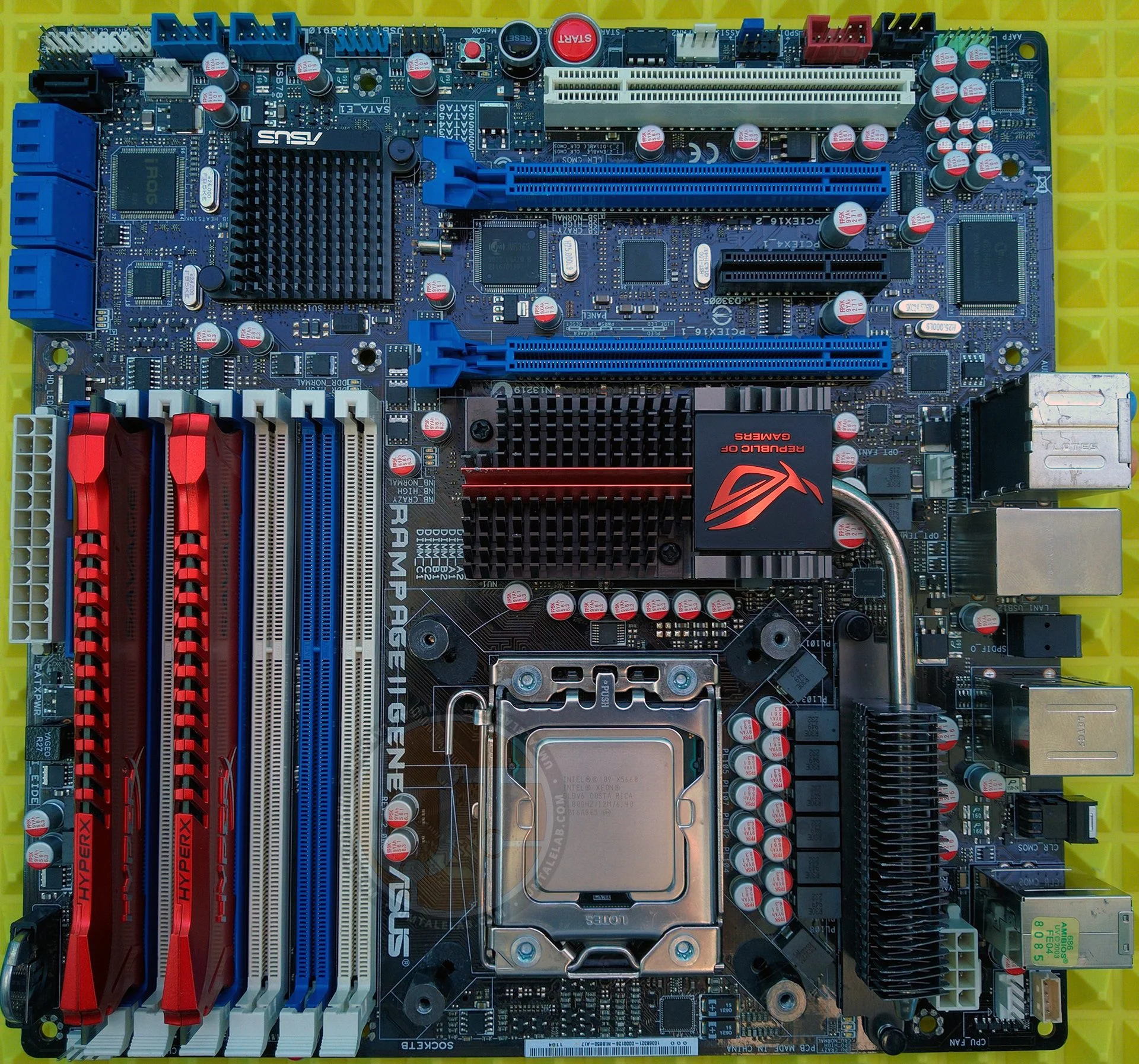
The Westmere-EP memory controller and L3 cache are supposed to run at 2667MHz. Oddly, though, our ASUS Rampage II Gene test motherboard sets their default frequency to 2133MHz, a speed more characteristic of first-gen Core i7 processors than Xeon X-series chips. We'll chalk that decision up to ASUS's engineers.
The stock CPU voltage should be in the 1.200-1.350 volt range. However, the ASUS Rampage II Gene motherboard intervenes again; even with a single core boosted to 3200MHz, it prevents this parameter from exceeding 1.200 volts (verified with a multimeter).
 ⤢ ВІДКРИТИ
Fortunately, in other respects, the ASUS Rampage II Gene adheres to Intel's specifications. The X5660 chip works perfectly fine with officially supported triple-channel DDR3 1333MHz RAM (tested with three 2GB sticks; two 4GB modules were used for overclocking), and its TDP doesn't exceed 95 watts. This last point, in particular, proved to be an immutable rule for the Rampage II Gene. While the chip comfortably passed the LinX test on a hypothetical DELL T3500 motherboard without dropping its frequency by a single megahertz, in our case, the X5660 periodically reduced its frequency to 2933MHz unless the 'Turbo-boost power limit' parameter was disabled.
Therefore, if you want to squeeze maximum performance from your processor, it's still better to disable the 'Turbo-boost power limit' parameter, even if you don't plan to overclock your CPU.
Test rig
Processors— Xeon X5660, Xeon E5-2620v3;
Cooling— Cooler Master Hyper 212 Black Edition (RR-212S-20PK-R1);
RAM for LGA 1366 overclocking— two 4GB Kingston HyperX Savage HX316C9SRK2/8 modules, 8GB total;
RAM for LGA 2011 v3— four 4GB G.SKILL DDR4@1866MHz F4-2400C15S-4GNT modules, 16GB total (timings 10-10-10-24);
Motherboard for LGA 1366 overclocking— ASUS Rampage II Gene Rev 2 (BIOS 1701);
Motherboard for LGA 2011 v3— Kllisre X99-D8 (AD12) with modified BIOS (unlocked Turbo Boost and timing control);
Graphics card— XFX R9-270X-CDFC@1150/1500MHz;
Solid-state drive— KINGSTON 120GB SA400S37120G (Windows 11), KINGSTON 480GB SA400S37/480G (demanding games);
Hard drive— Seagate 2TB ST2000DM008-2FR102 (other games);
Power supply— Chieftec GPS-1250C.
 ⤢ ВІДКРИТИ
Overclocking the Xeon X5660
First, let's figure out what our particular Xeon X5660 chip is capable of at stock voltages for the cores, RAM, and memory controller.
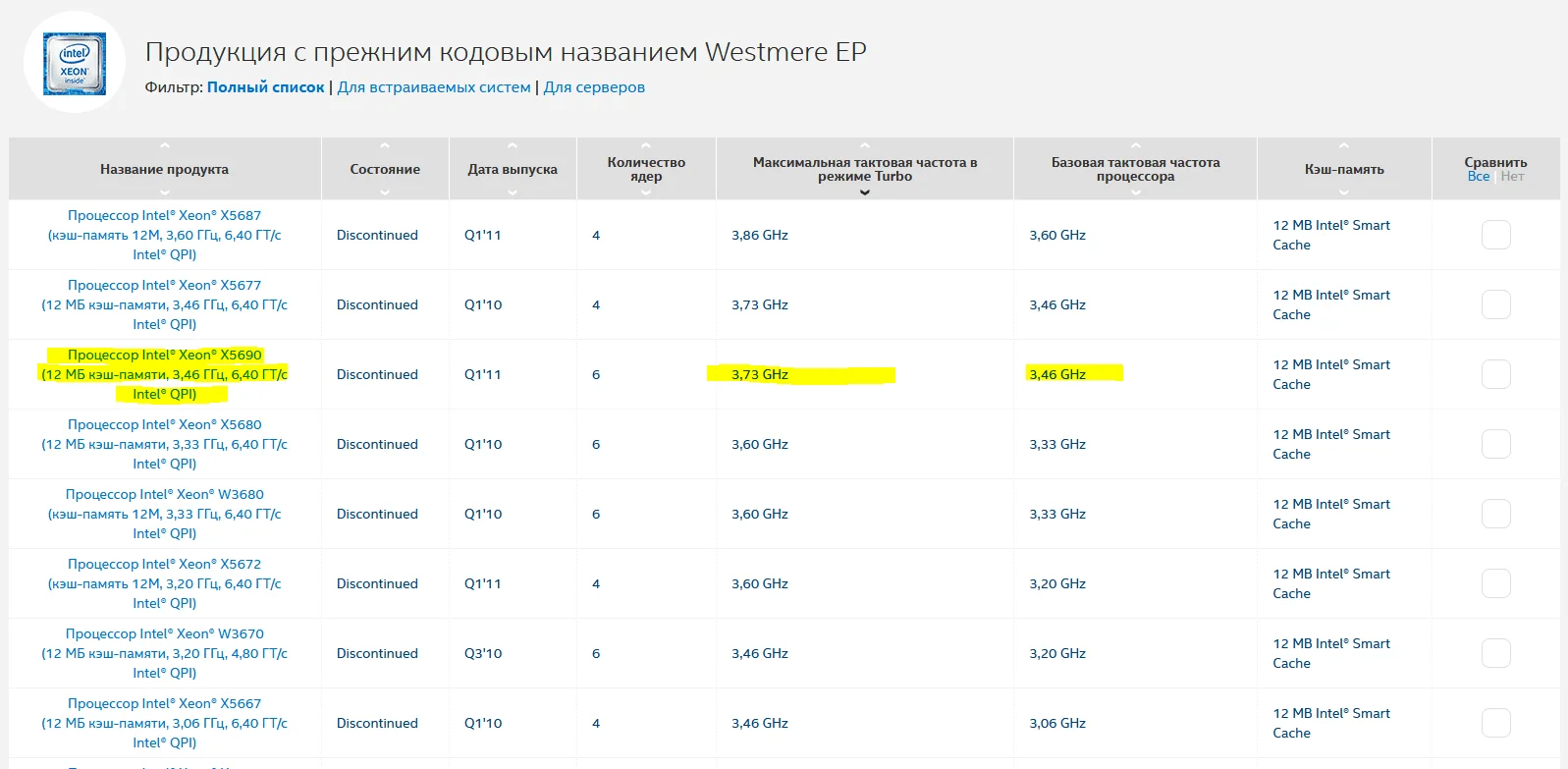
If you're not well-versed in process technologies, processor generations, and so on, there's no need to despair. To find out what your CPU model is theoretically capable of, you just need to identify its core's codename (Westmere-EP in our case). Then, simply Google the top model based on that same core.
 ⤢ ВІДКРИТИ
The fastest 6-core Westmere-EP processor is the Xeon X5690. Its base clock is 3466MHz, and Turbo Boost reaches an impressive 3733MHz. Therefore, theoretically (and I stress, *theoretically*), our chip should also be able to run stably at 3.4-3.7GHz at stock voltage settings.
But it's important to understand that in our case, the X5660's nominal voltage is slightly lower than Intel's official specifications. So, we'll use 1.230 volts as our reference and see what our CPU sample can do at this voltage.
Overclocking without increasing voltage
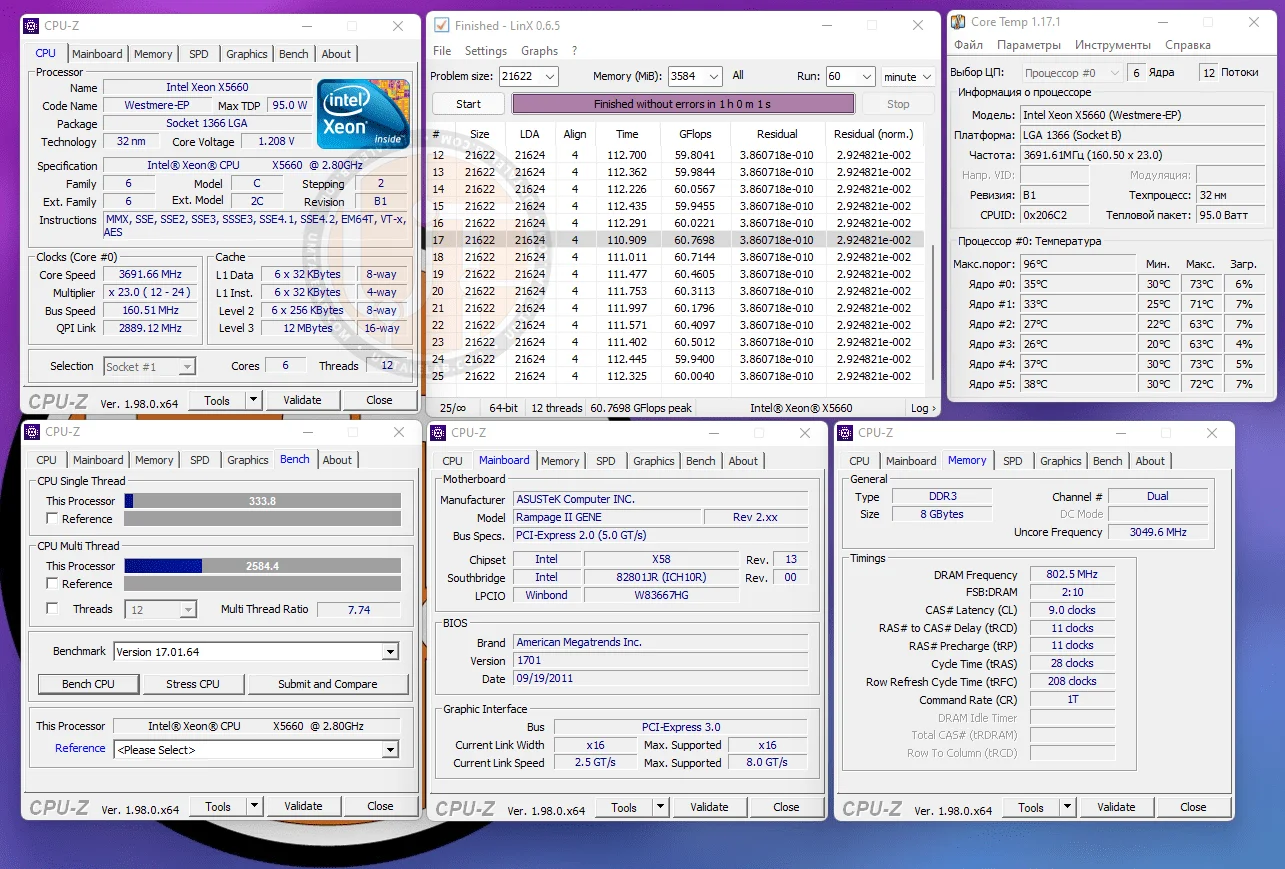
First, let's check what our X5650 sample can achieve at 1.200 volts for the cores and 1.200 volts for the QPI/DRAM Core (Uncore/L3 cache and memory controller).
 ⤢ ВІДКРИТИ
At base voltage settings, relative to Intel's specifications, the X5660 chip performed exceptionally poorly. It couldn't break the 3700MHz mark, stalling at 3691MHz for the cores and 3049MHz for the Uncore (QPI/DRAM Core/L3 cache). To be brutally honest, these are abysmal results.
As a reminder, our previous test subject, the X5650, managed to operate stably at 3637MHz for the cores and 2810MHz for the QPI/DRAM Core with 1.160 volts for the cores and 1.200 volts for the QPI/DRAM Core.
Overclocking with increased voltage
At 1.3 volts for the cores and 1.250 volts for QPI/DRAM Core, the X5660 chip only managed 3830/3064MHz. This put us in a bit of a bind, as the X5650, at 1.230/1.230 volts, hit 3927MHz for the cores and 3034MHz for the Uncore (QPI/DRAM Core/L3 cache).
Personally, I was puzzled. Tweaking QPI/Uncore multipliers or other related voltages like CPU PLL or IOH didn't yield any success. After over 10 hours of testing, we discovered our chip couldn't consistently operate at 4200MHz, even at 1.420 volts.
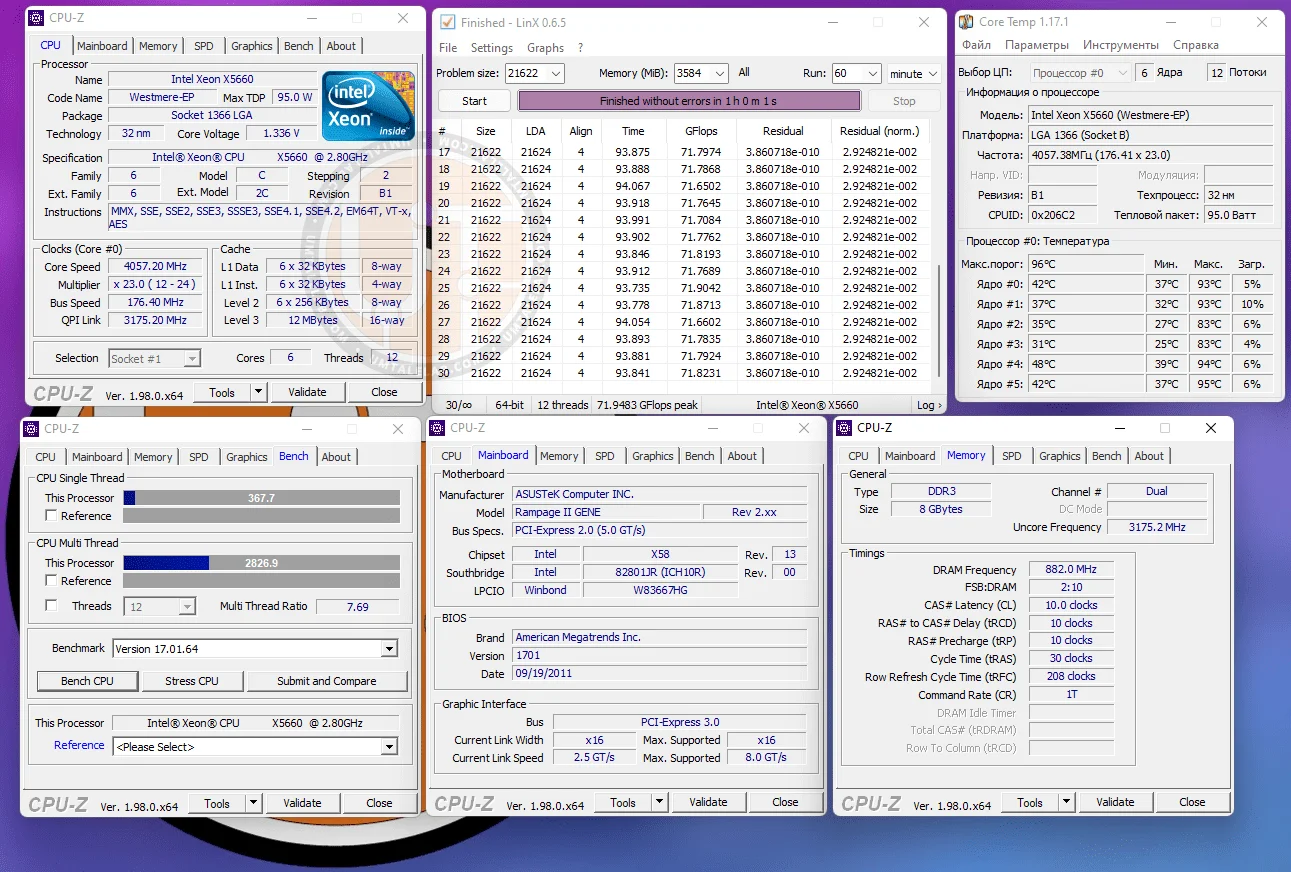
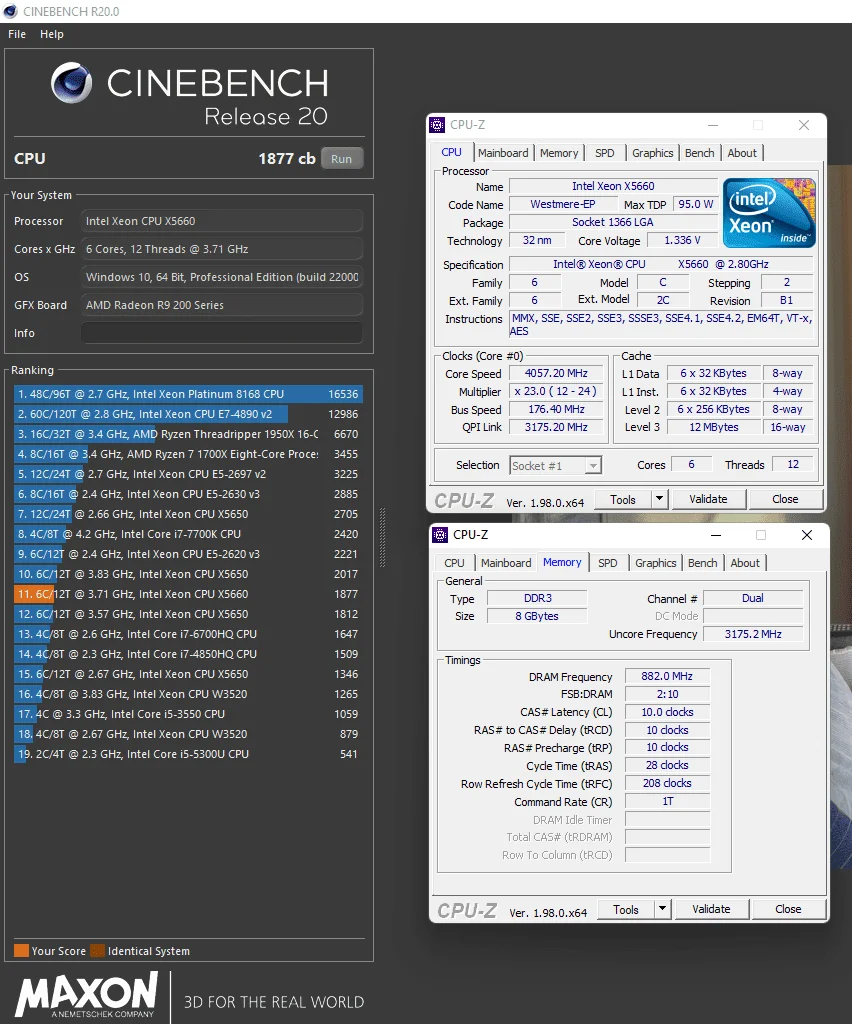
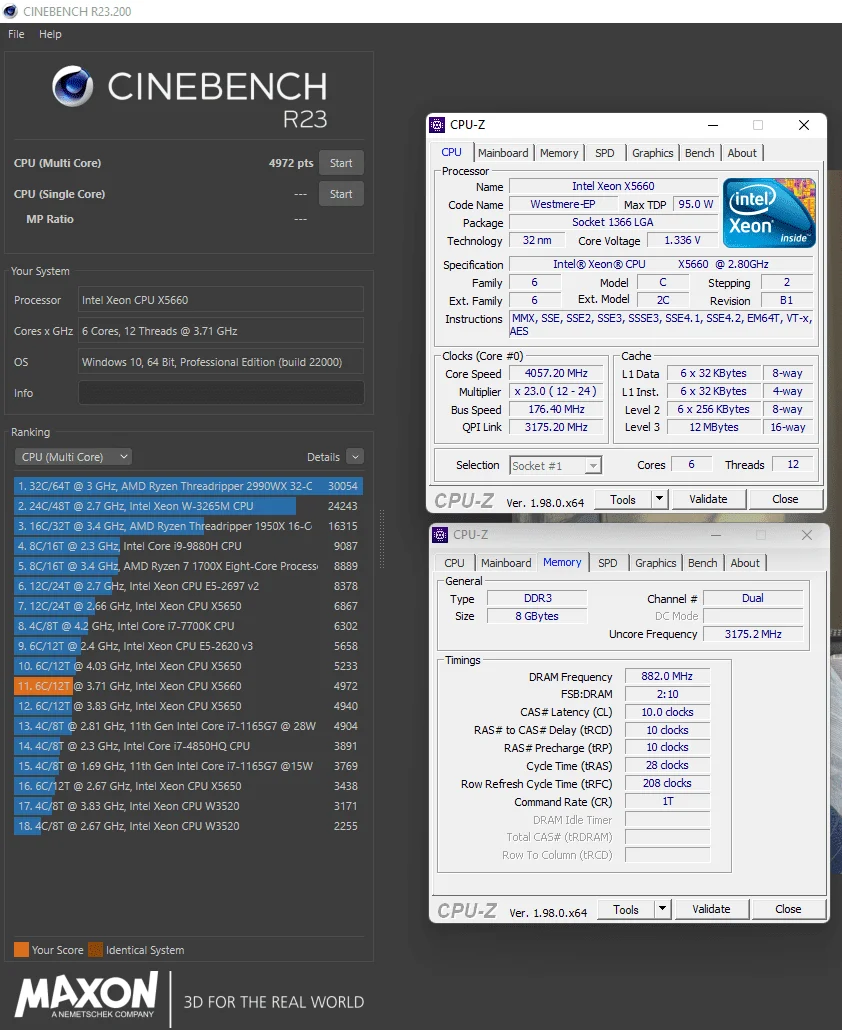
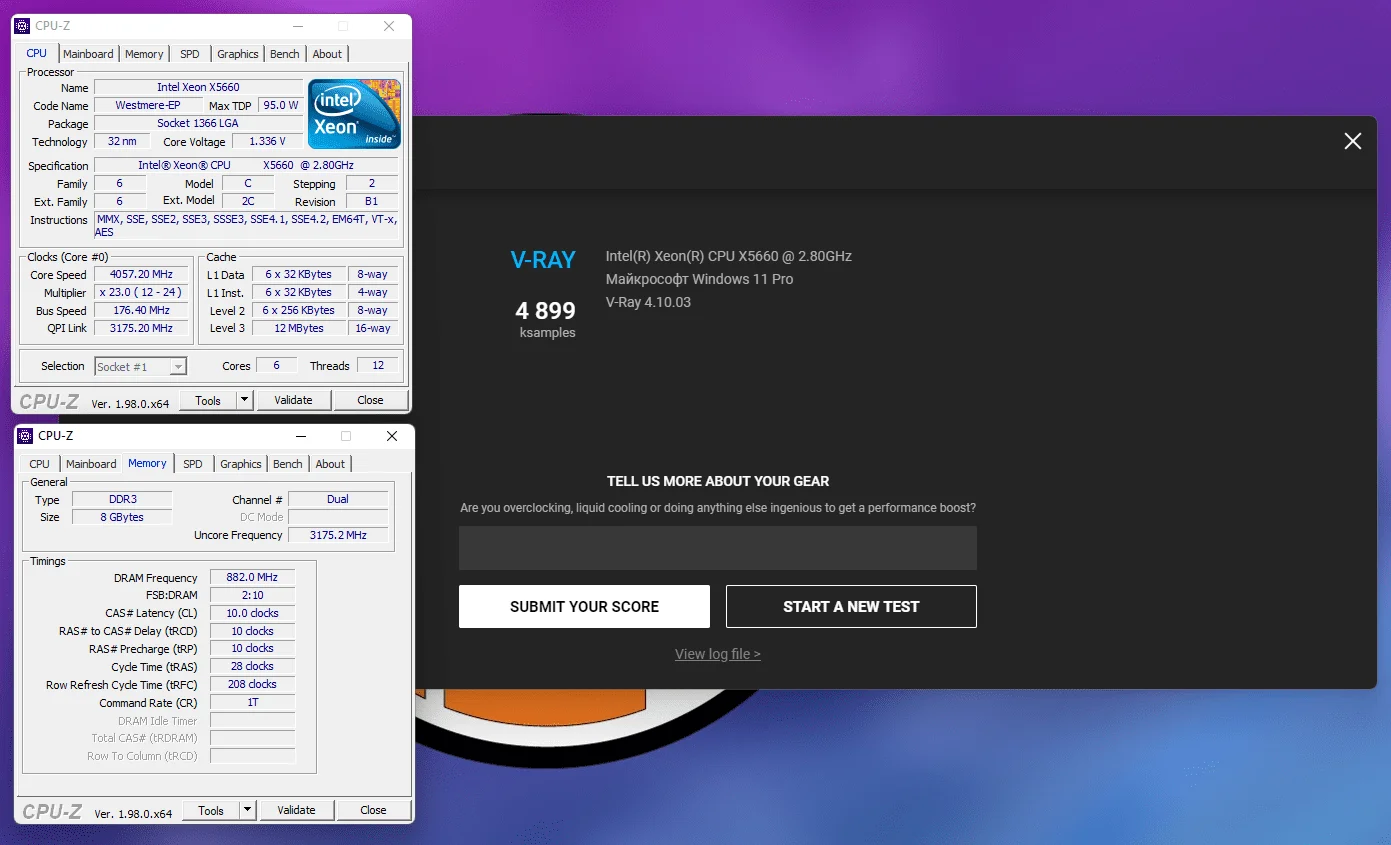
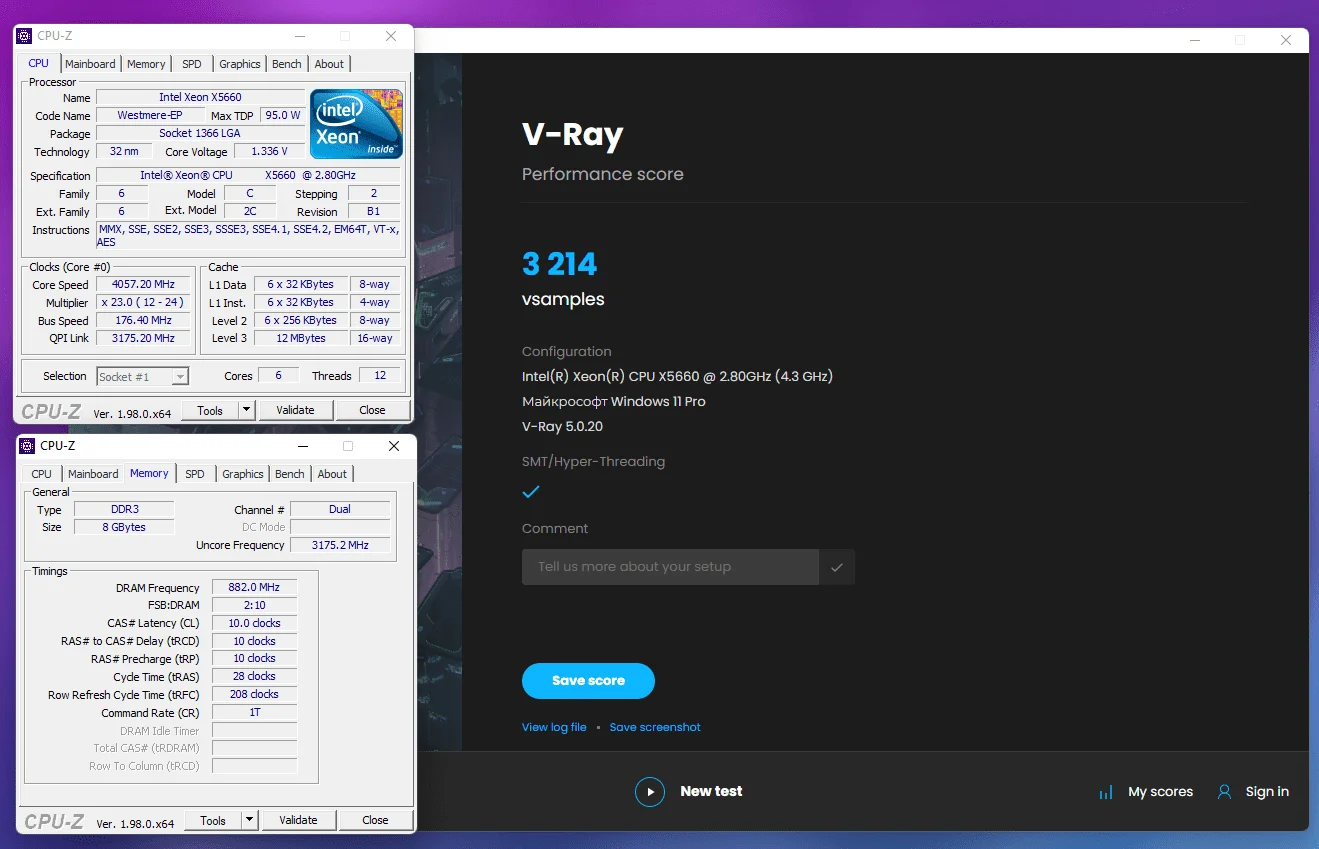
We managed to stabilize the processor at 4057/3175MHz with rather high core voltage at 1.340 volts, QPI/DRAM Core at 1.310 volts, CPU PLL at 1.850 volts, IOH at 1.25 volts, and DDR3 at 1.630 volts.
 ⤢ ВІДКРИТИ
Our X5660 sample proved to be exceptionally hot, a poor performer, and utterly disappointing—and that's putting it mildly. The X5650, for comparison, boasted 4213/3255MHz at a core voltage of 1.360 volts, QPI/DRAM Core at 1.290 volts, CPU PLL at 1.825 volts, and DDR3 at 1.69 volts.
Moreover, if you read our previous article on X5650 overclocking, you'd know that we considered the younger processor's overclocking result to be extremely weak at the time. However, based on the X5660's overclocking outcomes, the X5650 lab sample's overclocking potential can now be considered quite decent.
However, it's important to understand that overclocking is a lottery. Essentially, a single test sample doesn't reflect the true overclocking potential of all Xeon X5660 processors.
Xeon X5660: base clocks vs. overclocking and Xeon E5-2620 v3
Here's an express test of the Xeon X5660 chip at 3066MHz and 4057MHz across several games, benchmarks, and applications, along with a comparison to the most affordable representative of the current budget-friendly LGA 2011v3 platform—the Xeon E5-2620v3.
Applications and benchmarks
AIDA64 v6.50.5800
X5660@2800-3066МГц | X5660@4057МГц | E5-2620v3@3200МГц | |
Memory read | 15964 | 20518 | 45365 |
Memory write | 12772 | 16549 | 45215 |
Memory copy | 14226 | 18377 | 45439 |
Memory latency | 73.6 | 57.4 | 68.6 |
CPU Queen | 44244 | 64012 | 56119 |
CPU PhotoWorxx | 6527 | 7823 | 26937 |
CPU ZLib | 302.5 | 406.4 | 409.3 |
CPU AES | 10336 | 13796 | 21707 |
CPU SHA3 | 704 | 951 | 1765 |
FPU Julia | 14674 | 20271 | 37758 |
FPU Mandel | 7155 | 9775 | 19242 |
FPU SinJulia | 6308 | 8423 | 6088 |
FP32 Ray-Trace | 2089 | 2961 | 6655 |
FP64 Ray-Trace | 1164 | 1629 | 3484 |
Cinebench R15
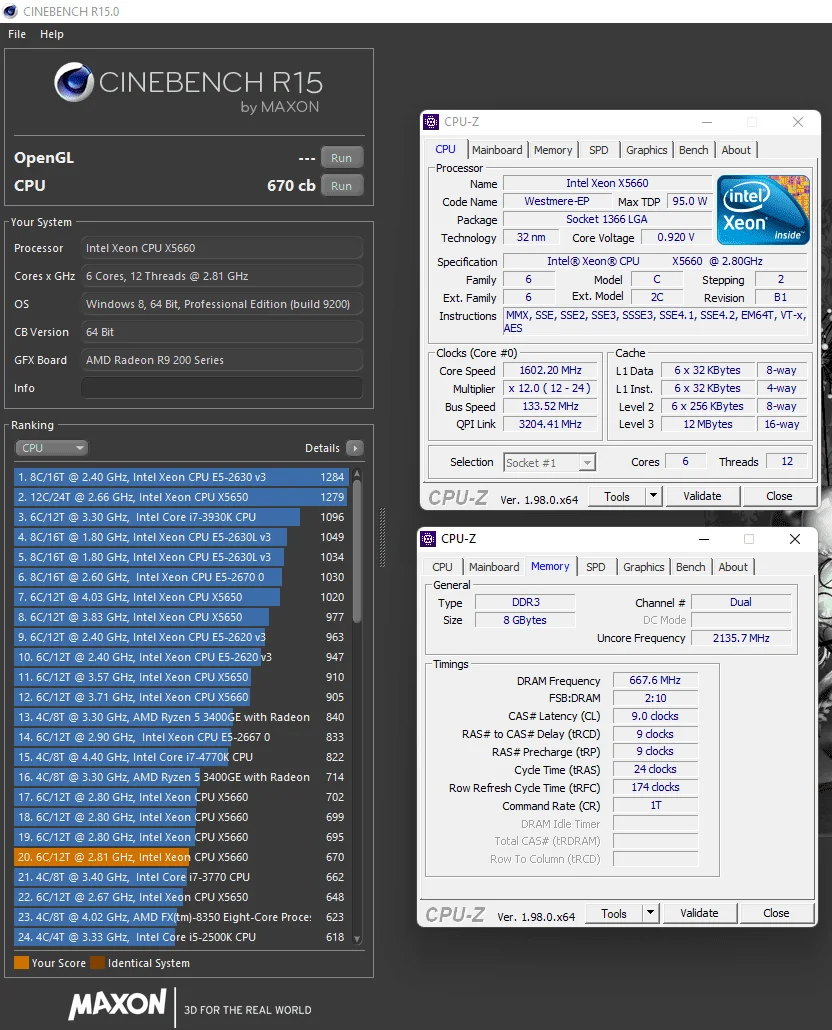
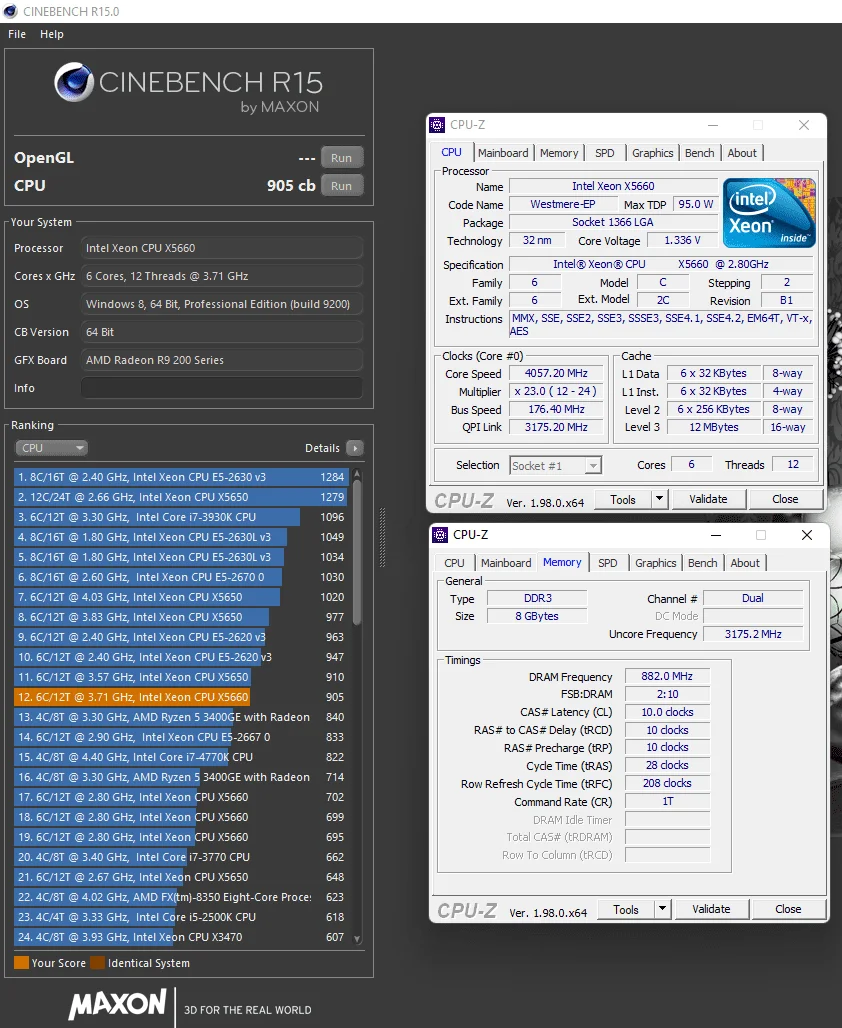
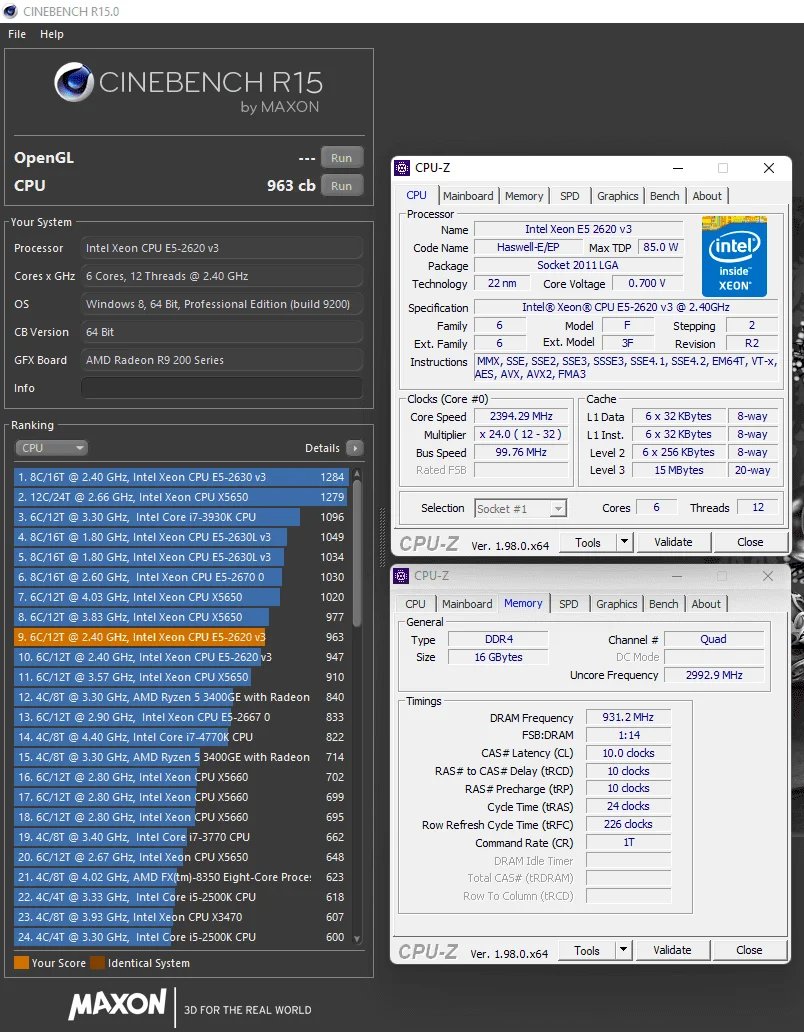
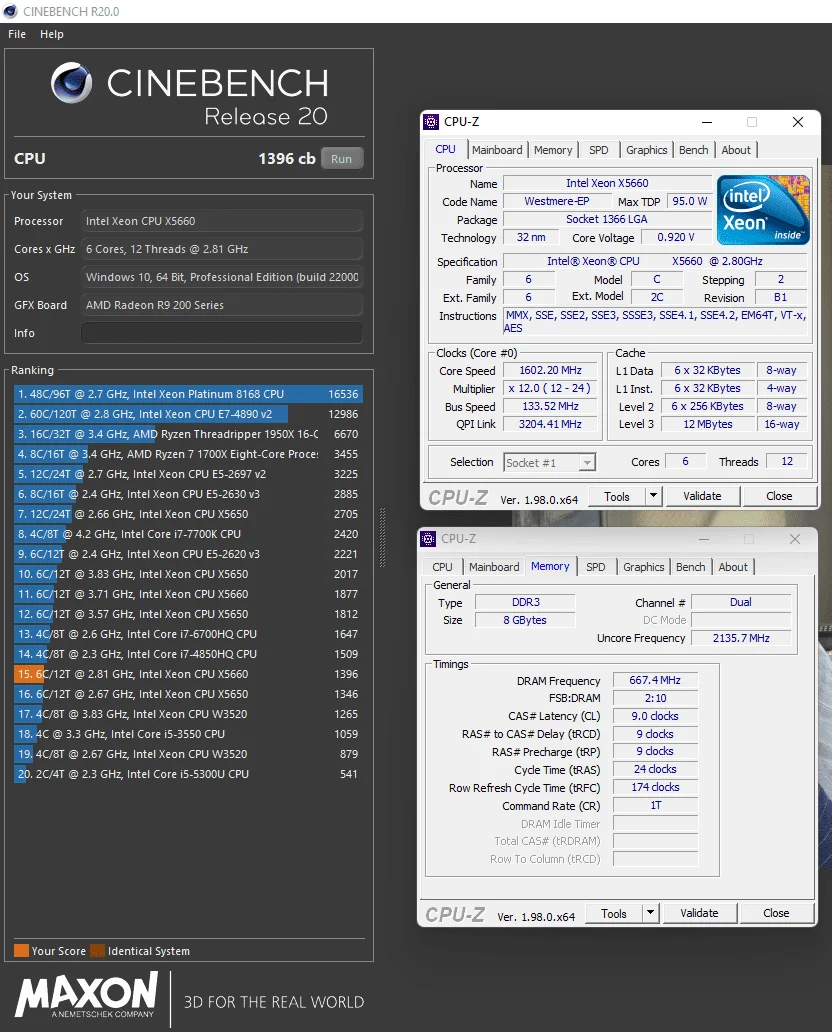
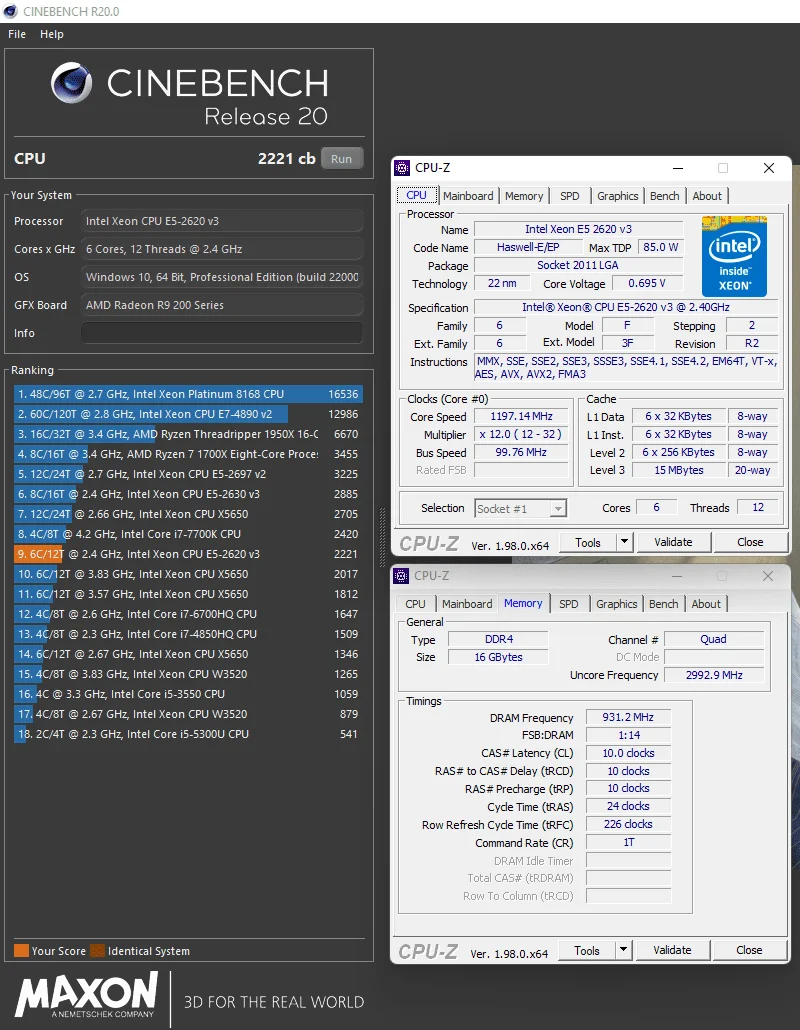
Cinebench R20
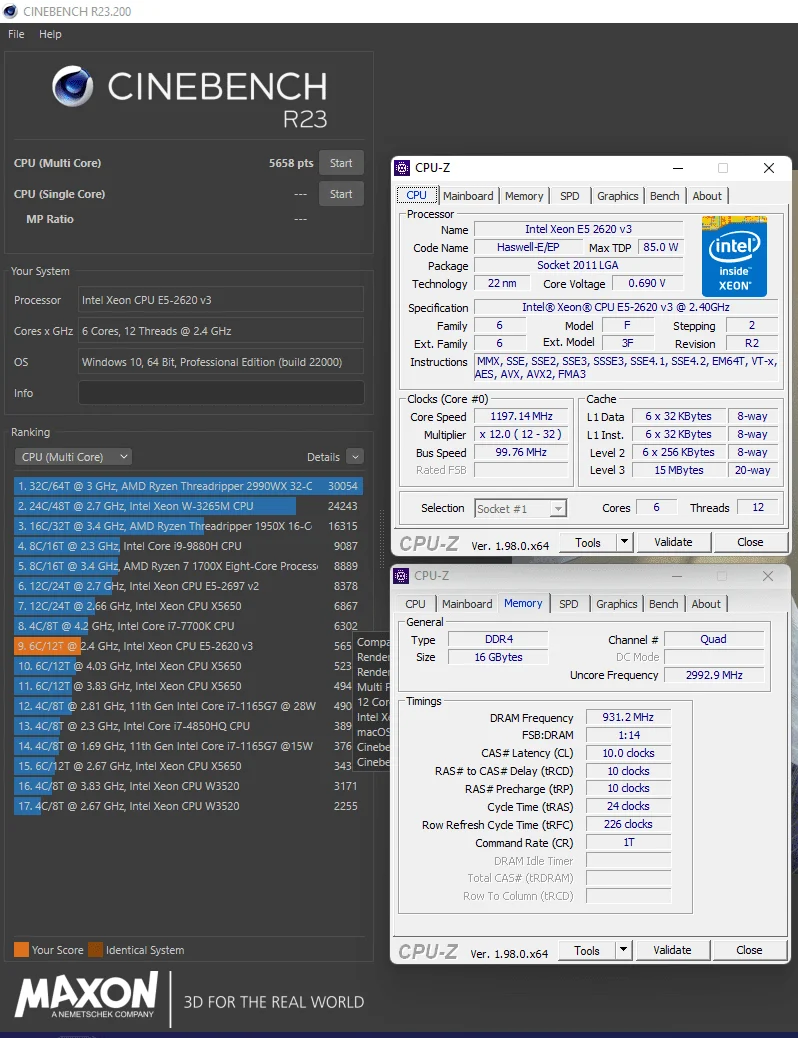
Cinebench R23
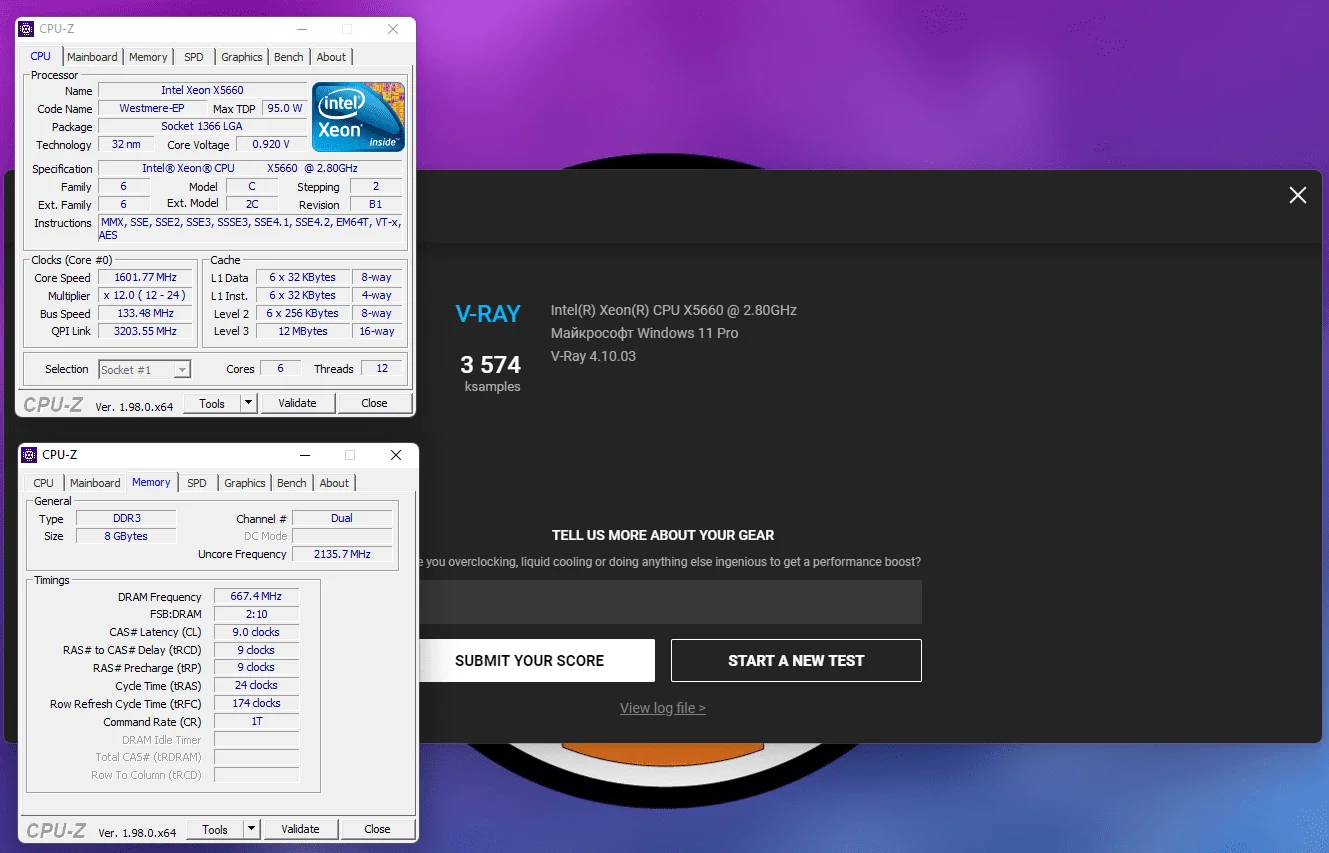
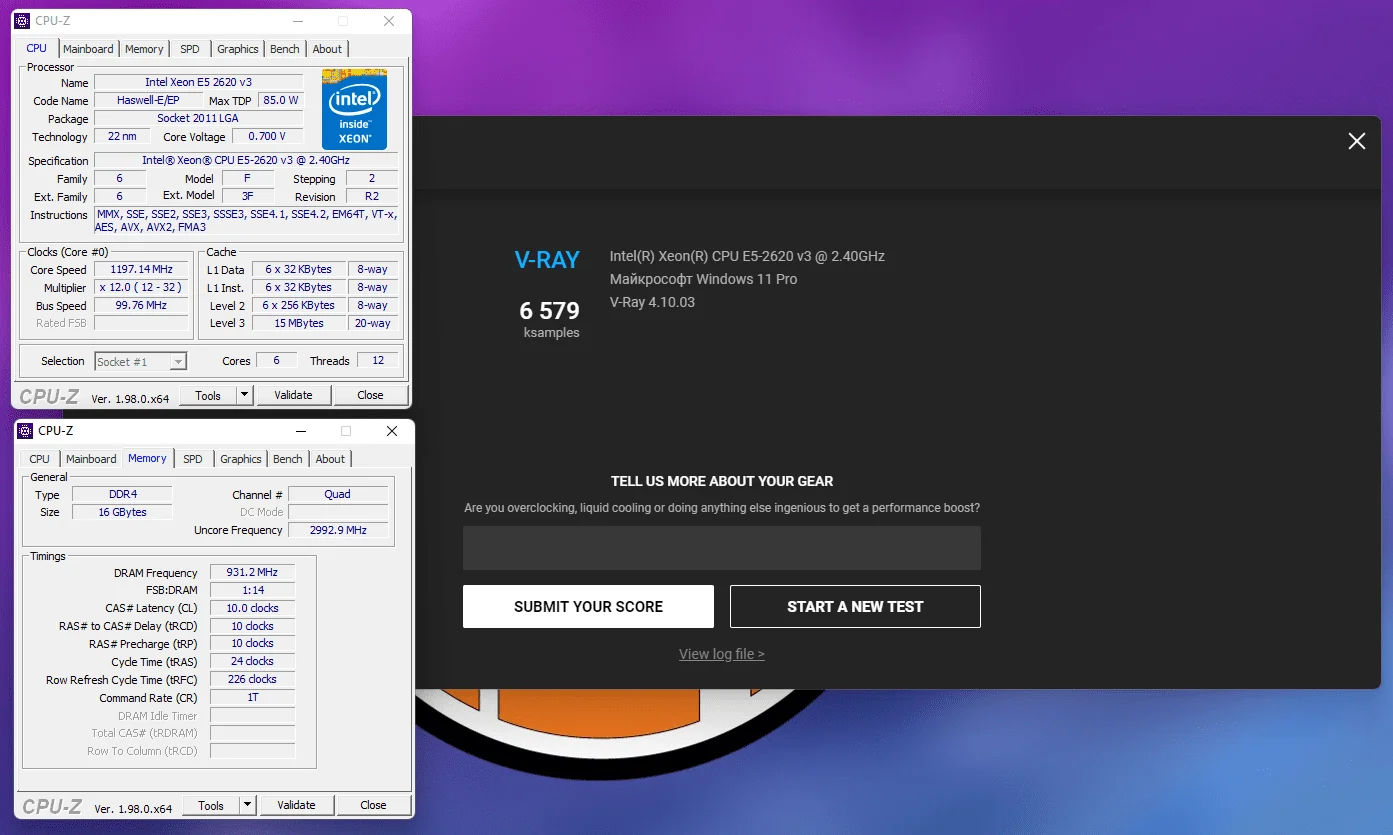
V-Ray 4
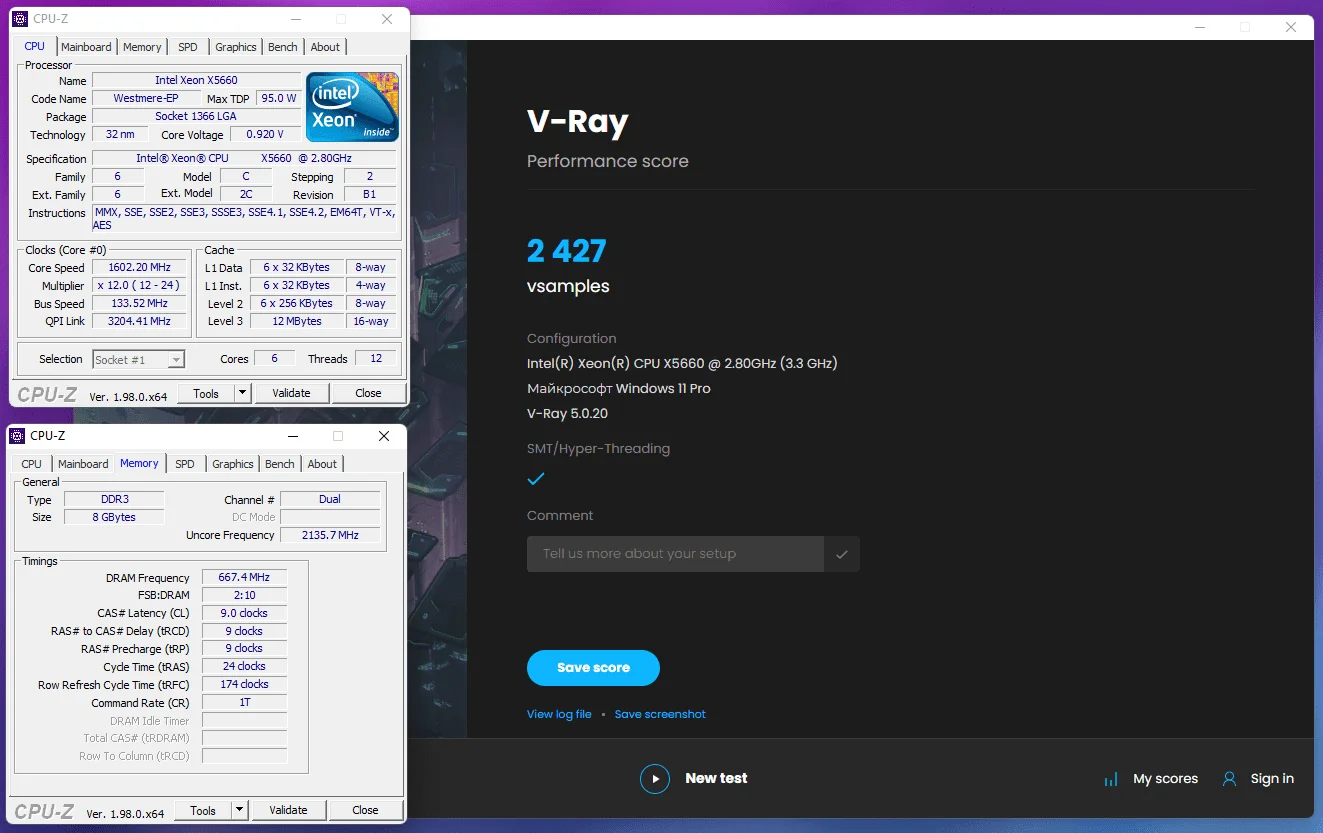
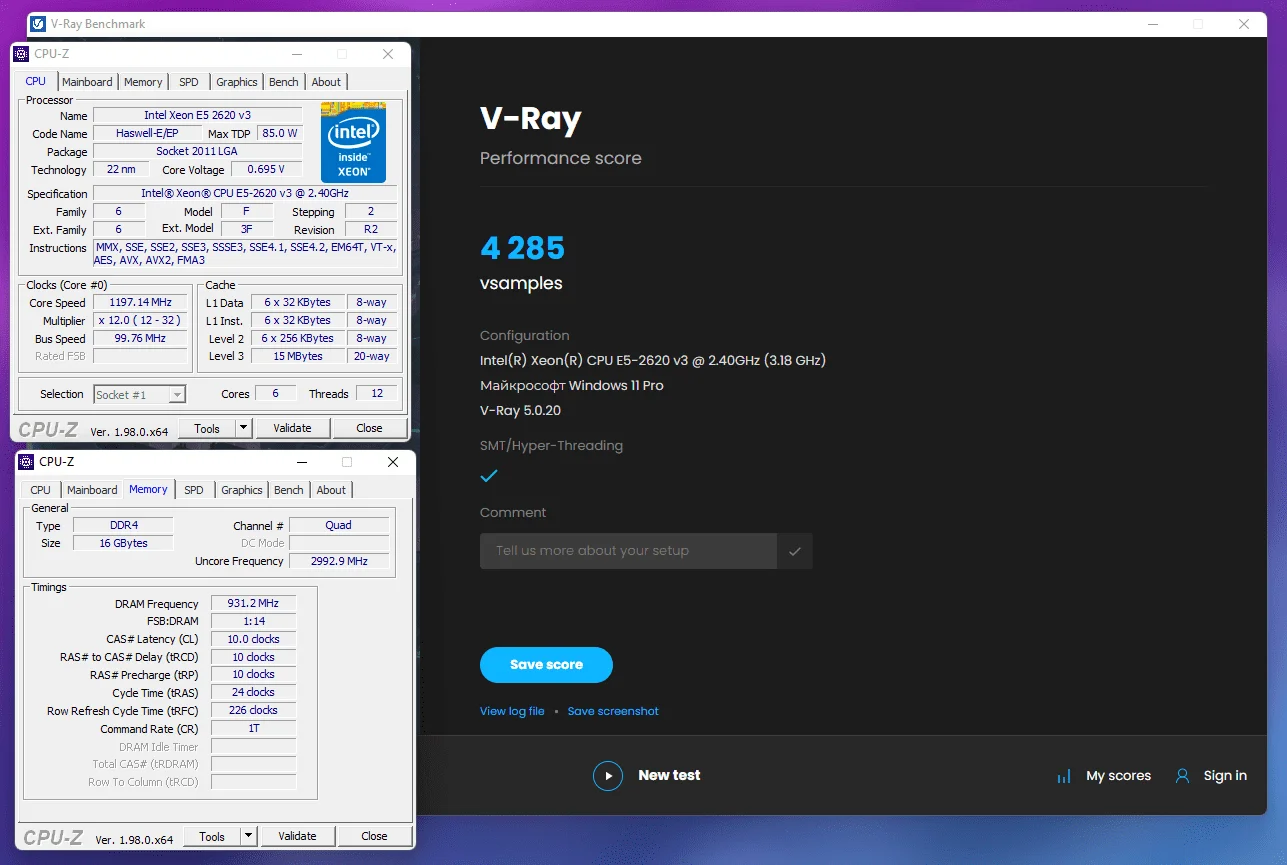
V-Ray 5
LinX
7-Zip
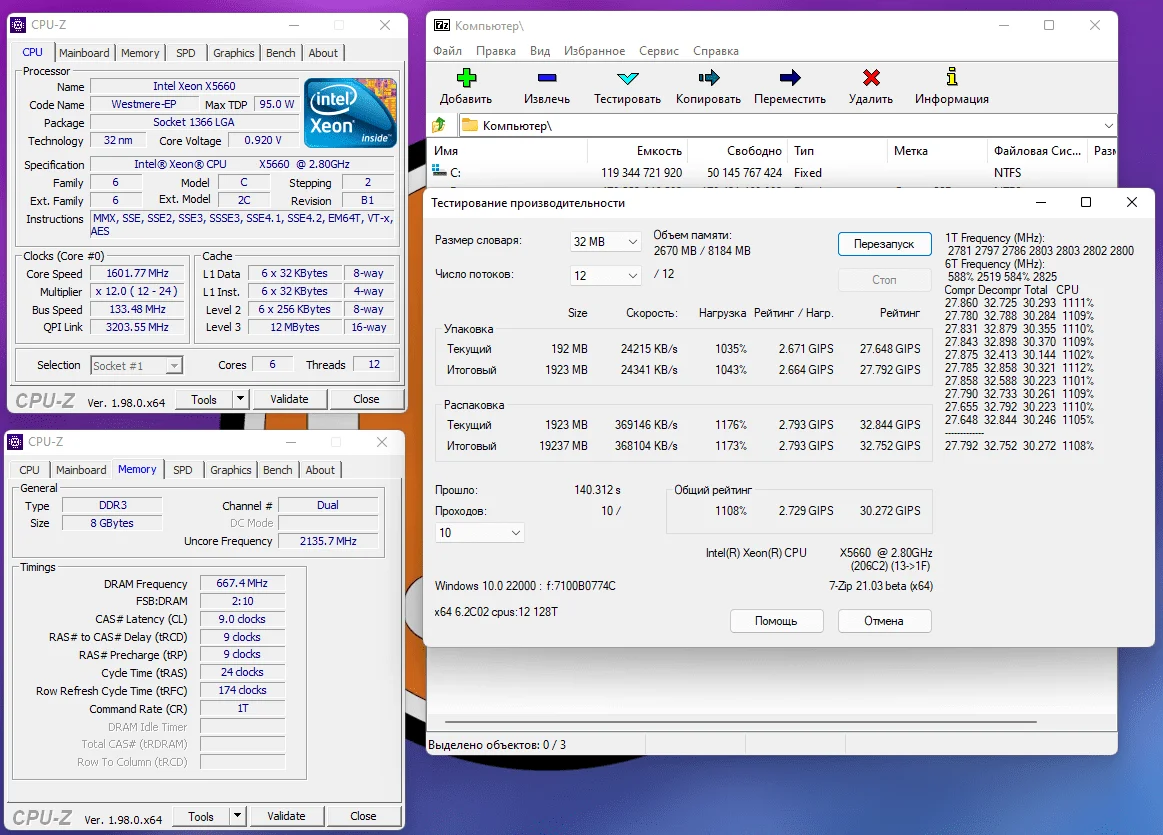
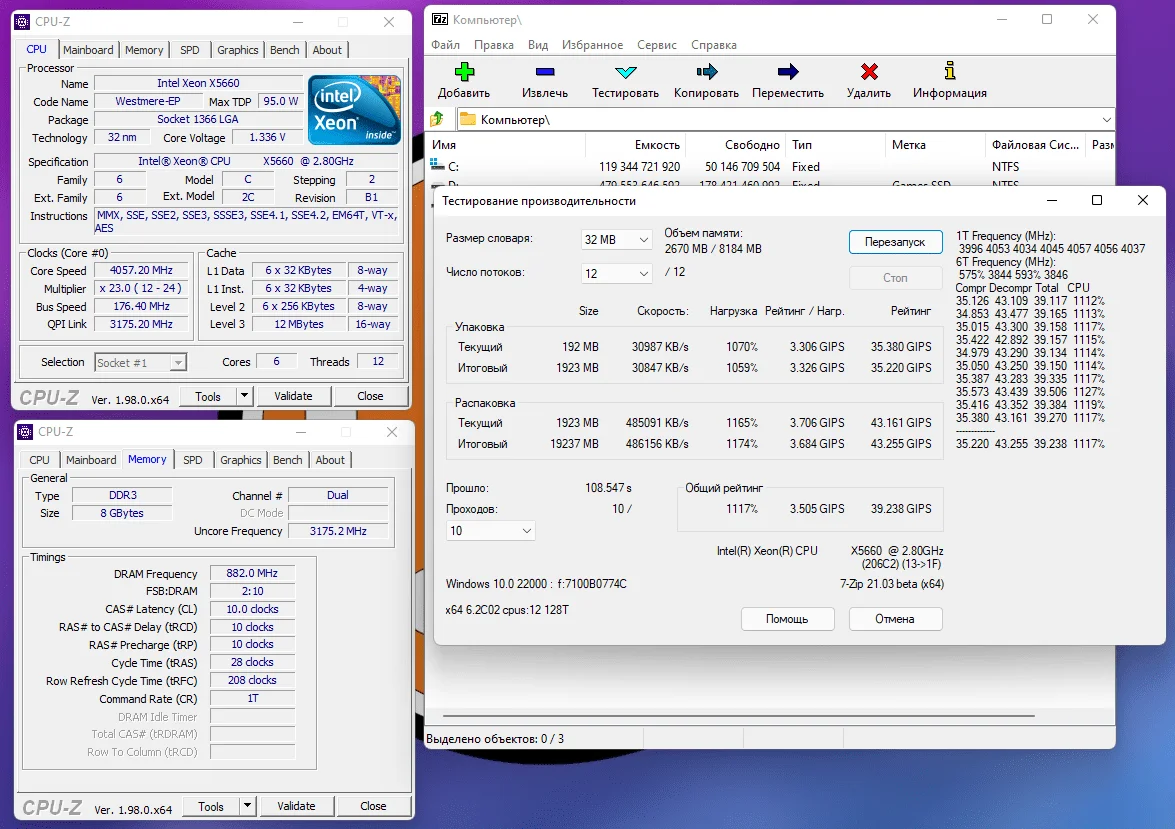
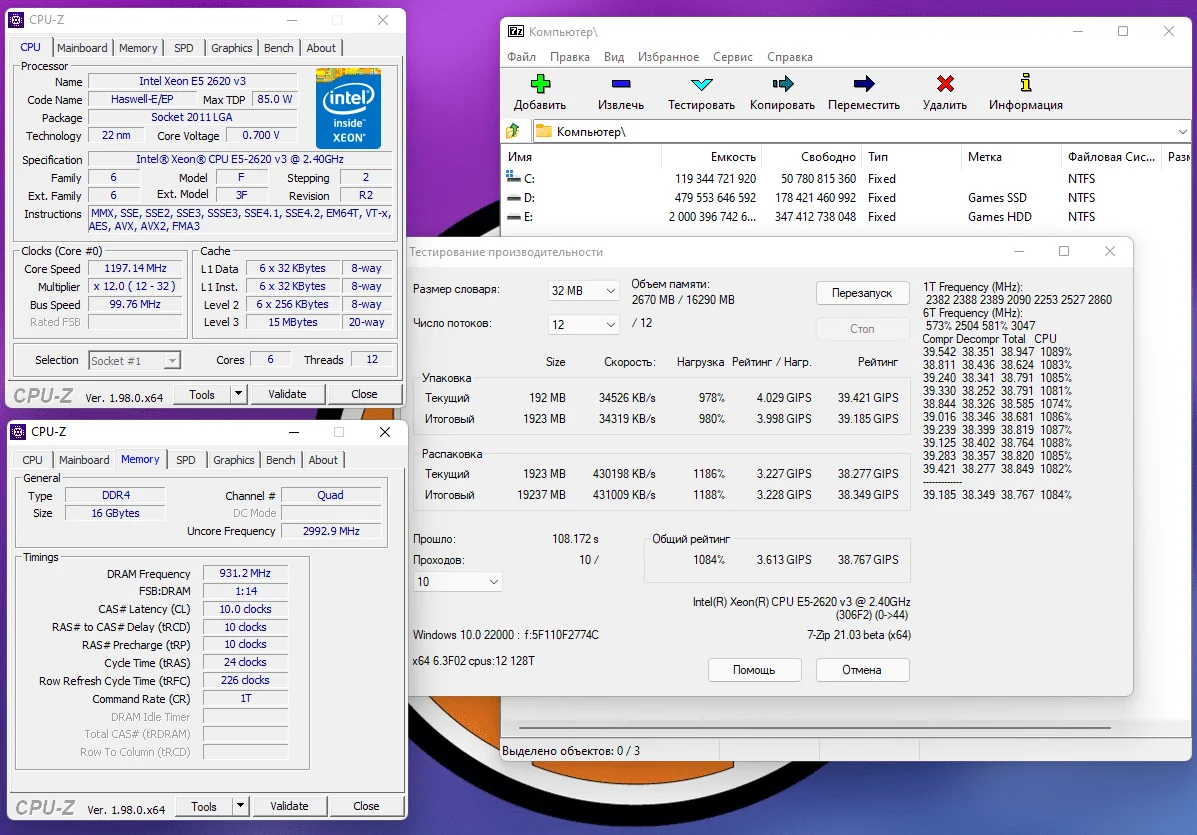
X5660: Application and benchmark results summary
Benchmark | X5660@2800-3066MHz | X5660@4057MHz | E5-2620v3@3200MHz | Overclocking gain | Difference between X5660@4057MHz and E5-2620v3@3200MHz |
Cinebench R15 | 670 | 905 | 963 | 35.07% | +6.40% |
Cinebench R20 | 1396 | 1877 | 2221 | 34.45% | +18.32% |
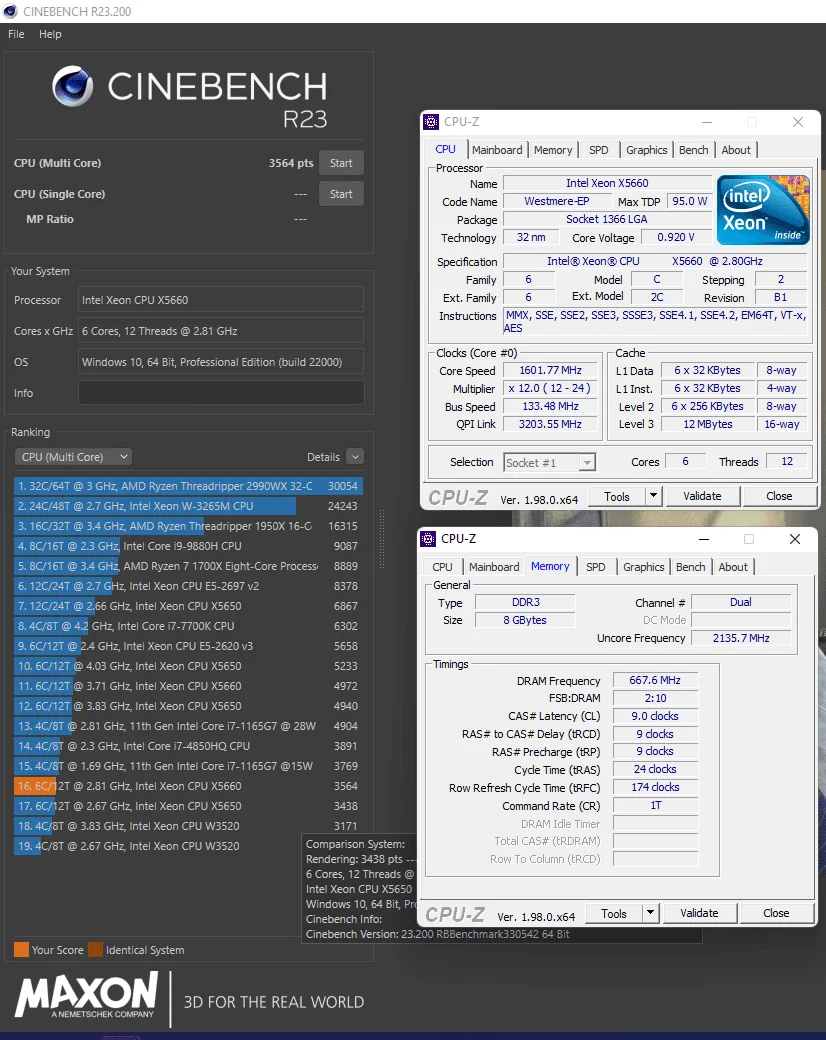
Cinebench R23 | 3564 | 4972 | 5658 | 39.11% | +13.79% |
V-Ray 4 | 3574 | 4899 | 6579 | 37.07% | +34.29% |
V-Ray 5 | 2427 | 3214 | 4285 | 32.42% | +33.32% |
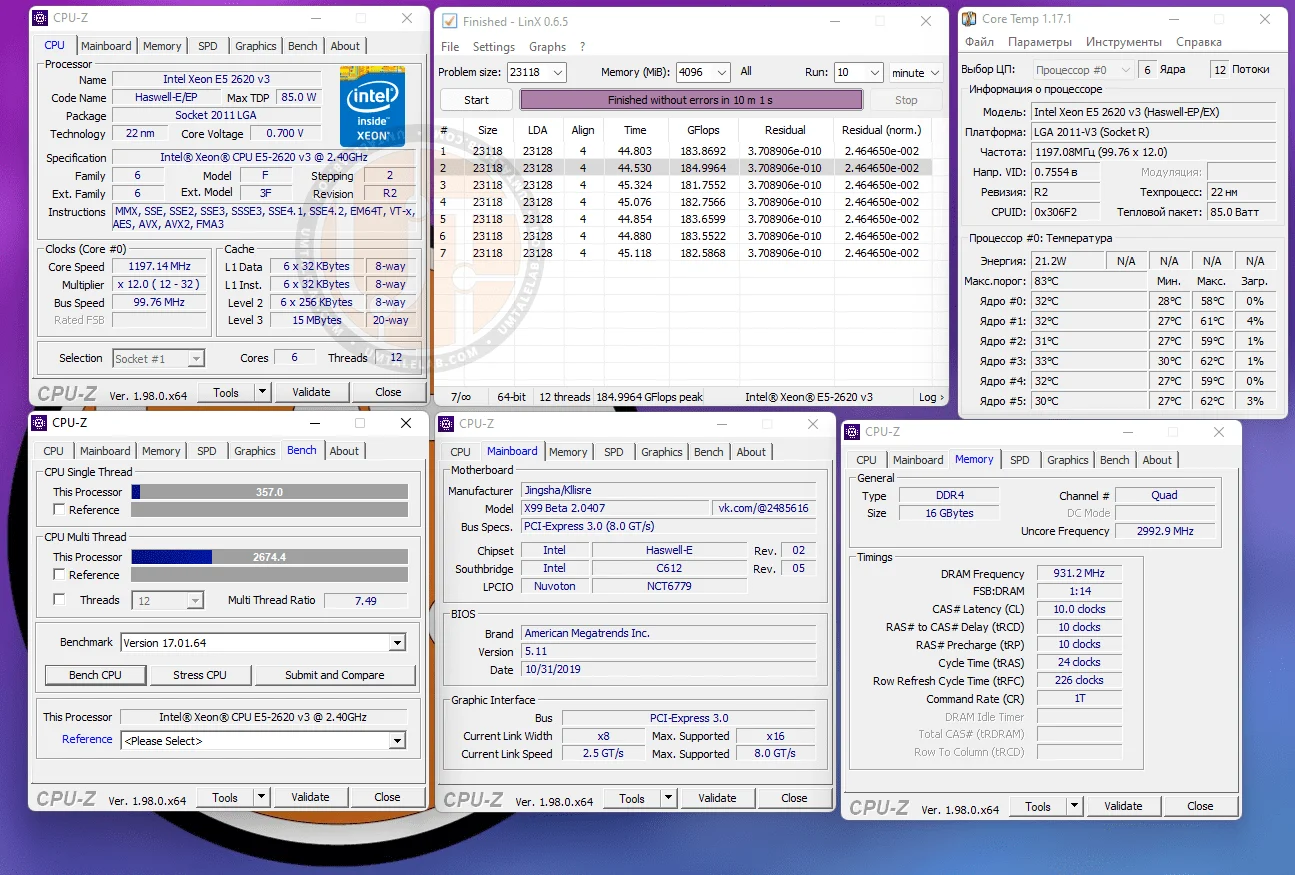
LinX 0.6.5 | 50.95 | 71.81 | 182 | 40.94% | +153.44% |
7-Zip | 30272 | 38238 | 38768 | 26.31% | +1.38% |
The average performance gain across benchmarks came in at roughly 36%. That's quite respectable, especially since the clock speed only jumped by 32%. Despite this, the X5660 at 4057MHz couldn't surpass the E5-2620v3 at 3200MHz in any of the seven benchmarks.
Gaming
Far Cry 5
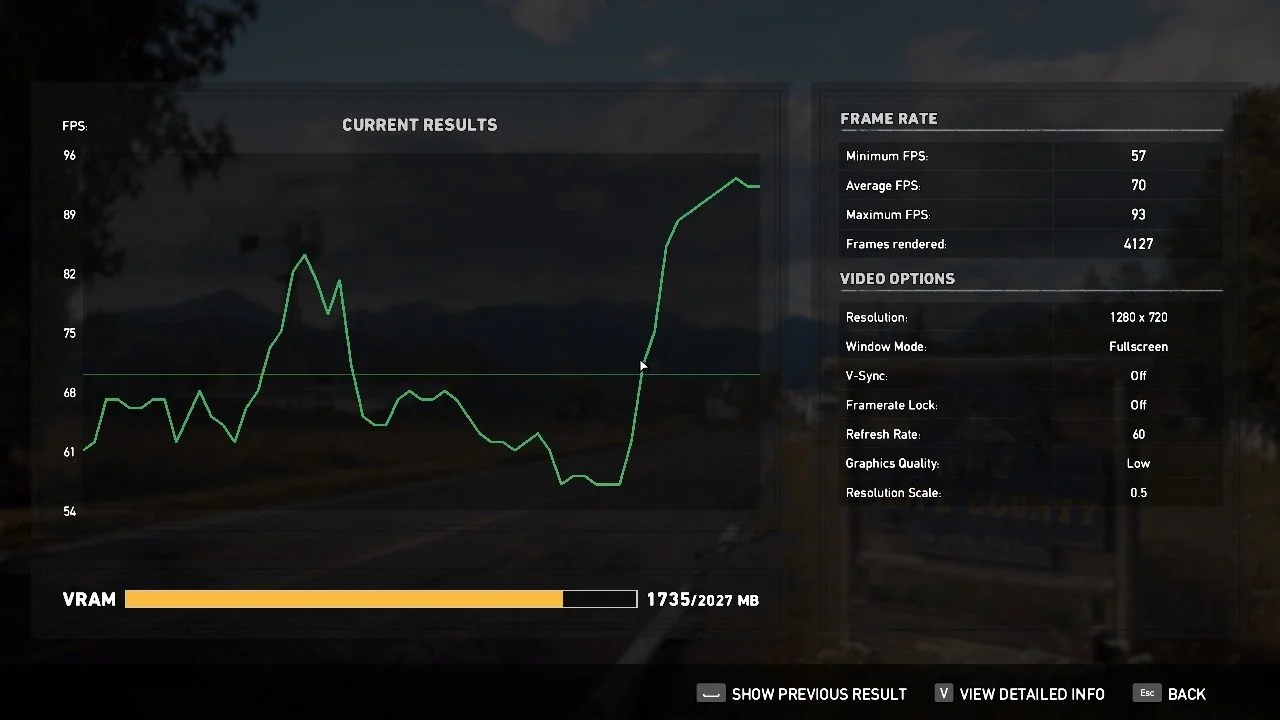
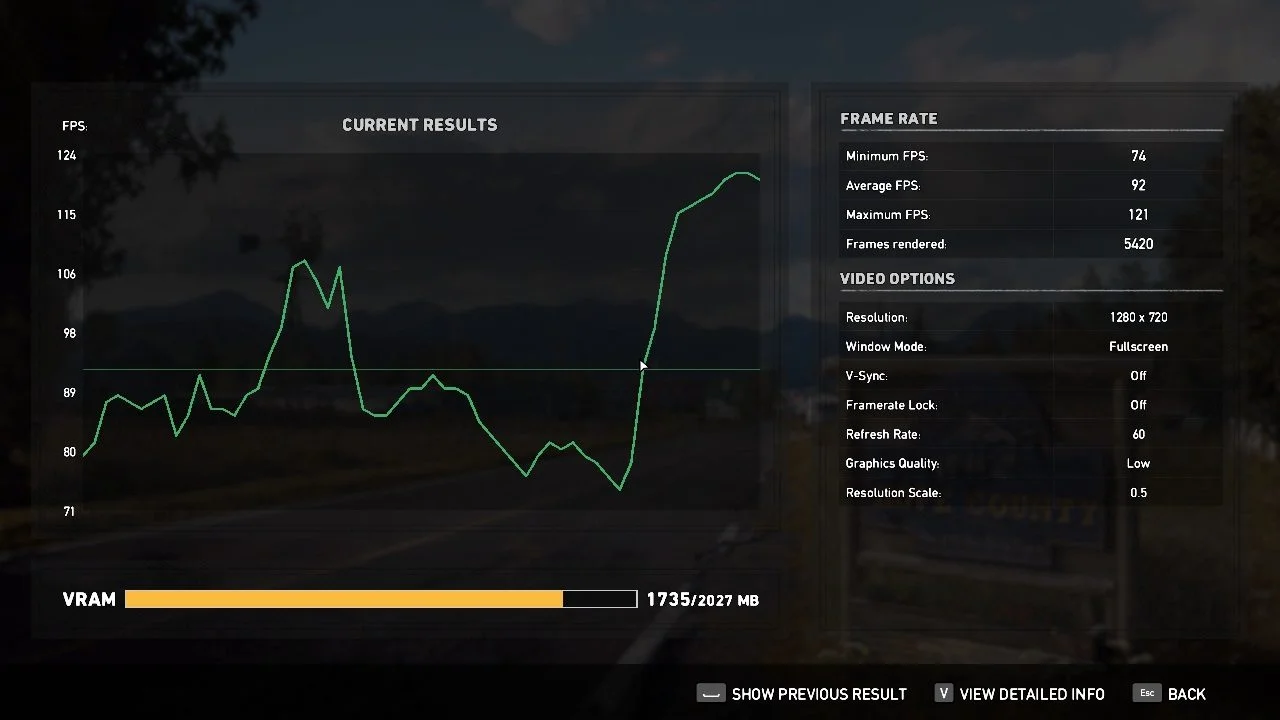
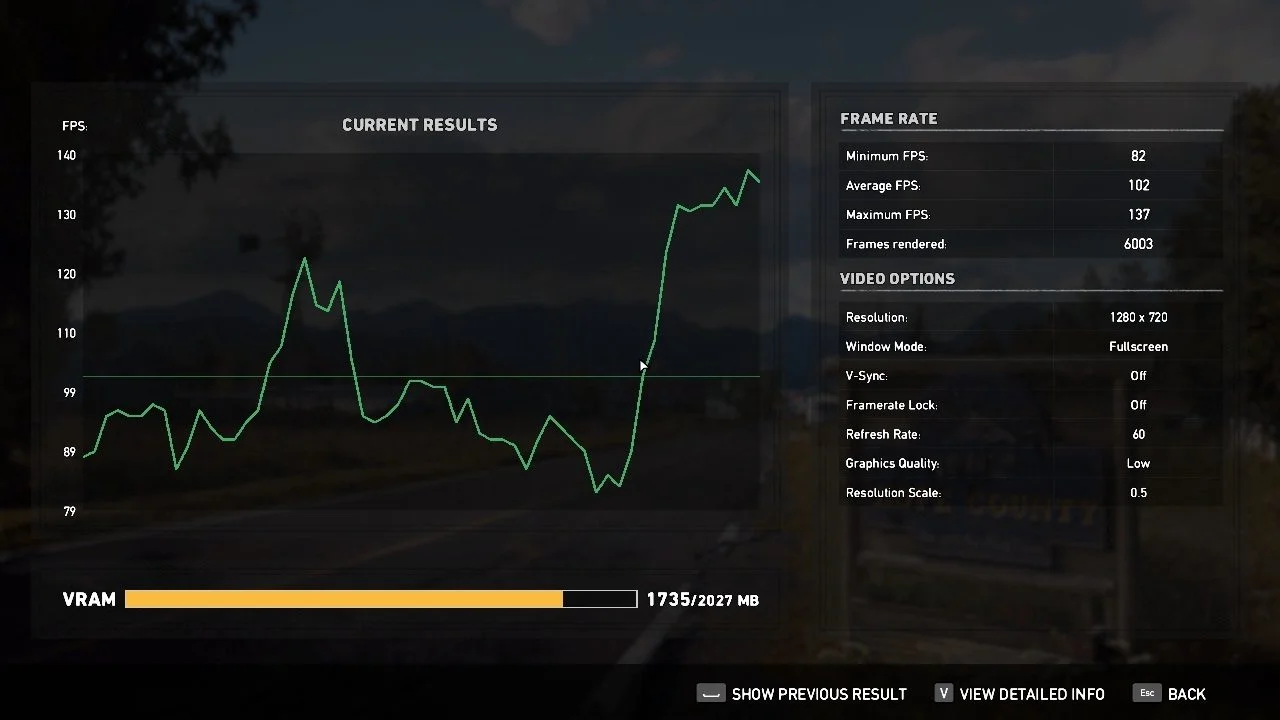
Far Cry 5 | Average FPS | Minimum FPS |
X5660@2800-3066MHz | 70 | 57 |
X5660@4057MHz | 92 | 74 |
E5-2620v3@3200MHz | 102 | 82 |
Overclocking gain | 31.42% | 29.82% |
Difference between X5660@4057MHz and E5-2620v3@3200MHz | 10.86% | 13.88% |
Watch Dogs Legion
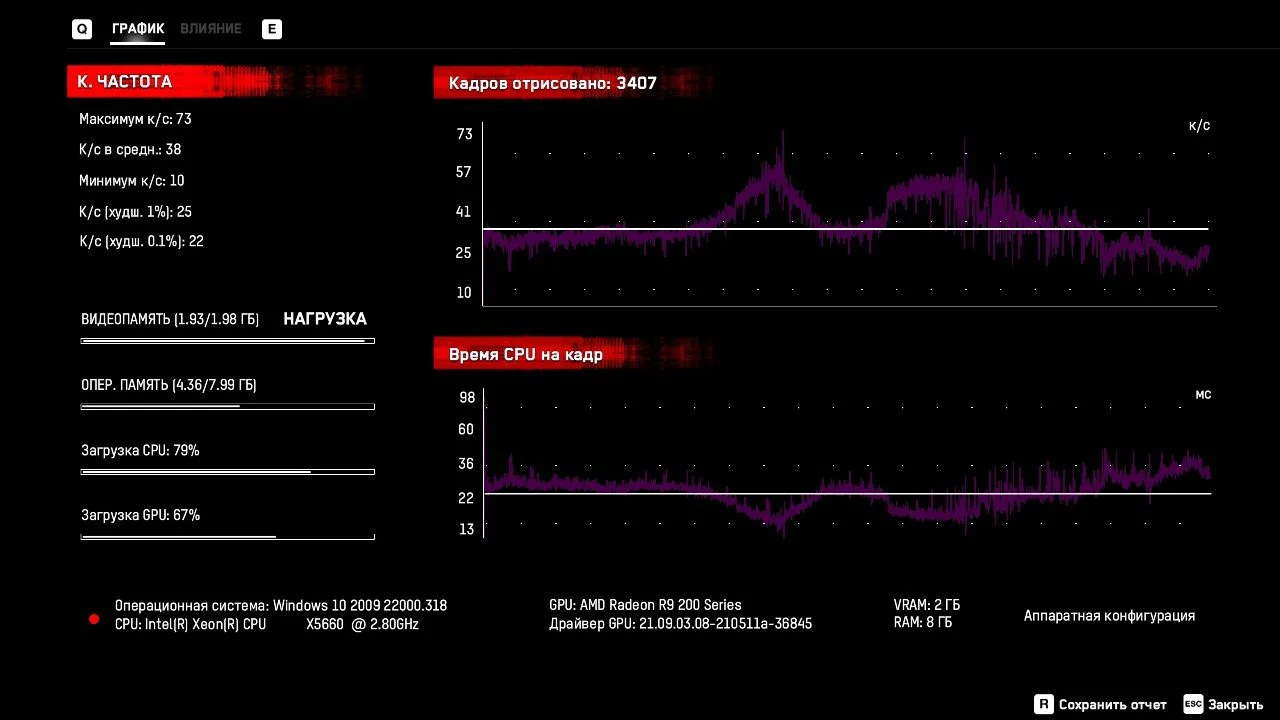
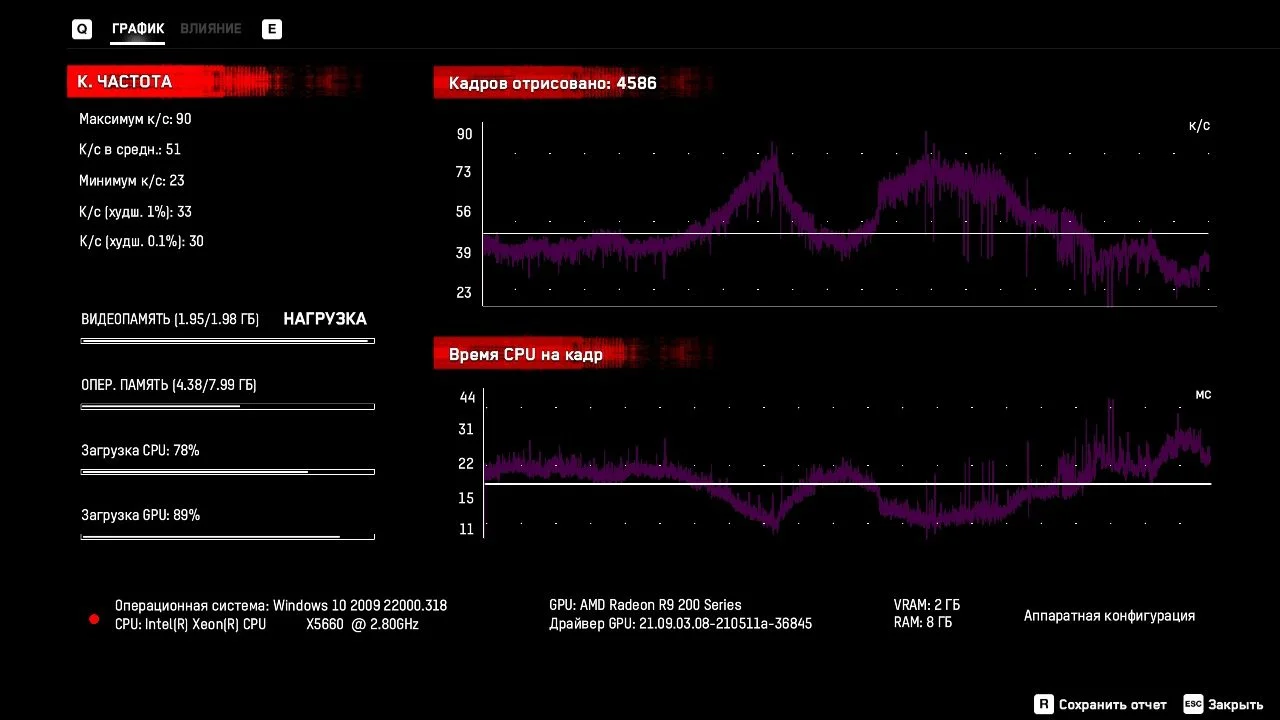
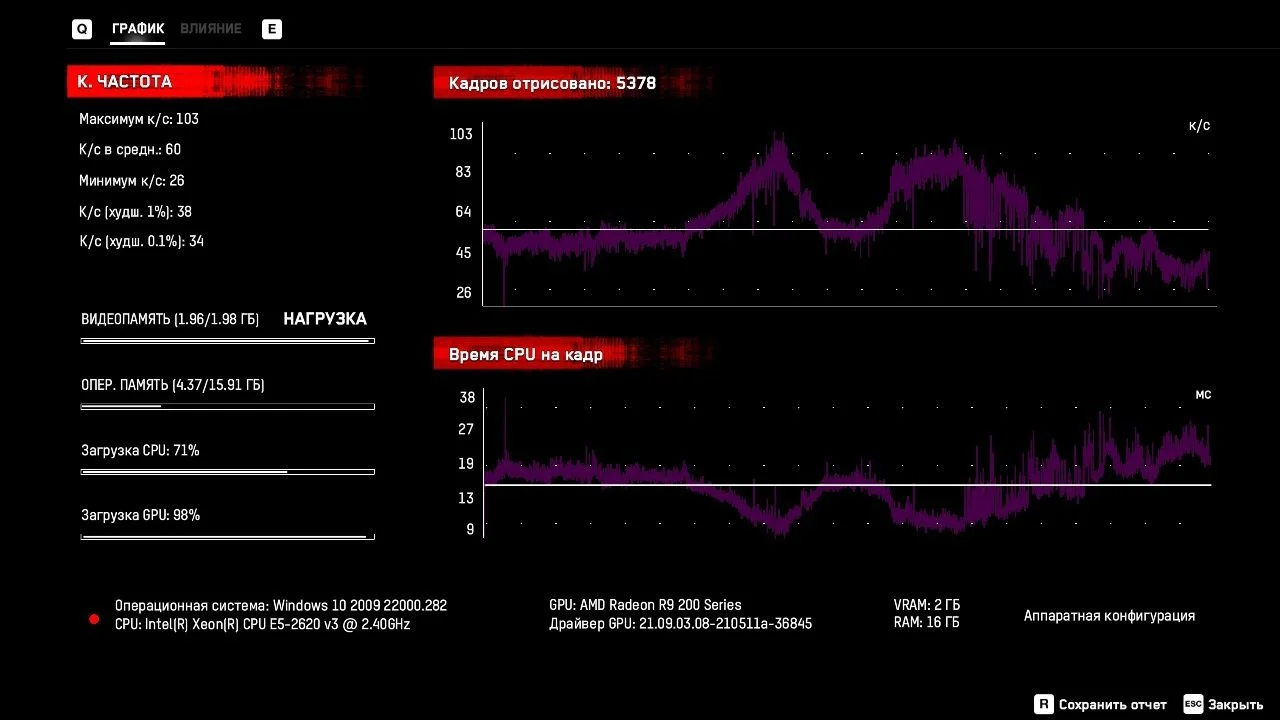
Watch Dogs Legion | Average FPS | Minimum FPS |
X5660@2800-3066MHz | 38 | 10 |
X5660@4057MHz | 51 | 23 |
E5-2620v3@3200MHz | 60 | 26 |
Overclocking gain | 34.21% | 129.99% |
Difference between X5660@4057MHz and E5-2620v3@3200MHz | 17.64% | 13.04% |
In gaming benchmarks, the average performance increase from overclocking was just ~32%. While this generally aligns with the clock speed increase, it's slightly less impressive when compared to synthetic benchmarks.
Summary
Unfortunately, our particular Xeon X5660 CPU turned out to be quite unlucky. However, frankly, achieving 4057MHz isn't the worst result. In fact, it aligns with the lower overclocking threshold for first-wave 32nm chips, a topic we covered in a previous article. Roughly 80-90% of all existing 6-core Westmere-EP processors (excluding very low-frequency CPUs) should be able to reach a similar clock speed. In our opinion, this is a perfectly acceptable outcome for an 11-year-old processor.
To conclude this article, we can now provide a tentative answer to the question posed at the very beginning: no, a higher-end processor model doesn't automatically guarantee greater overclocking potential simply because of its position in the product stack. Everything hinges on the silicon lottery of each individual CPU. However, it's worth noting that, in theory, when choosing more expensive models, your chances of winning that fabled silicon lottery are slightly higher compared to cheaper models with lower base frequencies.
In our specific case, the modest overclocking potential can likely be attributed to the advanced age of our Xeon X5660 test sample.
If you found this article helpful and would like to see more benchmarks like this from UmTale Lab, please support our website on Patreon! Our primary fundraising goal is to expand our hardware inventory and improve testing quality. This includes upgrading our test bench's storage to a larger SSD and purchasing a capture card to minimize the impact of ShadowPlay gameplay recording on final benchmark results, among other improvements.