BLOGS · OVERCLOCKING
PUBLISHED
READING13 min
Overclocking and benchmarking Athlon 200GE: 2 Zen cores in 2023
Can an Athlon 200GE with 2 Zen cores still power a gaming PC in 2023? We dive into its overclocking and performance to find out.
Dual-core processors have long been obsolete. They're now mostly relegated to office solutions or serve as temporary placeholder chips, soon to be replaced by a modern multi-core CPU.
The AMD Athlon 200GE once filled this role as a cheap, relatively performant placeholder. Many budget-conscious gamers and enthusiasts bought it with the intention of eventually upgrading to a 6-core Ryzen 5 1600 or Ryzen 7 1700. However, for one reason or another, not all 200GE owners followed through with their plans.
In this article, we'll explore the performance of this ultra-budget 2-core/4-thread solution and try to answer a key question: can such a processor still power a gaming PC in 2023?
It's worth noting upfront that the integrated Radeon Vega 3 GPU in the Athlon 200GE is, to put it mildly, uninspiring. Its performance is extremely low, meaning this integrated graphics solution can only handle very old games or current versions of older multiplayer titles. Nevertheless, we decided to benchmark it in a few current and relatively old games.
Processor
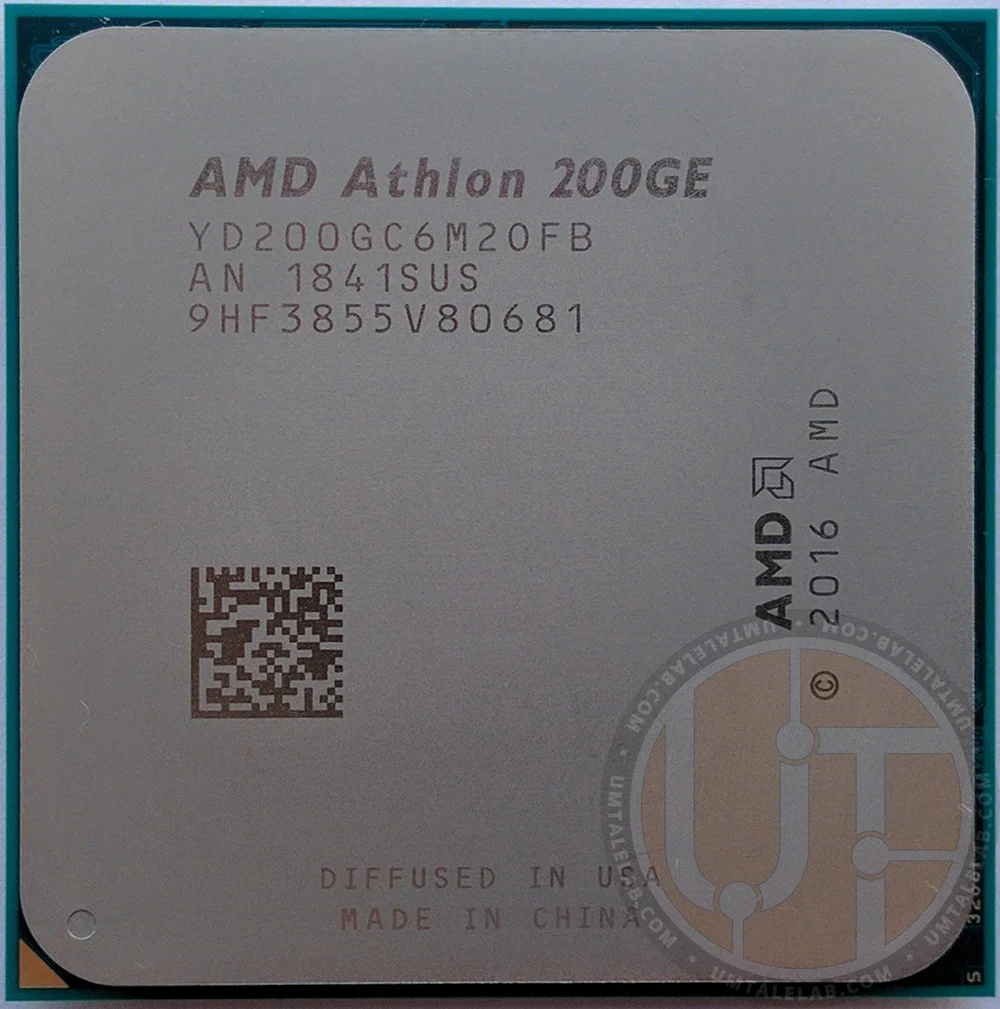
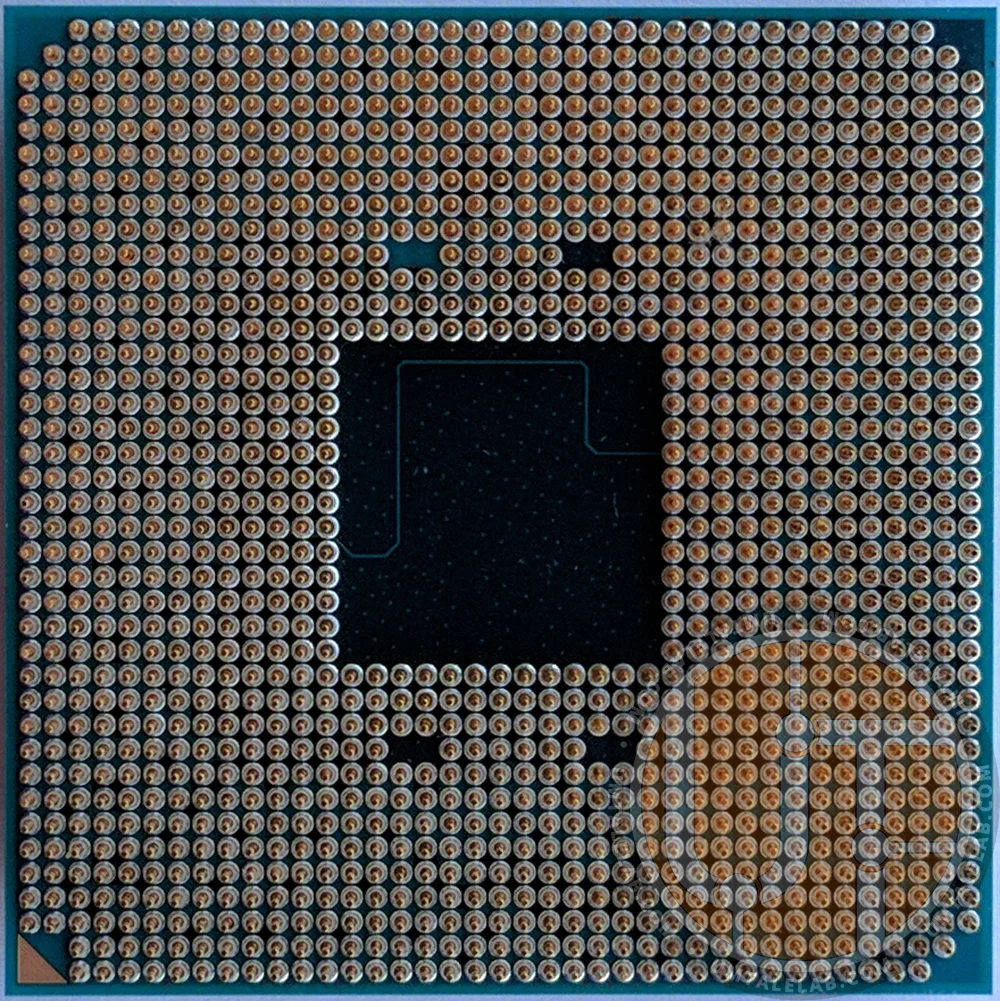
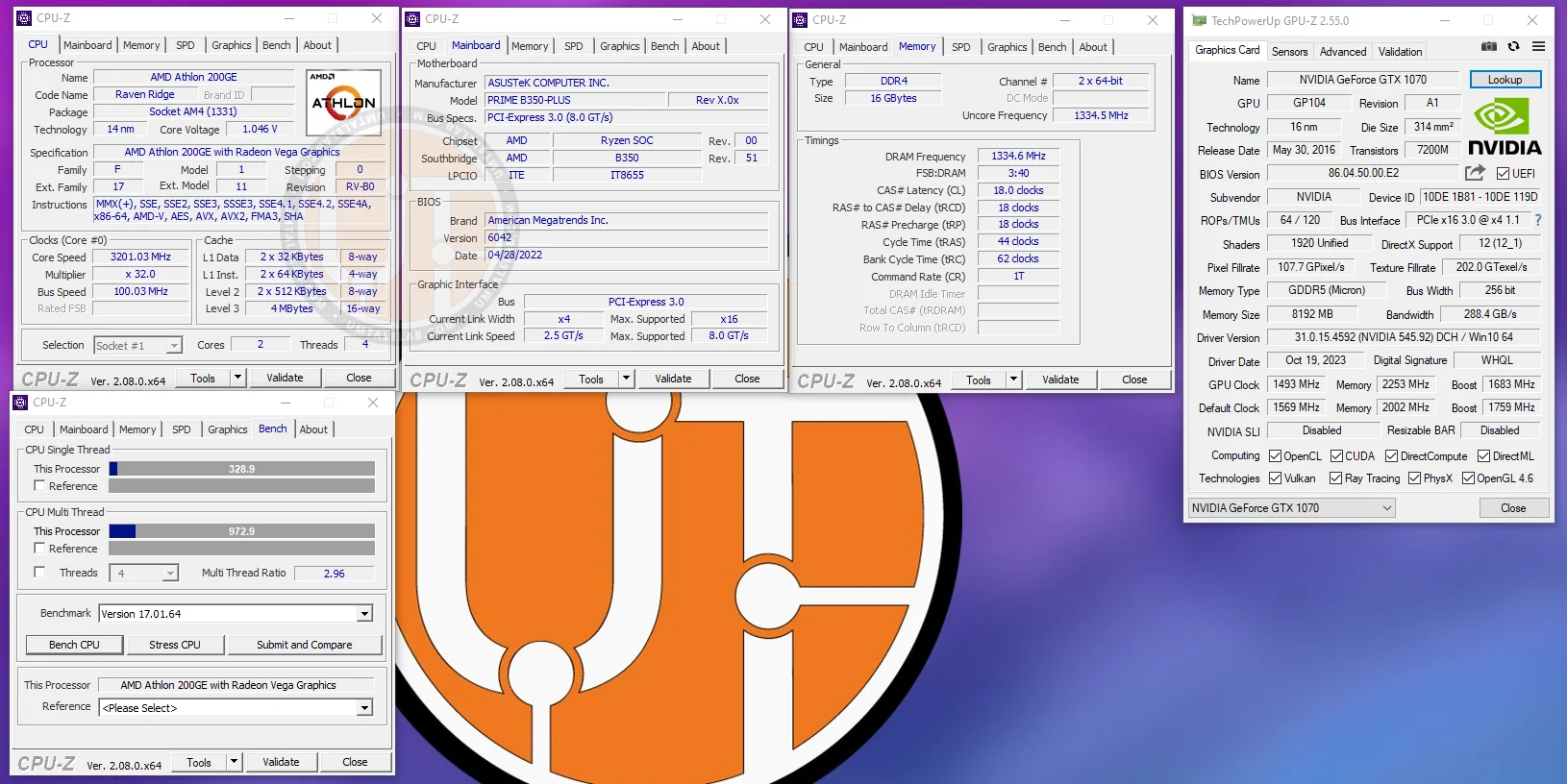
At the core of the Athlon 200GE is a monolithic 14nm Raven Ridge B0 die, featuring 2 cores and 4 threads. The chip's nominal frequency is only 3200 MHz, and, unfortunately, it lacks Precision Boost technology. However, this keeps the 2-core Zen's TDP at a modest 35 watts.
 ⤢ ВІДКРИТИ
The CPU features 512 KB of L2 cache per core and a total of 4 MB of L3 cache. This CPU is designed for AM4 motherboards.
The speed of the 200GE's integrated memory controller is tied to the RAM frequency and fully depends on its dividers. Consequently, AMD's factory specifications state that this CPU only supports DDR4@2667MHz memory. However, this is quite easy to fix; we'll delve into the details later.
It's also important to note that the Athlon 200GE processor only has four external PCI-Express 3.0 lanes. This means that when a discrete graphics card is installed with this CPU, its communication speed with the chip will be significantly limited. This limitation makes the dual-core Athlon a suboptimal choice for 75% of currently available discrete graphics adapters.
Beyond these specifications, the 2-core Zen also includes essential instructions for 2023, such as SSE4.2, FMA3, AVX, and AVX2.
Processor and RAM overclocking
First, it's important to note that not all motherboards can overclock processors with a semi-locked multiplier, which the Athlon 200GE essentially is. For instance, our lab's ASRock B450M-HDV board doesn't allow changing either the multiplier or the base clock of the test CPU. However, the ASUS Prime B350 Plus has no trouble overclocking AMD's budget solution, as its BIOS can control both the multiplier and BCLK frequency.
Given that the Zen architecture isn't as directly reliant on BCLK overclocking as Bulldozer/Piledriver, we decided to overclock the Athlon 200GE by adjusting its multiplier.
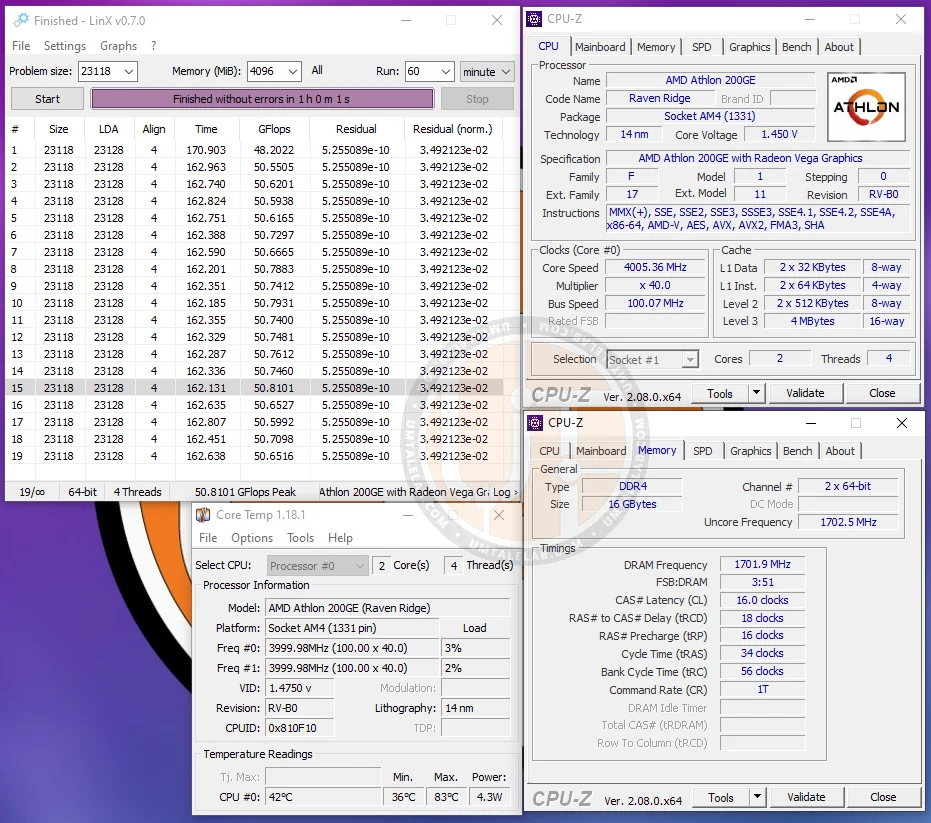
At a nominal voltage of 1.05 volts, the chip was stable at 3400 MHz. It reached 3600 MHz at 1.20 volts, but further core overclocking became extremely challenging. 3800 MHz was only achievable after increasing the core voltage to 1.325 volts. 1.4 volts were needed for 3900 MHz, and finally, a substantial 1.45 volts (1.44 according to multimeter readings under load) was required to hit the psychological 4 GHz mark.
Overclocking is always a lottery, but it's worth noting that our lab's Ryzen 3 1200 only needed 1.425 volts to reach 4100 MHz.
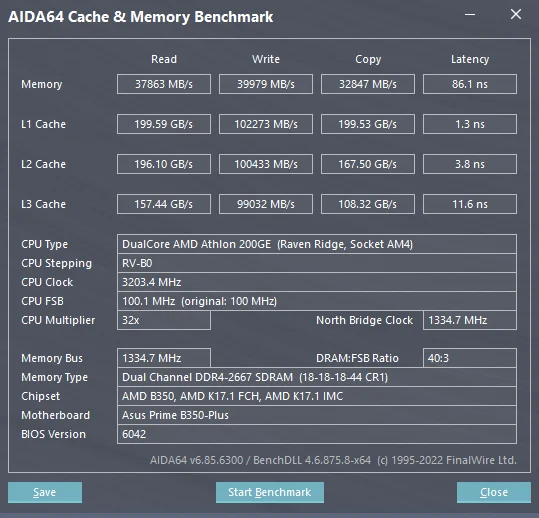
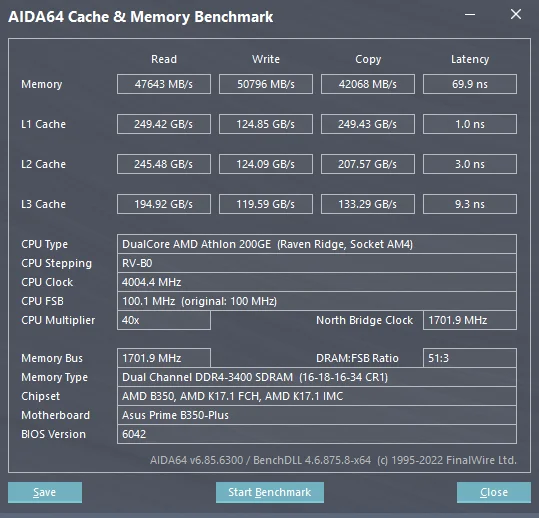
Now, let's move on to overclocking the RAM and Infinity Fabric bus. Fortunately, things were a bit more interesting here. First, we set the DDR4 voltage to 1.36 volts and timings to 16-18-16-34 (we chose these timings based on prior tests; yours might differ, so use timings from your XMP profile).
At the nominal SoC voltage, the memory reached 2933 MHz, and the bus hit 1466 MHz. Increasing the voltage to 1.05 volts yielded 3200/1600 MHz, while 1.1 volts opened the door to 3333/1666 MHz. Finally, at 1.175 volts, Infinity Fabric proved completely stable at a significant 1700 MHz, with DDR4, in turn, reaching 3400 MHz.
 ⤢ ВІДКРИТИ
With these settings, the system was absolutely stable in the Linx 0.7.0 AVX stress test. In the simpler AIDA stress test, the Athlon 200GE reached 4075 MHz with similar voltages.
If you decide to replicate this experiment, keep in mind that increasing voltage above 1.4 volts is not overly safe. Therefore, any modifications you make to your hardware are entirely at your own risk!
The results of our research yielded the following values:
CPU frequency – 4005 MHz (multiplier 40, BCLK frequency 100 MHz);
CPU core voltage – 1.45v;
DDR4 frequency – 3600 MHz, timings 16-18-16-34;
DDR4 voltage — 1.360v;
Infinity Fabric – 1800 MHz;
SOC voltage (IF) — 1.170v;
Further increases in voltage yielded no results. While we have no complaints regarding the RAM or Infinity Fabric overclock, the final core frequency was a bit disappointing.
Test setup, software, and CPU settings
Test setup
Processors— Core i5-2500K, FX-4350, Athlon 200GE, Ryzen 3 1200;
CPU Cooler— Cooler Master Hyper 212 Black Edition (RR-212S-20PK-R1);
RAM for AM3+/LGA 1155— Two 8GB HyperX Genesis Na’Vi Edition (KHX16C9C2K2/8) modules, totaling 16GB;
RAM for AM4— Two 8GB Corsair Vengeance RGB PRO (CMW16GX4M2C3600C18) modules, totaling 16GB;
AM3+ Motherboard— ASUS M5A97 LE R2.0 (BIOS 2701);
AM4 Motherboard— ASUS Prime B350 Plus (BIOS 6042);
LGA 1155 Motherboard— Gigabyte GA-Z68P-DS3 (rev. 2.0, BIOS Ua6);
Graphics card— Manli Gallardo GeForce GTX 1070 8GB (~2000/9000MHz, Power Limit 112%);
Solid-state drive— KINGSTON SUV400S37120G 120GB (Windows 10), KINGSTON SUV400S37240G 240GB + KINGSTON SUV400S37400G 400GB (Games);
Power supply— Chieftec GPS-1250C.
Software
Operating system:Windows 10 x64 with the latest updates as of October 2023;
Graphics card drivers:NVIDIA GeForce 545.92 WHQL;
Additional software for FPS measurement:MSI Afterburner 4.6.5;
Games:Testing was performed on the latest game versions as of October 2023;
Game settings:Given the extremely low performance of 4-thread solutions in modern titles, we decided to conduct testing at the lowest possible graphics settings at 1080p resolution.
Test CPU settings
AMD Processors: Athlon 200GE@3200MHz, Dual Channel DDR4@2667MHz (18-18-18-44);
Athlon 200GE@4005MHz, Dual Channel DDR4@3400MHz, Infinity Fabric@1700MHz (16-18-16-34, CPU Core voltage — 1.45v, SOC voltage — 1.170v, DDR4 voltage — 1.36v);
FX-4350@4200-4300MHz, Dual-Channel DDR3@1866MHz (11-11-11-28);
FX-4350@4731MHz, CPU-NB@2628MHz, Dual-Channel DDR3@2102MHz (11-12-12-30, CPU Core voltage — 1.44v, CPU-NB voltage — 1.375v, DDR3 voltage — 1.690v);
Ryzen 3 1200@3100-3400MHz, Dual Channel DDR4@2667MHz (18-18-18-44);
Ryzen 3 1200@4100MHz, Dual Channel DDR4@3400MHz, Infinity Fabric@1700MHz (16-18-16-34, CPU Core voltage — 1.428v, SOC voltage — 1.175v, DDR4 voltage — 1.37v);
Intel Processors: Core i5-2500K@3300-3700MHz, DDR3@1333MHz;
Core i5-2500K@4714MHz, DDR3@1912MHz (CPU Core voltage – 1.452v, QPI/Vtt voltage – 1.250v, CPU PLL voltage – 1.800v, DDR3 voltage 1.680v);
Benchmark results
Data archiving
7-Zip
 ⤢ ВІДКРИТИ
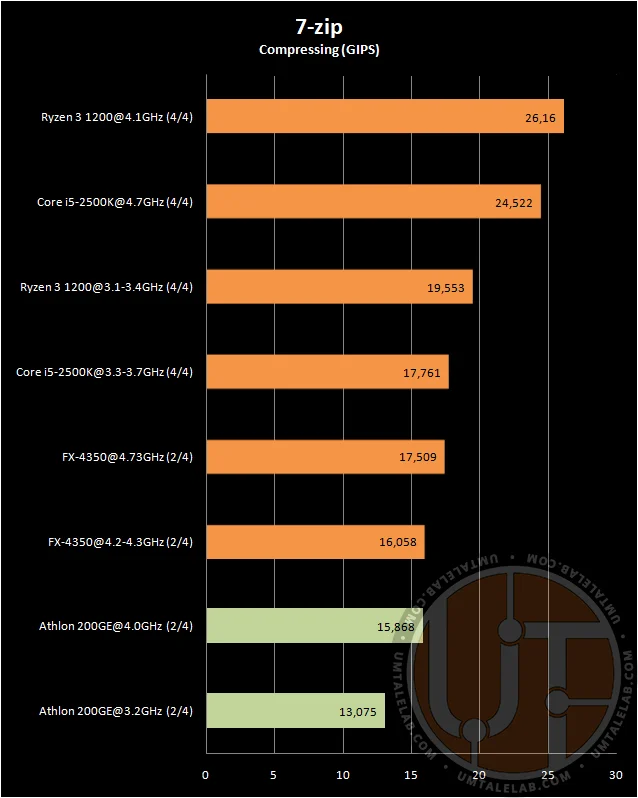
The Athlon 200GE's performance in the free 7-Zip archiver isn't particularly impressive. The dual-core Zen processor actually lost to the 2-module FX-4350, both at stock frequencies and when overclocked.
3D rendering
Blender 3.6.5
 ⤢ ВІДКРИТИ
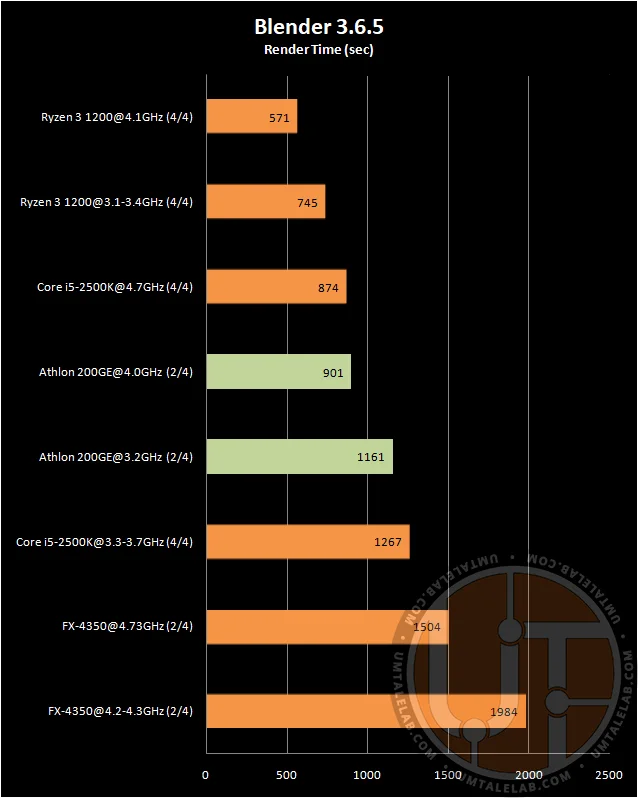
However, the 200GE chip shines in the final rendering of the free 3D editor Blender 3.6.5. At stock frequencies, the dual-core chip managed to outperform its direct competitor, the stock and overclocked FX-4350, as well as the Core i5-2500K running at its nominal clock speed. Overclocking to 4GHz allowed the Athlon to match the performance of the 4-core Sandy Bridge, even when the latter was pushed to a significant 4.7GHz.
Cinebench R23
 ⤢ ВІДКРИТИ
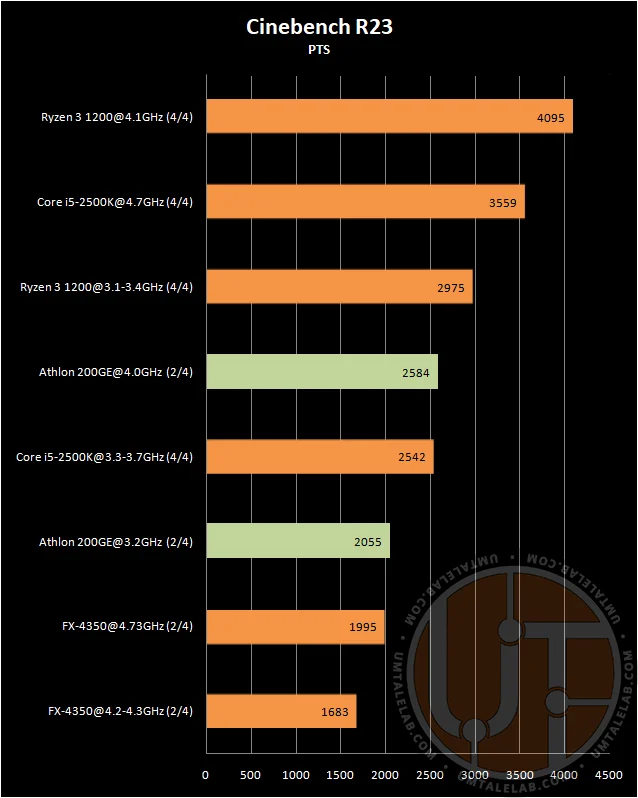
We saw roughly similar results in the Cinebench R23 benchmark as we did in Blender, with the notable exception of the Core i5-2500K: in this test, Intel's processor proved significantly stronger.
Only with an overclock to 4GHz did the Athlon 200GE manage to approach the performance of the stock Sandy Bridge.
Web browsing
JetStream 2.01
 ⤢ ВІДКРИТИ
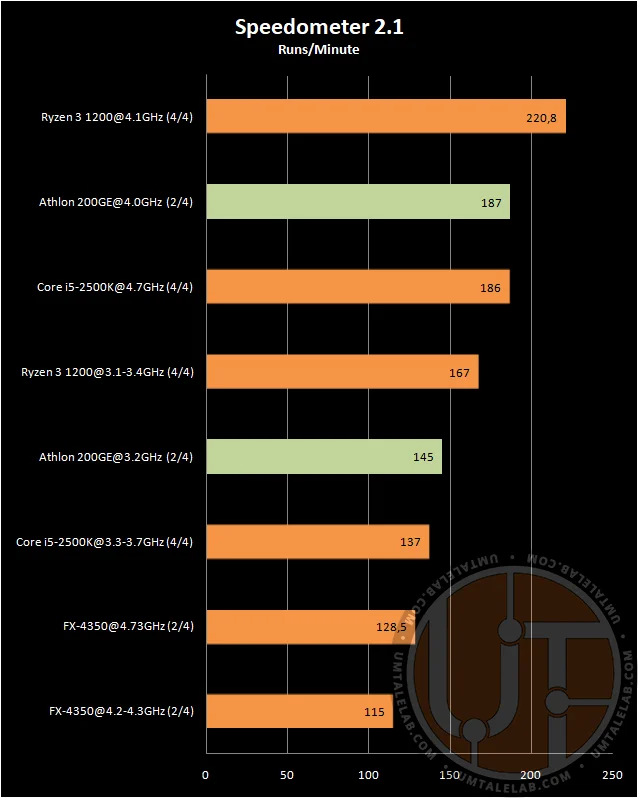
Speedometer 2.01
 ⤢ ВІДКРИТИ
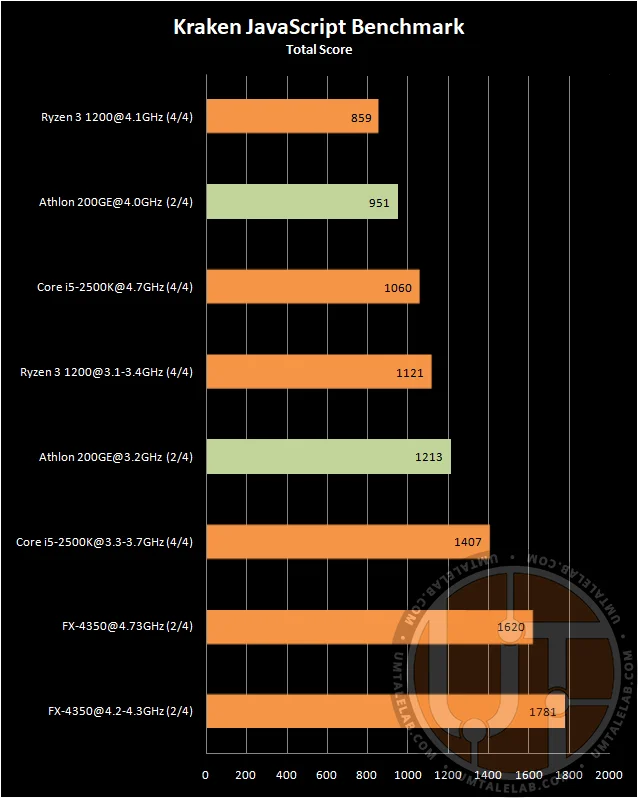
Kraken JavaScript benchmark
 ⤢ ВІДКРИТИ
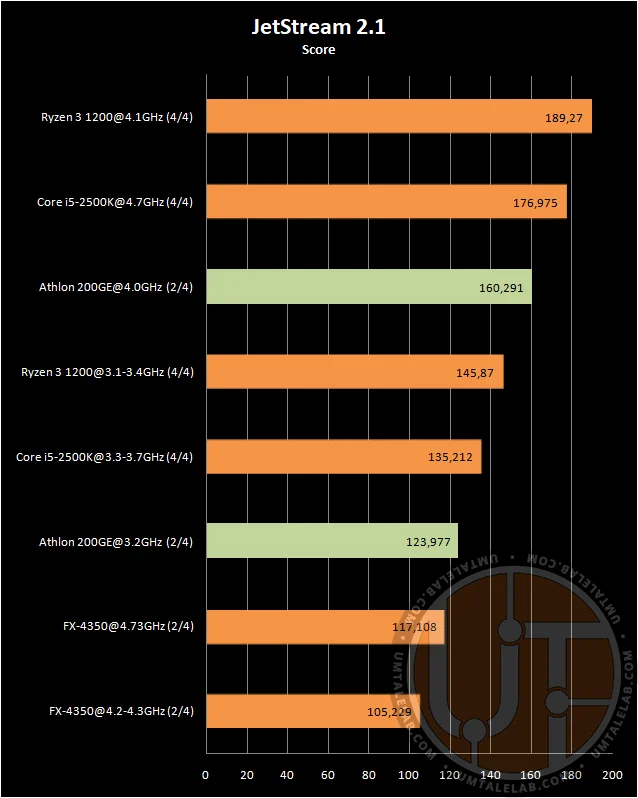
If there's one area where AMD's 4-thread chip still shines, it's web browsing. The reason for these results is quite simple: browsers still can't effectively utilize a large number of CPU threads. This means that even with only two cores/four threads, the relatively modern Zen architecture often proves slightly faster than a 4-core Sandy Bridge.
Overclocking gains in software benchmarks
Application: | Athlon 200GE@4000MHz |
|---|---|
7-Zip | 21.36% |
Blender 3.6.5 | 22.39% |
Cinebench R23 | 25.74% |
JetStream 2.01 | 30.08% |
Speedometer 2.01 | 28.97% |
Kraken JavaScript Benchmark | 27.55% |
Gaming
While the Athlon 200GE does boast all the accompanying Zen architecture "goodies," like AVX2 instructions, this unfortunately doesn't enable the dual-core chip to competently run most games released in 2023. Titles such as Starfield and Alan Wake 2 weren't even included in this test due to extremely low performance, even with all available patches and community fixes. Still, even in this situation, we have some interesting findings to share.
Counter-Strike 2
 ⤢ ВІДКРИТИ
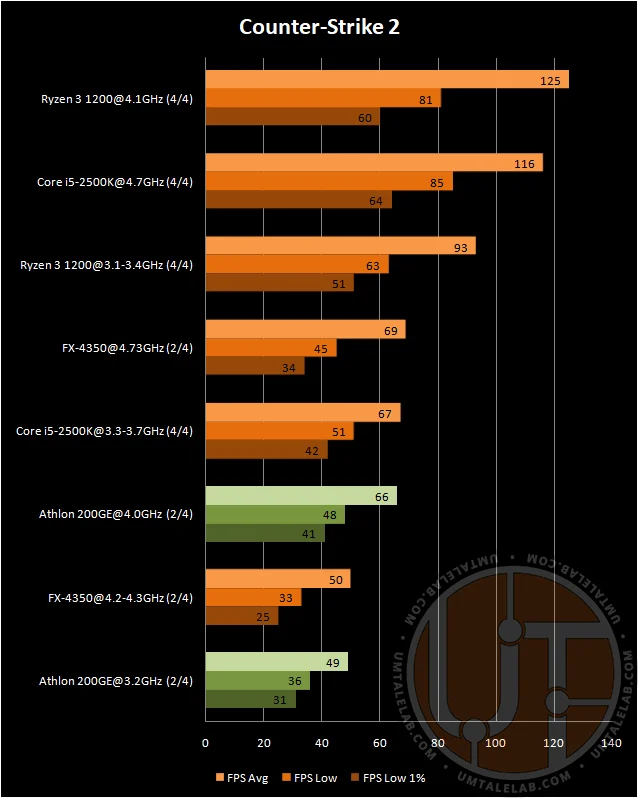
Let's start with gaming. The recently released Counter-Strike 2 performs quite poorly on most budget processors, and the Athlon 200GE is no exception. However, an overclock to 4 GHz somewhat remedies the situation, allowing this ultra-affordable CPU to hit the coveted 60 frames per second.
What's more interesting, though, is that older chips like the stock Core i5-2500K and the overclocked FX-4350 deliver results that are no worse than the overclocked Athlon 200GE. In fact, a boosted 2500K even comes close to the Ryzen 3 1200@4100MHz.
Dota 2
 ⤢ ВІДКРИТИ
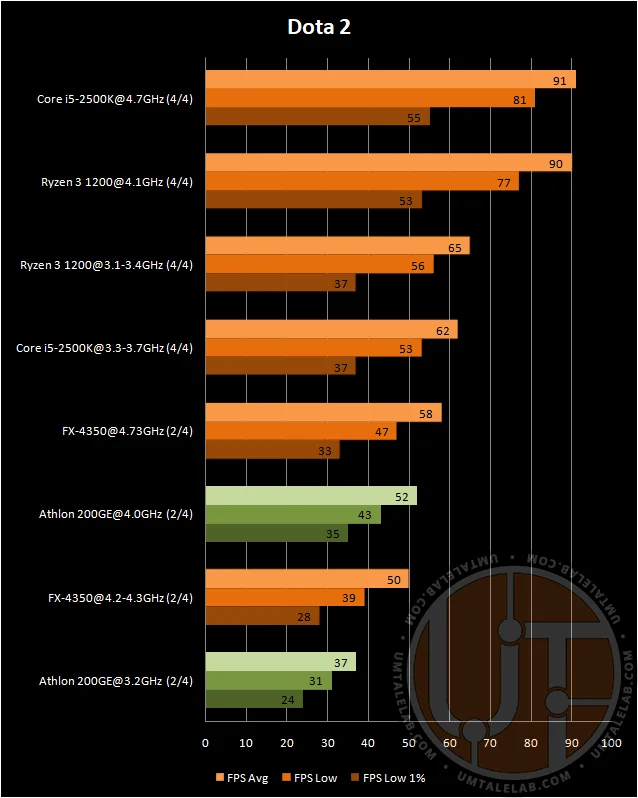
Dota 2 doesn't look great for the 200GE. The dual-core Zen surprisingly fell behind the older FX-4350, both at stock and overclocked speeds. And the Core i5-2500K and Ryzen 3 1200 were simply out of the Athlon's league.
Baldur's Gate 3 [Patch #4]
 ⤢ ВІДКРИТИ
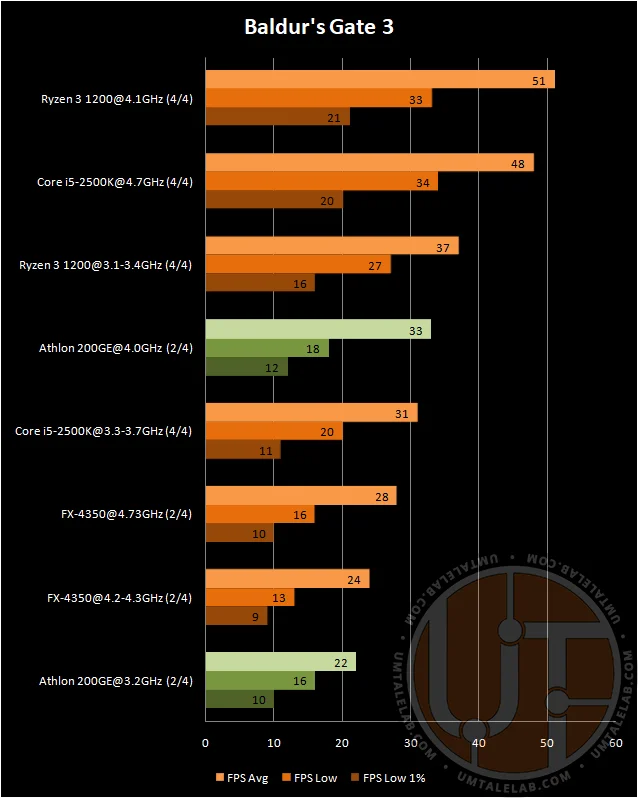
The demanding Baldur's Gate 3 proved too much for the dual-core Zen. While it's a turn-based game not typically known for action, simply moving between locations on the Athlon 200GE causes serious stuttering. Worse, in the CPU-intensive city of Baldur's Gate itself, minimum FPS plummets to critically low levels.
Still, it's worth noting that the 200GE chip can introduce an undemanding player to the world of Baldur's Gate 3.
Cyberpunk 2077 Phantom Liberty [Patch 2.02]
 ⤢ ВІДКРИТИ
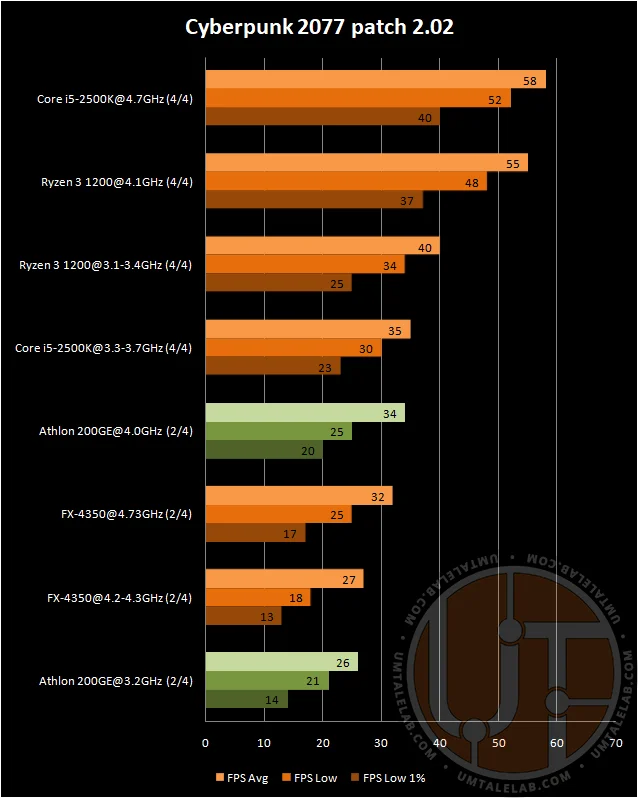
The Phantom Liberty update for Cyberpunk 2077 changed how the REDengine functions, meaning weaker CPUs can no longer handle the game, even on minimum graphics settings. An overclocked Athlon 200GE only manages "console framerates" – and by that, we mean the performance seen on last-gen consoles like the PS4 or Xbox One.
A stock 200GE, however, makes the game practically unplayable. Expect freezes in almost every location, and assets will pop in right before your eyes.
On the plus side, Cyberpunk 2077 Phantom Liberty runs noticeably more stably on the Athlon 200GE than Baldur's Gate 3 does.
Hogwarts Legasy
 ⤢ ВІДКРИТИ
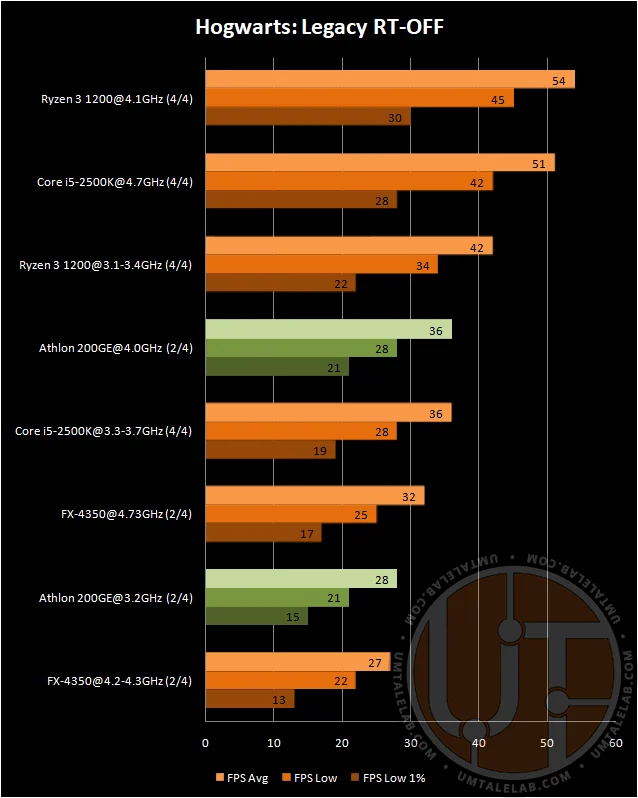
Hogwarts Legasy performs slightly better on the 200GE than Cyberpunk 2077, but the core issues persist: expect freezes in large outdoor areas and lengthy loading screens for rooms and halls within the castle.
Overclocking to 4GHz offers some improvement, even allowing the dual-core Zen to slightly edge out the stock Core i5-2500K in minimum FPS. Still, the overall framerate remains far from acceptable.
The Witcher 3: Wild Hunt Next-Gen Update [Patch 4.04]
 ⤢ ВІДКРИТИ
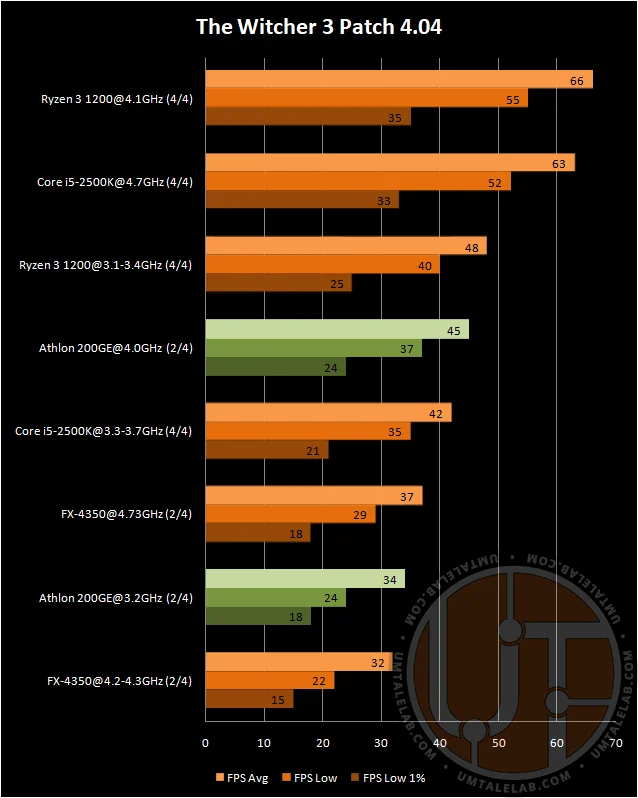
Among single-player titles, The Witcher 3: Wild Hunt Next-Gen Update runs best on the Athlon 200GE. Even at stock speeds, it manages just over 30 frames per second. Overclocking to 4GHz boosts the average FPS to 45.
Game: | Athlon 200GE@4000MHz |
|---|---|
Counter-Strike 2 | 34.69% |
Dota 2 | 40.54% |
Baldur’s Gate 3 | 50% |
Cyberpunk 2077 | 30.77% |
Hogwarts Legasy | 28.57% |
The Witcher 3: Wild Hunt | 32.35% |
Radeon Vega 3 quick test results in games
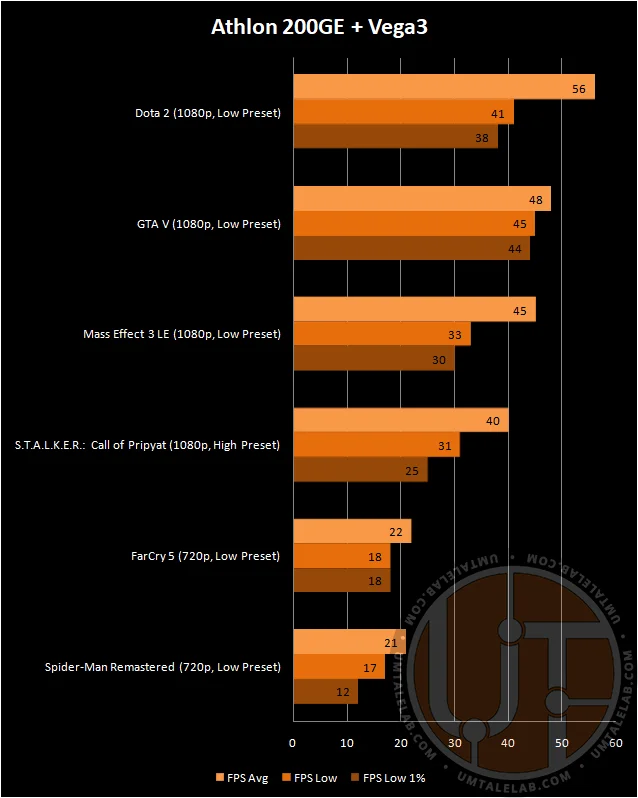
The Vega 3 was tested at its base clock speeds because overclocking is locked on our available motherboards. RAM frequency was set to 3200MHz, which accounts for 90% of existing DDR4 modules.
 ⤢ ВІДКРИТИ
As we mentioned at the start of this article, don't expect the Vega 3 to serve as your primary graphics processor. This iGPU can only handle older games like GTA 5, S.T.A.L.K.E.R., or Mass Effect, along with a few multiplayer titles such as Dota 2.
Summary
 ⤢ ВІДКРИТИ
Well, it's time to wrap up this piece. The Athlon 200GE chip launched almost six years ago, and since then, it's evolved into the Athlon 3000G with a slight frequency bump. But as we've learned today, those minor clock speed increases don't make much difference for a 2-core, 4-thread CPU in the realities of 2023.
Neither significantly boosted RAM speeds nor an overclock to 4GHz can compensate for the 200GE's critical lack of execution units. What's more, the chip's integrated graphics processor offers little value. The Vega 3, much like the CPU it's housed within, is bottlenecked by its modest number of execution units. Even if you could overclock it, the performance increase would be negligible.
Realistically, an Athlon 200GE owner's only silver lining is the AM4 platform's immense upgrade potential. Even a budget A320 motherboard can likely support a 6-core R5-1600 or R5-3600 (though you should always check compatibility on your motherboard manufacturer's official site). Such an upgrade would make the system far more viable in 2023.
However, if you specifically need a CPU with integrated graphics (an APU), your best bet is the undeniably excellent Ryzen 5 5600G. Alternatively, you could scour the used market for something like a 2200G or 2400G.