BLOGS · AI
PUBLISHED
READING4 min
NVIDIA CMP 170HX: How a VRAM unlock tool turned 'mining junk' into a hot AI hardware in few days
NVIDIA's CMP 170HX graphics card is experiencing a phenomenal resurgence thanks to the new CMPUnlocker tool, which unlocks up to 80GB of its memory.
The NVIDIA CMP 170HX graphics accelerator first appeared on the market in 2021. It was released at the peak of the cryptomining boom as a cut-down A100 configuration based on the Ampere architecture, offering 8GB and 10GB VRAM variants. After the crypto market crash, these cards found a few niche uses, but lacking full support for 3D rendering and inference, they generally held little commercial value.
However, five years later, the CMP 170HX is getting a true second life. A specialized tool called CMPUnlocker is now available on GitHub. This tool reportedly unlocks the full potential of the CMP 170HX chip.
According to its description, CMPUnlocker restores full bandwidth and unlocks HBM2e memory geometry that was artificially limited by firmware and OTP (One-Time Programmable) programming. NVIDIA implemented numerous locks to make these cards exclusively "mining-focused," but the AI era gives this chip new strategic value.
Feature | Status |
|---|---|
Full SM compute bandwidth (SS0/SS1) | Working ✓ |
Memory geometry (64GB on 8GB cards, 40GB on 10GB) | Working ✓ |
PCIe Gen 2 speed | Working ✓ |
JTAG (Host2Jtag register access) | Working ✓ |
State preservation after reboot (patched modules) | Working ✓ |
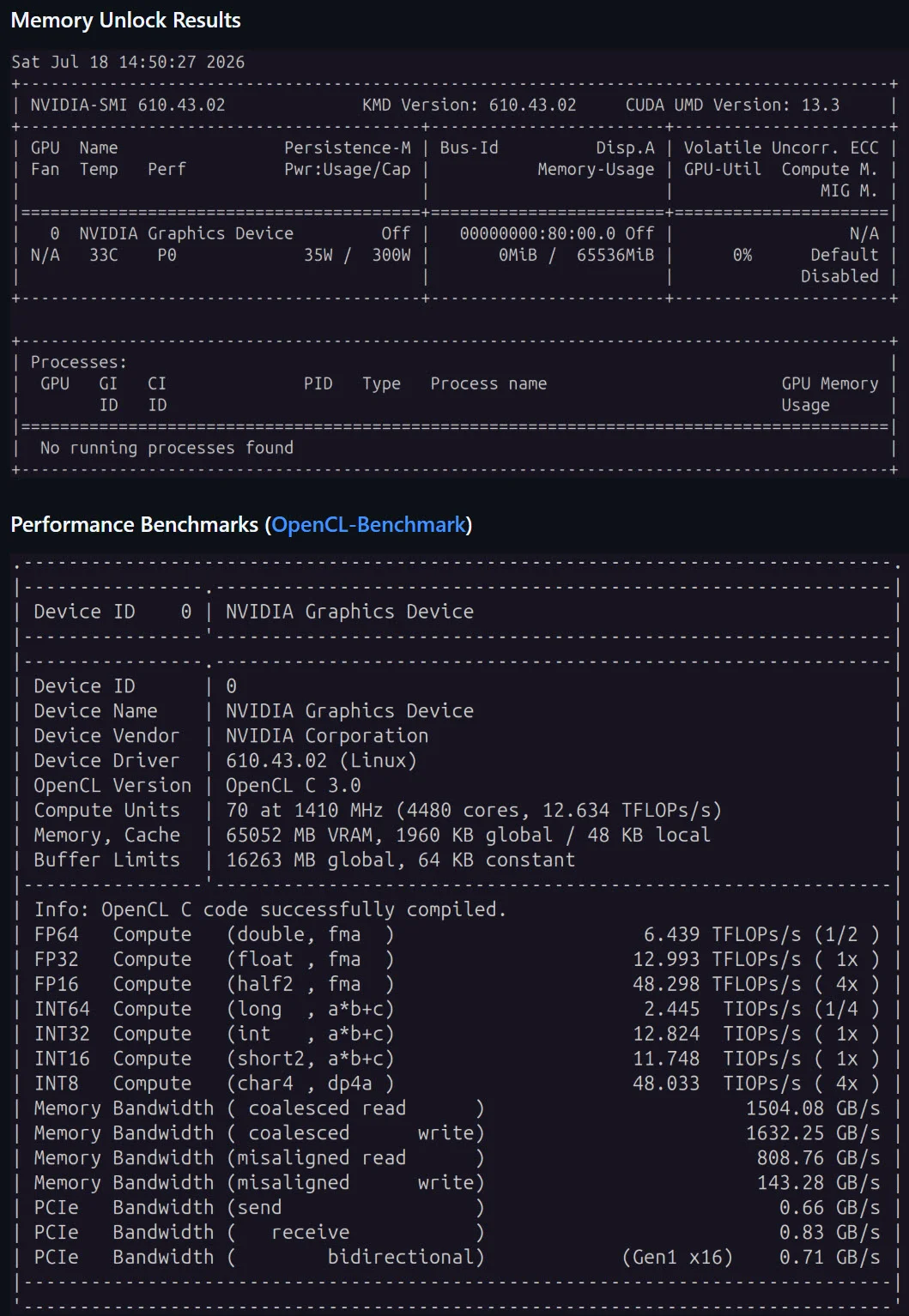
Preliminary tests, sourced from GitHub, show a device identified as "NVIDIA Graphics Device" demonstrating successful memory unlocking and impressive benchmark results, including 4480 cores, 12.63 TFLOPS/s, and 65,052 MB of VRAM.
 ⤢ ВІДКРИТИ
Caveats and risks
It's important to understand that this unlocked memory is far from a panacea. There are several significant limitations and issues, making acquiring one of these cards a real gamble.
Memory limitations: The 8GB version of the 170HX can be unlocked to 64GB, while the 10GB version can reach 40/80GB.
The "binning" issue: Since the CMP 170HX is based on lower-tier A100 "bins," not all chips will correctly report the full memory stack. Most HBM2e stacks are disabled due to defective or low-quality memory dies.
Stability: Only certain chips will be able to detect the full memory capacity, and even then, full speed isn't guaranteed. Achieving significant capacities (32GB or 40GB) requires chips with better silicon binning quality (memory dies).
Performance: Some cards won't be able to sustain full bandwidth, lowering clock speeds depending on the quality of the HBM silicon. Theoretical bandwidth is in the range of 700–800 GB/s per board. It's reported that Samsung 10GB models unlock to 80GB but are unstable, whereas the 8GB Hynix model is more stable when unlocked to 64GB.
What about AI?
These chips are already being actively tested by users for AI inference or training. However, there are key limitations to keep in mind:
Data formats: The chip only supports the INT8 format. It lacks support for newer formats like FP8, FP6, or FP4, unlike modern NVIDIA GPUs, which significantly reduces its speed compared to, for example, an RTX 5090.
Compute power: Its performance level is estimated at 48 TOPS.
Summary (based on feedback from the r/LocalLLaMA community):
Stability at 64GB isn't guaranteed. Tests have only shown reliable operation up to 40GB under load.
The PCIe interface is limited to Gen2 x4. Unlocking Gen2 and achieving x16 Gen1 requires physical board modification, such as adding missing components.
The lack of FP8/FP4 support makes the CMP 170HX less competitive for demanding, modern AI tasks.
There's a high risk of acquiring a card with defective HBM stacks. NVIDIA likely disabled these during testing for a reason; unlocking them could brick the card, as it's essentially faulty memory.
Market Reaction
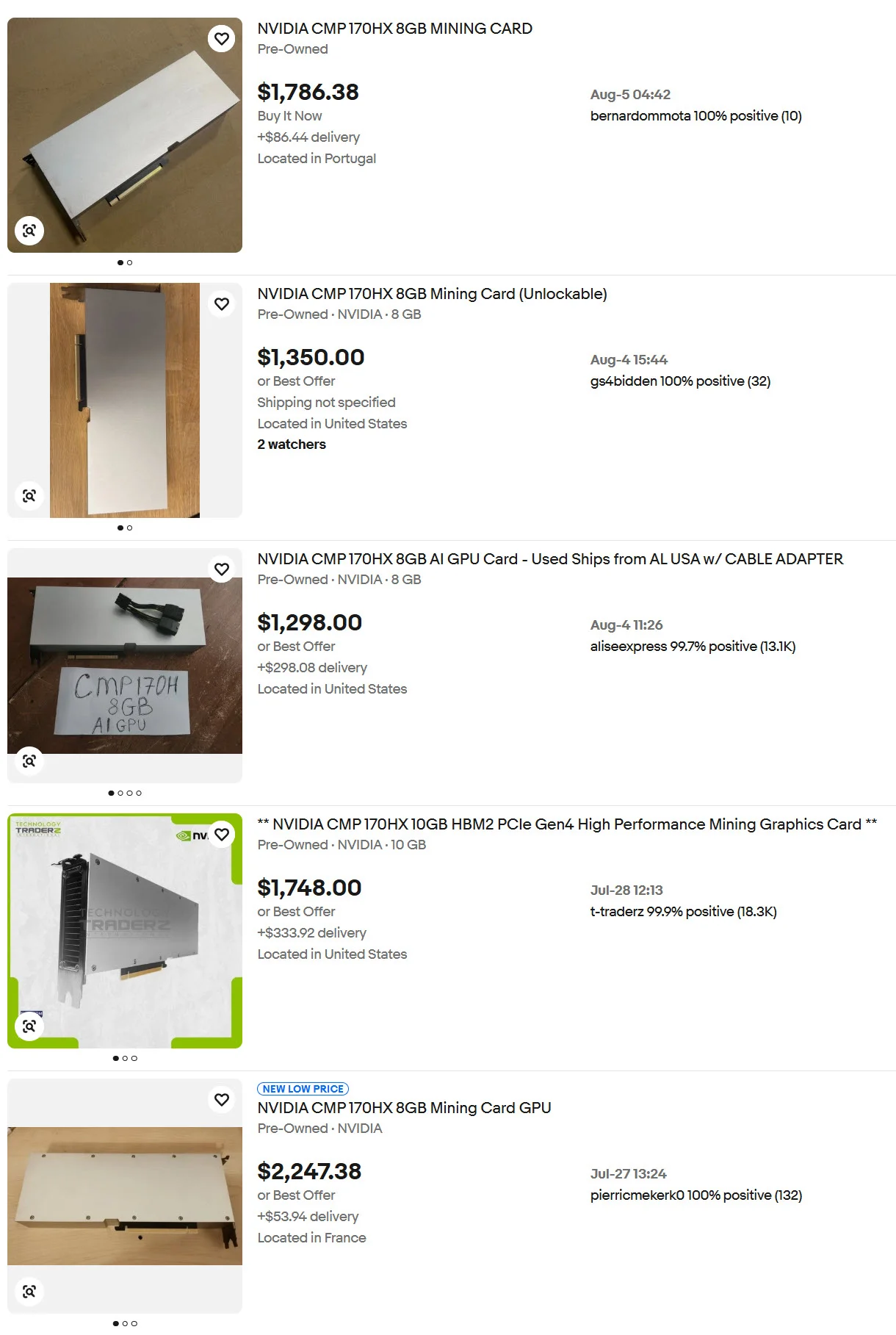
This is a classic story. Just a few weeks ago, NVIDIA CMP 170HX cards were selling for $100–$200. However, since the release of CMPUnlocker, prices have skyrocketed, with these cards now trading on eBay for $1,200–$2,000.
 ⤢ ВІДКРИТИ
On one hand, having a 64GB or 80GB chip in this price range seems like a genuinely compelling offer. On the other hand, you have to weigh all the aforementioned drawbacks, turning this deal into a true gamble. You might end up simply throwing money away on a brick with only 8-10GB of usable VRAM. You never know what "bin" or memory quality you'll get, but this market is heating up fast, with buyers already reserving dozens of units.
Honestly, for the hypothetical $1,000–$2,000, you'd be better off getting a couple of RTX 3090s. That way, you wouldn't have to deal with unlocking issues or the memory lottery. But that's just our opinion.