NEWS · ШТУЧНИЙ ІНТЕЛЕКТ
PUBLISHED
READING5 min
Muse Glimmer 30B: Meta unveils a new open agent model for running locally
Meta wasn't keen on waiting for Qwen 3.8 27B, choosing instead to launch its new LLM ahead of its Chinese rivals.
Meta Superintelligence Labs has announced Muse Glimmer, a new model now available as open weights under the Apache 2.0 license. This 30-billion parameter powerhouse is optimized for offline operation, enabling users to run complex AI tasks directly on their personal devices without constant cloud connectivity.
Today, Meta Superintelligence Labs released the open weights for Muse Glimmer on Hugging Face, marking the next breakthrough in artificial intelligence. This 30-billion parameter model was developed with a strong focus on 'always-on' agent scenarios.
Muse Glimmer's key advantage is its efficiency. It's compact enough to run on standard Macs or PCs with a single consumer-grade graphics card (16GB or more for Q4/IQ4 quantization). This unlocks a wide range of applications, from local agents and function calling to local coding and LLM-as-a-Judge evaluations. Thanks to its architecture, Muse Glimmer delivers high performance in critical agent tasks, competing well against leaders in its size class.
 ⤢ ВІДКРИТИ
While local models have achieved impressive results in reasoning, code generation, and tool utilization, most still rely on cloud infrastructure and stable network access.
Muse Glimmer changes this paradigm. By running models locally, users gain complete autonomy: access to AI anywhere, anytime, regardless of internet connectivity. This is becoming increasingly feasible thanks to the open-source community, which is proving that smaller, well-trained models can achieve performance comparable to cutting-edge models in highly specialized tasks. Muse Glimmer was specifically optimized for these local scenarios.
In line with Meta's tradition of disseminating fundamental AI research, Muse Glimmer is now available as open weights on Hugging Face. Alongside the model, Meta has provided detailed developer documentation to streamline the process of building and launching custom agents. The model is designed for seamless integration with tools already used by the community. Optimized integrations for llama.cpp, MLX, and ExecuTorch will be available in the coming days, enabling users to go from download to a functional agent in minutes.
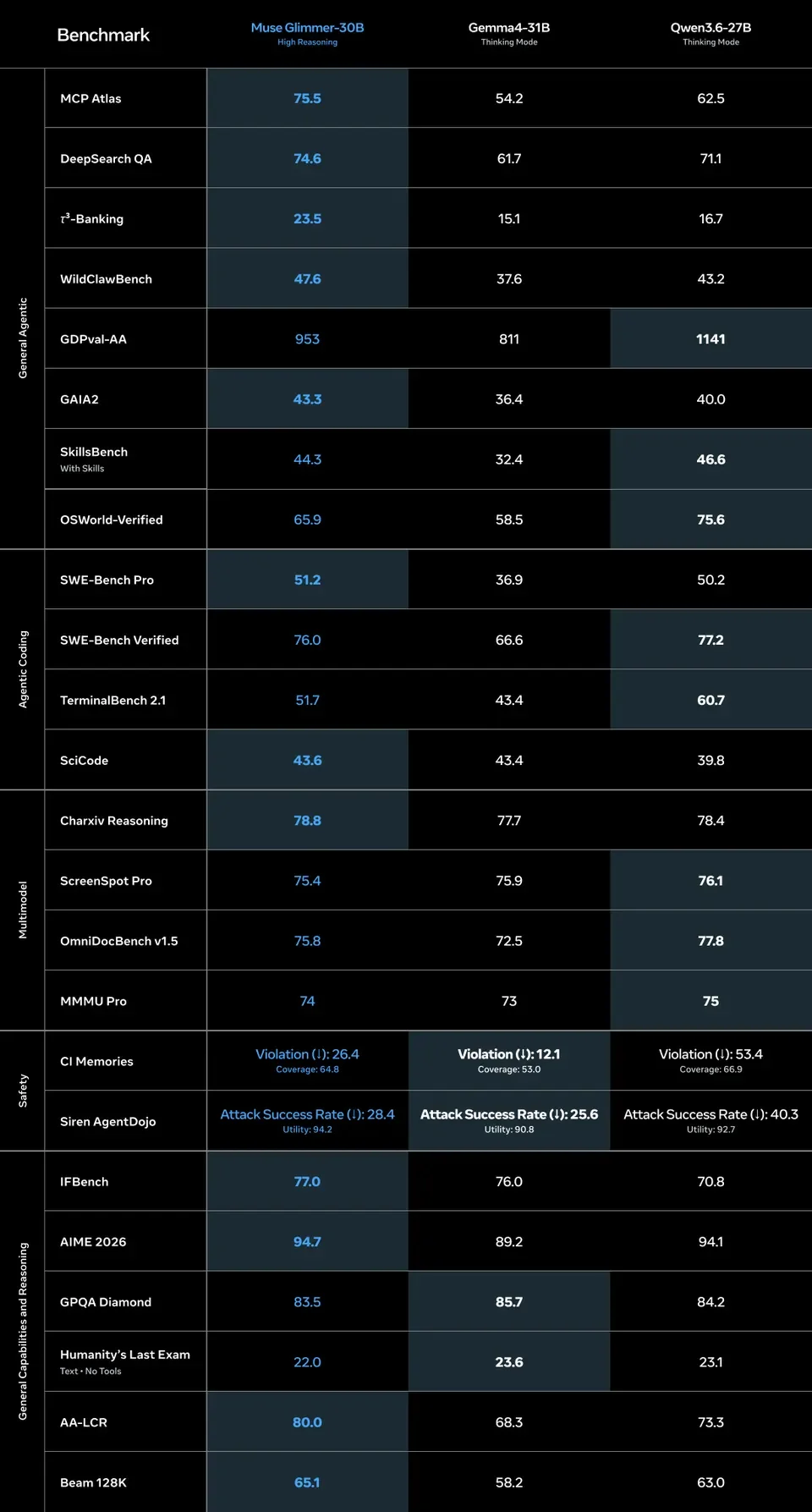
In its release post, Meta evaluated Muse Glimmer across a wide range of benchmarks to measure its autonomous capabilities. Compared to Gemma4-31B and Qwen3.6-26B, Muse Glimmer demonstrates strong performance for its class and size on many widely used LLM benchmarks.
Speed is key to local efficiency. An agent that takes minutes to respond or plan its next step disrupts real-world workflows. Meta applied two critical optimizations to ensure Muse Glimmer runs at practical speeds on consumer hardware without sacrificing quality.
1. On-Device Model Adaptation (Quantization):At full precision, a 30B model would require over 55GB of memory, far more than any consumer GPU offers. Meta uses quantization techniques to compress the model weights to approximately 4-bit precision, reducing the language model's footprint to 20GB or less. This leaves sufficient headroom for the model's working memory (context/KV cache), vision module, and speculative decoder (a small MTP model) to all run concurrently within 24GB or 32GB. Meta confirmed that this compression does not lead to a degradation in reasoning abilities for agent tasks.
2. Accelerating Generation via Speculative Decoding:Language models typically generate text token by token, which can feel slow during long reasoning chains. Muse Glimmer comes with a lightweight 'draft' model based on DFlash, a small companion network that speculatively proposes entire blocks of tokens at once. The main model then verifies these proposals in parallel, accepting correct tokens and correcting incorrect ones. This technique allows Muse Glimmer to generate text significantly faster than standard token-by-token generation, while maintaining identical output quality. For this release, we provide quantized versions of the draft models to minimize additional memory overhead.
Meta measured the speed of the 17GB Q4_K quantized model, along with the quantized DFlash drafter, on a MacBook M4-Max and an RTX-5090. They found the model to be fast enough for fluid conversation and real-time interaction, with the entire process occurring entirely on the local device.
How to get started with Muse Glimmer
Muse Glimmer is available now, and you can download the weights on Hugging Face. In the coming days, you'll be able to run it locally via Meta's partners like Ollama, LM Studio, and Unsloth. You can also deploy it using edge frameworks including llama.cpp, ExecuTorch, and MLX, or serve it at scale with vLLM and SGLang.
You can even fine-tune the model for your specific needs using PyTorch's TorchTitan feature.
Meta is actively working with partners, including AMD, ARM, Dell, Intel, and NVIDIA, to optimize performance across various devices. Additionally, Meta is releasing comprehensive documentation to ensure developers have all the necessary resources to get started and use Muse Glimmer responsibly. This includes guides for setting up custom scaffolds, making it as easy as possible to start building personal agents on day one.
Muse Glimmer continues Meta's long history in open AI research, extending it into the realm of agentic AI and providing developers access to local agent capabilities.