TESTS · CPU · INTEL
PUBLISHED
READING5 min
Testing and overclocking the Intel Core 2 Duo E4400 on a budget motherboard
An overview of testing and overclocking the Intel Core 2 Duo E4400 on an affordable motherboard. Includes comparisons with AMD and an assessment of its relevance for budget PCs.
The era of multi-core processors arrived quickly and continues to advance rapidly, pushing core counts and clock speeds ever higher. Currently, the market is saturated with numerous entry-level CPUs based on modern architectures, often available for ridiculously low prices, sometimes under $70. The Intel Celeron Dual Core E1200 at 1600MHz might seem like a top budget contender, but its meager 512KB of L2 cache holds it back. Plus, overclocking this chip requires a rather expensive motherboard due to its low multiplier. There's also the Pentium Dual Core E2140 with a megabyte of cache, but its price isn't much different from today's test subject.
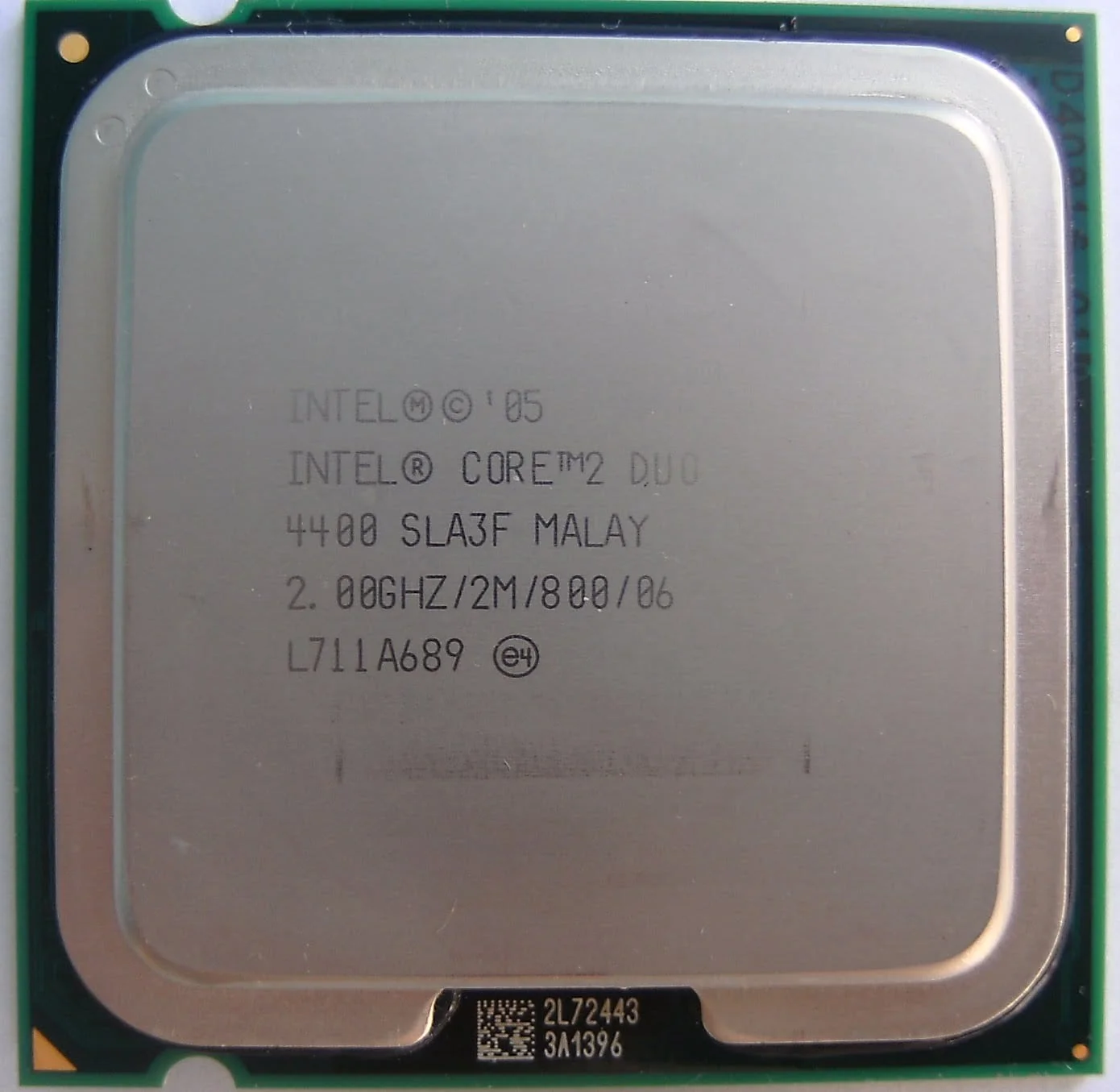
Let's take a look at our test sample, the Intel Core 2 Duo E4400:
 ⤢ ВІДКРИТИ
Even at its low stock clock, this processor can outperform its direct competitor from AMD, the Athlon 64 X2 4200+ at 2.2GHz. While similarly priced, overclocking a Core 2 Duo usually demands a non-budget motherboard, which is a significant drawback. This flaw makes it hard to recommend buying an E4400 for overclocking if you can't spend over $100 on a motherboard. However, this article focuses on overclocking this CPU specifically on a budget board. So, don't expect frequencies near 3000MHz.
AMD testbed specs:
Processors: Athlon 64 X2 4200+, Athlon II X2 250, and Athlon 64 X2 6000+
Motherboards: ASUS M2V and ASUS M2N68-AM SE2
Cooler: Zalman 7000cu
RAM: 2x 1GB PQI PC 6400 modules
Graphics card: NVIDIA GeForce GTS 250 1GB DDR3
Hard drive: Seagate 160GB
Power supply: FSP 400W
Intel testbed specs:
Motherboard: MSI 945GCM5-F (MS7267)
Cooler: Zalman 7000cu
RAM: 1GB PQI PC 6400 module
Graphics card: NVIDIA GeForce GTS 250 1GB GDDR3
Hard drive: Seagate 160GB
Power supply: FSP 400W
Overclocking was achieved by increasing the FSB frequency and core voltage. The maximum I managed to squeeze out was 2660MHz:
 ⤢ ВІДКРИТИ
The system bus frequency was changed from 200MHz to 266MHz, and the RAM multiplier was lowered by one. Core voltage was increased to 1.360 volts, and the system bus voltage to 1.300 volts. With this CPU overclock, the RAM frequency reached 800MHz with 5-5-5-18 timings.
In other words, I managed to push the E4400 to E5400 levels. And all this on a humble $30 motherboard with $13 RAM modules. Not bad, right? Now, let's see how the E4400 stacks up against processors like the Athlon X2 4200+ running at 2750MHz, the Athlon 64 X2 6000+, and the Athlon II X2 250 at both stock speeds and overclocked to 3600MHz.
Unfortunately, the Core 2 Duo E4400 wasn't in the lab for long, so I couldn't run our full suite of standard tests. However, I believe I still managed to test the most interesting scenarios:
Benchmarks
 ⤢ ВІДКРИТИ
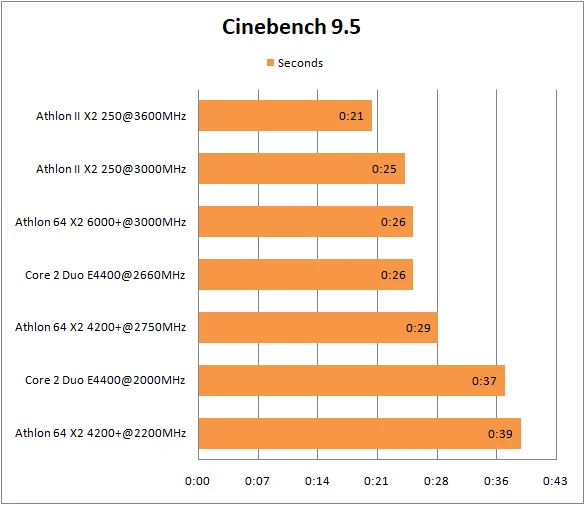
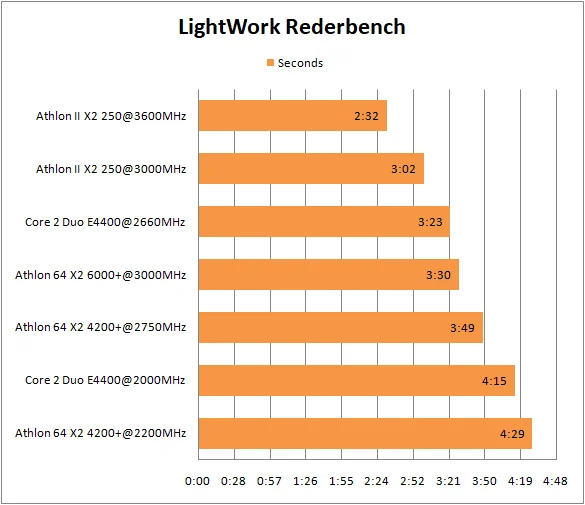
My disappointment was palpable when, after the benchmark, I witnessed the total defeat of the overclocked Athlon X2 4200+. Despite running at a higher frequency and boasting an integrated memory controller, it still managed to lose... The Core architecture's efficiency is undeniable here. But, as the saying goes, 'the music didn't play for long.' Even running at a higher clock speed, the Athlon II processor first edged out its older, similarly clocked sibling, the X2 6000+, and then utterly crushed the E4400. Bravo, AMD!
 ⤢ ВІДКРИТИ
Once again, the Athlon II chip is simply unbeatable! That is, if you ignore the fact that the Core 2 Duo E4400 is over two years old. Nevertheless, the E4400 is essentially a copy of the Pentium DC E5300, making the Athlon II's performance look very appealing. However, it's worth noting that the E4400 easily beat the higher-clocked Athlon 64 X2 6000+ and the overclocked Athlon 64 X2 4200+. A stunning result!
 ⤢ ВІДКРИТИ
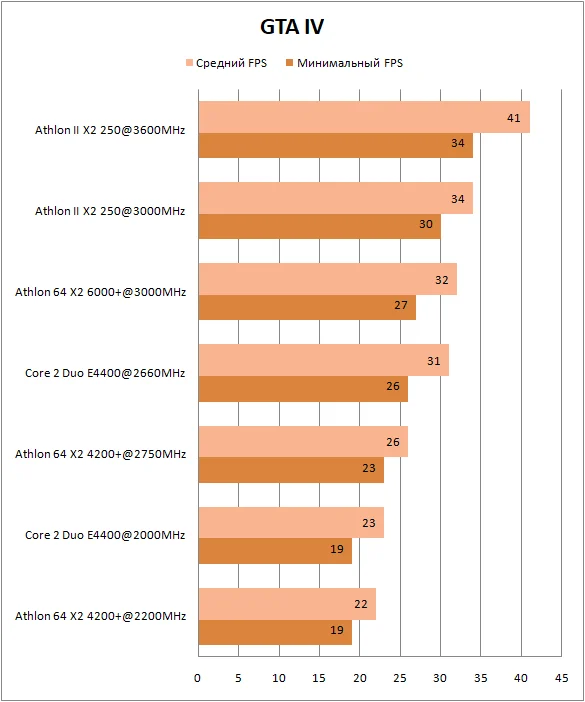
Surprisingly, in Grand Theft Auto 4, the situation shifted dramatically, and the Core 2 Duo E4400 no longer looks so favorable. To my surprise, when overclocked, it lost to the Athlon 64 X2 6000+, and at stock speeds, it barely outperformed the stock Athlon 64 X2 4200+!
Conclusion
What conclusions can you draw about a processor that's been off the market for over a year? Probably none... or rather, no conclusions *should* be drawn, unless it's specifically the Core 2 Duo E4400. Why? Because it's essentially the same chip as the Pentium Dual Core E5xxx. Their only differences lie in the manufacturing process and support for one new instruction. Perhaps this will play some role in the distant future, but currently, it offers no real advantages. Sure, you could buy a Pentium Dual Core E5xxx, but those still fetch $60-$70. While a decent option for a budget PC, if you can find a used E4400 for around $30-$50, I believe it's the better choice. Ultimately, the decision is yours, but in its prime, I considered it the best budget CPU from Intel's lineup. But then again, have you looked at the competition? AMD's Athlon II X2 chips have long been staples in many store price lists.
Update 05.31.2020: Per reader requests, the quality of the benchmark graphs has been improved.