TESTS · CPU · AMD
PUBLISHED
READING6 min
AMD Athlon 64 3700+ processor: review, overclocking, and testing
A detailed review, overclocking guide, and performance testing for the AMD Athlon 64 3700+ processor. We explore its capabilities, thermal behavior, and gaming potential.
This article focuses on a CPU proudly carrying the 3700+ rating. But was that rating truly deserved? While the internet is full of debate, it's clear this processor genuinely stood its ground against the then-pricey Pentium 4 641, even though Intel's chip could handle two threads per core.
But enough with the history lesson; let's get straight to the processor itself. Below is a photo of our Athlon 64 3700+ test sample:
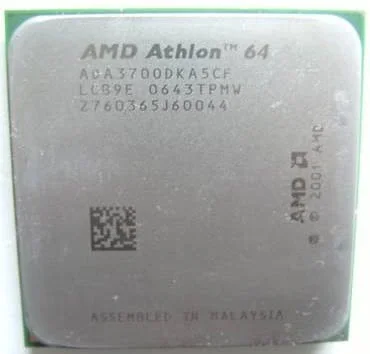 ⤢ ВІДКРИТИ
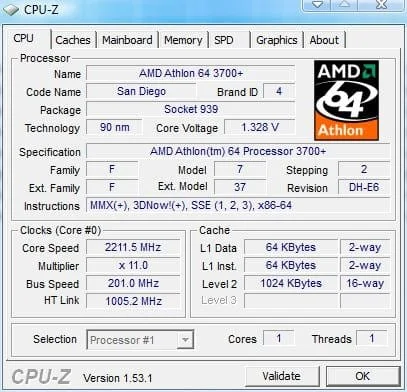
And a screenshot from CPU-Z:
 ⤢ ВІДКРИТИ
The Athlon 64 3700+ processor uses the 90nm San Diego core, revision E6. It features 1MB of L2 cache, operates at a clock speed of 2200 MHz, and has a nominal core voltage of 1.328V. The chip's power consumption is rated at 90W, and it supports the Socket 939 platform.
Test Bench
Processors: AMD Athlon 64 3000+, Athlon 64 3700+
Cooling System: Cooler Master Hyper TX3
Motherboard: Biostar NF4UL-A9 (BIOS 6.00 PG)
RAM: Apacer 512MB PC3200 (2.5-3-3-8)
Graphics Card: XpertVision 8500GT@732/900MHz
Hard Drive: Seagate ST340016A 40GB
Power Supply: Microlab 360W
Software
Microsoft Windows 7 x64 Home Premium 6.1.7600
CPU-Z 1.53
GPU-Z 0.3.4
Crystal mark 2004
3D Mark 2001/2003/2005
NVIDIA Force Ware 162.22
CineBench x64 9.5
Light Ware Render Bench
Wprime 1.52
Overclocking
Honestly, I didn't expect any surprises from this benchmarking session. The Biostar NF4UL-A9 motherboard we received for testing didn't inspire much confidence initially. However, once I started overclocking, I was pleasantly surprised:
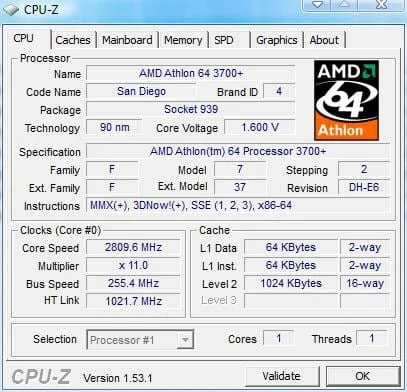
We pushed the CPU voltage to its maximum acceptable level, 1.6V. The HyperTransport multiplier was dropped to 3, and the system bus frequency was set to 270 MHz. I was naive... The Athlon 64 3700+ simply wouldn't hit the frequency its lower-clocked sibling, the Athlon 64 3000+, barely managed. The system would boot, but instantly reboot when launching the S&M utility. At 260 MHz on the bus, I managed a 10-minute S&M test, but then it rebooted again. Only after setting the bus frequency to 255 MHz did the system complete a 4-hour test without errors or reboots. The final stable frequency was 2809 MHz. Here's the screenshot:
 ⤢ ВІДКРИТИ
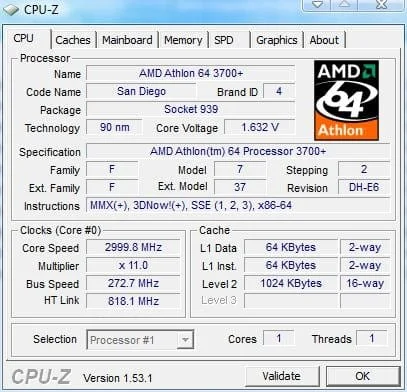
For those curious, here's a 'screenshot of death': the processor managed to boot at almost 3 GHz, but there was absolutely no stability. Still, I managed to capture a CPU-Z screenshot:
 ⤢ ВІДКРИТИ
Perhaps raising the voltage to 1.7-1.8V might have yielded stability, but the motherboard's power delivery system was too weak for such a reckless move. Even so, a stable 2800 MHz is a respectable result. We not only outpaced the more expensive Athlon 64 4000+ but also the era's top-tier Athlon 64 FX55, which ran at 2600 MHz. If we take AMD's arguments seriously and trust their rating system, it seems we effectively created a CPU with a 4600+ rating! This rating was never officially assigned to a single-core CPU from the company. It's also worth noting that at 2809 MHz, this processor hit 67 degrees Celsius on an open test bench. This suggests potential issues with overclocking in enclosed cases or with weak stock coolers.
Performance Measurements
Rendering
 ⤢ ВІДКРИТИ
 ⤢ ВІДКРИТИ
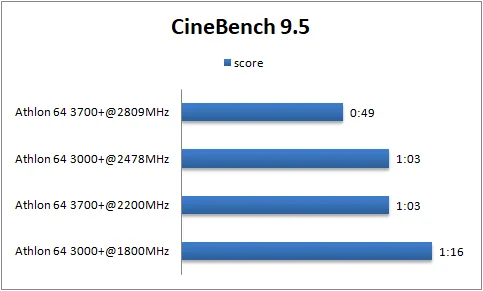
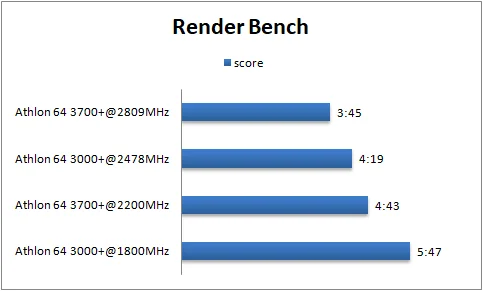
Performance increased by 20-30% depending on the benchmark. This result is quite satisfactory.
Overall Performance
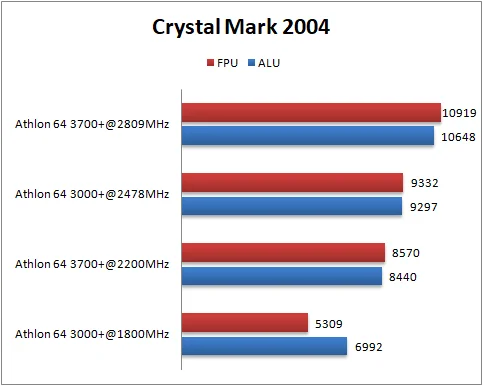 ⤢ ВІДКРИТИ
A 20% increase feels somewhat sluggish compared to previous tests. However, the raw results are still impressive.
Gaming, Synthetics
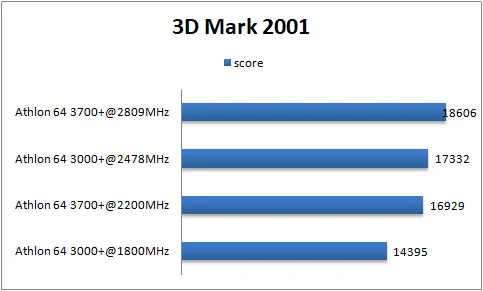 ⤢ ВІДКРИТИ
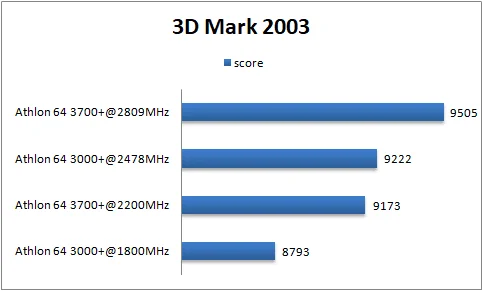 ⤢ ВІДКРИТИ
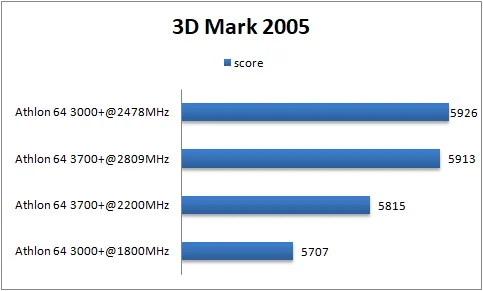 ⤢ ВІДКРИТИ
As expected, 3DMark 2001 is highly sensitive to CPU computational power, so the increased clock speed and cache on the Athlon 64 3700+ give it a huge lead here. You might have noticed that the stock Athlon 64 3700+ nearly caught up to the Athlon 64 3000+ overclocked to 2478 MHz. In 3DMark 2003, the situation changes slightly; the overclocked Athlon 3700+ doesn't pull as far ahead, as the graphics card became the bottleneck. 3DMark 2005, however, reacted unusually to the CPU overclock. The Athlon 3000+ at 2478 MHz actually outperformed it. I ran the test three more times, but the results were consistent; an explanation for this phenomenon is still elusive.
Gaming
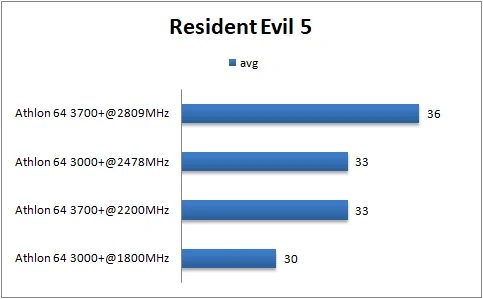
Moving on. The new Resident Evil 5 includes its own built-in benchmark. Let's see how this older but still capable processor handles a modern game. All settings were set to minimum to eliminate any GPU bottleneck.
 ⤢ ВІДКРИТИ
Even at minimum settings and without quality enhancements, the Athlon 64 3700+ overclocked to 2800 MHz managed to achieve a somewhat acceptable framerate. But who would want to play like that? Overclocking drastically improves the situation, yet it still isn't enough to push settings to even medium. For reference, at maximum settings but without quality enhancements, the system managed only 10-11 frames per second. With the same graphics card, an Athlon II X2 240 dual-core system, overclocked to 3600 MHz, achieved 38-46 FPS at maximum settings.
Conclusion and Summary
Frankly, this processor had instilled much higher hopes in me, but unfortunately, it didn't quite live up to them. The A64 3700+ certainly outperforms its younger sibling, but its heat output is also higher. As I mentioned, the thermal regime was too high, and it would have been another 5-7 degrees warmer in an enclosed case. Of course, replacing the cooler would solve this issue, but does it make sense to invest in a new cooling system if it won't pay for itself? That's a rhetorical question. However, if you didn't skimp on a cooler back in the day and equipped your Athlon 3700+ with proper cooling, you can confidently overclock it to 2700 MHz+.