BLOGS · OVERCLOCKING
PUBLISHED
READING5 min
Retro overclocking: Overclocking the AMD Athlon II X3 440 (C2) on the AM2+ platform
An investigation into the overclocking potential of the AMD Athlon II X3 440 (C2) on AM2+. The C2 stepping showed low potential, high temperatures, and instability, reaching only 3615MHz.
Well, it's time to dive into the arduous and not-so-exciting exploration of a C2 stepping processor's overclocking potential. In my previous blog about overclocking the Athlon II X3 450, I mentioned how lucky I was with its C3 revision, and I wasn't exaggerating in the slightest. Beyond its low overclocking headroom, high heat, and excessive power consumption, the C2 stepping brings nothing but moral pain and suffering. The latter is mostly an exaggeration, of course, but frankly, I don't find constantly dialing down frequencies due to instability very engaging, especially when you're aiming for absolute stability. Crashes 45 minutes into a stress test can be quite soul-crushing.
Nevertheless, chips based on the C2 stepping die are still quite common, so this article might still be useful to some. For everyone else, I invite you to indulge in nostalgia (and suffering) with me.
Welcome to the third entry in our "Retro Overclocking" series for AM2+ platform processors.
The processor
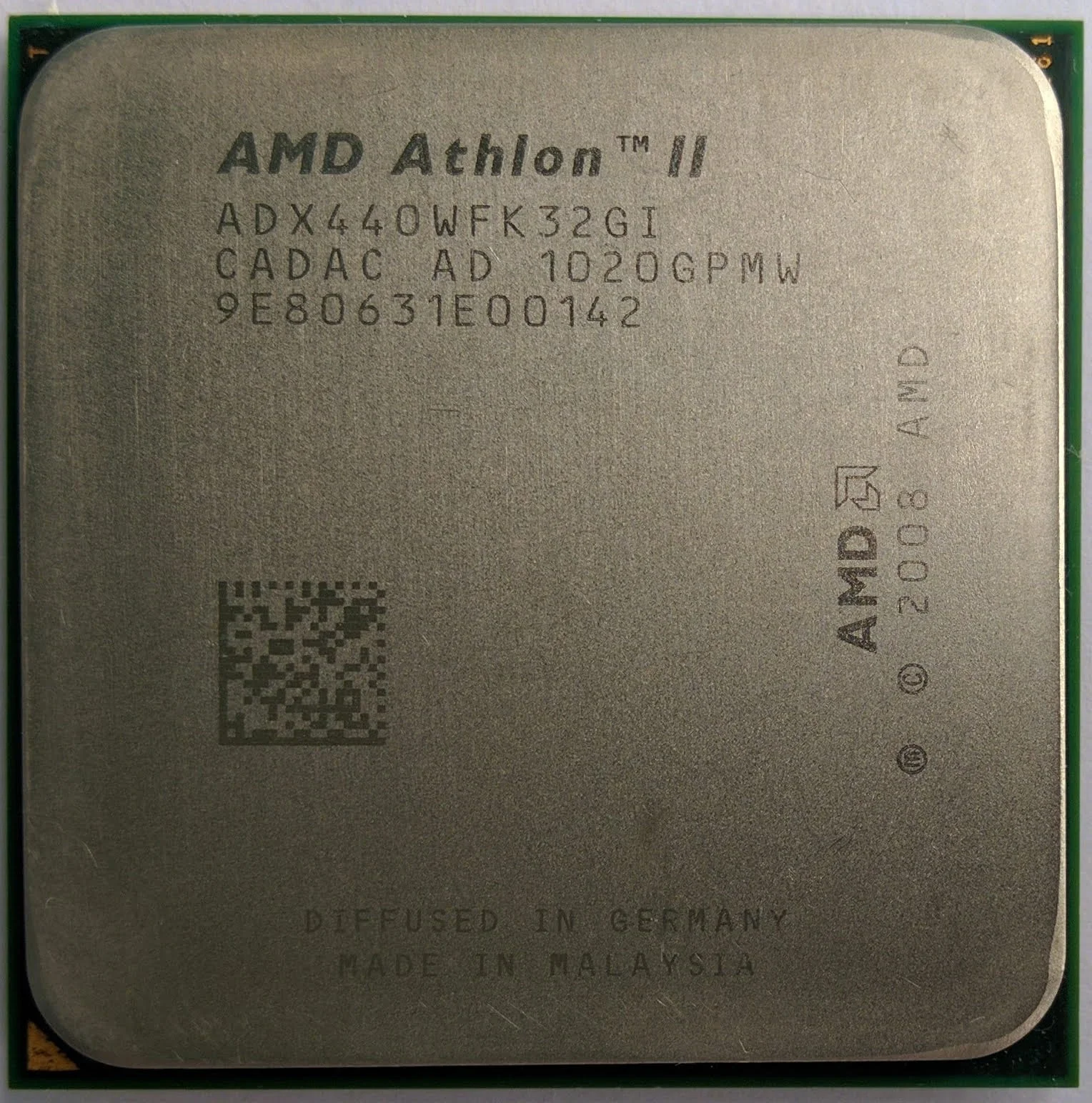
The Athlon II X3 440 processor sample that arrived in our lab bears the marking ADX440WFK32GI CADAC AD 1020GPMW. The "2GI" indicates this is a C2 revision, while "1020GPMW" signifies the chip was manufactured in the 20th week of 2010.
 ⤢ ВІДКРИТИ
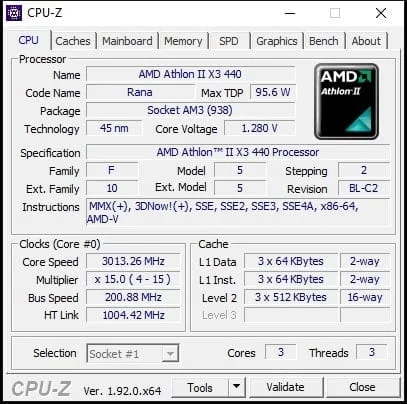
The CPU-Z utility reveals a few more details about our test subject:
 ⤢ ВІДКРИТИ
The processor's nominal frequency is 3000 MHz. The chip features 512 KB of L2 cache per core and has a 95-watt TDP.
 ⤢ ВІДКРИТИ
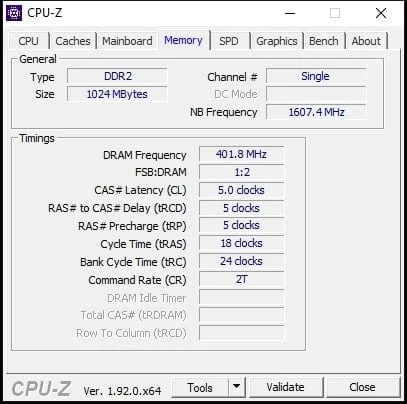
Due to AM2+ platform limitations, the memory controller in K10.5 processors operates at a reduced frequency of 1600 MHz. DDR2 RAM runs at 800 MHz.
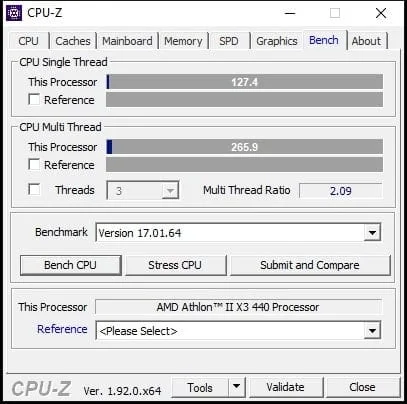
Traditionally, I benchmarked the chip using CPU-Z. However, as I mentioned in the previous article, the utility struggles to properly test triple-core processors, effectively reporting performance as if it were a dual-core chip:
 ⤢ ВІДКРИТИ
However, in the classic Cinebench R11.5 and R15 benchmarks, everything works as expected. Therefore, we'll use these to measure performance gains:
Test setup
Motherboard — ASUS M2N-E
Processor — Athlon II X3 440 (rev. C2)
CPU Cooler — Cooler Master Hyper 212 EVO
RAM — 1GB DDR2 SK Hynix HYMP512U64CP8-S5
Graphics Card — ZOTAC GeForce GTX 760 AMP!
Storage — KINGSTON 120GB SA400S37120G
Power Supply — Chieftec GPS-1250C
Operating System — Windows 10 with latest updates as of May 2020
Overclocking the Athlon II X3 440 chip
Just like with the Athlon II X3 450 overclock, I lowered the HT link by one divider, also dropped the RAM speed to 667 MHz, and attempted to set the base clock to 260 MHz with a core voltage of 1.550 volts. As expected, the chip failed to even POST.
Alright, I thought, no big deal. It was clearly foolish to even consider 4 GHz on the C2 stepping. Onward.
I set the base clock to 250 MHz, but the processor disappointed me again. It POSTed, but crashed with a blue screen when attempting to load the operating system.
Gritting my teeth, I lowered the base clock even further, to 245 MHz, which finally allowed me to reach the Windows desktop. But alas, after half an hour of AIDA64 testing, I was greeted by another blue screen of death.
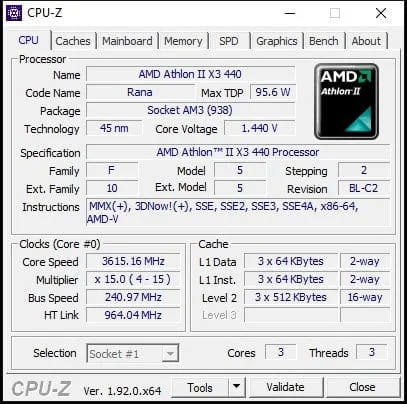
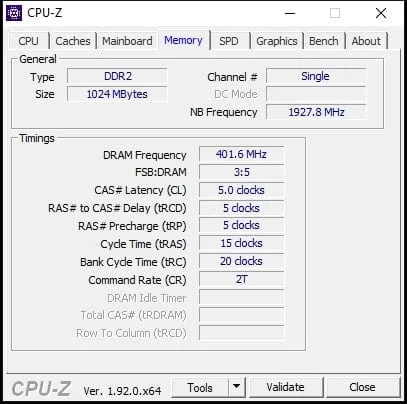
My further attempts to find a stable frequency can be summarized in a few words: By reducing the base clock by 1 MHz with each crash or blue screen, I eventually reached a stable 3615 MHz after roughly six to seven hours of real-time effort:
 ⤢ ВІДКРИТИ
 ⤢ ВІДКРИТИ
Not much to show for it, is there? Especially when compared to the stable 4 GHz achieved with the Athlon II X3 450 in the previous article.
Below are screenshots of an hour-long run in the AIDA64 stress test:
And here are the BIOS settings for the ASUS M2N-E motherboard used to overclock the Athlon II X3 440 processor:
Now, let's evaluate the performance gain compared to stock frequencies:
In Cinebench R11.5, it went from 2.23 points to 2.64 points.
In Cinebench R15, it went from 173 points to 200 points.
Conclusion
I've mentioned before that for me, a K10.5 architecture CPU benchmark session is only worthwhile if the chip can conquer the coveted 4000 MHz. Unfortunately, it was overly optimistic to think that the C2 core revision would allow me to achieve this. Especially since this is a Propus core, not a Deneb, which, even with the C2 stepping, can often overclock beyond 3700 MHz.
Of course, compared to its stock frequency, the performance gain is quite respectable — that's hard to argue with. However, next to the Athlon II X3 450, it looks frankly pathetic. While the previously tested Athlon II X3 450 will remain in my collection for a long time, this Athlon II X3 440 sample, unfortunately, won't share the same fate.
Thanks for reading, and happy overclocking!