BLOGS · OVERCLOCKING
PUBLISHED
READING8 min
Retro overclocking: overclocking and express testing the Intel Pentium D 930 (B1, Presler) processor
Retro overclocking the Intel Pentium D 930: we overclock the processor to 4350 MHz and test its performance in DiRT 3 and synthetic benchmarks.
Pentium D chips were among the first x86 CPUs that, instead of a monolithic dual-core design, essentially glued together two single-core Pentium 4 dies. While some supported Hyper-Threading (one core, two threads), not all HT technology was active. Back in 2005, the Pentium D series was a necessary stopgap for Intel. Development of Core 2 Duo/Quad was in its final stages, but still far from launch. However, Intel desperately needed to respond to AMD's highly successful Athlon 64 X2 chips immediately. This is how the "glued-together" two-Pentium 4 solution came to be, a term coined by tech media at the time.
It's certainly hard to believe in 2020, but AMD wasn't the pioneer in modular CPU design — Intel was. This is incredibly ironic, given that Intel now champions monolithic CPU designs (extolling their undeniable advantages in gaming). Yet, back in 2005, Intel brought to market the first mass-produced x86-compatible chip to consist of two dies: the Pentium D. (Of course, multi-die processors existed at IBM and elsewhere, but not in the mass-market x86 space).
Our test subject, the Pentium D 930, wasn't Intel's first "chiplet" processor, but it belongs to the second generation of the blue giant's dual-die, dual-core CPUs.
The processor
Unfortunately, my Pentium D 930 sample had a rather warped integrated heat spreader (IHS). Back in 2011, I lapped its base, which significantly reduced its operating temperatures. However, because of that, my sample now looks like this:
 ⤢ ВІДКРИТИ
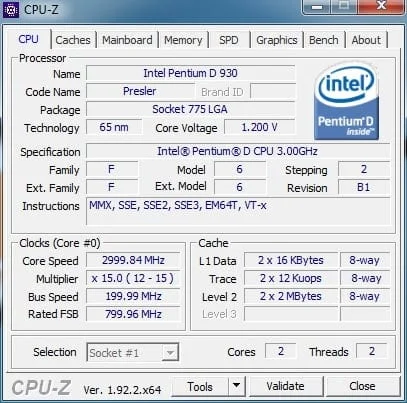
The Intel Pentium D 930 processor is built from two 65-nanometer Pentium 4 Cedar Mill dies, based on the long-pipeline NetBurst architecture. Due to manufacturing considerations, Intel gave the resulting product a new codename: Presler. This CPU features 2 megabytes of L2 cache per core, operates at a stock frequency of 3000 MHz (with a 15x multiplier and 200 MHz bus), and has a TDP of 95 watts. The nominal core voltage is 1.260 volts (as reported by the motherboard; CPU-Z tends to slightly understate the final figures).
The chip supports x86-64, SSE3, and VT-x instructions. However, it lacks the currently essential SSE4.1 and SSE4.2 extensions.
Unlike modern CPUs, the chip itself doesn't directly support a specific type or speed of RAM. Back in those 'old-school' days, the northbridge handled memory control. Our test board features a P35 chipset, which technically supports both DDR2 and DDR3 up to 1333 MHz. However, the board itself only has DDR2 slots. Therefore, our chip booted with 800 MHz DDR2 RAM at 5-5-5-15 timings in its stock configuration.
Test setup
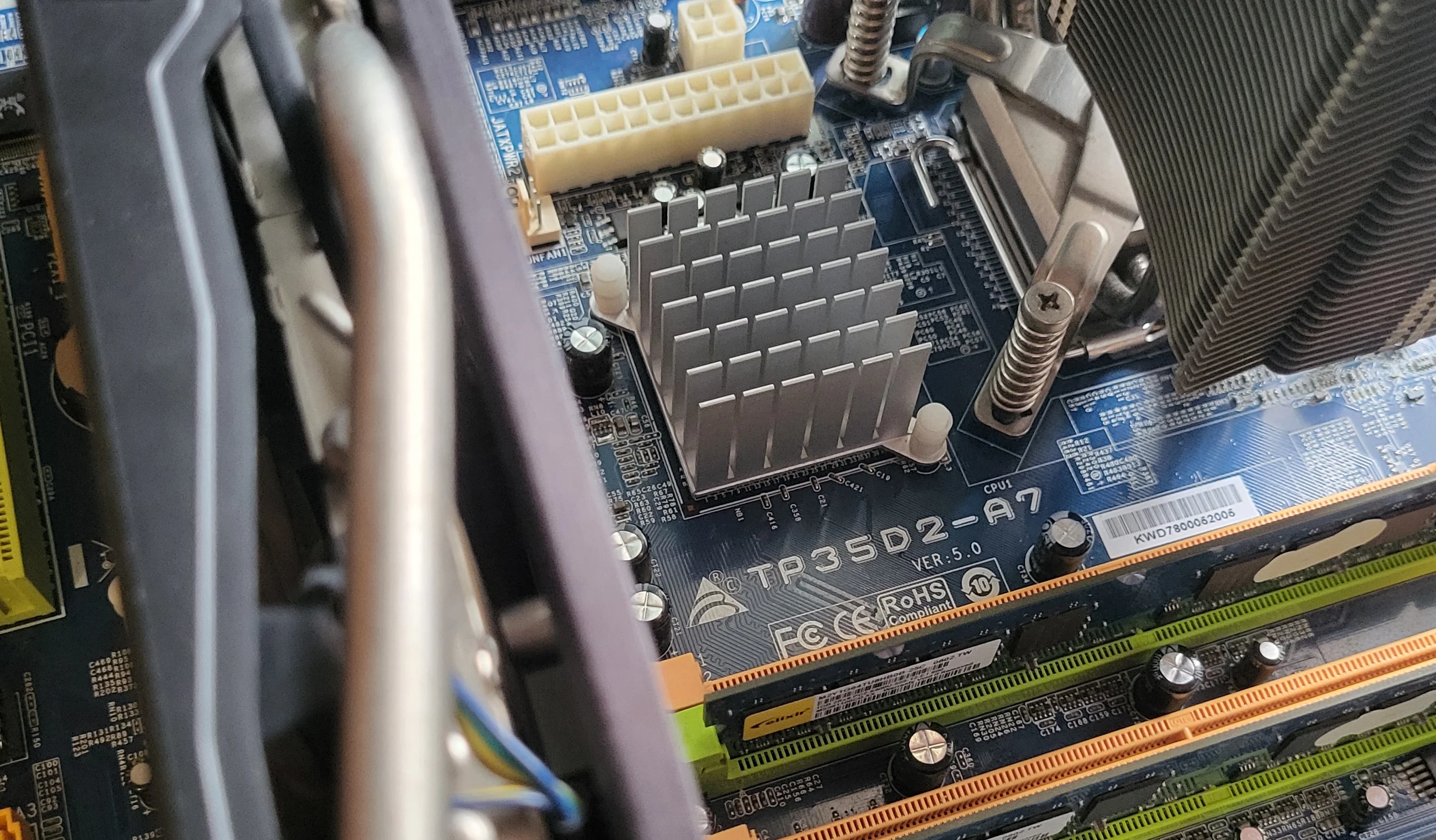
Motherboard — Biostar P35D2-A7 with modified BIOS from TP35D2-A7
Processor — Pentium D 930 (rev. B1)
CPU cooler — Cooler Master Hyper 212 EVO
RAM — 4x 2GB Kingston sticks (99U5429-007.A00LF 34CC2E04), 8GB total
Graphics card — Gigabyte Radeon HD 5870 1GB GDDR5 850/4800 MHz (GV-R587OC-1GD)
Storage — KINGSTON 120GB SA400S37120G
Power supply — Chieftec GPS-1250C
Operating system — Windows 7
Overclocking the Pentium D 930
First, I aimed to determine the highest stable frequency for the Pentium D 930 at its stock voltage. This exploration took me about an hour and a half. The test chip managed 3945 MHz at its nominal 1.260 volts. While not the best result, it's not entirely surprising, as this particular sample likely endured frequent overheating in the past and has probably degraded.
Next, I decided to slightly increase the voltage to 1.320 volts, which allowed me to pass an hour-long stress test at 4125 MHz. Frankly, these were just initial attempts. My primary goal was to get this 65-nanometer monster stable at 4500 MHz, and considering it cleared 4125 MHz at 1.320 volts, I felt my chances were pretty good. Unfortunately, after setting the FSB to 300 MHz and the vCore to 1.450 volts, I couldn't even last 10 minutes in an AIDA64 stress test.
Regrettably, while the motherboard technically allowed voltage adjustments up to 1.750 volts, its power phases buckled at just 1.460 volts. Consequently, I had to reduce both the voltage and, in turn, the FSB frequency.
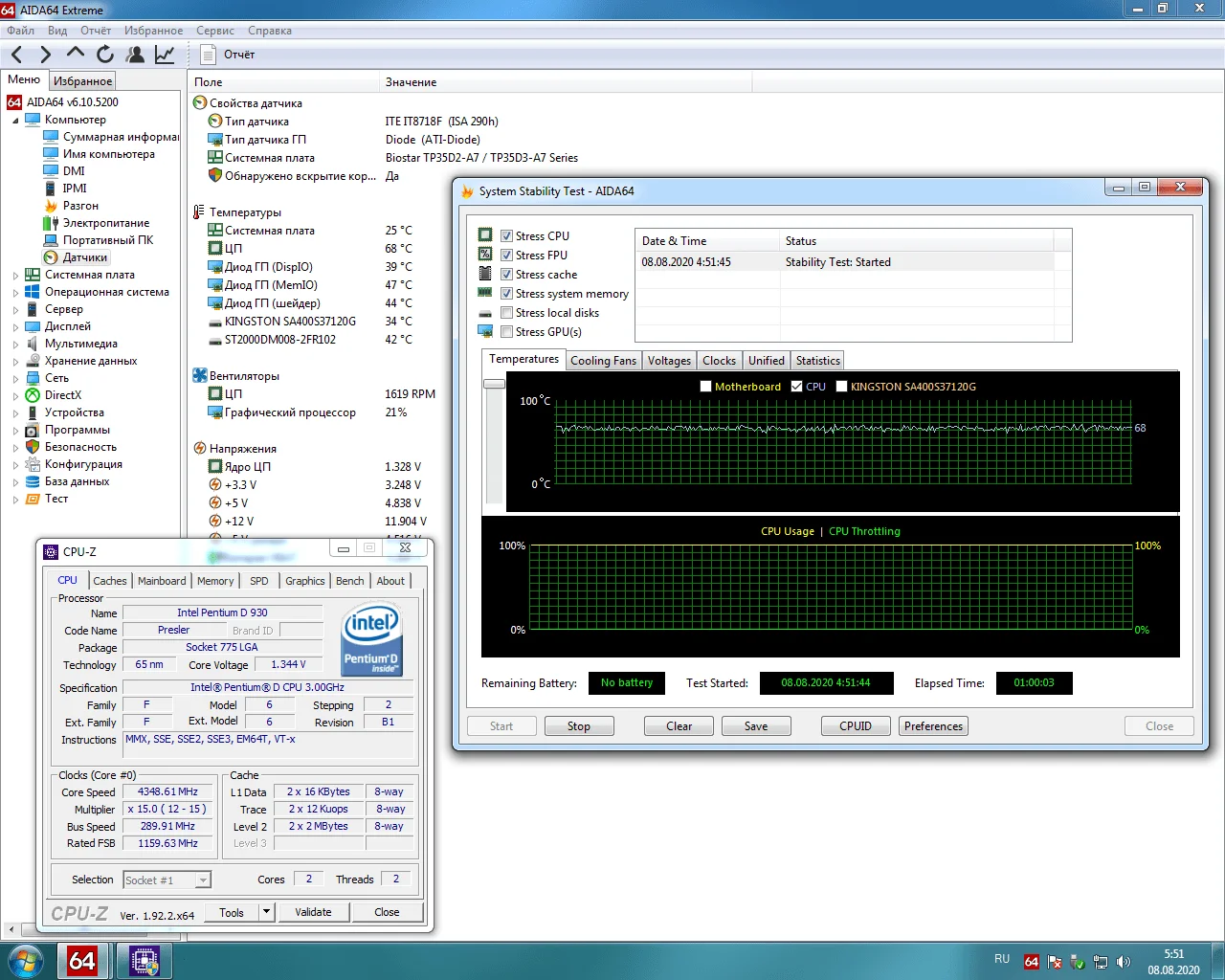
Ultimately, the stable frequency for this bench session settled at 4350 MHz with a voltage of 1.348 volts. It's crucial to note that passing a stress test at this frequency and voltage wasn't possible without additional airflow directed at the CPU's power delivery. Keep that in mind if you plan to replicate my experiment.
 ⤢ ВІДКРИТИ
Below is a table outlining the overclocking steps:
FSB frequency (MHz) | 263 | 275 | 290 | 300 | 308 |
Final CPU frequency (MHz) | 3945 | 4125 | 4350 | 4500 | 4617 |
CPU core voltage (volts) | 1.260 | 1.320 | 1.348 | 1.450 | 1.492 |
Peak load temperature (℃) | 61 | 67 | 72 | ~83 | ~88 |
Successful AIDA64 stress test | + | + | + | - | - |
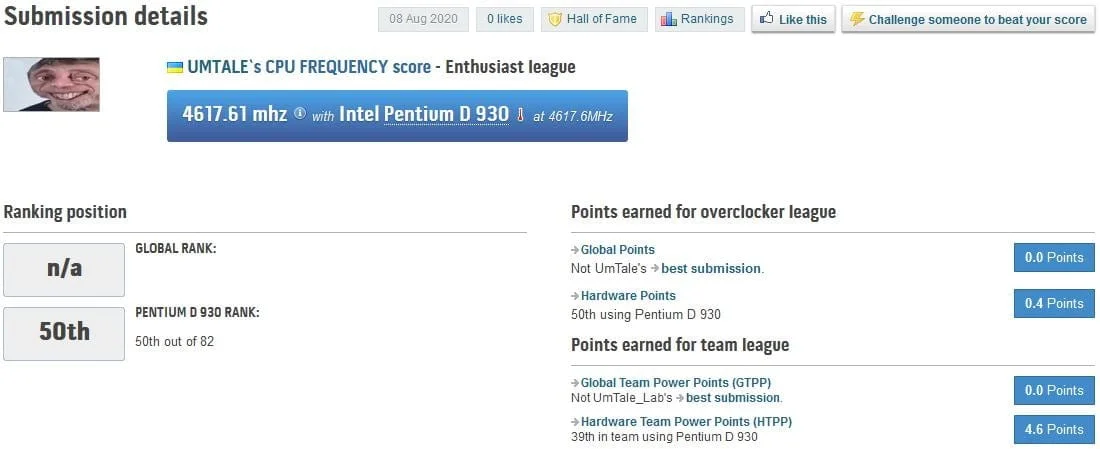
And of course, a screenshot-only result for the HWBot database:
 ⤢ ВІДКРИТИ
Frankly, breaking into the top 40 on air cooling would be quite difficult — in my case, practically impossible. After all, this test sample operated in terrible conditions before it came into my hands, which adversely affected the physical properties of its silicon.
 ⤢ ВІДКРИТИ
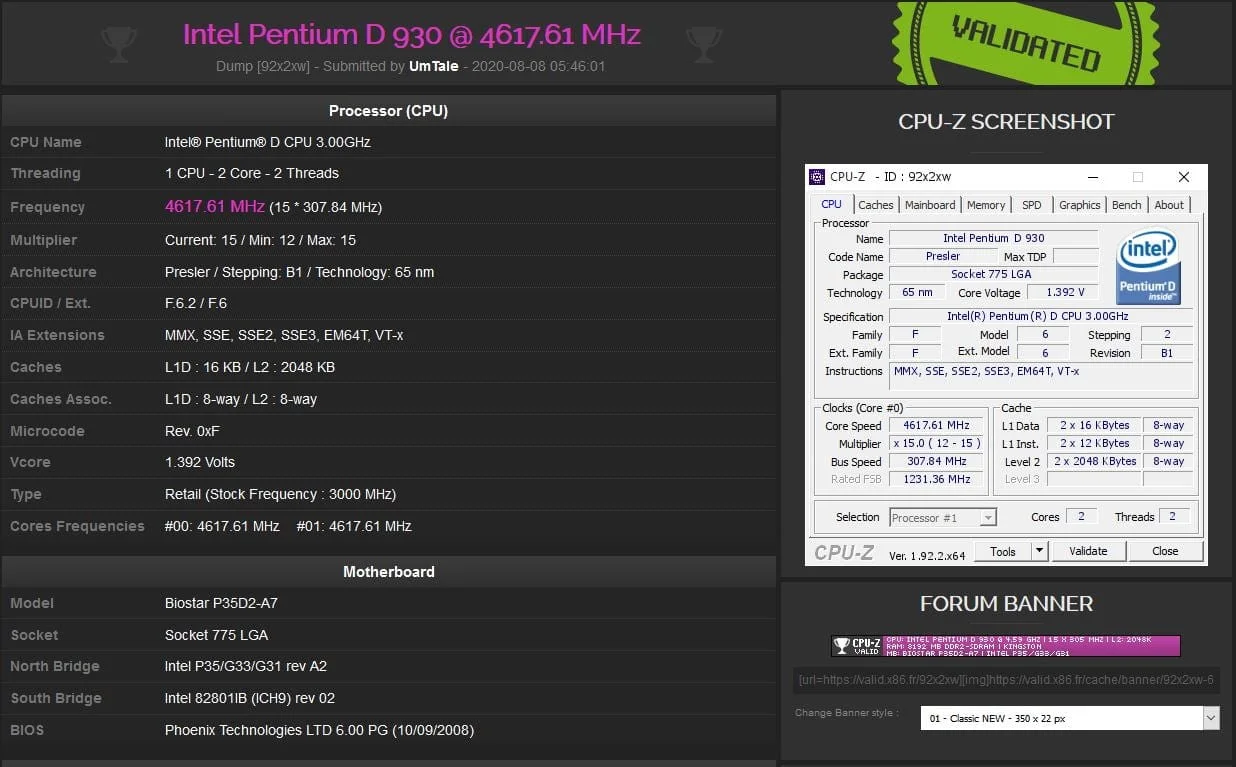
Stability isn't even a consideration here: at 4617 MHz, the chip barely managed to pass validation in CPU-Z.
Pentium D 930 overclocking settings to 4350 MHz:
FSB — 290 MHz;
CPU multiplier — 15;
FSB voltage — 1.35v;
CPU vCore — 1.348v (+0.187 volts over stock)
DRAM clock — 580 MHz (with a Pentium D chip installed, the motherboard lacks a 533 MHz divider, making it less ideal for overclocking this CPU lineup);
DRAM timings — 5-5-5-15 2T;
DRAM voltage — 2.0v;
PCI-e — 101 MHz;
Test results
I think it's no secret that Pentium D series chips have been physically incapable of running the vast majority of modern titles for several years now. The reason is their lack of the necessary SSE4.1 and SSE4.2 instructions. That's precisely why I chose the rather old game DiRT 3 to evaluate performance gains. This rally simulator, released back in 2011, theoretically (at least according to the game's minimum system requirements) should have launched on an old Pentium D. And it did. What I didn't expect, however, was that I could actually play a 9-year-old game comfortably on a 14-year-old processor that didn't exactly shine in performance even at its release. Not at maximum or even medium settings, of course, but damn, comfortably!
For DiRT 3, I used "Ultra Low" graphics settings and a 1280x720 resolution. The in-game benchmark served as our performance metric. The remaining tests (Cinebench R11.5, Cinebench R15, and CPU-Z Benchmark) were run using each application's default settings.
Here's the final table with the test results:
Pentium D 930 CPU frequency | 3000 MHz | 4350 MHz |
Cinebench R11.5 results (points) | 0.83 | 1.2 |
Cinebench R15 results (points) | 72 | 101 |
CPU-Z benchmark results (single|multi) | 101.4|200.8 | 147.2|292.8 |
DiRT 3 results (FPS - min|avg) | 38|55 | 45|66 |
Benchmark screenshots:
The test results reveal that in synthetic benchmarks, the Pentium D 930, when overclocked to 4350 MHz, saw a performance increase of approximately 35-45% depending on the application. However, the situation in DiRT 3 was drastically different. The frame rate only increased by 19% for minimum FPS and 20% for average FPS. The blame for this lies with the rather mediocre RAM and FSB frequencies, as these two dies communicate with each other via the FSB.
Conclusion
I never managed to reach the NetBurst architecture's coveted 5 GHz mark. As you've already read, the primary reasons were inadequate CPU cooling and the test motherboard's extremely weak power delivery subsystem. For extreme overclocking, 4600 MHz is undeniably a very poor result. However, the stable-across-the-board 4350 MHz is a relatively decent figure.
Nevertheless, I'm well aware that the Pentium D 930 sample we have in our lab is, to put it mildly, not ideal and doesn't fully represent the overclocking potential of the entire Pentium D series. Therefore, as soon as I acquire a few new samples from the 65-nanometer Pentium family, I'll immediately dive into researching their overclocking capabilities.
But generally speaking, you should understand that virtually any Pentium D processor you might acquire in 2020 will likely be in terrible physical condition, ranging from die degradation and knocked-off capacitors to complete non-operability.
Until next time, and happy overclocking!