TESTS · CPU · INTEL
PUBLISHED
READING11 min
Pentium 4 541: what NetBurst's Hyper-Threading was capable of in 2011? Review, overclock, and benchmarks
A 2011 look at the Pentium 4 541 (NetBurst): Hyper-Threading offers a 15-35% performance boost, but the CPU still struggles against rivals in games.
A bit about the Pentium 4
Much has changed since the Pentium 4, and many architectures have come and gone. Yet, NetBurst, though retired, still left its mark. Its strength was its weakness – that pretty much sums up this CPU, which was based on the once-innovative NetBurst architecture. Intel engineers were once so caught up in the "megahertz race" that ignited between them and AMD after AMD became the first to release a processor clocking over 1 GHz. This challenged Intel's leadership, and they were determined to win that race at any cost.
In 2000, they launched a processor built on a fundamentally new architecture, bearing almost no resemblance to its predecessor. This microarchitecture aimed to conquer previously distant frequencies of 2 GHz, then 3 GHz, but those "megahertz" gains didn't come easily.
Engineers had to increase the pipeline length to 20 stages (Pentium III had just 10 stages), a technology they dubbed "Hyper-Pipelined Processing." Pentium 4 processors with Willamette and Northwood cores featured a 20-stage pipeline, while Prescott and Cedar Mill cores used a 31-stage design. This allowed Pentium 4 CPUs to achieve higher clock speeds compared to processors with shorter pipelines manufactured using the same process technology. For instance, the maximum clock speed for Intel Pentium III processors on the Tualatin core (130 nm technology) was 1400 MHz, Athlon XP hit 2200 MHz, Athlon 64 reached 2800 MHz, and Pentium 4 processors with the Cedar Mill core could operate at frequencies exceeding 3800 MHz.
To minimize the impact of mispredicted branches from the long pipeline, NetBurst architecture processors utilized an enlarged branch prediction buffer and a new branch prediction algorithm compared to their predecessors. This allowed them to achieve high prediction accuracy (around 94%) in Willamette core processors. Subsequent cores saw further modernizations to the branch prediction mechanism, boosting accuracy up to 98% in the Cedar Mill core.
Despite all these impressive examples of high frequencies, superior branch prediction mechanisms, and other "perks," the Pentium 4 still couldn't surpass its rival, the Athlon. That historical milestone ultimately remained AMD's.
Looking at processors now, it's safe to say Athlon "isn't what it used to be," while Pentium, conversely, is increasingly regaining its once-lost ground. But those are just my thoughts.
The processor
 ⤢ ВІДКРИТИ
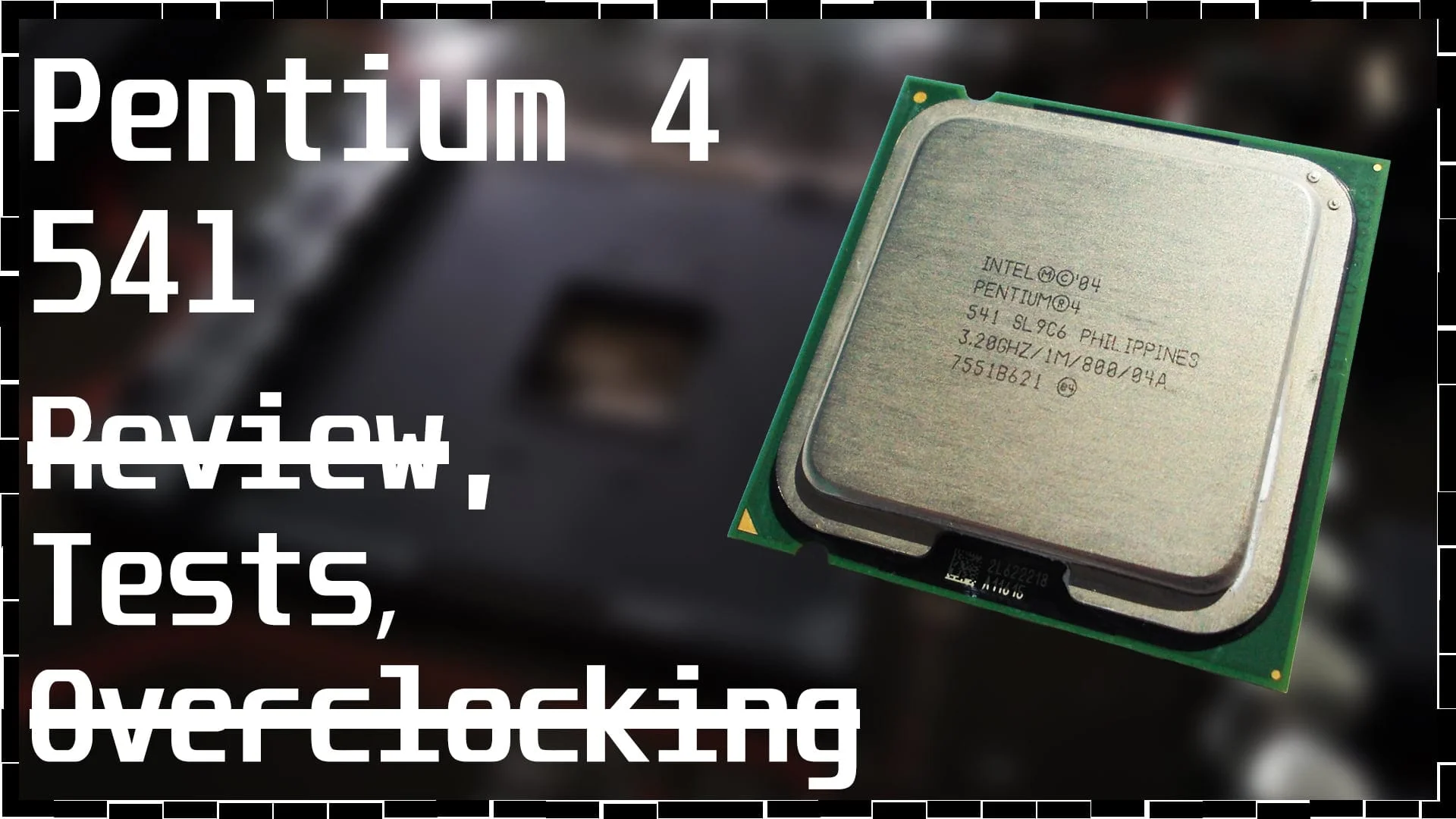
The test sample is marked SL9C6. The Pentium 4 541 is built on a 90nm Prescott core and features 1MB of L2 cache. Its nominal clock speed is 3200 MHz, derived from a 200 MHz bus multiplied by 16. Manufactured in the Philippines, it has a 90-watt thermal design power (TDP).
 ⤢ ВІДКРИТИ
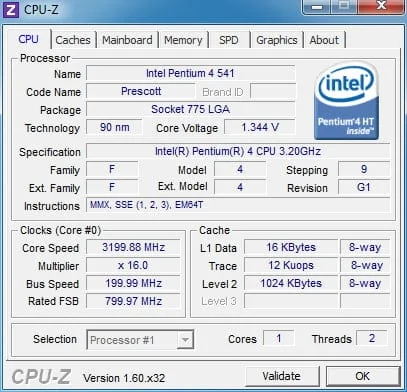
The CPU-Z utility confirms the above information and adds that the chip's nominal voltage is 1.344V. As you've probably noticed, the core is based on the superior 90nm revision, G1.
Test bench and software
AM3 motherboard – ASUS M4A785TD-V EVO
AM2 motherboard – ASUS M2V
LGA775 motherboard – Biostar P35D2A7
Processors – Core 2 Duo E6300; Pentium 4 541; Celeron D 326; Sempron 140; Sempron 3400
LGA775 CPU cooling – Cooler Master Hyper 101; Cooler Master Hyper TX3
AM2/AM3 CPU cooling – Cooler Master Susurro (RR-KCT-T9E1)
RAM – 2x2GB DDR3 Corsair XMS3 PC10700 (9-9-9-34)
RAM – 2x2GB DDR2 PQI PC6400 (5-5-5-16)
Graphics card – Sapphire Radeon HD5770 (960/5300MHz) (for tests)
Graphics card – XFX GeForce 8600GT (540/1080/1400MHz) (for overclocking)
PSU – Cooler Master 500W
Hard drives – Samsung SP160GB
Software
Windows 7 x64 SP1
CPU-Z 1.60
CineBench 9.5 x64
CineBench 11.5 x64
Light work - Renderbench
3D Mark Vantage v1.1.1 (CPU test only)
Hot CPU tester pro
AMD Catalyst 12.3
wPrime v1.55
Fritz chess benchmark
FRAPS v3.1.0
In-game graphics settings
GTA IV:
Resolution - 1280x1024
Textures – high
Reflection resolution – high
Water quality – very high
Shadow quality – high
Filtering quality – x16
View distance – 100
Detail distance – 100
Traffic density – 100
Depth of field – on/on
Vertical synchronization – off/off
Prototype:
Resolution - 1280x1024
Textures - high
Shadows - high
Anti-aliasing - 0x
Overclocking
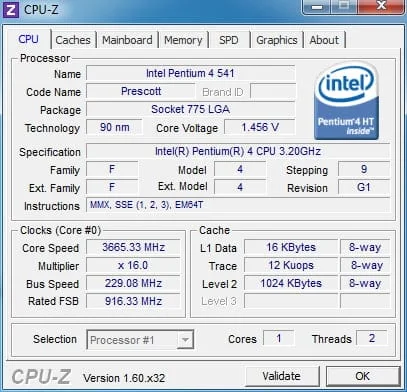
Let's move directly to overclocking. This particular sample disappointed me. At 1.456V, it only managed 3665 MHz, which isn't much for a 90nm NetBurst core. It's worth noting that HT was enabled during this overclock.
 ⤢ ВІДКРИТИ
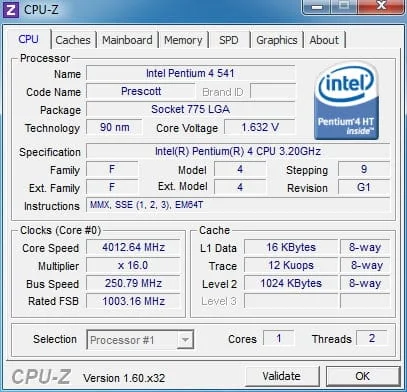
A quick note on the first result: with HT disabled, the processor hit 3790 MHz at the same voltage. That's what sparked the idea to test the Pentium 4 541 with HT disabled as well. Unsatisfied with the initial outcome, I decided to push the voltage to 1.6V, which allowed me to complete 1 hour in LinX at 4012 MHz:
 ⤢ ВІДКРИТИ
The RAM operated at 1003 MHz with 5-5-5-24 timings and 2.1V.
The Cooler Master Hyper TX3 was already at its limit. The overclocked Pentium 4 541 at 4012 MHz and 1.6V started to exceed 79 degrees, but there was no throttling. So, this result was deemed stable enough for testing.
Benchmarks
Let's look at today's test subjects:
Athlon 64 X2 3600+Sempron 3400+Sempron 140Core 2 Duo E6300Celeron D 326Pentium 4 541 Frequency2000MHz1800MHz2700MHz1866MHz2533MHz3200MHz Core codenameWindsorManilaSargasConroePrescottPrescott Process tech, nm909045659090 Hyper-Threading supportNoNoNoNoNoYes Socket typeAM2AM2AM3LGA775LGA775LGA775 TDP, W656565656590 L1 cache, KB2x6464642x321616 L2 cache, KB2x256256102420482561024 L3 cache, KB----- Cores|Threads2|21|11|12|21|11|2
Now, let's look at the CPU testing modes:
Athlon 64 X2 3600+ 2000@2600MHz
Sempron 3400+ 1800@2466MHz
Sempron 140 2700@3780MHz
Core 2 Duo E6300 1866@3360MHz
Celeron D 326 2533@4005MHz
Pentium 4 541 HT-off 3200@3665MHz
Pentium 4 541 HT-on 3200@3665@4012MHz
Naturally, the charts turned out huge due to the many "clones" of the Pentium 4 541, but they remained readable.
Rendering
 ⤢ ВІДКРИТИ
 ⤢ ВІДКРИТИ
 ⤢ ВІДКРИТИ
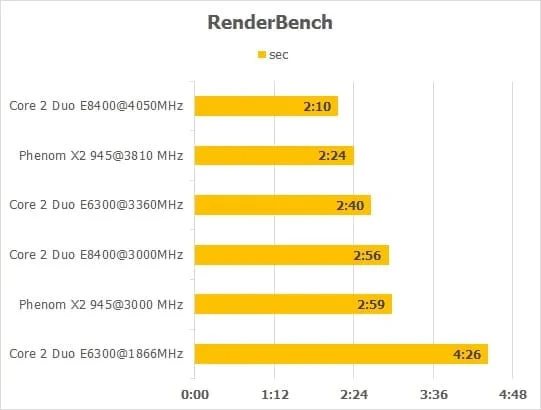
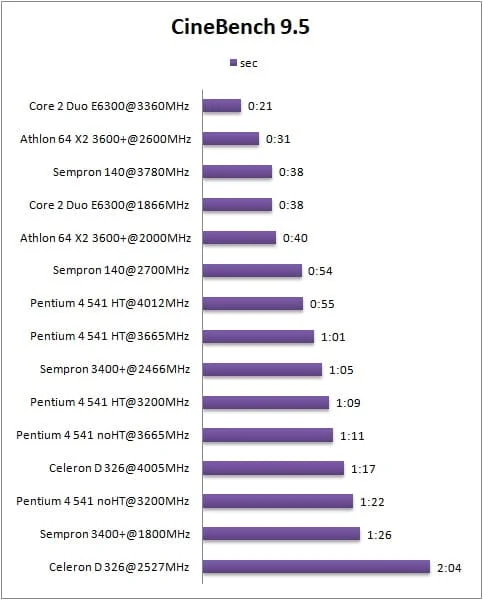
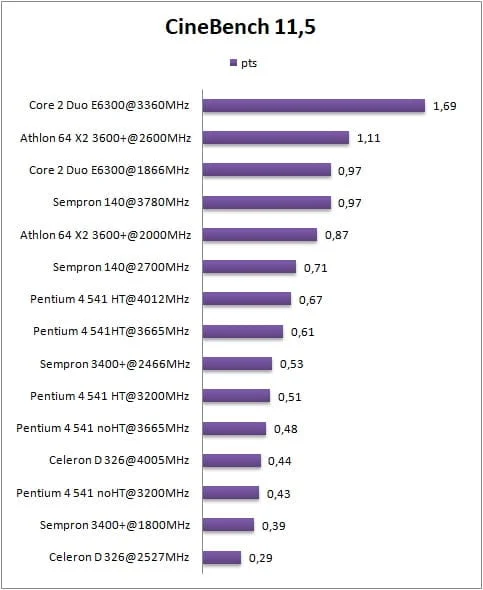
Let's start with the HT-enabled variant: when overclocked to 4012 MHz, the Pentium 4 approached the stock Sempron 140 but couldn't quite surpass it. In RenderBench, which doesn't support multi-threading at all, the Pentium 4 couldn't even match the stock Core 2 Duo E6300.
What about the non-HT variant? At 3665 MHz, the Pentium 4 could only compete with the stock Sempron 3400+ and the overclocked 4005 MHz Celeron D 326.
Comparing the HT and non-HT variants, it becomes clear that even an aging Pentium 4 gets a decent performance boost of 20 to 40% from it.
Overall performance
 ⤢ ВІДКРИТИ
 ⤢ ВІДКРИТИ
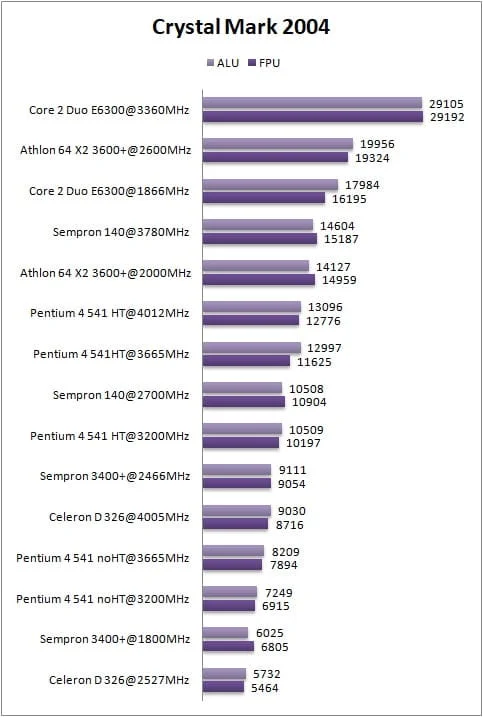
Crystal Mark, though old, supports up to eight threads. Here, the Pentium 4 found itself in its best possible scenario! At 3200 MHz, it nearly matched the stock Sempron 140 and even surpassed it when overclocked. What's more, I was surprised that the Pentium 4 541, overclocked to 4012 MHz, managed to beat (!) the stock Core 2 Duo E6300, catch up to the stock Athlon 64 X2 3600+, and even overtake the 3780 MHz overclocked Sempron 140! Hyper-Threading provided a full 30% boost here!
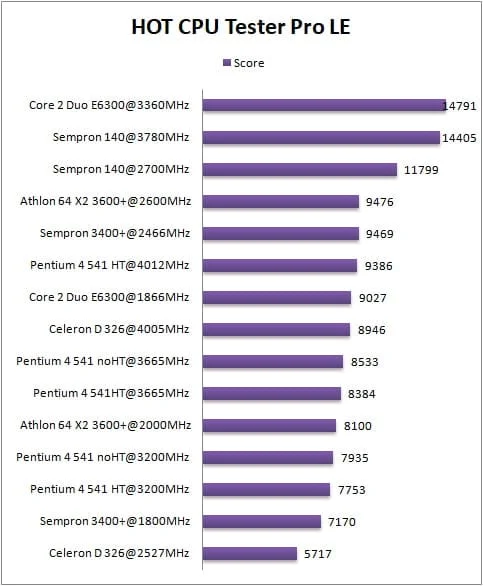
Hot CPU tester, conversely, only supports single-threaded operation. The 4012 MHz overclocked Pentium 4 541 couldn't even keep up with the AMD Sempron 3400+ running at 2466 MHz. Yet, it still managed to outperform the stock E6300 and X2 3600+. Competing with the Sempron 140 was out of the question; it, like the overclocked E6300, plays in a completely different league.
Archiving
 ⤢ ВІДКРИТИ
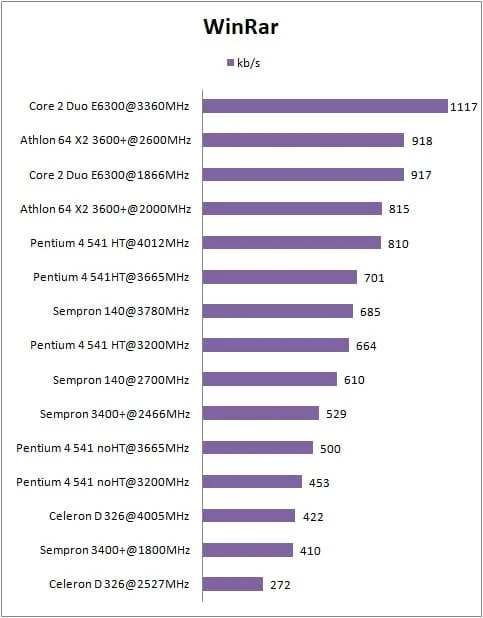
WinRAR has long supported multi-threading, and thanks to this, the Pentium 4 541 HT, running at 4012 MHz, shows impressive results, outperforming the 3780 MHz overclocked Sempron 140 and catching up to true dual-core processors! This benchmark reveals a 30% performance increase from Hyper-Threading on the CPU.
Computation
 ⤢ ВІДКРИТИ
 ⤢ ВІДКРИТИ
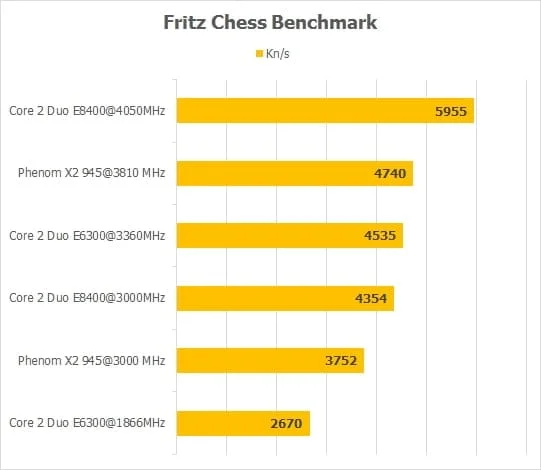
The Fritz chess benchmark excellently utilizes any number of cores or threads, yet due to its architectural peculiarities, the Pentium 4 couldn't deliver a decent result and lost to the Sempron 140. What's more, it barely edged out the single-core Sempron 3400+. I simply can't overlook the outstanding performance of the Core 2 Duo E6300. When overclocked to 3360 MHz, it left opponents no chance of victory!
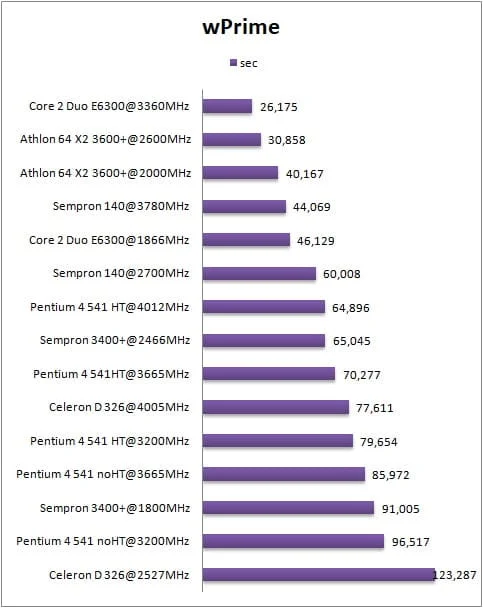
wPrime is also a multi-threaded benchmark. Upgrading from a Pentium 4 541 to a Sempron 140 would bring significant dividends, as even with an "infernal" overclock, the Pentium couldn't get close to the Sempron 140 and only weakly competed with the Sempron 3400+. The underdog Celeron D 326, when overclocked to 4005 MHz, still manages to surpass its older sibling running at stock speeds – though, who really cares?
Games: Synthetics
 ⤢ ВІДКРИТИ
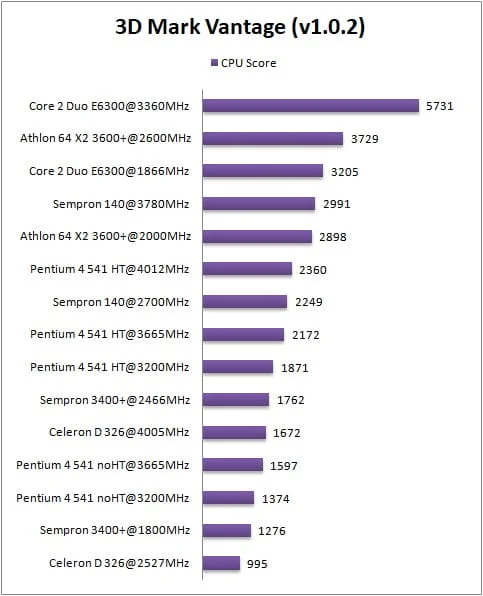
3D Mark Vantage, an almost insurmountable challenge for most processors in our test, is also optimized for a high number of threads. Here, the Pentium 4 541 caught a slight break, but only just. When overclocked to 4012 MHz, it managed to surpass the stock Sempron 140, and the latter's overclock propelled it into the dual-core league, where it gave the stock Athlon 64 X2 3600+ a decent run for its money. The performance of the Core 2 Duo E6300 after overclocking is simply captivating.
Games:
 ⤢ ВІДКРИТИ
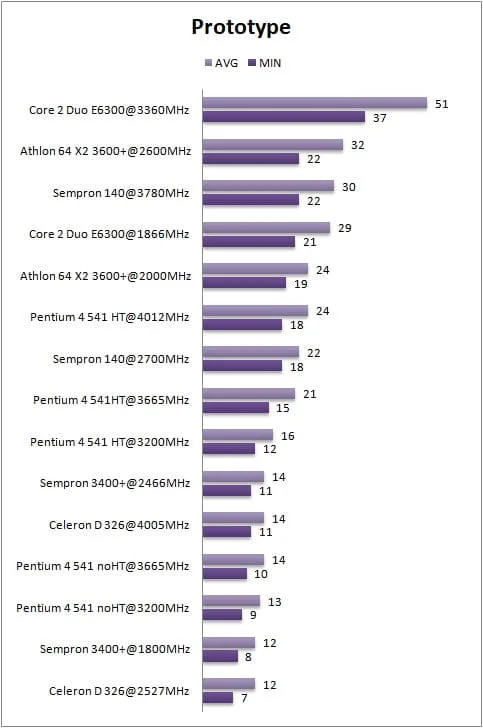
Overclocking the Pentium 4 to 4012 MHz allows you to enjoy all the visual splendors of Prototype, which is significant for a processor built on the NetBurst architecture. At this frequency, it even managed to outperform the Sempron 140, but overclocking the latter again placed it in the dual-core league, despite having only one physical core. Oddly enough, the stock Pentium 4 managed to surpass the Sempron 3400+ overclocked to 2466 MHz here, a rare occurrence.
 ⤢ ВІДКРИТИ
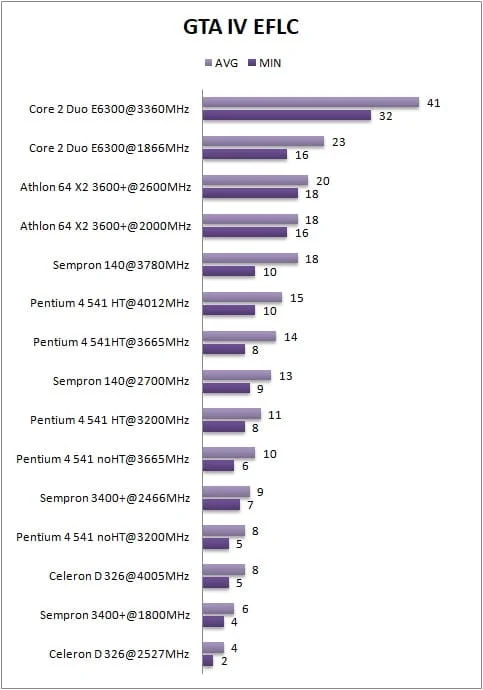
After running the tests, I realized how overzealous I was with such high settings. Performance in the in-game (!) benchmark was abysmal, and during freeplay on the 4012 MHz overclocked Pentium 4, it was around 4-7 FPS. Horrible! To reassure you slightly: at minimum image quality settings and draw distance, the FPS became acceptable for this type of processor, around 16-23 FPS. With HT disabled, the situation worsened considerably, with FPS dropping to 12-16 FPS.
Alright, let's talk about the results – the 4012 MHz overclocked Pentium 4 541 managed to outperform the Sempron 140 running at its stock frequency. When the AMD processor was overclocked, everything fell into place, except that this time the overclock didn't allow the Sempron 140 to surpass the stock dual-core processors.
Conclusion
And so concludes the showdown between the Pentium 4 541 and the Sempron 140. What conclusions can we draw after testing a processor that's turning seven this year? To be fair, it wasn't a performance king even in its prime. But back then, Hyper-Threading wasn't utilized to its full potential. Now, we're seeing a 15-35% performance uplift. Those who once argued that saving a few tens of dollars by getting a CPU without HT wouldn't limit them were wrong, but only partly.
Even with HT, Intel processors in most applications couldn't gain a decisive advantage over contemporary AMD processors.
The situation only drastically changed with the release of Nehalem. In that architecture, HT found its second life and propelled performance to an entirely new level.
Summing up all the tests, it's safe to say the Pentium 4 almost always only competed with the Sempron 3400+, which, in theory, is supposed to rival the Celeron D. Except for games, as strange as that sounds. After all, NetBurst-based processors were never known for high gaming performance. However, it probably helped that for these tests, we only used games capable of loading more than two cores. Here, the P4 541's "bonus" – namely HT – played in its favor.