TESTS · CPU · INTEL
PUBLISHED
READING5 min
Intel Sandy Bridge: review, overclocking, and testing of Core i5 2300 and Core i5 2500
We dive deep into Intel's Core i5 2300 and Core i5 2500 Sandy Bridge processors, covering a detailed review, overclocking potential, and performance benchmarks.
Introduction
Six months ago, Intel refreshed its highly successful Core processor lineup. The Sandy Bridge architecture replaced the aging Nehalem. While it didn't introduce anything fundamentally new, it still pushed performance even higher, putting significant pressure on rival AMD.
So, what did Intel improve in these CPUs? The most significant change was the move from a 45nm to a 32nm manufacturing process. While Nehalem did exist on 32nm, Intel rebranded those six-core designs as Westmere (like the Core i7 980/990 for LGA1366, plus a host of Xeon W36xx and X56xx lines for the same LGA1366).
Second, Intel integrated a relatively potent graphics core directly into the processor. Third, they substantially improved the memory controller, even if it was trimmed compared to LGA1366, now only featuring two channels.
In practice, the reduced RAM bandwidth only looked like a disadvantage on paper. The new processors' overall performance actually kept pace with previous CPUs thanks to significant internal architectural improvements.
The processors
 ⤢ ВІДКРИТИ
 ⤢ ВІДКРИТИ
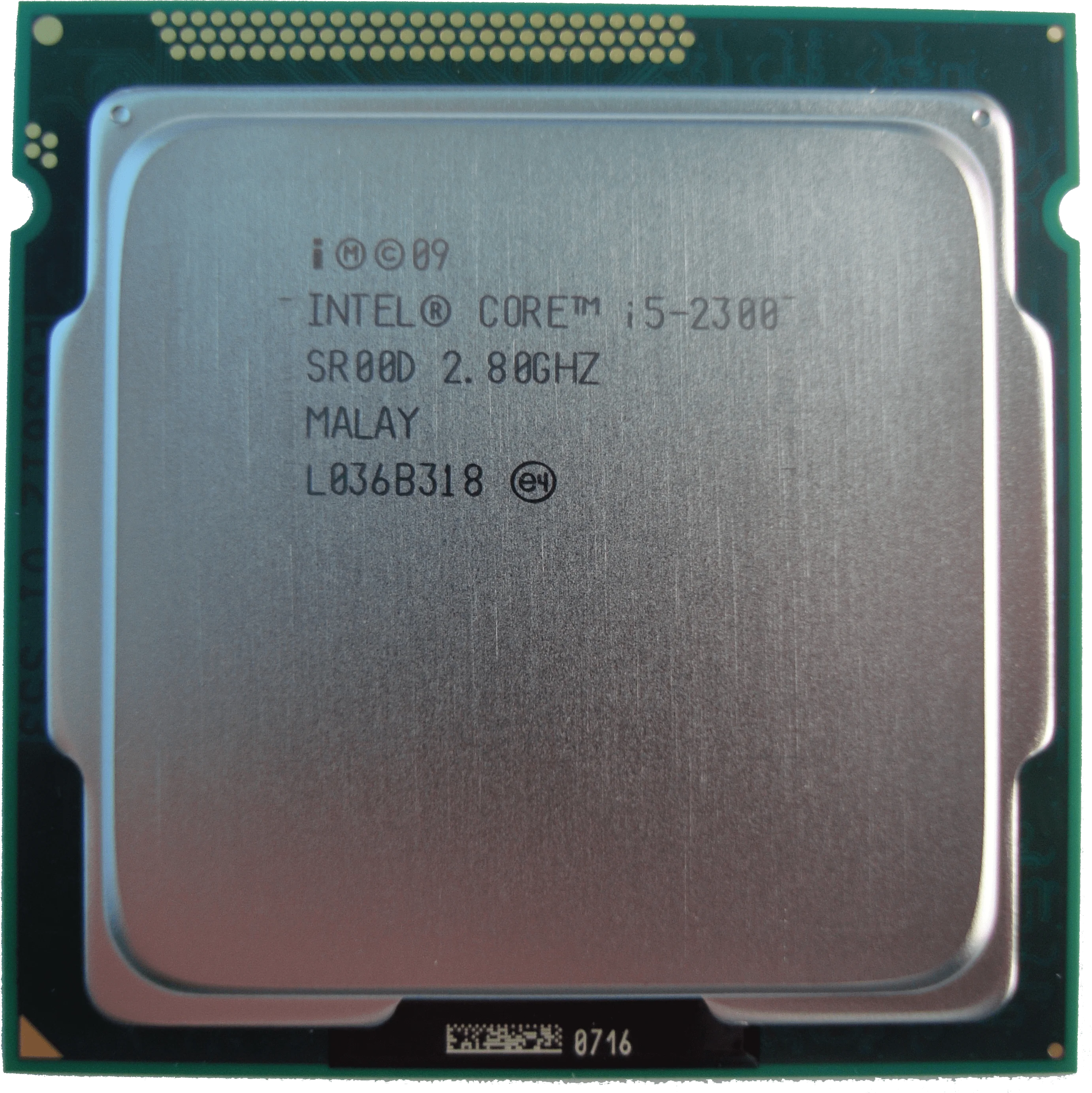
Bearing the SR00D designation, the Core i5 2300 processor is built on a 32nm Sandy Bridge core. It features 256KB of L2 cache per core and a shared 6MB L3 cache for all four cores. Our sample has a nominal voltage of 1.168V, a D2 core revision, and a maximum TDP of 95 watts. Its stock frequency is 2800MHz.
 ⤢ ВІДКРИТИ
 ⤢ ВІДКРИТИ
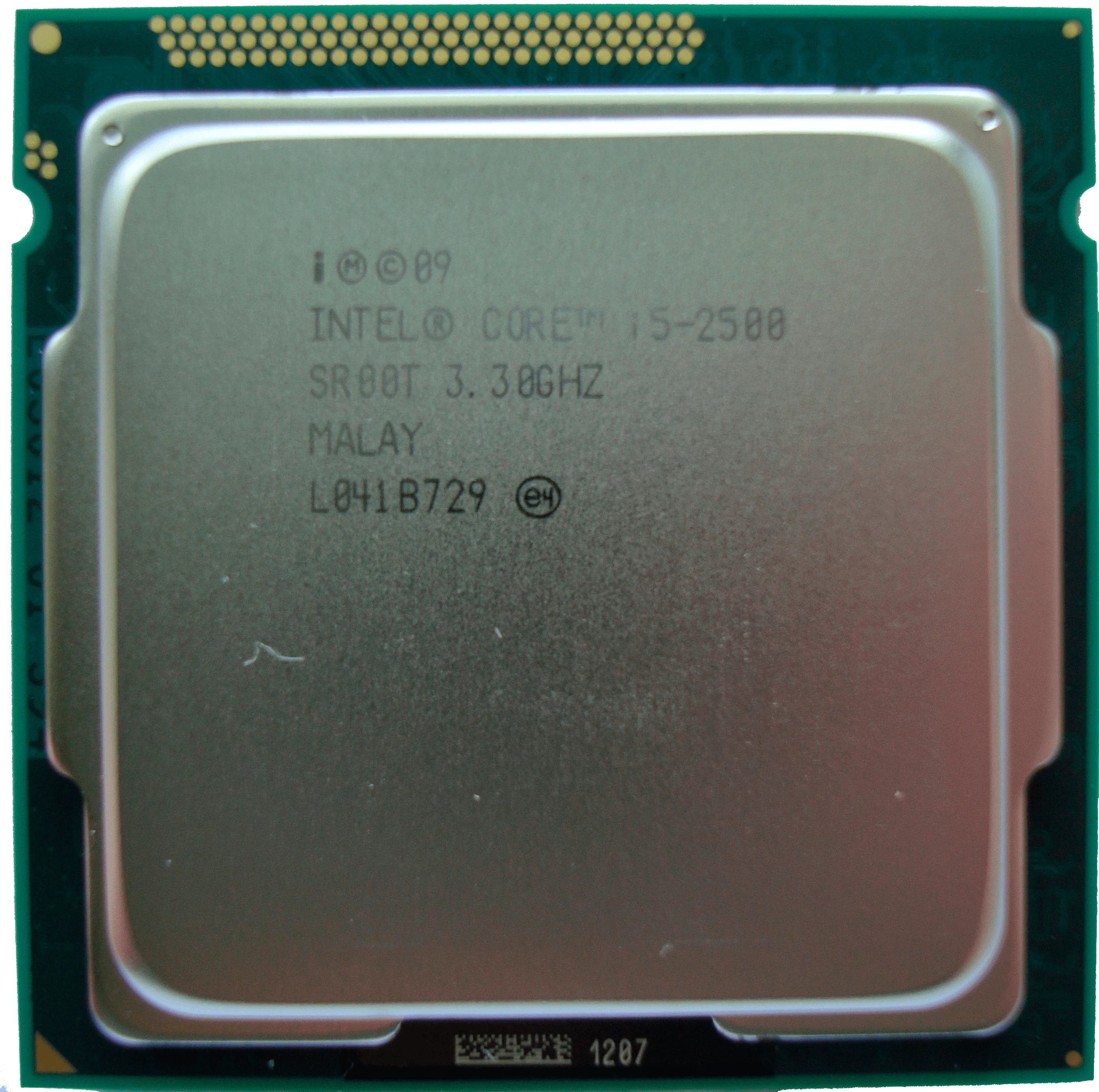
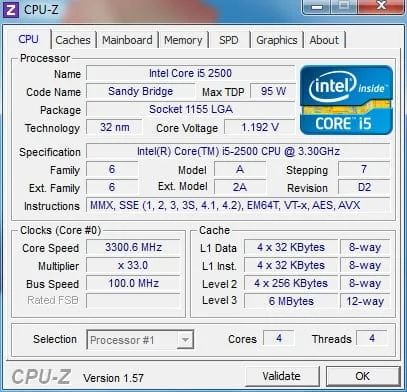
The Core i5 2500, also based on a 32nm Sandy Bridge core, mirrors the i5 2300 with 256KB of L2 cache per core and a shared 6MB L3 cache. Its nominal voltage is slightly higher at 1.192V, retains the D2 core revision, and has a 95-watt maximum TDP. The key difference lies in its higher stock frequency of 3300MHz.
Test setup:
LGA1155 motherboard - ASUS P8P67-PRO
LGA775 motherboard - Biostar P35D2A7
Processors - Core 2 Duo E8400, Core i5 2300, Core i5 2500
LGA1155 CPU cooling - Intel BOX
LGA775 CPU cooling - Zalman 7700cu
RAM - 2x2GB DDR3 Corsair XMS3 PC10700 (9-9-9-34)
RAM - 2x2GB DDR2 Corsair PC6400 (5-5-5-16)
Graphics card - Sapphire Radeon HD5770 (960/5300MHz)
PSU - FSP 500W
Hard drives - Samsung SP160GB
Software:
Windows 7 x64 SP1
CPU-Z 1.57
CineBench 9.5 x64
CineBench 11.5 x64
Light Work - Renderbench
3D Mark 2006 v1.2.0 (CPU test only)
3D Mark Vantage v1.1.1 (CPU test only)
Hot CPU tester PRO
AMD Catalyst 11.6
wPrime v1.55
Fritz Chess Benchmark
SuperPi 1.4
FRAPS v3.1.0
In-game graphics settings:
GTA IV:
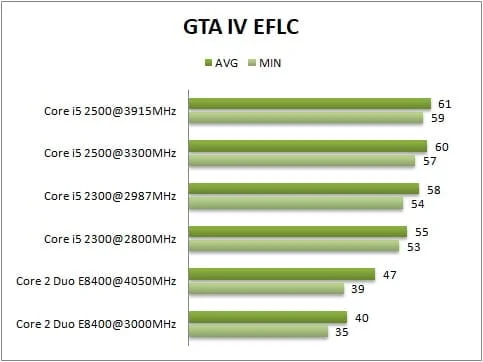
Resolution - 1280x1024
Textures – high
Reflection resolution – high
Water quality – very high
Shadow quality – high
Filtering quality – x16
View distance – 100
Detail distance – 100
Vehicle density – 100
Depth of field – on
Vertical sync – off
Prototype:
Resolution - 1280x1024
Textures - high
Shadows - high
Anti-aliasing - 0x
Overclocking
As most of you already know, conventional overclocking methods won't work on LGA1155 processors. Simply put, Intel locked down overclocking and started charging a premium for their "K" series models, which come with unlocked multipliers. At least this "privilege" doesn't cost users a grand, like it used to.
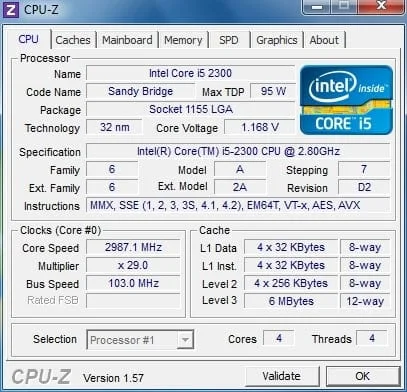
Moving on to overclocking. The Core i5 2300 was our first test. Using the multipliers available through Turbo Boost, I hit 2900MHz, then pushed the base clock (BCLK) to 103MHz. Unfortunately, that 103MHz BCLK proved to be the maximum stable frequency our test motherboard could handle, resulting in a final Core i5 2300 overclock of 2987MHz.
 ⤢ ВІДКРИТИ
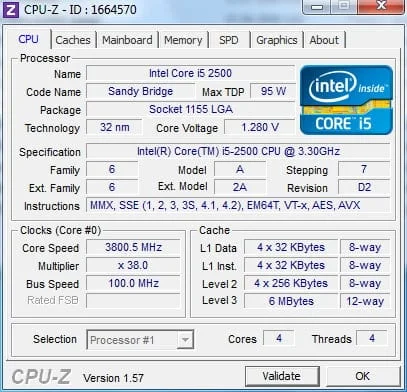
But the Core i5 2500 was a pleasant surprise! Its maximum multiplier is considerably higher than the Core i5 2300's, which alone allowed me to reach 3800MHz:
 ⤢ ВІДКРИТИ
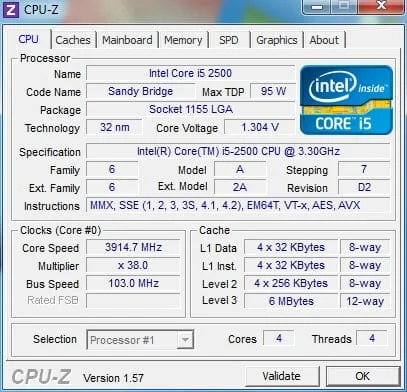
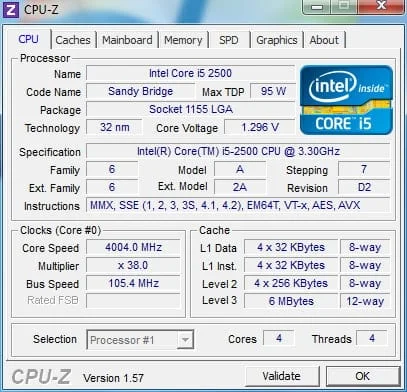
Then, I nudged the base clock. A mere 3MHz increase in BCLK added another 114MHz to the CPU, ultimately pushing it to a substantial 3914MHz:
 ⤢ ВІДКРИТИ
Naturally, I couldn't resist pushing it further, aiming for that sweet 4GHz mark just to satisfy my ego. No need for a lengthy explanation; here's a CPU-z screenshot:
 ⤢ ВІДКРИТИ
This, of course, was a "screenshot frequency." Stability wasn't even a consideration. But it's worth noting that with a more expensive and capable motherboard, hitting a stable 4GHz would likely be within reach.
Benchmarks
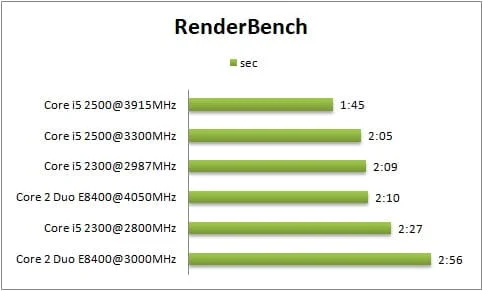
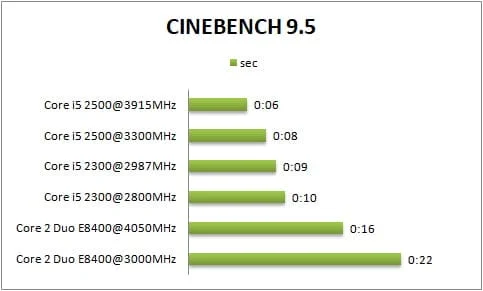
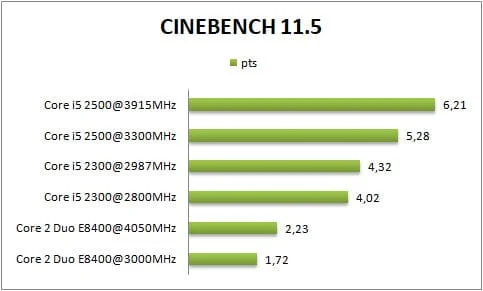
Rendering
 ⤢ ВІДКРИТИ
 ⤢ ВІДКРИТИ
 ⤢ ВІДКРИТИ
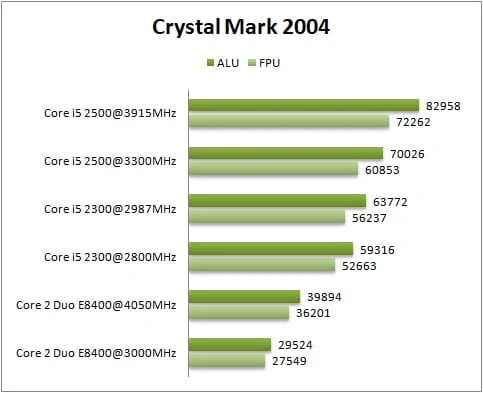
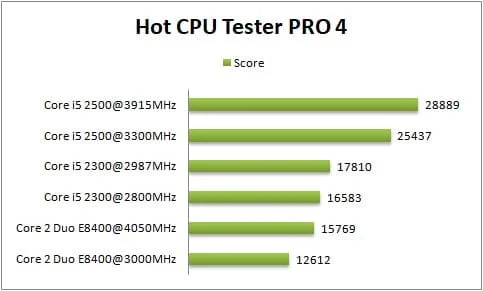
Overall performance
 ⤢ ВІДКРИТИ
 ⤢ ВІДКРИТИ
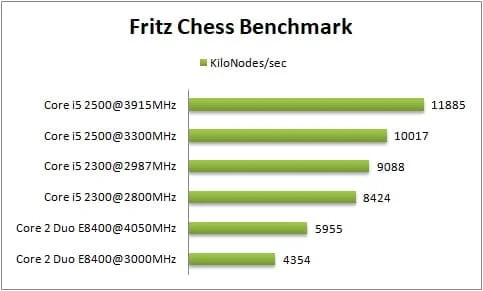
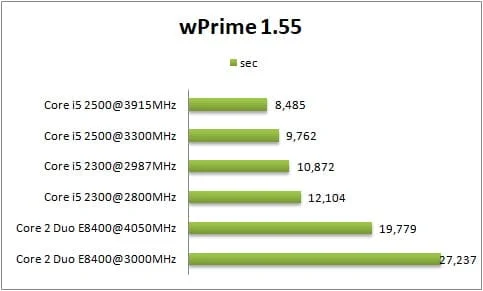
Calculations
 ⤢ ВІДКРИТИ
 ⤢ ВІДКРИТИ
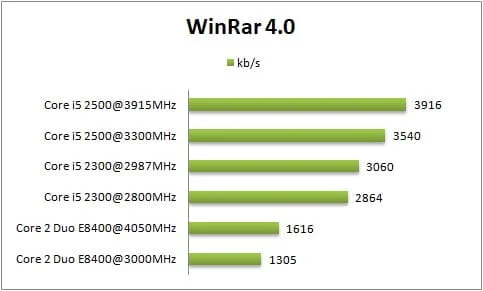
Archiving
 ⤢ ВІДКРИТИ
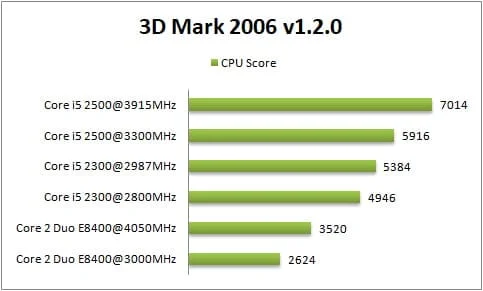
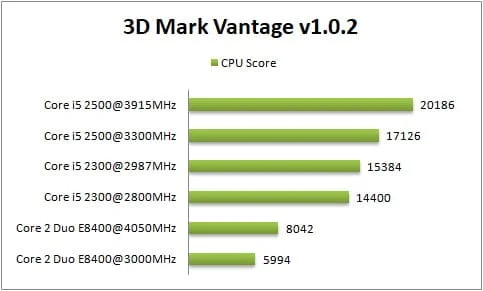
Gaming: synthetics
 ⤢ ВІДКРИТИ
 ⤢ ВІДКРИТИ
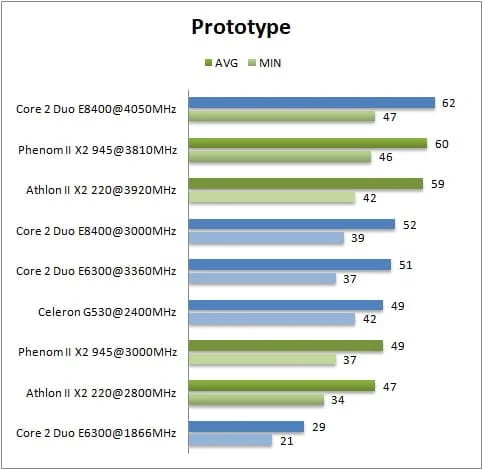
Gaming
 ⤢ ВІДКРИТИ
 ⤢ ВІДКРИТИ
Conclusion
You might've noticed the benchmarks lacked a proper competitor for the two processors we covered. We'll fix that omission in future reviews. But even without one, it's clear: Intel's new Sandy Bridge-based CPUs are unrivaled in both synthetic tests and real-world applications, especially when it comes to gaming.
The single-threaded RenderBench test clinches it: even an overclocked Core 2 Duo E8400 at 4050MHz couldn't beat the Core i5 2300, which was chugging along at a comparatively 'ludicrous' 2987MHz.
Author: UmTale Test bench components: UmTale, DENIM, MTPZP