TESTS · CPU · INTEL
PUBLISHED
READING16 min
Intel Xeon E5-2670 review and benchmarks
A review and benchmarks of the Intel Xeon E5-2670. We cover the 8-core processor's features, its strengths (price, ECC RAM) and weaknesses (the LGA2011 platform).
This processor review happened spontaneously. I hadn't planned any benchmark sessions in the near future, largely because our lab's GeForce GTX 1060 3GB graphics card just wasn't cutting it.
Currently, it barely handles 720p gaming benchmarks, let alone the 1080p resolution our readers demand. So, I wasn't keen on dedicating time to extensive testing of the various setups we have. But then, plans suddenly shifted.
It all changed when we briefly got our hands on the Intel Xeon E5-2670 — a fascinating and still incredibly popular processor. And it didn't come alone; it brought along its companion: a highly intriguing Hewlett-Packard Z420 (HP 1589) revision 2 motherboard.
What makes it so interesting? First, it's not a typical 'Chinese knockoff' with all the usual BIOS quirks, weak power delivery, and so on. While the HP Z420 is manufactured in China, Hewlett-Packard is the OEM. Second, it boasts eight RAM slots. And third, unlike branded boards from Dell, the HP Z420 fits comfortably into any ATX-compatible case.
The processor
 ⤢ ВІДКРИТИ
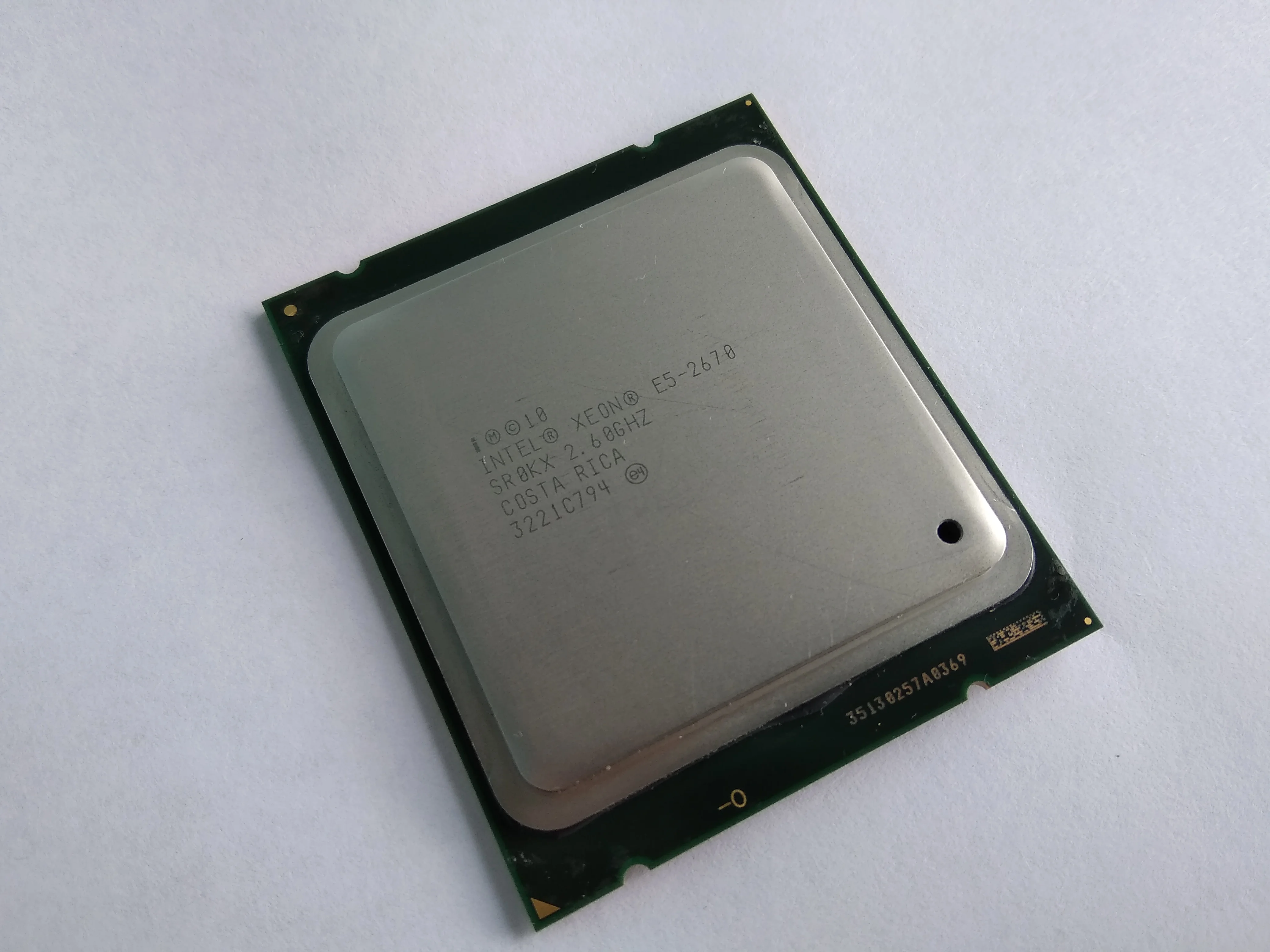
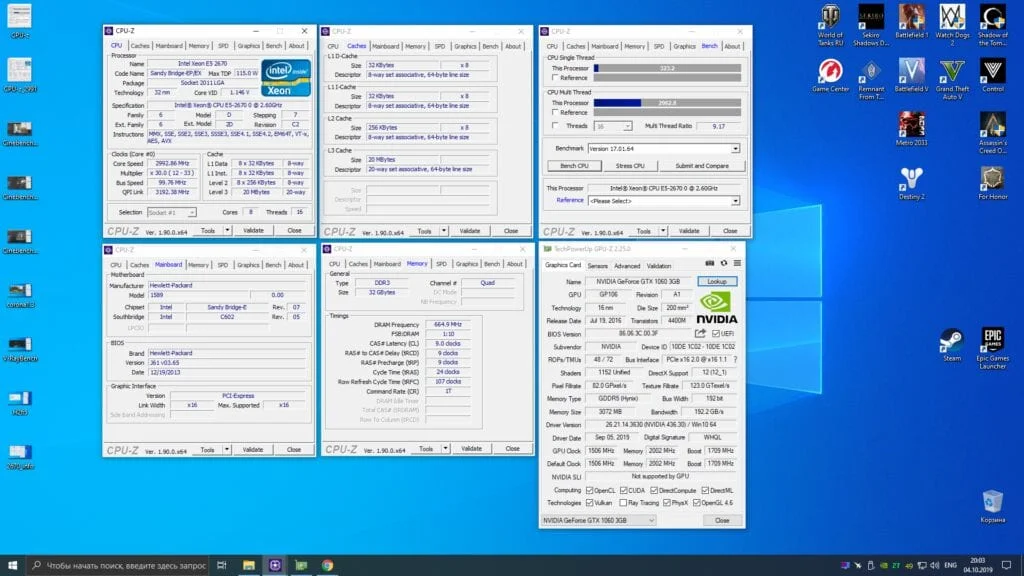
This is a typical Sandy Bridge-EP family member. The processor uses the C2 core revision, which should positively impact its heat and power consumption. Overall, C2 is the best possible stepping for Sandy Bridge-EP.
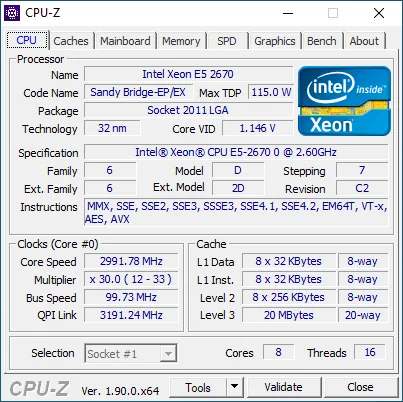
The Xeon E5-2670 features 8 cores and 16 threads, running at a nominal 2600 MHz. Thanks to Turbo Boost, the processor can reach 3000 MHz across all eight cores.
This CPU comes with 20 MB of L3 cache and a 115-watt TDP.
 ⤢ ВІДКРИТИ
 ⤢ ВІДКРИТИ
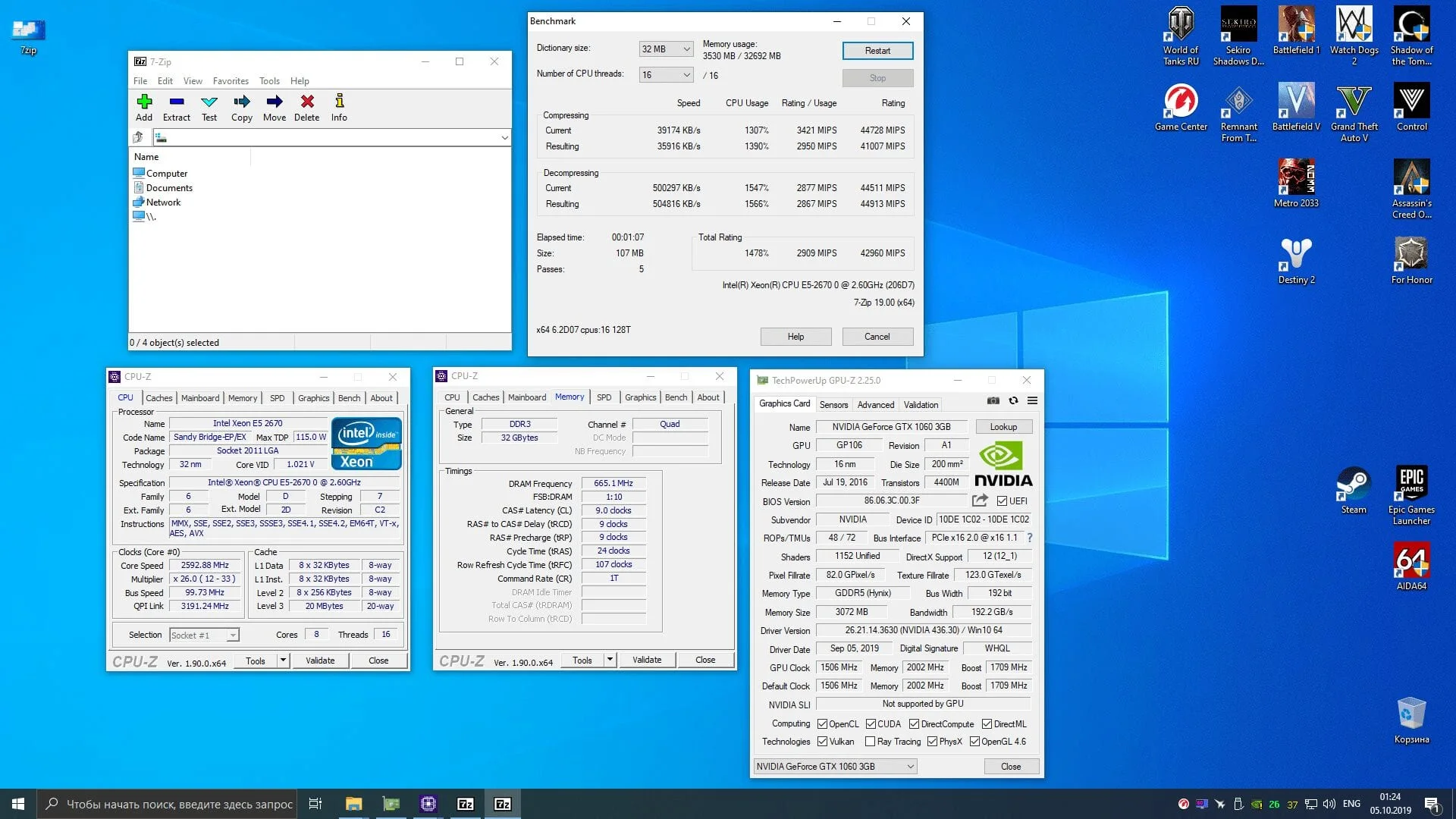
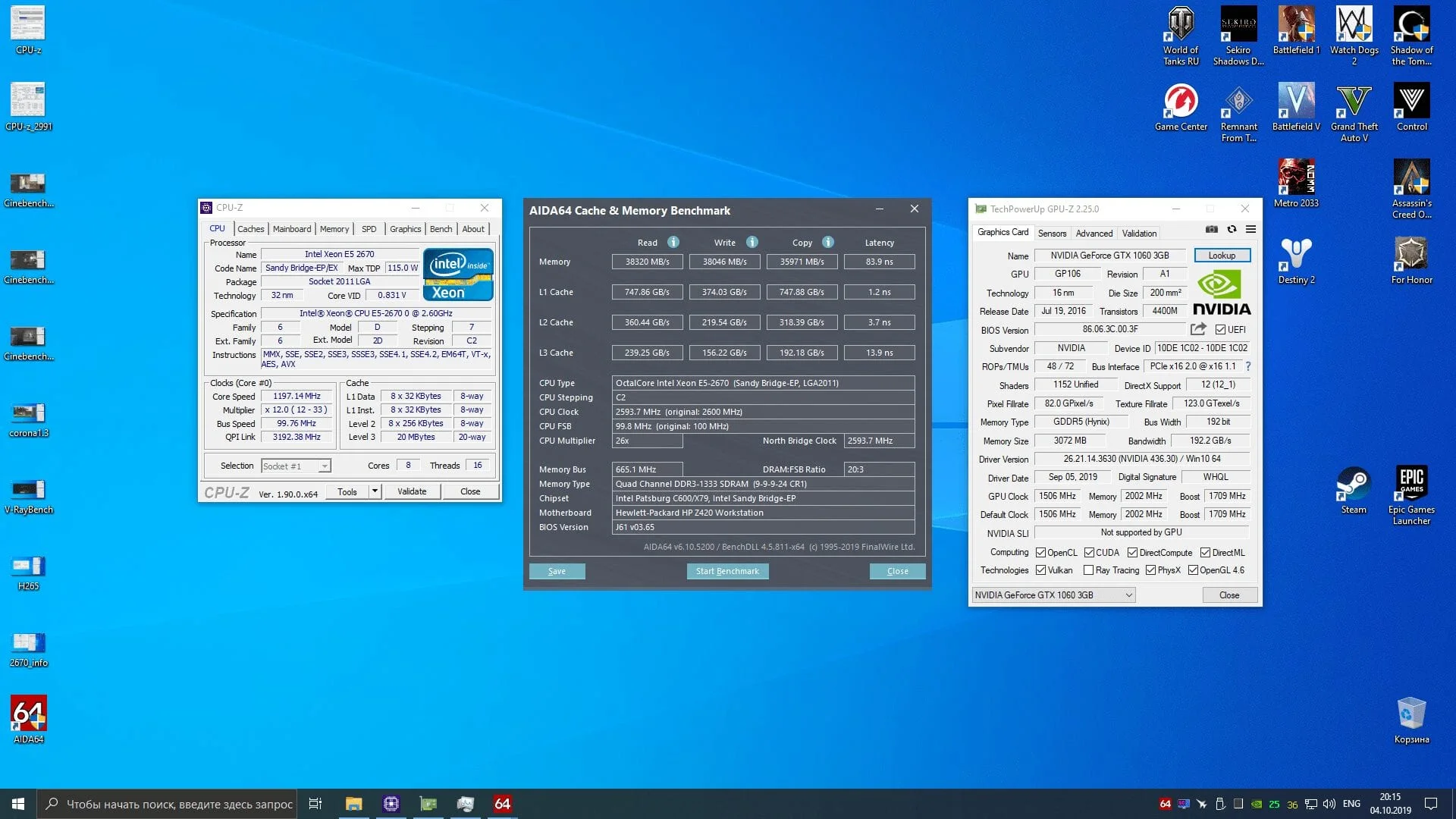
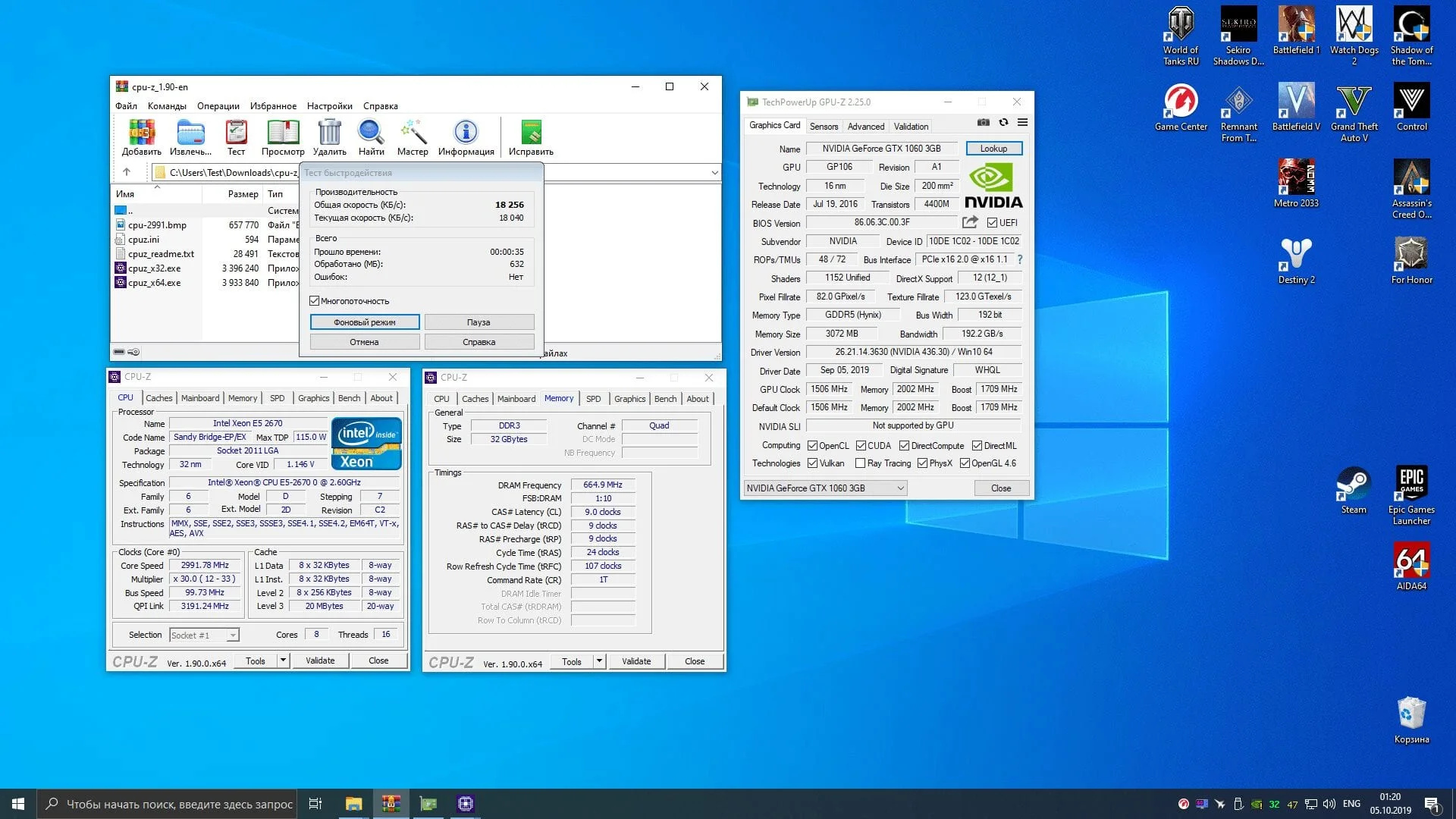
CPU-Z confirms all the above, except for the processor's frequency. Under maximum load across all cores, it slightly deviates from the advertised spec, hitting 2991 MHz instead of 3000 MHz.
The Xeon E5-2670 supports almost all relevant instruction sets: AES, AVX, EM64T, MMX, SSE, SSE2, SSE3, SSE4, SSSE3, VT-d, and VT-x. The key exceptions are AVX2 and TSX-NI, which it unfortunately lacks. But their absence isn't as critical as, for instance, the lack of SSE4.2 in Core 2 processors.
One notable characteristic of this CPU is that when testing with certain resource-intensive applications like LinX that utilize AVX instructions, the processor's frequency can temporarily drop to its base 2600 MHz. This drop is due to the CPU's 115-watt power consumption limit. As soon as the chip hits its TDP limit, internal mechanisms reduce the clock speed to keep consumption within manufacturer-specified bounds.
However, in real-world use, I didn't observe any clock speed drops — not in relatively demanding 3D rendering, nor in archiving software, and certainly not in games.
Pros and cons
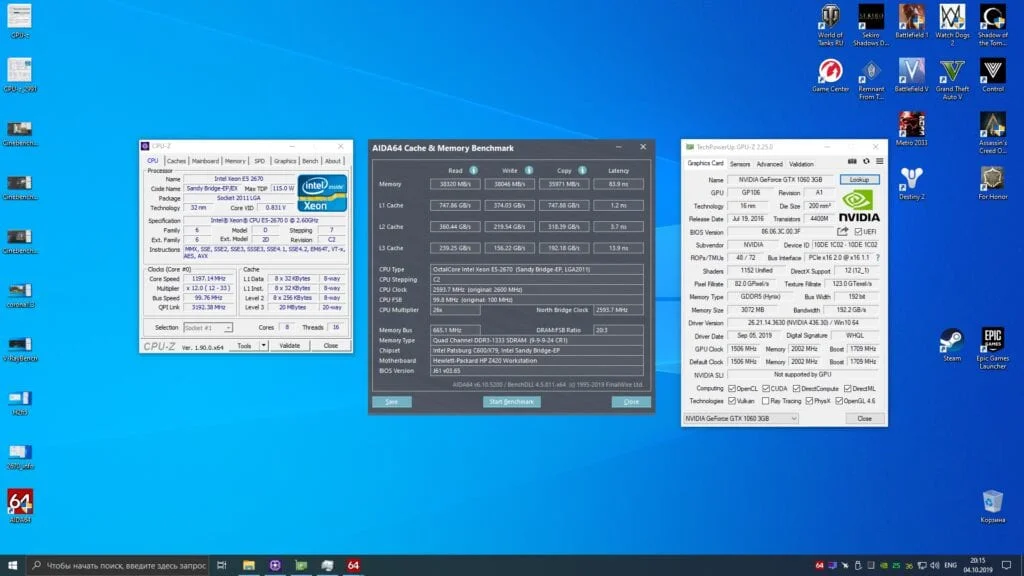
Among the main advantages of the Xeon E5-2670, and indeed the entire LGA2011 platform, is its support for incredibly cheap ECC REG DDR3 RAM.
 ⤢ ВІДКРИТИ
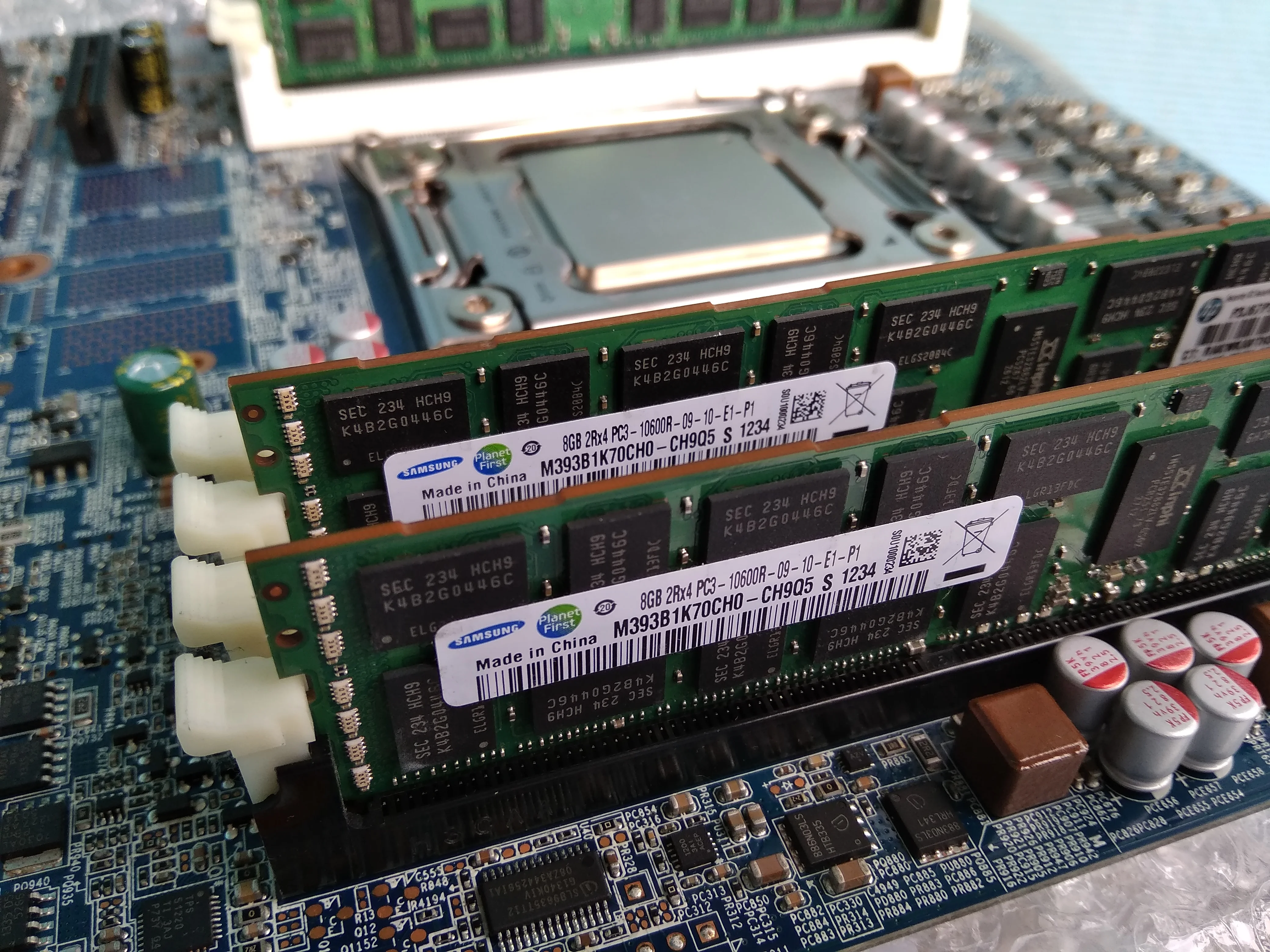
For example, we purchased 32 GB of 1333 MHz RAM for the test system — four 8 GB sticks — for just $50. If you want higher-frequency RAM, a similar four-stick, 8 GB (1866 MHz) kit would cost twice as much: $100.
However, not all processors require such high-frequency memory. The E5-2670, for instance, is perfectly content with quad-channel 1333 MHz RAM. We'll definitely verify this in a future article and publish the results.
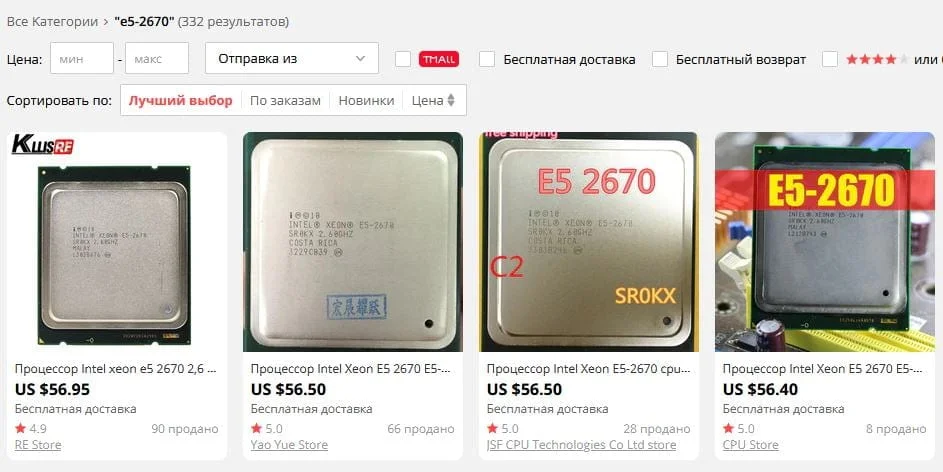
The second pro is the processor's price. Currently (as of October 23, 2019), the Xeon E5-2670 can be found for $50-60. For example, on AliExpress, the chip sells for $56:
 ⤢ ВІДКРИТИ
Now that we've covered the pros, let's move on to the obvious cons.
The first, and arguably the only, drawback is the 'dead-end' nature of the LGA2011 platform. The best processor for this socket is the 12-core, 24-thread Intel Xeon E5 2697 v2.
But there's little point in considering that processor. At a price comparable to AMD Ryzen and other modern CPUs, it still loses to them in almost every aspect — from its clearly inferior per-core performance and high power consumption to its lack of support for modern instruction sets.
Given that feature-to-price ratio, it's hardly worth mentioning.
Another con is the absence of extensions like AVX2 and TSX-NI. The latter, for instance, is crucial for proper functioning of the PlayStation 3 emulator, RPCS3.
Overclocking
There's virtually none to be had. While it depends on the motherboard, you won't be able to push the processor beyond 105-107 MHz via the BCLK, which only adds 100-200 MHz to the chip's final clock speed.
And what's the point of such an overclock if it resets every time you reboot or shut down? While overclocks might stick on premium boards from MSI, ASUS, or Gigabyte, their price tags border on the ridiculous. At that point, you're better off looking at first-gen Ryzen CPUs and their motherboards.
A few words about the HP Z420 motherboard
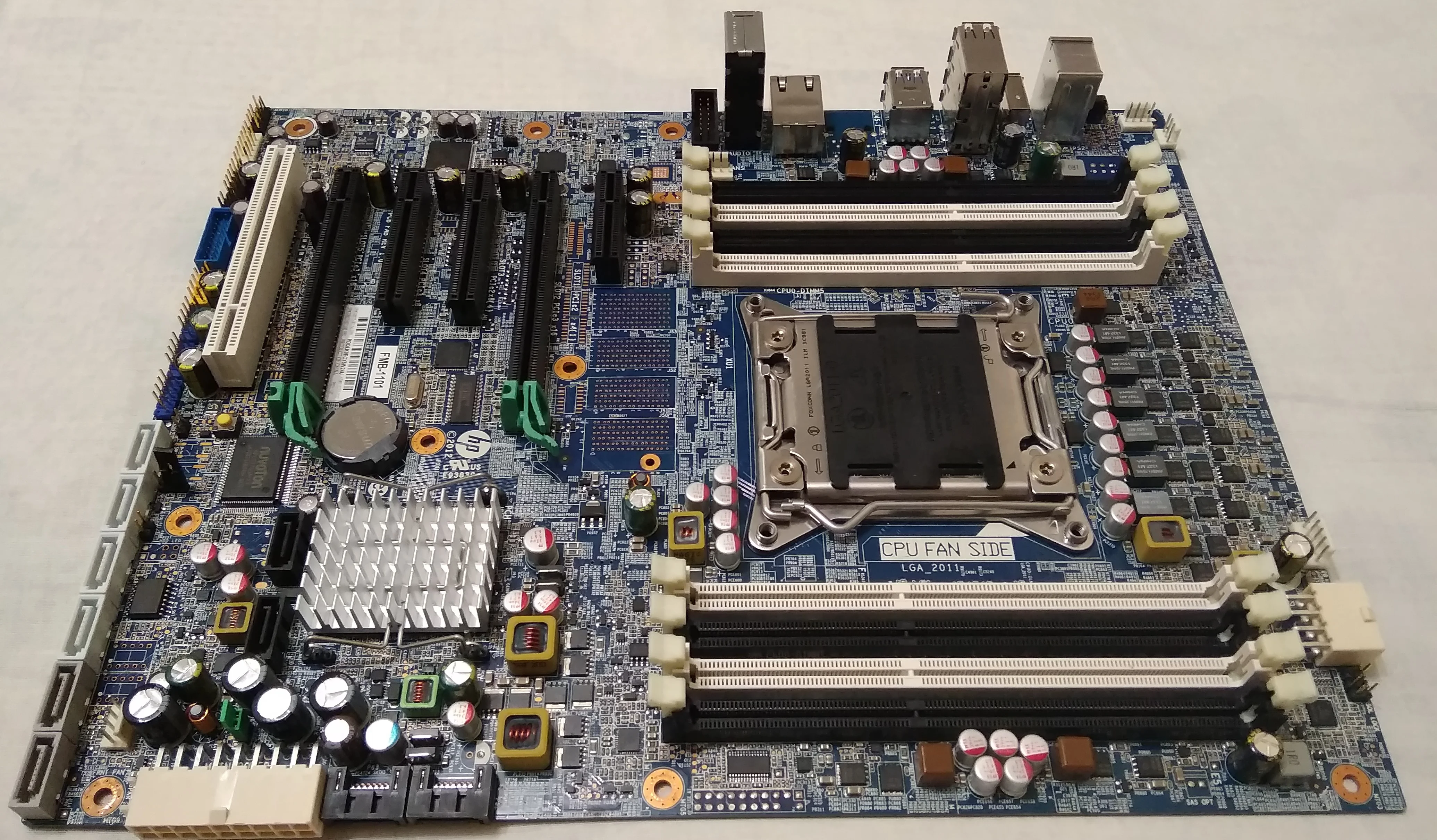
For a proprietary branded board, the HP Z420 has surprisingly few gotchas, if you can even call them that.
The first is, of course, the adapter from standard 24-pin power to 'HP' proprietary power. But sellers usually include it, especially since the board is useless without it – unless you're capable of making your own adapter, which isn't too difficult.
Second are the non-standard and unregulated fan headers. This is even simpler to solve: just connect all fans directly to the power supply at your desired voltage (5, 7, or 12 volts).
Otherwise, it's a standard ATX board with 10 SATA ports (two of which are SATA 3.0) and two full-speed PCI-e 3.0 slots.
As a bonus, the revision 2 board we tested also boasts support for Xeon E5-2600 v2 processors (Ivy Bridge-EP, up to 12 cores, 24 threads).
 ⤢ ВІДКРИТИ
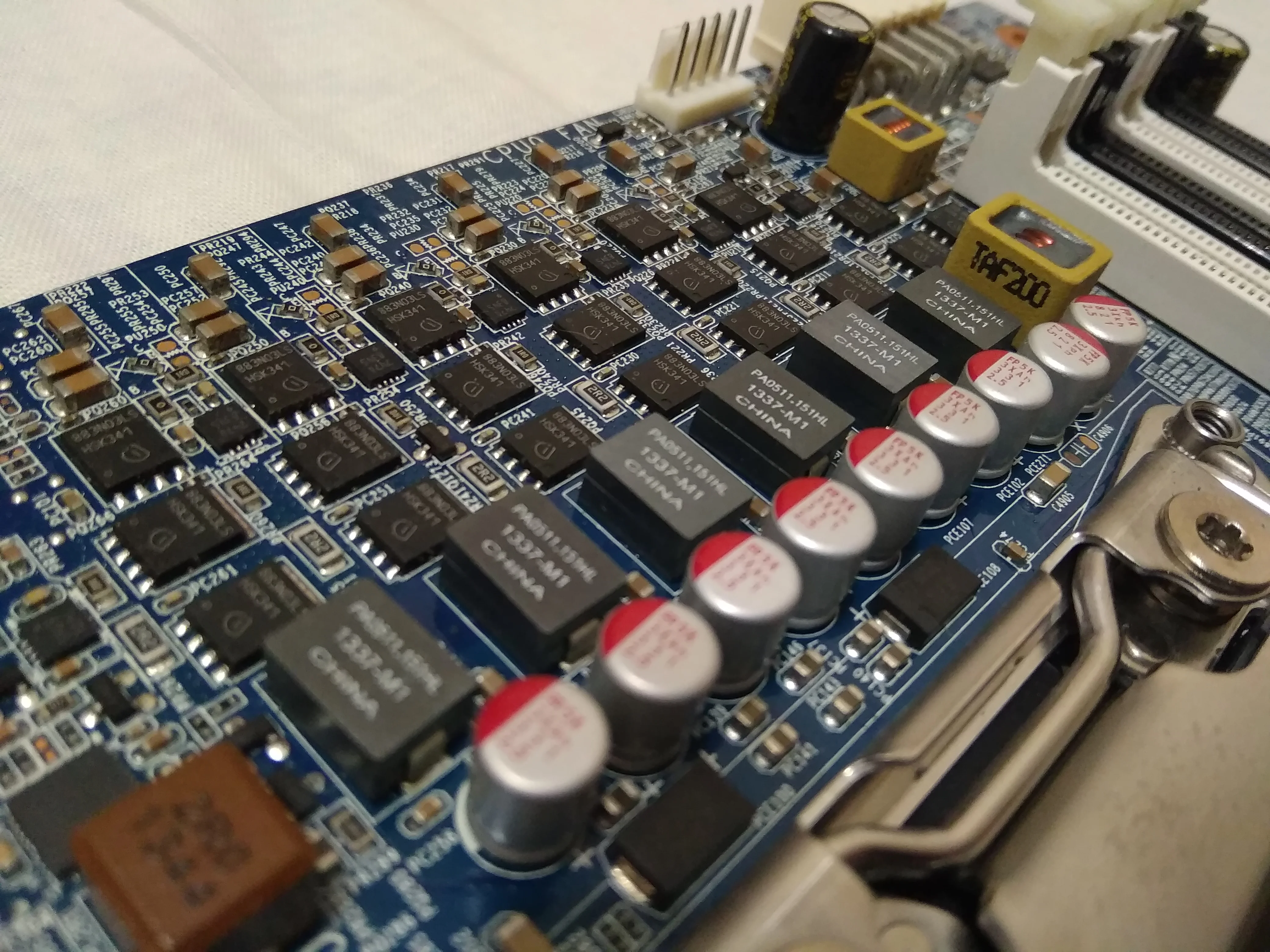
The CPU VRM on the HP Z420 motherboard uses a 6+1 phase design:
 ⤢ ВІДКРИТИ
On paper, the CPU power delivery looks decent, but real-world performance isn't as rosy. Under sustained loads with the 115-watt Xeon E5-2670, transistor temperatures often exceeded 85 degrees Celsius (measured with a somewhat inaccurate Chinese infrared thermometer, but it was too hot to touch). This is tolerable, but with more powerful 135-watt CPUs, like the E5-2680 or E5-2690, the motherboard might struggle.
But don't worry — this issue is easily solved by adding small heatsinks to the power transistors, or, at the very least, by providing directed airflow to the VRM.
 ⤢ ВІДКРИТИ
Competitors
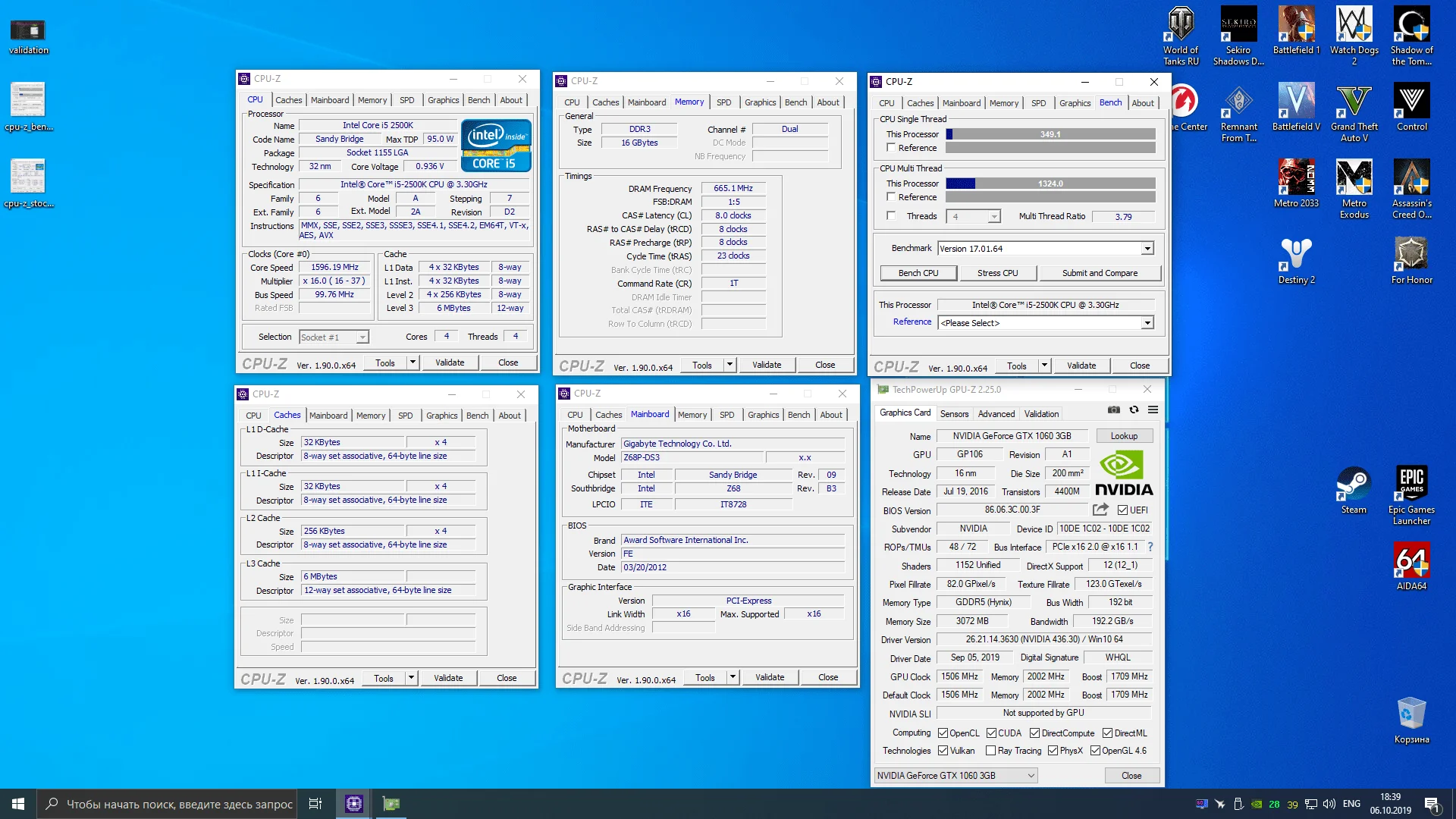
Let's start with the Xeon E5-2670's price rivals. Among the so-called 'legitimate' (desktop, simply put) processors, we currently have the Core i5-2500K:
 ⤢ ВІДКРИТИ
This CPU needs no introduction, but in brief: it's a 4-core, 4-thread Sandy Bridge-based processor that runs at a nominal 3300 MHz and can hit 3400 MHz across all cores thanks to Intel Turbo Boost. The chip features an unlocked multiplier and is designed for the LGA1155 socket.
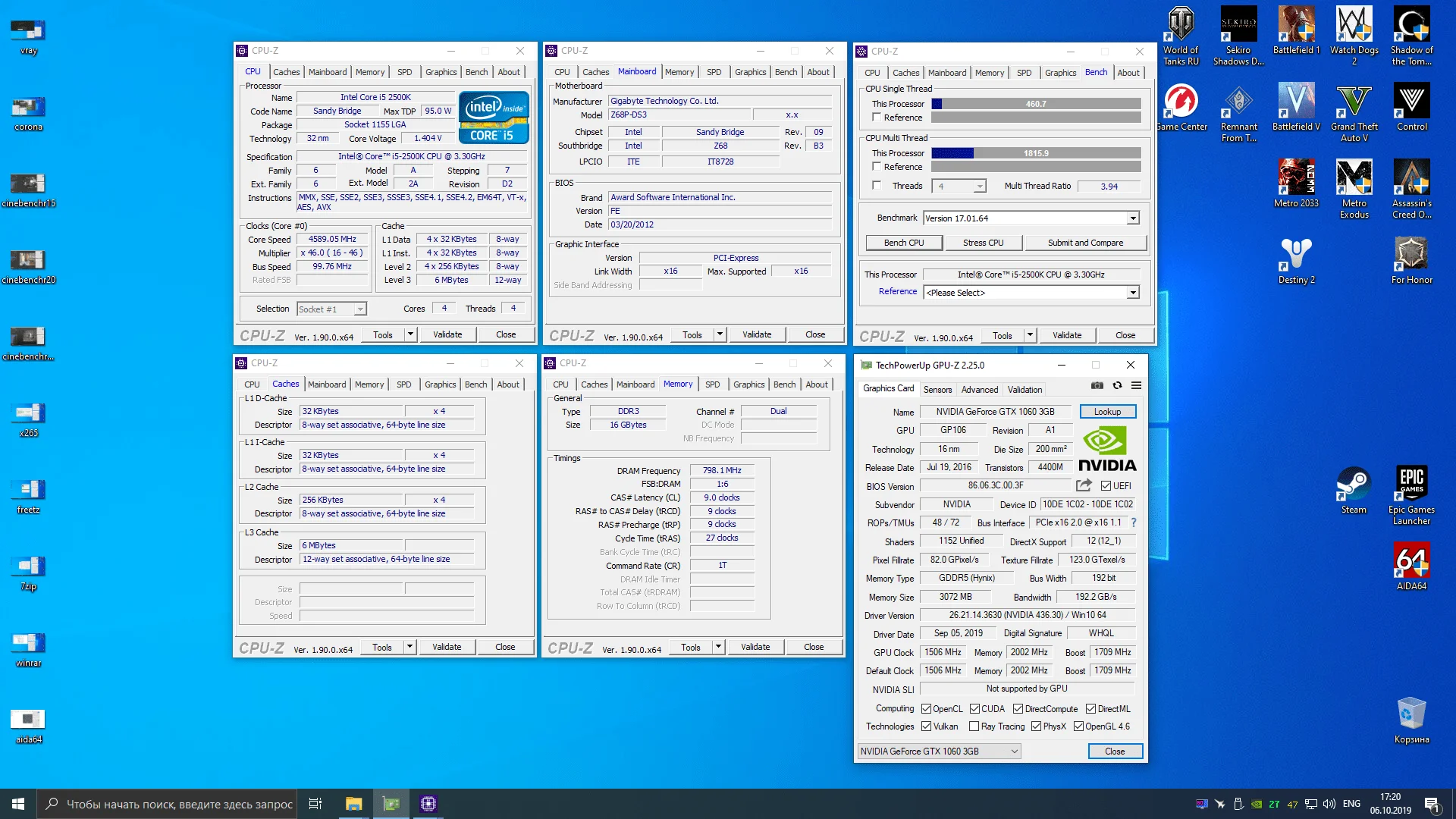
We managed to overclock the processor to 4589 MHz at 1.46 volts. RAM was set to 1600 MHz, as the test board refused to boot with higher dividers:
 ⤢ ВІДКРИТИ
As of October 23, 2019, the Core i5-2500K's cost is exactly $50-60, which makes it directly competitive with the Xeon E5-2670.
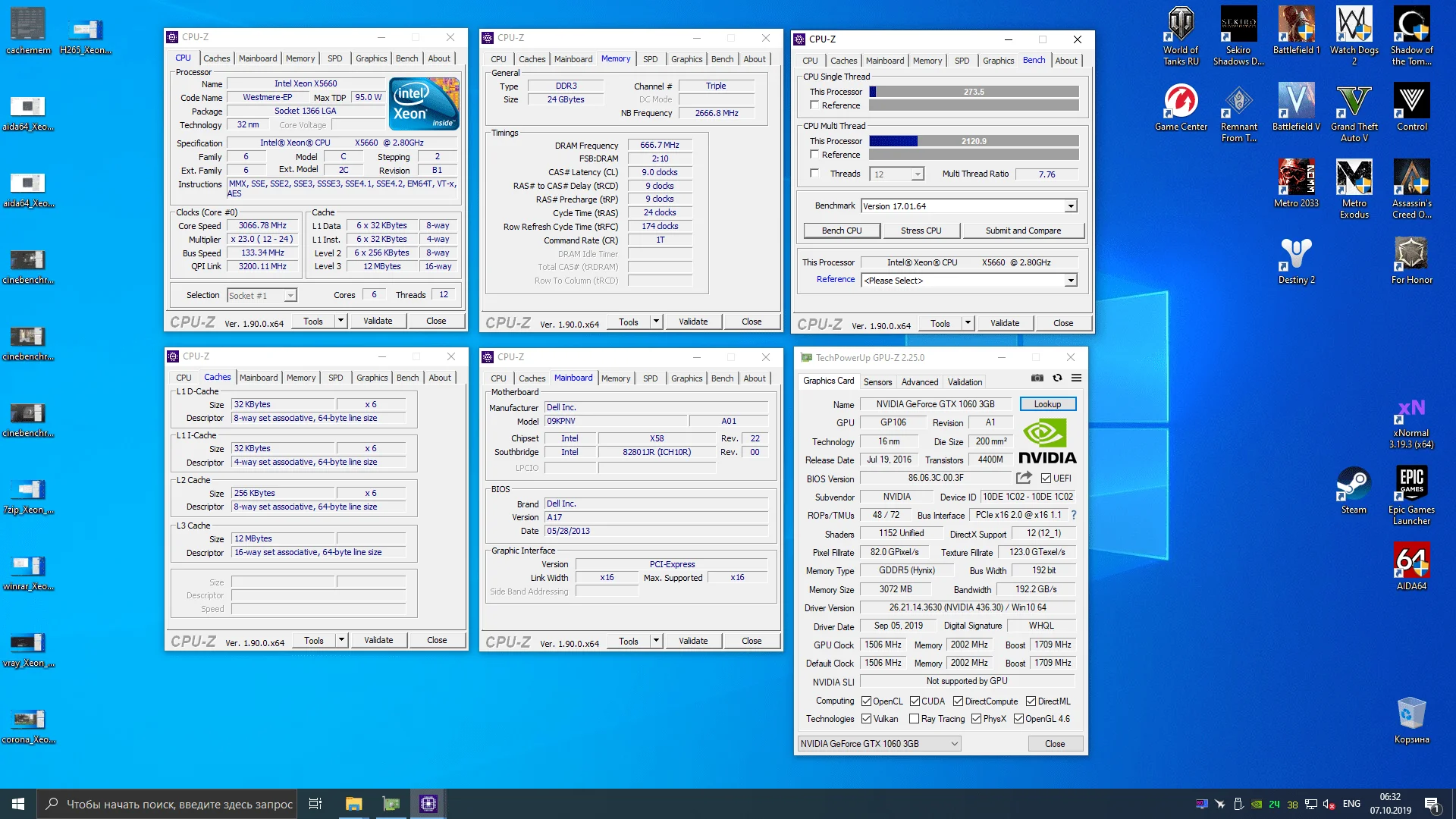
Our hero's second, and in my opinion, primary competitor is the Xeon X5660 — a 6-core, 12-thread beast straight out of 2010. This chip sports 12 MB of L3 cache and a triple-channel memory controller.
Designed for the relatively dated LGA 1366 platform, this CPU is an incredibly good value at its laughable $16 price, even in 2019.
 ⤢ ВІДКРИТИ
The processor was installed in a Dell T3500 (09KPNV) motherboard, which inherently implies no overclocking potential. For these tests, the Xeon X5660 will run at its maximum all-core frequency of 3066 MHz.
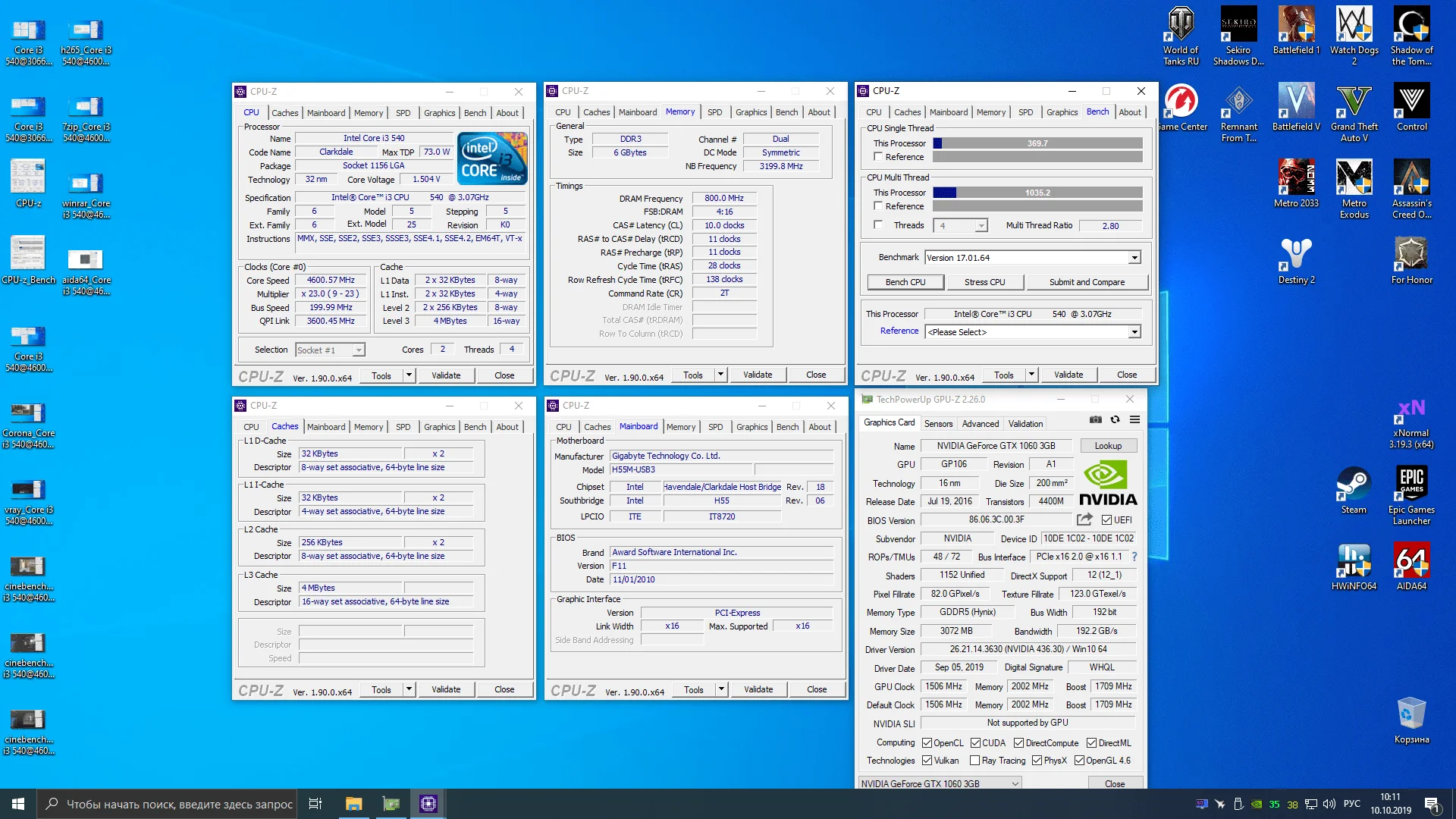
The final processor being tested today is the Core i3-540. We're only testing it overclocked, though, because its performance at stock speeds is so abysmal it utterly 'choked' during the entire Assassin's Creed benchmark.
 ⤢ ВІДКРИТИ
The processor was overclocked to 4600 MHz with a core voltage of 1.521 volts and a memory controller voltage set to 1.21 volts.
IMPORTANT: Not all first-gen, 32nm Core i3 processors can sustain such high voltages long-term. When overclocking a Core i3-500 series chip, I recommend not exceeding 1.40 volts for the cores and 1.2 volts for the memory controller.
Test setup:
Processors: Intel Xeon E5-2670@3000MHz, Xeon X5660@3066MHz, Core i5-2500K@3400/4600MHz, and Core i3-540@4600MHz
Cooling: Cooler Master Hyper 212 Black Edition (RR-212S-20PK-R1)
RAM for LGA 2011: 32GB (4x8GB) Samsung ECC REG 1333MHz (M393B1K70CH0-CH9Q5)
RAM for LGA 1366: 24GB (3x8GB) HyperX Genesis Na'Vi Edition (KHX16C9C2K2/8)
RAM for LGA 1155: 16GB (2x8GB) HyperX Genesis Na'Vi Edition (KHX16C9C2K2/8)
RAM for LGA 1156: 6GB (2x2GB Hynix 1333MHz (HMT325U7EFR8C-RD) plus 2x1GB Patriot 1333MHz (PSD31G133381))
LGA 2011 motherboard: HP Z420 (HP 1589) (rev. 2.0)
LGA 1366 motherboard: Dell T3500 (09KPNV)
LGA 1155 motherboard: Gigabyte GA-Z68P-DS3 (rev. 2.0)
LGA 1156 motherboard: Gigabyte H55M-USB3
Graphics card: Palit GeForce GTX 1060 DUAL 3GB (1506/1709/8000MHz, Power Limit 115%)
SSD: Kingston 120GB SA400S37120G (Windows 10 1903/Applications)
HDD: Seagate 2TB ST2000DM008-2FR102 (Games)
PSU: Chieftec GPS-1250C
A small clarification regarding the LGA1156 platform: the first-gen, 32nm Core i3 chip absolutely refused to 'boot' with 8 GB HyperX Genesis Na'Vi Edition sticks. Unfortunately, I completely forgot that Clarkdale simply doesn't support that much RAM per channel.
Because of this, I had to dig through my spare parts to find at least two 2 GB sticks and two 1 GB sticks. This allowed me to gather the minimum required RAM for relatively adequate performance in most games and applications, all while maintaining dual-channel memory mode.
Processor | Xeon E5-2670 | Xeon X5660 | Core i5-2500K | Core i3-540 |
Base frequency | 2600МГц | 2800МГц | 3300МГц | 3066МГц |
Max frequency | 3300МГц | 3200МГц | 3700МГц | 3066МГц |
Max all-core frequency | 3000МГц | 3066МГц | 3400МГц | 3066МГц |
Core count | 8 | 6 | 4 | 2 |
Thread count | 16 | 12 | 4 | 4 |
Process node | 32нм | 32нм | 32нм | 32нм |
L2 cache (per core) | 256КБ | 256КБ | 256КБ | 256КБ |
L3 cache (total) | 20МБ | 12МБ | 6МБ | 4МБ |
TDP | 115 watts | 95 watts | 95 watts | 73 watts |
Memory controller | Quad-channel | Triple-channel | Dual-channel | Dual-channel |
Software:
Windows 10 Pro v1903 x64
CPU-z v1.90.0 x64
AIDA64 v6.10.5200
NVIDIA GeForce Game Ready Driver 436.30 WHQL
V-Ray Benchmark v4.10.03
Corona Benchmark v1.3
Cinebench R11.5
Cinebench R15.38
Cinebench R20.060
HWBot x265 Benchmark v2.0.0
WinRar v5.8 Beta 2 x64
7-Zip v19.0 x64
Benchmarks
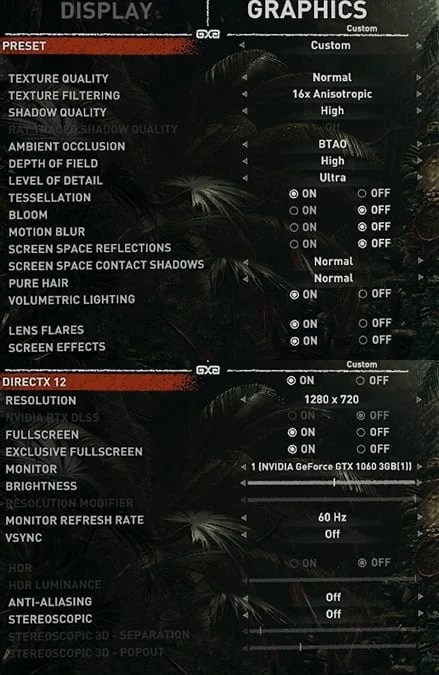
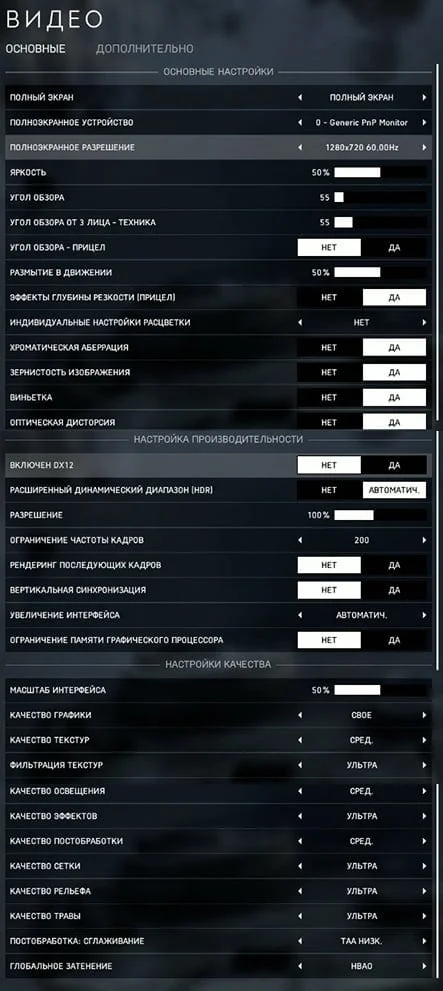
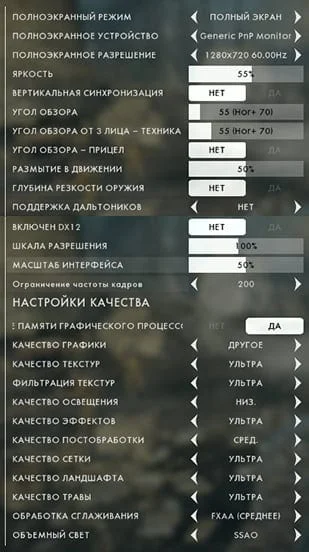
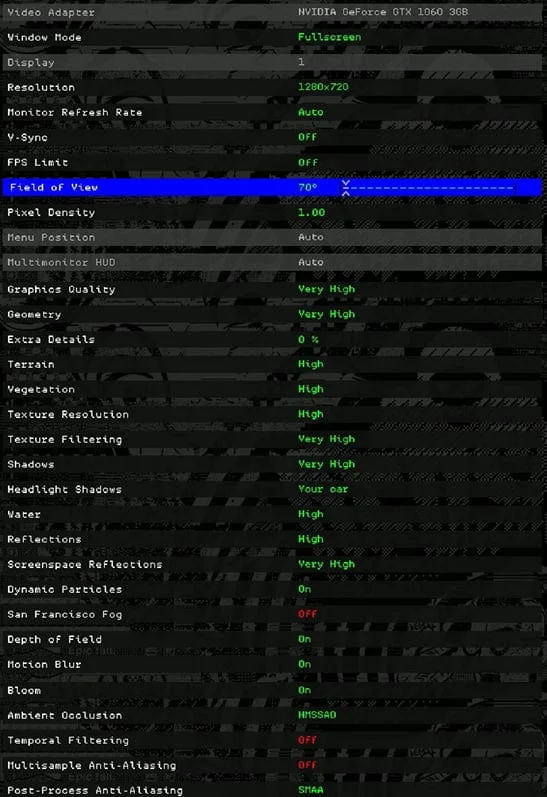
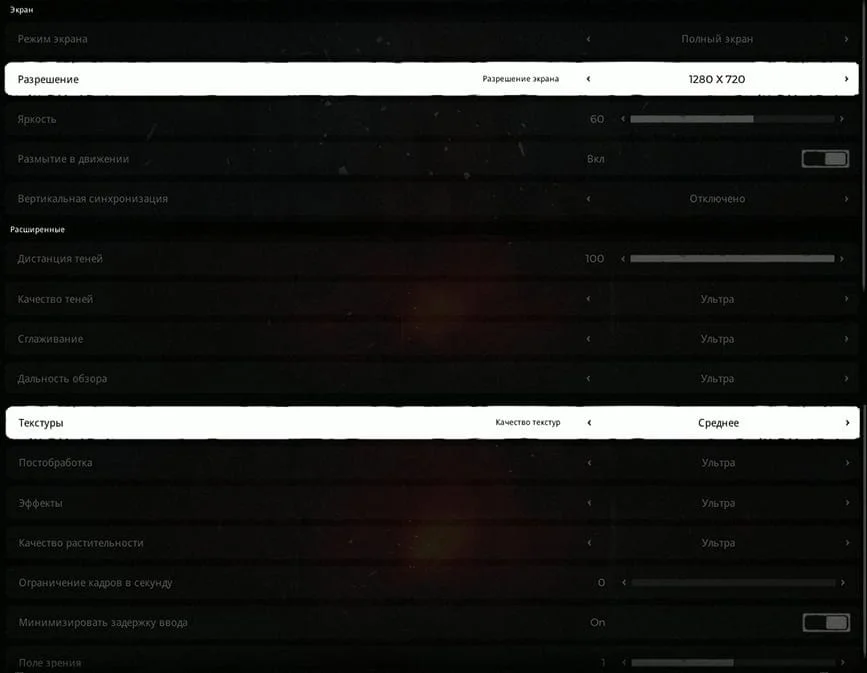
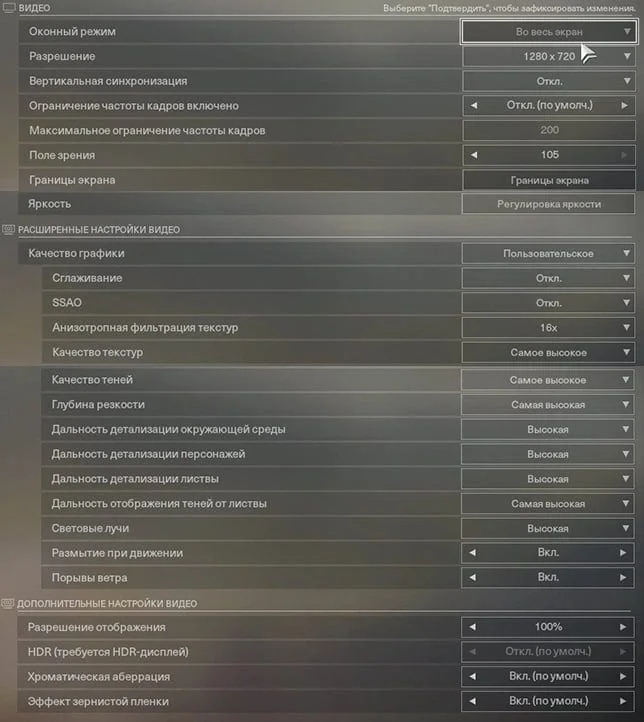
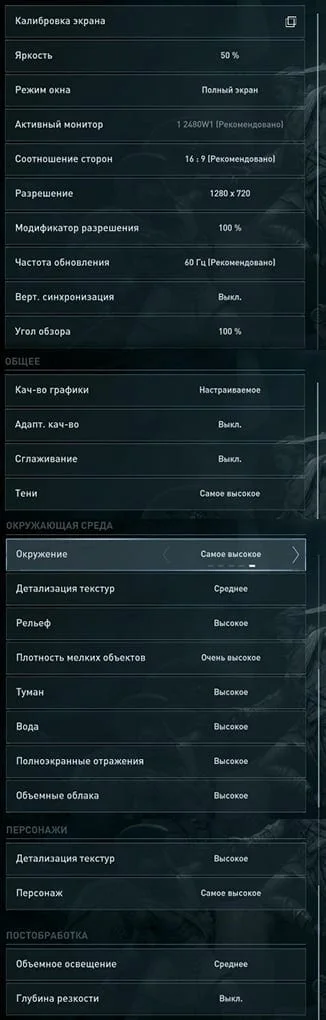
Due to the weaker GeForce GTX 1060 3GB graphics card, gaming benchmarks were conducted at 1280x720 resolution. Graphics quality settings were adjusted to minimize GPU load, aiming to identify which processor could deliver the highest frame rates to the graphics card.
Graphics settings:
Shadow of the Tomb Raider
 ⤢ ВІДКРИТИ
Battlefield V
 ⤢ ВІДКРИТИ
Battlefield 1
 ⤢ ВІДКРИТИ
Watch_Dogs 2
 ⤢ ВІДКРИТИ
Remnant: From the Ashes
 ⤢ ВІДКРИТИ
Destiny 2
 ⤢ ВІДКРИТИ
Assassin's Creed Odyssey
 ⤢ ВІДКРИТИ
First, let's see how the processor performs in professional applications and synthetic benchmarks:
Overall performance
 ⤢ ВІДКРИТИ
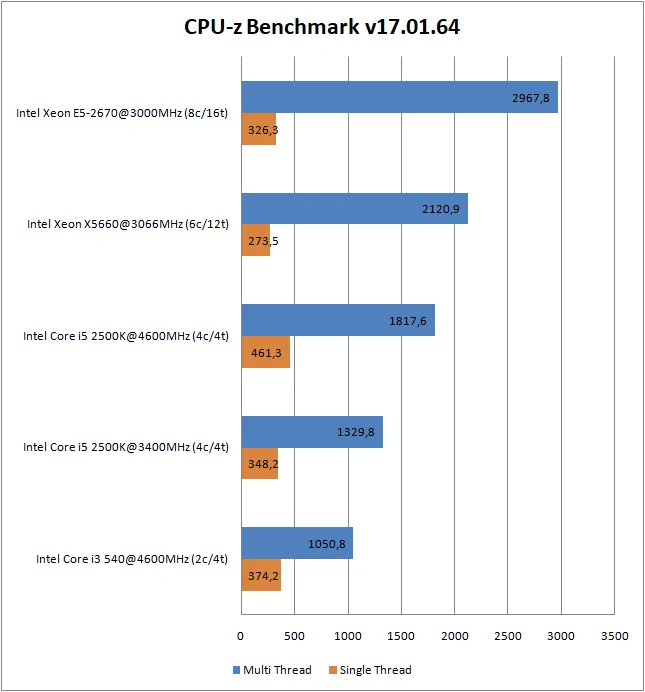
CPU-Z has long included a built-in performance test. This benchmark is interesting because it tests both single-threaded and multi-threaded performance.
Here, the E5-2670 is 40% faster than its closest contender, the X5660, in the multi-threaded test, and 19.5% faster in single-threaded workloads.
Rendering, synthetic benchmarks
 ⤢ ВІДКРИТИ
 ⤢ ВІДКРИТИ
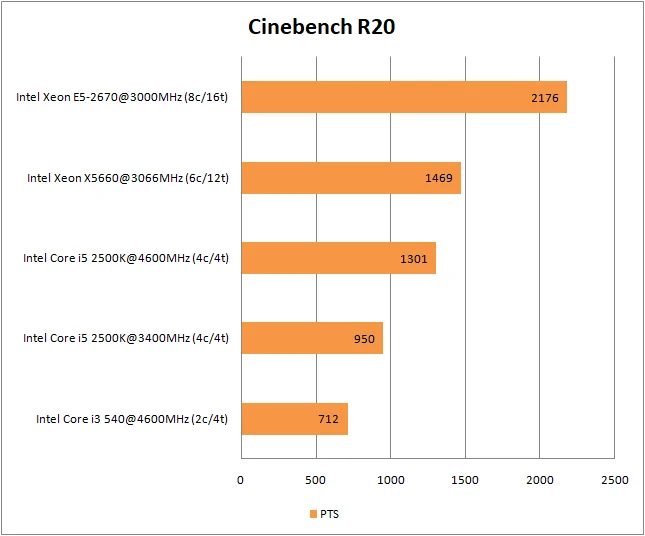 ⤢ ВІДКРИТИ
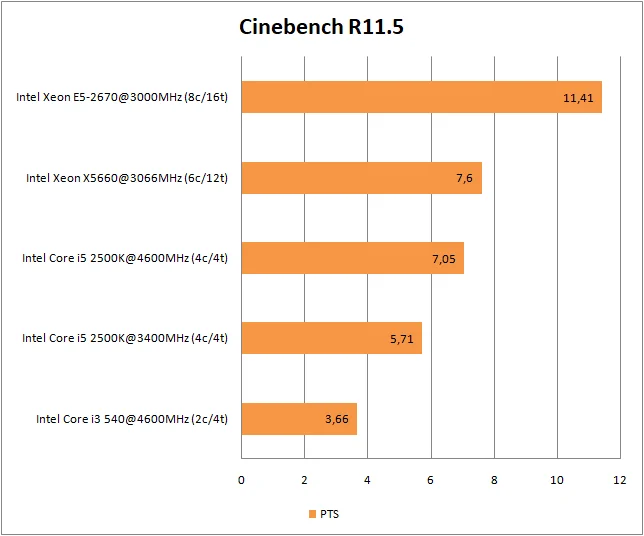
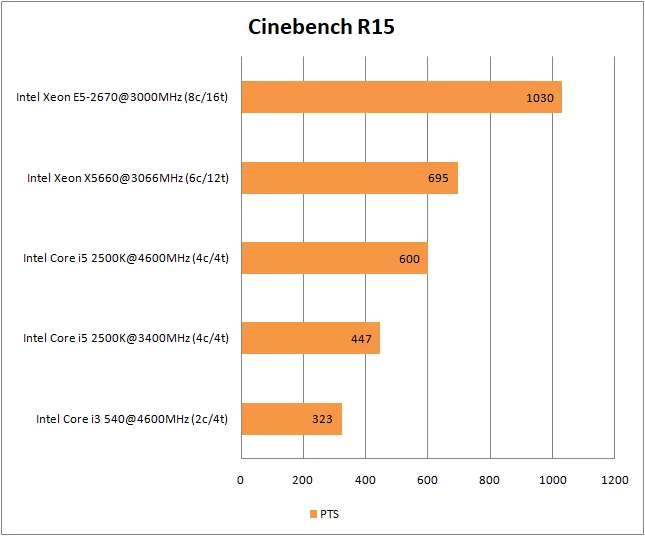
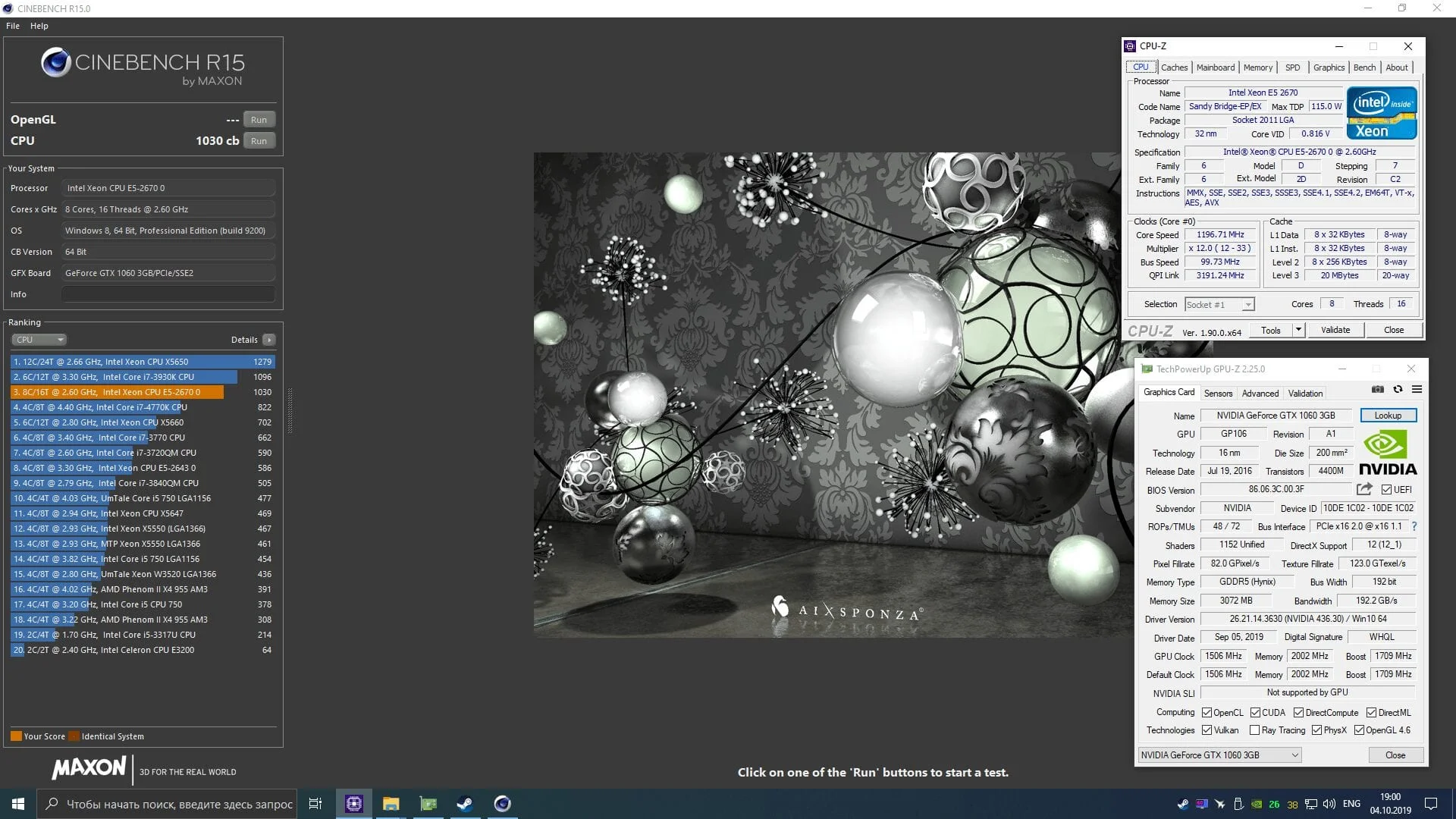
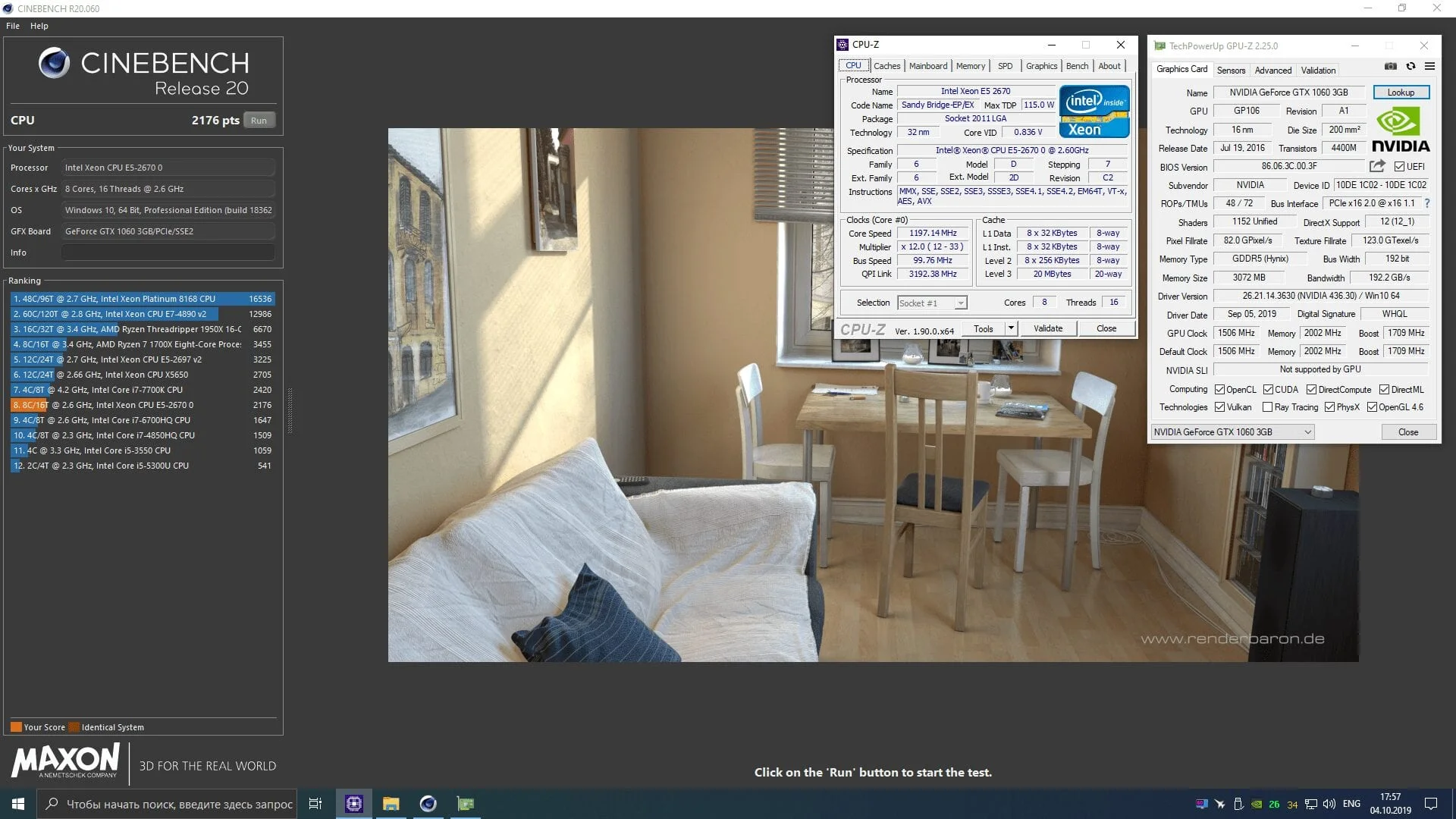
Total domination by the Xeon E5-2670. In synthetics, it simply has no equal, unless you consider the X5660's price. Also noteworthy is the overclocked Core i5-2500K: at 4600 MHz, it delivers very confident results, breathing down the neck of the 12-thread X5660. If our lab sample could hit 5000 MHz and remain stable, it might even overtake the Xeon X5660.
But these are synthetic benchmarks; real-world applications tell a different story:
Rendering
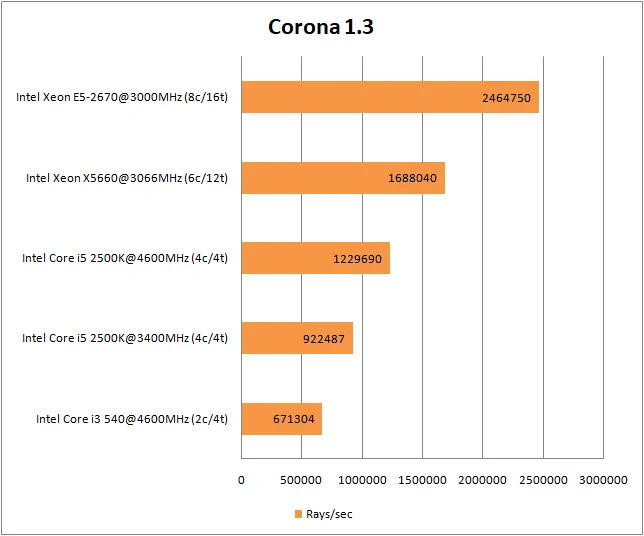 ⤢ ВІДКРИТИ
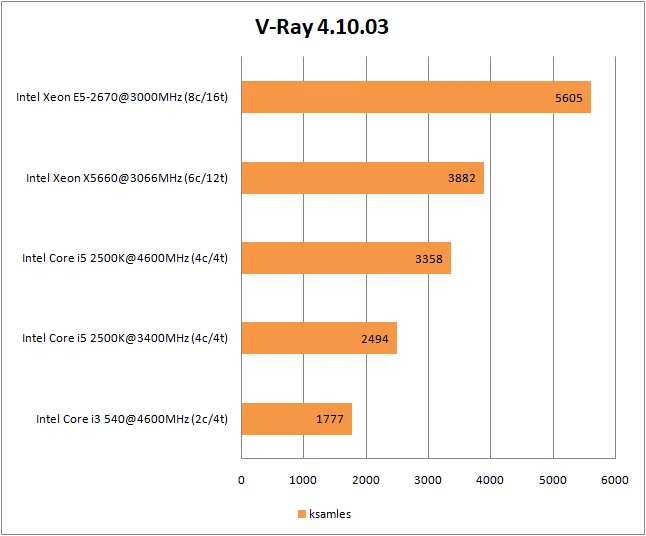 ⤢ ВІДКРИТИ
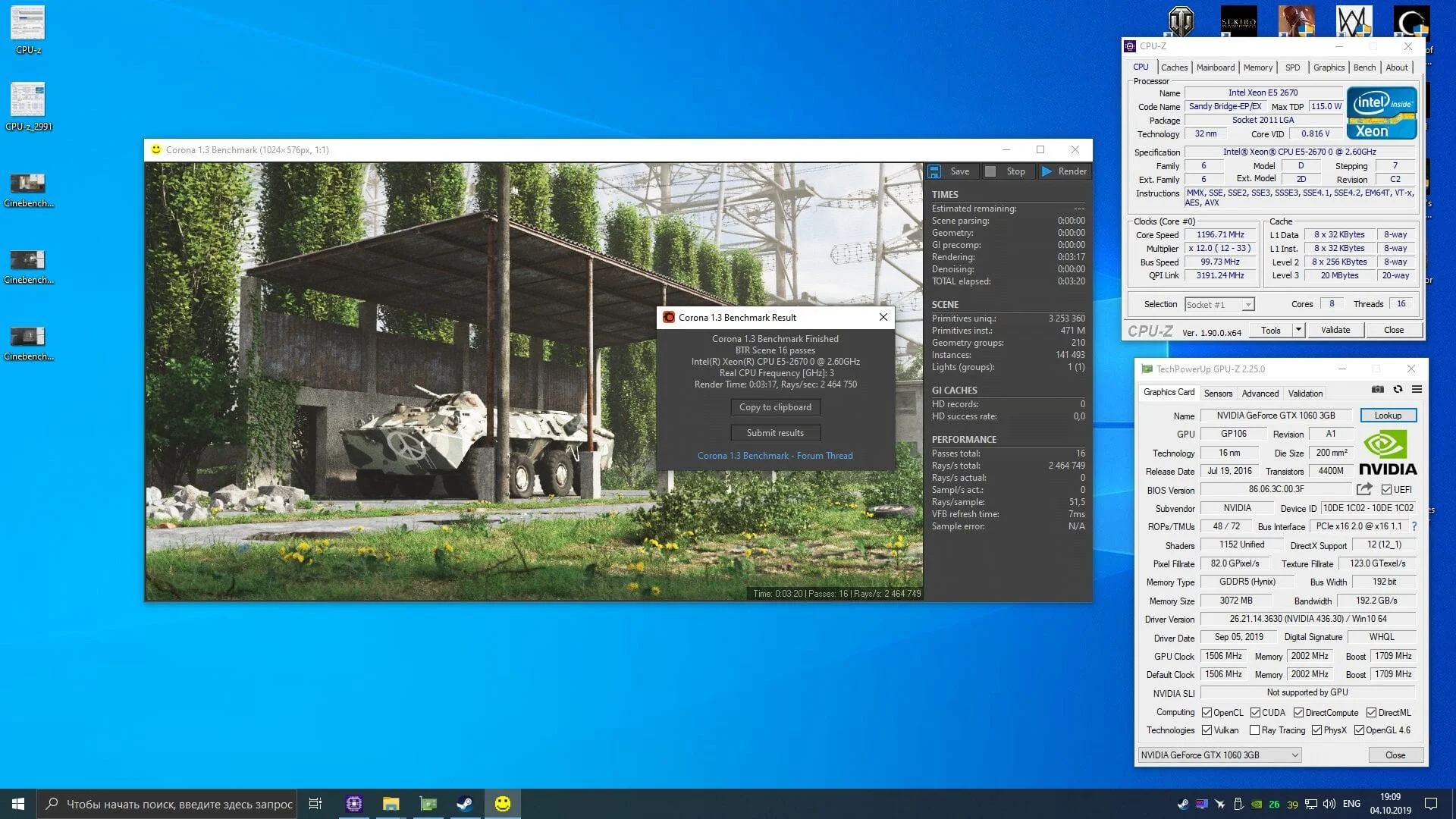
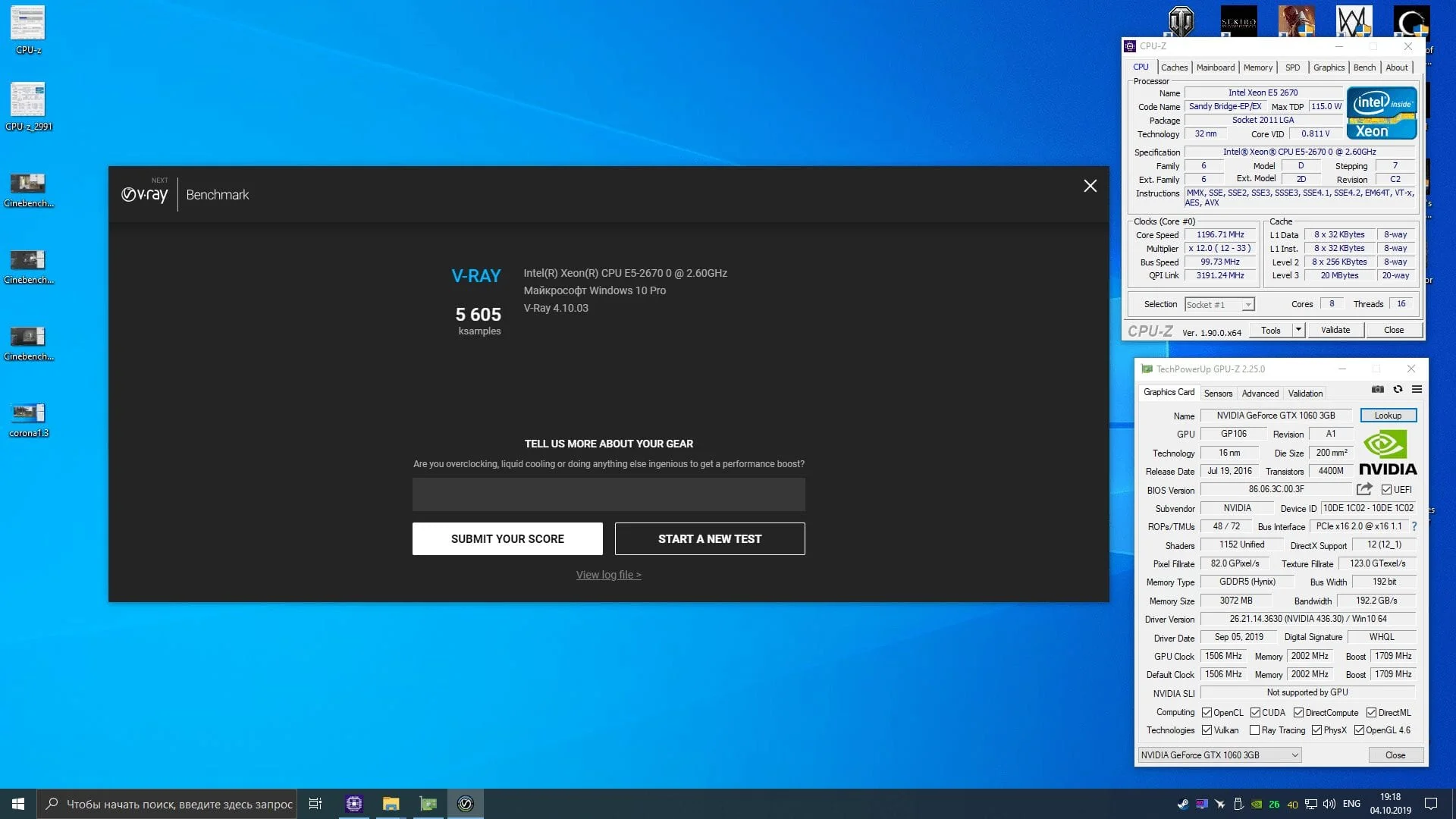
The Xeon E5-2670's total domination continues. The overclocked Core i5-2500K no longer looks as strong against the stock X5660. In Corona, its performance could even be described as mediocre.
Video encoding
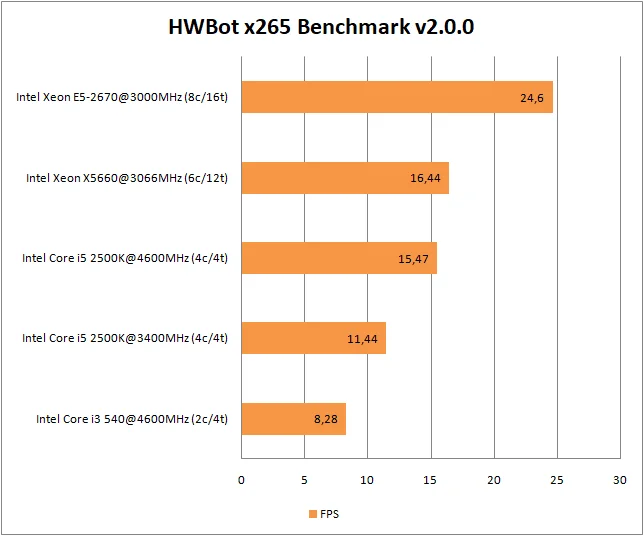 ⤢ ВІДКРИТИ
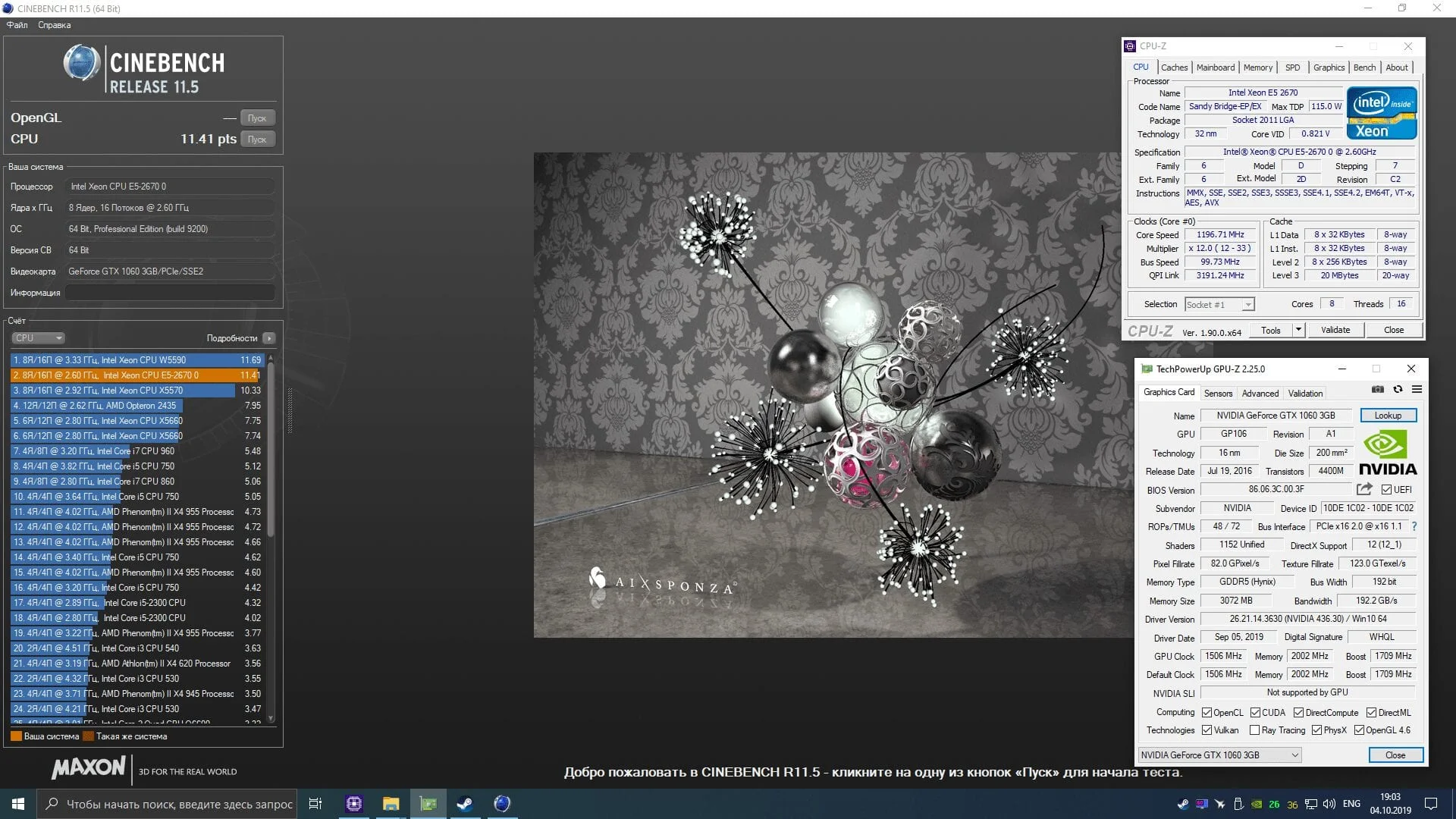
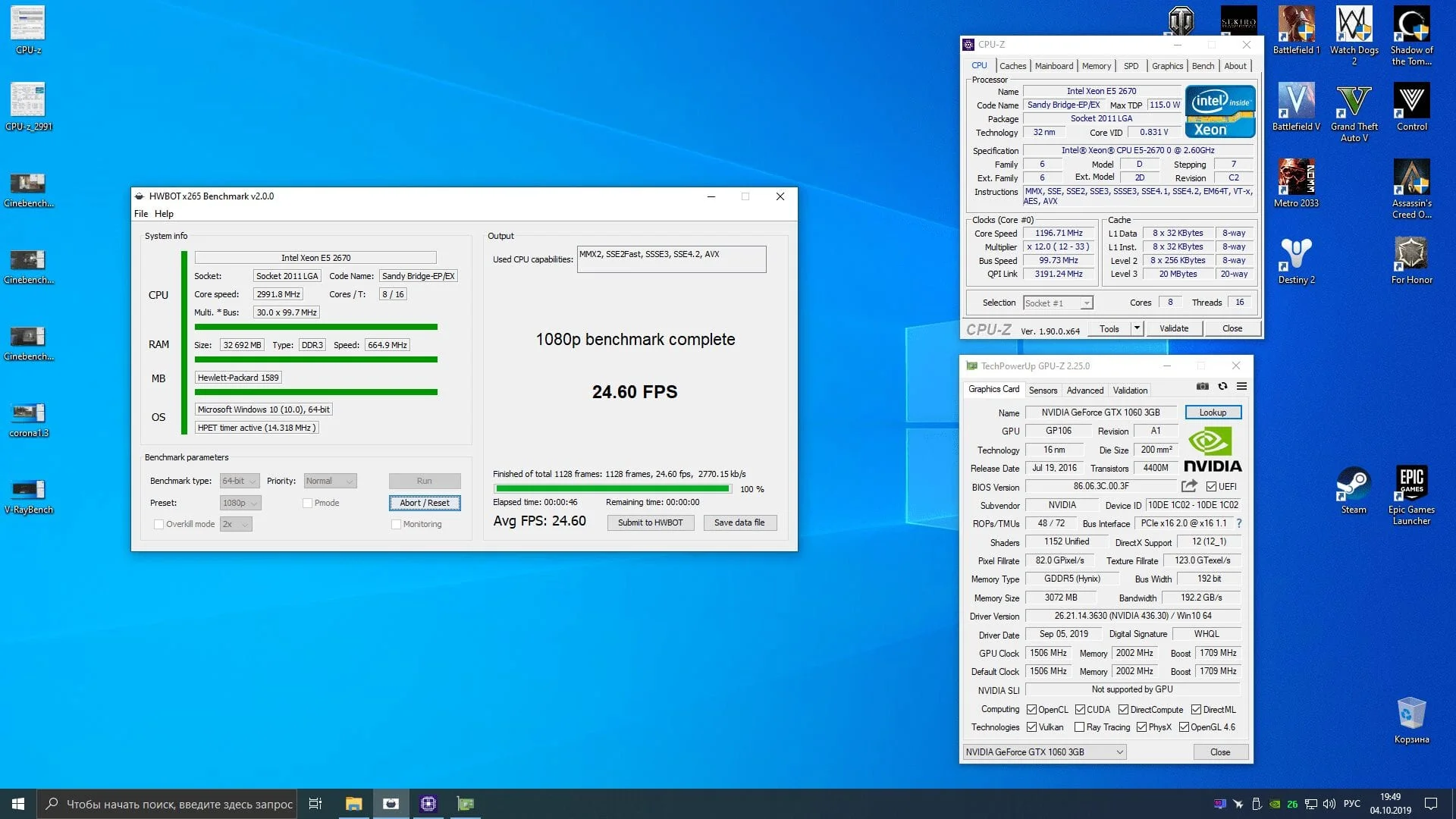
Converting video files to x265 also holds no surprises, with the E5-2670 leading by a significant margin. Its result of 24.6 fps is quite impressive. What's more interesting is that the Core i5-2500K at 4600 MHz performs virtually identically to the stock X5660.
Archiving
 ⤢ ВІДКРИТИ
 ⤢ ВІДКРИТИ
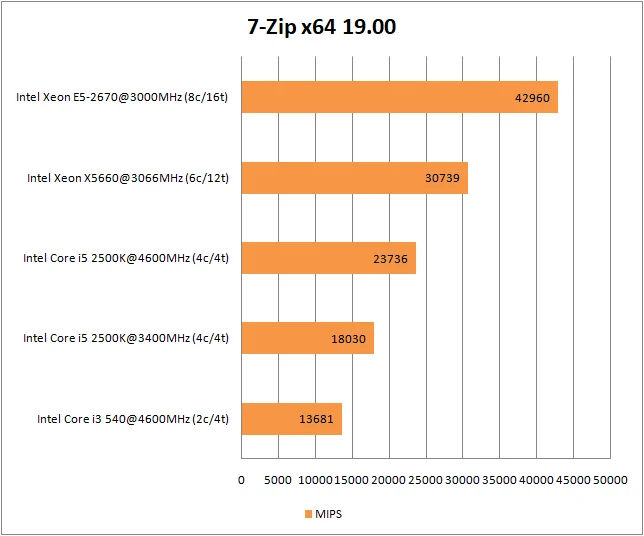
While the 7-Zip results are straightforward, WinRAR delivered a surprise that genuinely shocked me. The 12-thread Xeon X5660 managed to double the performance of the Core i5 running at 4600 MHz. What's more, the overclock didn't significantly help the Core i5-2500K itself. 'Excellent' optimization from the developers indeed.
Gaming
 ⤢ ВІДКРИТИ
 ⤢ ВІДКРИТИ
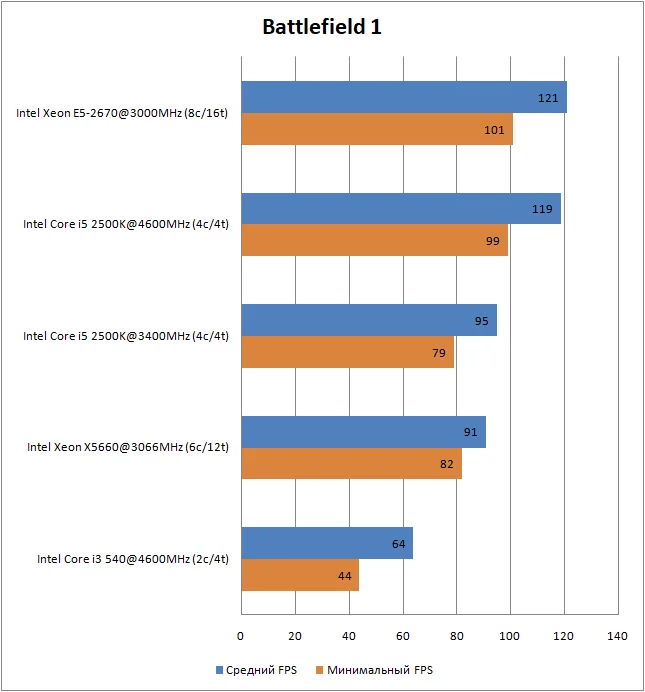
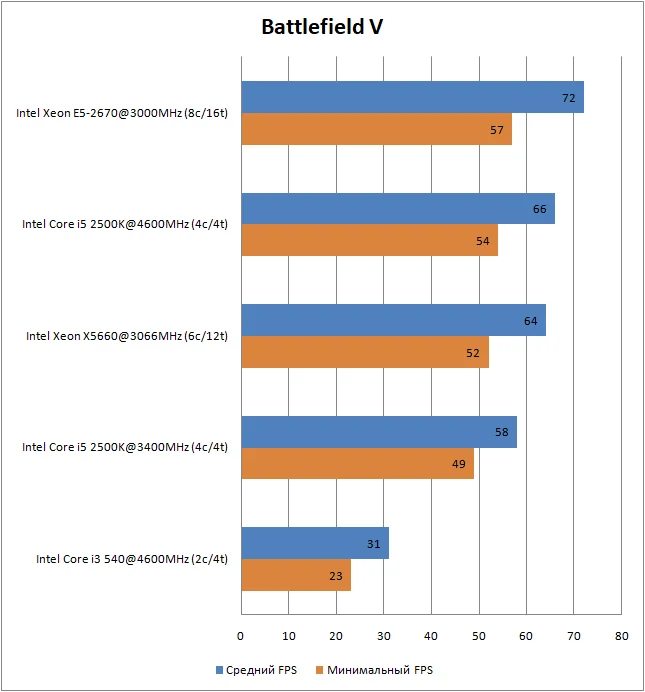
To my surprise, both Battlefield titles in DX11 mode were quite lukewarm towards the 8-core Xeon E5-2670. Multiplayer performance would likely be far more interesting, but unfortunately, it's quite challenging to adequately benchmark hardware in a multiplayer game. And in Battlefield specifically, achieving a repeatable scenario is nearly impossible.
Regardless, in the future, once we have a more powerful graphics card in the lab, all tests will be conducted in DirectX 12.
 ⤢ ВІДКРИТИ
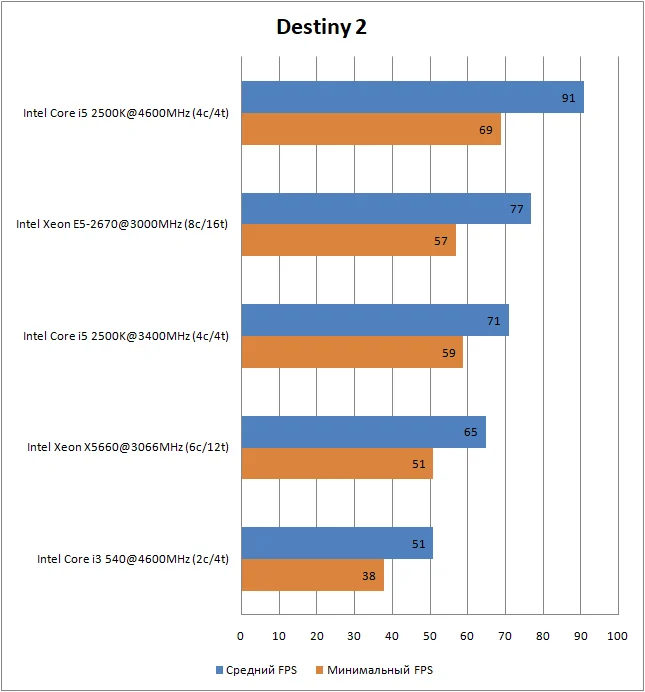
Destiny 2's engine is quite peculiar, only supporting four threads. Hyper-Threading, in fact, tends to degrade performance in this game, at least on older processors.
Here, the overclocked Core i5-2500K was the undisputed leader, with its stock version even surpassing the E5-2670 in minimum FPS.
 ⤢ ВІДКРИТИ
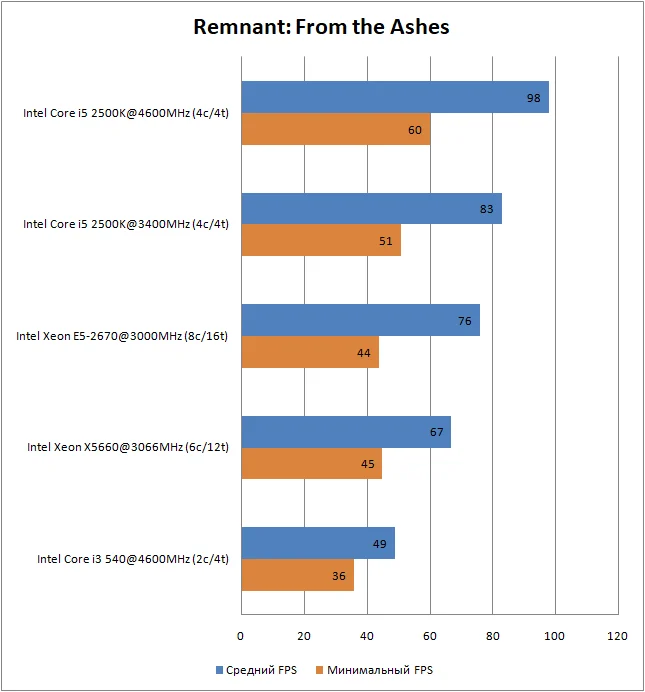
Remnant: From the Ashes, built on Unreal Engine 4, has certain limitations. In DX11, the game can't utilize more than 4 threads, leading to the Xeon E5-2670's rather low scores here.
 ⤢ ВІДКРИТИ
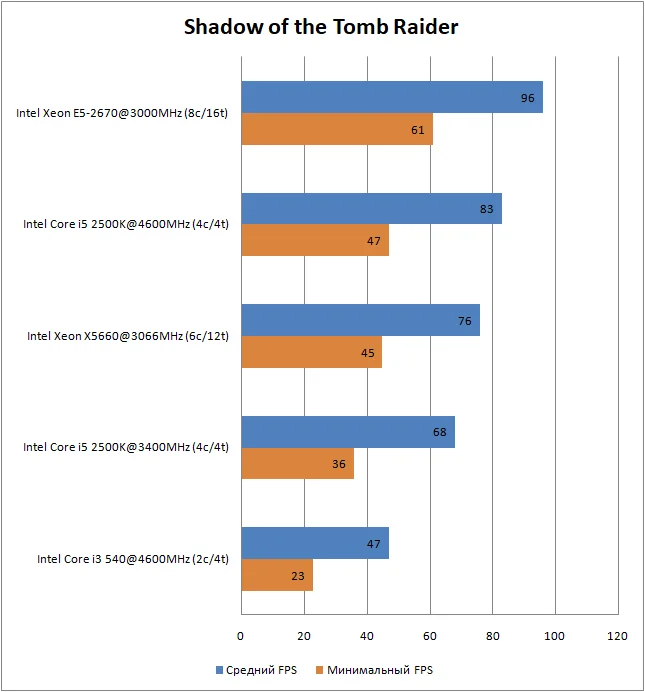
Our Shadow of the Tomb Raider tests reveal that FPS isn't always the sole indicator; it's crucial to consider the visual experience. Below, we've included video evidence of the processor testing, where you can see the Core i5-2500K's 'stellar' performance with your own eyes.
Four-core processors aren't always capable of rendering all the geometry present in a game scene. Because of this, they might sometimes show higher frame rates than processors that have already offloaded all geometry to the graphics card.
But even that didn't help the Core i5-2500K. The Xeon E5-2670 delivered a very confident minimum FPS, without sacrificing average performance either.
 ⤢ ВІДКРИТИ
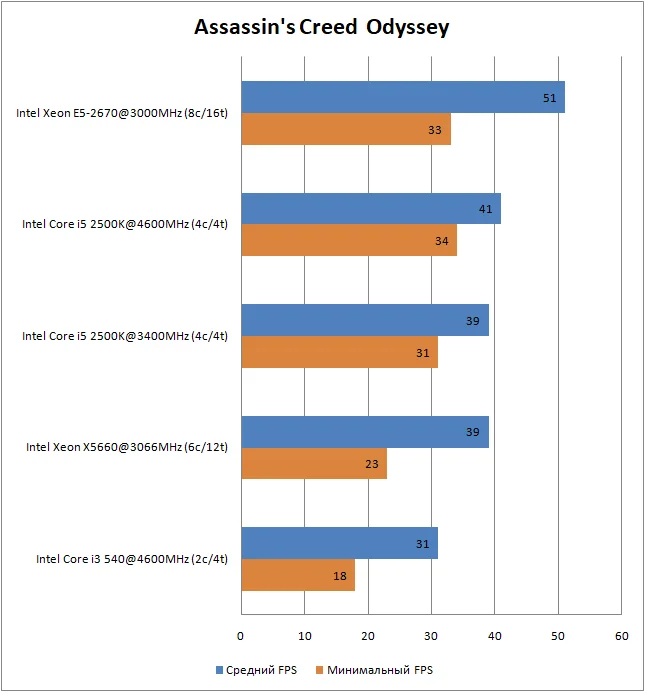
Assassin's Creed Odyssey is an extremely demanding game, both for the processor and the graphics card. Unfortunately, in our case, it primarily ended up being a graphics card benchmark.
 ⤢ ВІДКРИТИ
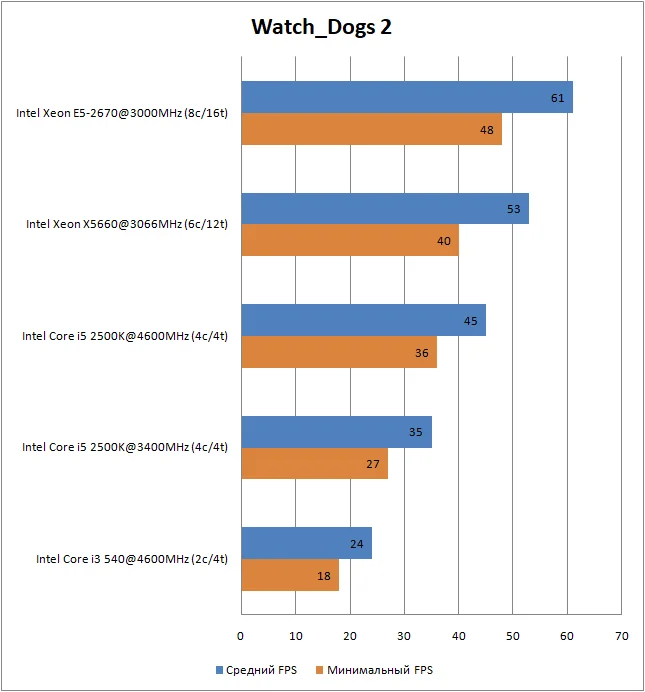
Watch_Dogs 2, however, isn't as demanding on the PC's graphics subsystem. I'd even say it's a benchmark for CPUs. Here, the clear advantage of multi-core processors over high-frequency ones becomes obvious.
Among the tested processors, the Xeon E5-2670 demonstrates ultimate performance. Playing Watch_Dogs 2 on this processor is an absolute pleasure. The game doesn't stutter, and frame rate drops to 48 FPS only occur in similar, heavily loaded areas, which aren't that common in the game.
In the videos below, you can see the Xeon E5-2670's gaming performance for yourself:
YouTube
By loading, you allow content from YouTube (cookies may be set).
And compared to the stock Xeon X5660 at 3066 MHz, as well as the Core i5-2500K at stock speeds and overclocked to 4600 MHz:
YouTube
By loading, you allow content from YouTube (cookies may be set).
At the very beginning of this article, I mentioned the limitations of our GeForce GTX 1060 test GPU, and the results of our experiments confirmed my words. This is especially evident in Assassin's Creed, where both GPU power and VRAM capacity are insufficient.
Conclusion
The Xeon E5-2670 truly shined. While it didn't particularly stand out in gaming, it's unmatched in content creation. And considering its price, which is on par with the Core i5-2500K, finding fault with it becomes increasingly difficult.
What's more, multi-threaded applications are becoming more prevalent every day. And next year, new-gen consoles are launching with 8-core, 16-thread Ryzen chips inside.
Sixty dollars for such high performance is simply ridiculous. Even if you're not keen on branded boards like HP, you can grab any motherboard from Chinese manufacturers. Thankfully, they're relatively reliable and affordable now.
A few words about using the Xeon E5-2670 in a dual-monitor setup+
Twitch, YouTube, 4K movies, plus a game (virtually any, like Battlefield 1 or Destiny 2) on the first monitor – the processor handles it all. It also managed streaming Battlefield 1 and Destiny 2. We'll try to incorporate game streaming into future tests.
Hardware provided by BaLRoG+
Special thanks to BaLRoG for providing the test hardware: the Intel Xeon E5-2670 processor, the HP Z420 motherboard, and a 32GB (four 8GB sticks) kit of Samsung 1333MHz (M393B1K70CH0-CH9Q5) RAM.