TESTS · CPU · INTEL
PUBLISHED
READING13 min
Benchmarking the Intel Xeon E5-2670 v3: 12 Haswell cores in modern games
We benchmarked the 12-core Intel Xeon E5-2670 v3 (Haswell) in modern games, discovering that Hyper-Threading can sometimes actually reduce FPS.
To be frank, choosing a 24-thread Haswell-based processor as a budget gaming CPU is highly questionable. It runs hot, operates at relatively low frequencies, and consumes a lot of power. The latter necessitates a rather expensive, reliable motherboard with a high-quality power delivery system featuring powerful MOSFETs, along with an effective cooling solution capable of taming this hot-headed 12-core monster. Ultimately, this adds significant costs for potential buyers, a burden not everyone will want to deal with.
However, judging by sales figures for similar chips, demand for 24-thread processors remains quite significant. That's why we decided to investigate the performance of one of the cheapest 12-core Intel Xeon chips: the E5-2670 v3.
Processor
Here's a 12-core, 24-thread processor based on Intel's relatively current Haswell-EP architecture, codenamed Xeon E5-2670 v3. Let's take a look at the chip itself:
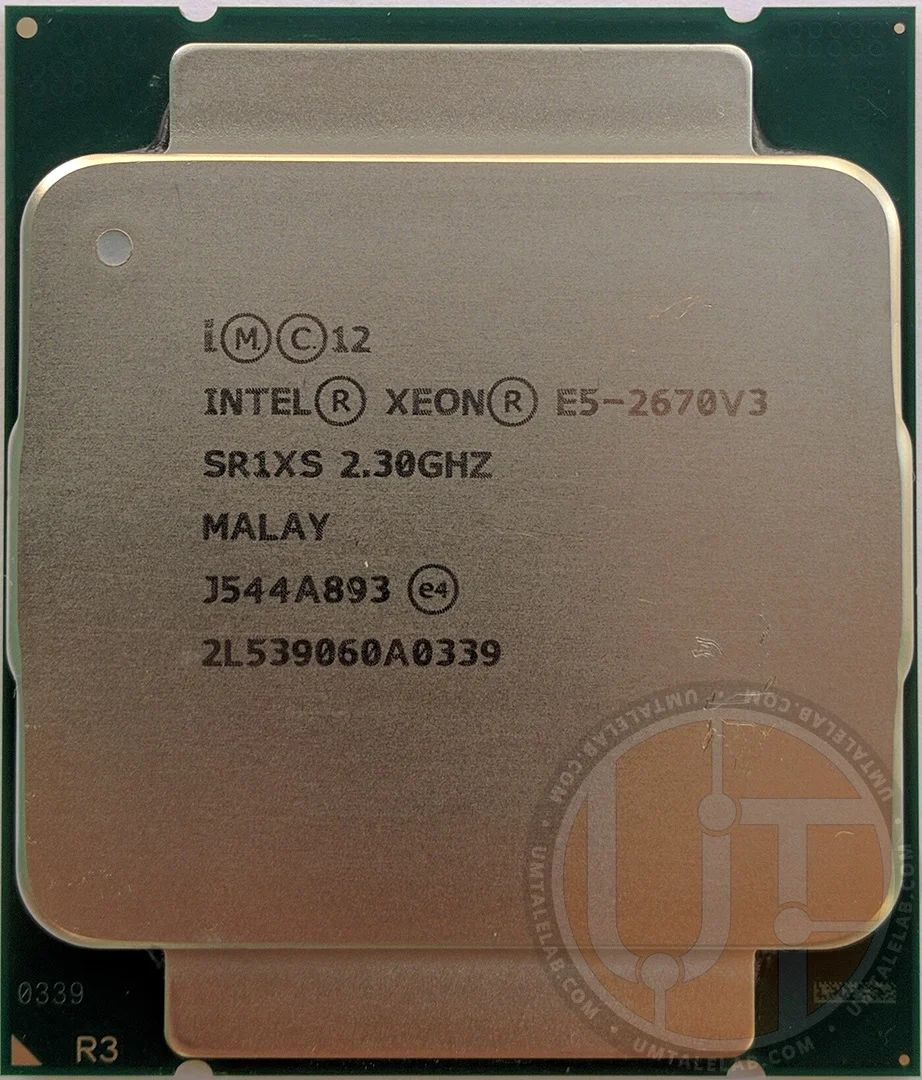
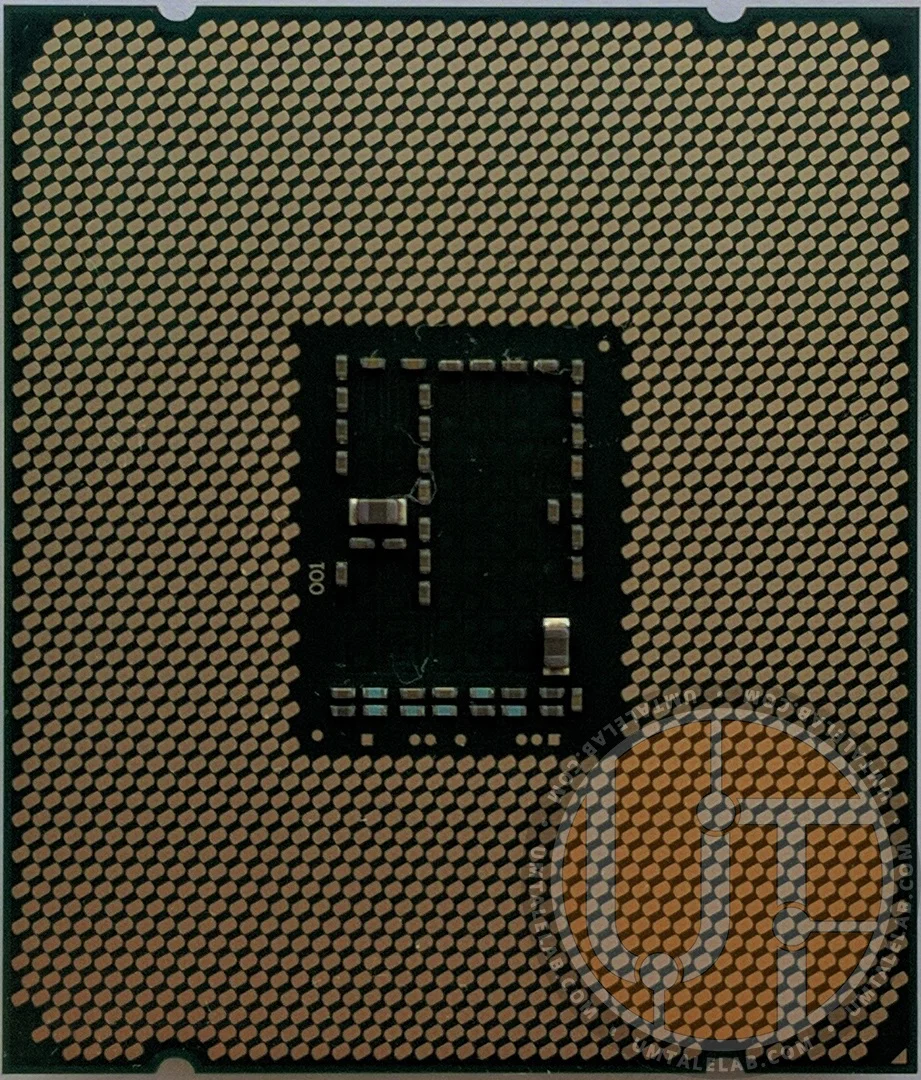
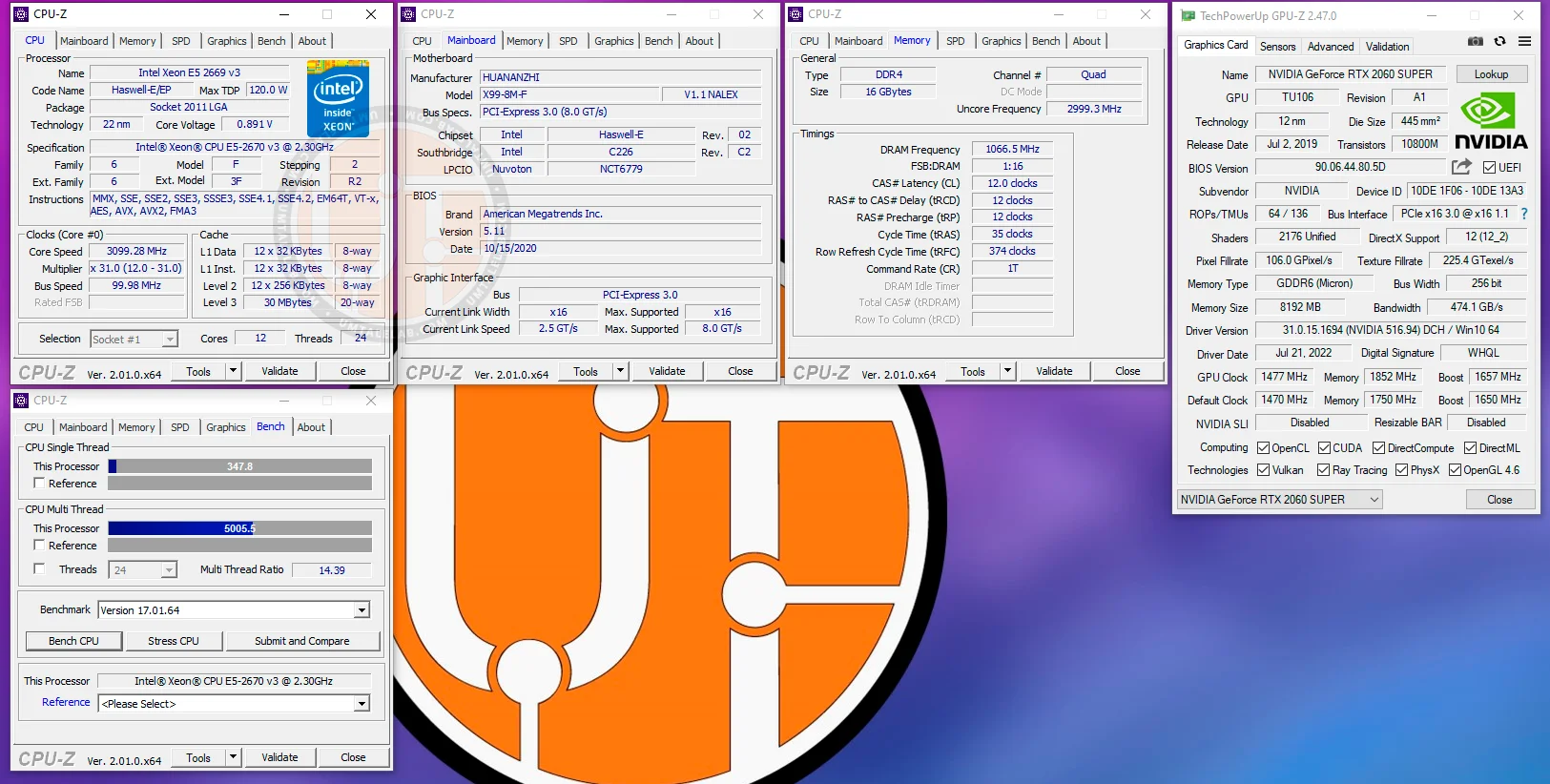
Our test sample is marked SR1XS; the chip was manufactured in Malaysia. Its nominal frequency is 2300MHz, and its TDP is set at 120 watts. This is a significant figure, so if you decide to purchase such a hot CPU, be sure to pair it with an appropriate cooling system.
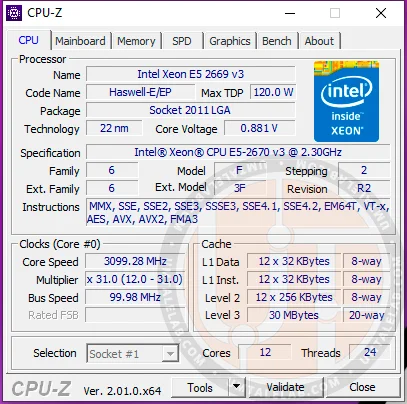
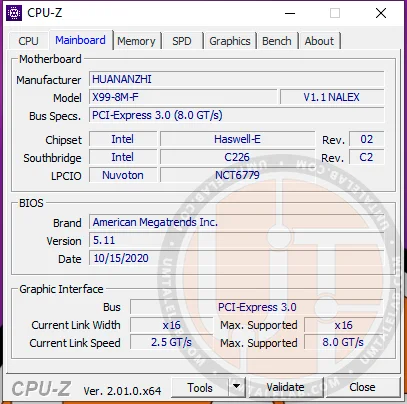
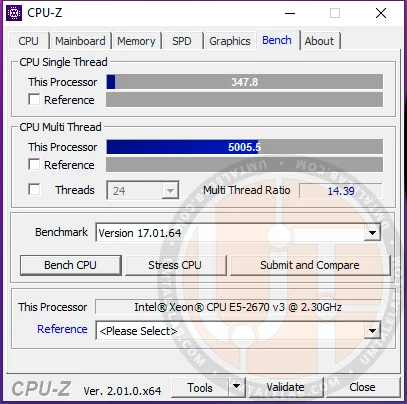
The E5-2670 v3 processor is based on a 22nm, 12-core, 24-thread variant of the Haswell-EP die. This chip is designed for motherboards with an LGA 2011 v3 socket. While its nominal frequency is 2300MHz, it can significantly increase with Turbo Boost 2.0 technology: up to 3100MHz for a single core and 2700MHz for all 12 cores/24 threads.
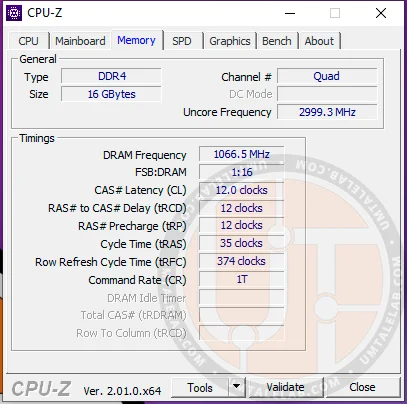
The Xeon E5-2670 v3 features 256KB of L2 cache per core and a shared L3 cache of 30MB, which was truly massive for its time. The integrated memory controller in the E5-2670 v3 operates at 3000MHz, the same speed as the L3 cache. Its quad-channel DDR4-2133MHz controller limits the maximum RAM frequency.
Additionally, the 12-core
 ⤢ ВІДКРИТИ
Test setup and software
Test setup
Intel Processors — Xeon X3470, Core i7-2600, Xeon X5660, Xeon E5-2667, Xeon E5-2620 v3, Xeon E5-2630 v3, Xeon E5-2660 v3 and Xeon E5-2670 v3;
AMD Processors — FX-8350, FX-6350;
CPU Cooler — Cooler Master Hyper 212 Black Edition (RR-212S-20PK-R1);
RAM for LGA 1155/1156 — 4 sticks of 8GB HyperX Genesis Na’Vi Edition (KHX16C9C2K2/8), totaling 32GB;
RAM for LGA 1366 — 3 sticks of 8GB HyperX Genesis Na’Vi Edition (KHX16C9C2K2/8), totaling 24GB;
RAM for LGA 2011 — 4 sticks of 8GB Micron MT36JSF1G72PZ-1G4M1HF, totaling 32GB;
RAM for LGA 2011 v3 — 4 sticks of 4GB G.SKILL DDR4 F4-2400C15S-4GNT, totaling 16GB;
RAM for AM3+ — 4 sticks of 8GB HyperX Genesis Na’Vi Edition (KHX16C9C2K2/8), totaling 32GB;
Motherboard LGA 1156 — DELL OptiPlex 980 (0D441T, mod-BIOS);
Motherboard LGA 1155 — Gigabyte GA-Z68P-DS3 (rev. 2.0);
Motherboard LGA 1366 — DELL T3500 (09KPNV);
Motherboard LGA 2011 — DELL T3610 (09M8Y8);
Motherboard LGA 2011 v3 — Qiyida X99-H9 with a modified BIOS from Huananzhi x99-8m-f (Unlock Turbo Boost, and unlocked timing control);
Motherboard AM3+ — ASUS M5A97 LE R2.0;
Graphics Card — KFA2 GeForce RTX 2060 SUPER 8GB (~1950/14816MHz, Power Limit 112%);
Solid-State Drive — KINGSTON SUV400S37240G 240.0 GB (Windows 10 + Games) + KINGSTON SUV400S37400G 400.0 GB (Games);
Power Supply — Chieftec GPS-1250C.
Software
Operating System: Windows 10 x64 with the latest updates as of August 2022;
Graphics Card Drivers: NVIDIA GeForce 516.94 WHQL;
Additional Software for FPS measurement: MSI Afterburner 4.6.4;
Games: testing was conducted on the current versions of games as of August 2022;
Game Settings: testing was conducted at the maximum possible graphics settings at 720p resolution.
Tested CPU Settings
Intel Processors:Core i7-2600@3400MHz, Dual-Channel DDR3@1866MHz (DDR3 timings 10-11-11-26, DDR3 voltage 1.550v);
Xeon X3470@3200MHz, Dual-Channel DDR3@1333MHz;
Xeon X5660@3066MHz, Triple-Channel DDR3@1333MHz;
Xeon E5-2667@3200MHz, Quad-Channel DDR3@1333MHz;
Xeon E5-2620 v3@3200MHz, Quad-Channel DDR4@1866MHz (DDR4 timings 10-10-10-24);
Xeon E5-2630 v3@3200MHz, Quad-Channel DDR4@1866MHz (DDR4 timings 10-10-10-24);
Xeon E5-2660 v3@3300MHz, Quad-Channel DDR4@2133MHz (DDR4 timings 12-12-12-32);
Xeon E5-2670 v3@3100MHz, Quad-Channel DDR4@2133MHz (DDR4 timings 12-12-12-35).
AMD Processors: FX-6350@4200MHz, CPU-NB@2200MHz, Dual-Channel DDR3@1866MHz; FX-6350@4595MHz, CPU-NB@2608MHz, Dual-Channel DDR3@2086MHz (CPU Core voltage — 1.440v, CPU-NB voltage — 1.375v, DDR3 voltage — 1.660v); FX-8350@4200MHz, CPU-NB@2200MHz, Dual-Channel DDR3@1866MHz;
FX-8350@4434MHz, CPU-NB@2608MHz, Dual-Channel DDR3@2086MHz (DDR3 timings 11-12-12-30, CPU Core voltage — 1.416v, CPU-NB voltage — 1.375v, DDR3 voltage — 1.660v).
You can find more detailed information about almost all the processors we've tested in our full reviews, or by checking out the blogs section for shorter notes.
A quick reminder about our CPU testing methodology: we ran each game five times, then took the average frame rate from those five runs and recorded it as the final result. Also, it's worth reiterating that all games were installed specifically on an SSD.
Benchmark results
Before diving in, here's a quick note on this article's specifics: beyond the E5-2670 v3's performance in its stock configuration with an unlocked Turbo Boost frequency, we also decided to test the processor with Hyper-Threading disabled and include those figures in our charts. Consequently, the graphs will feature two versions of the aforementioned CPU: "Xeon E5-2670 v3 12/24" (12 cores, 24 threads) and "Xeon E5-2670 12/12" (12 cores without virtual threads).
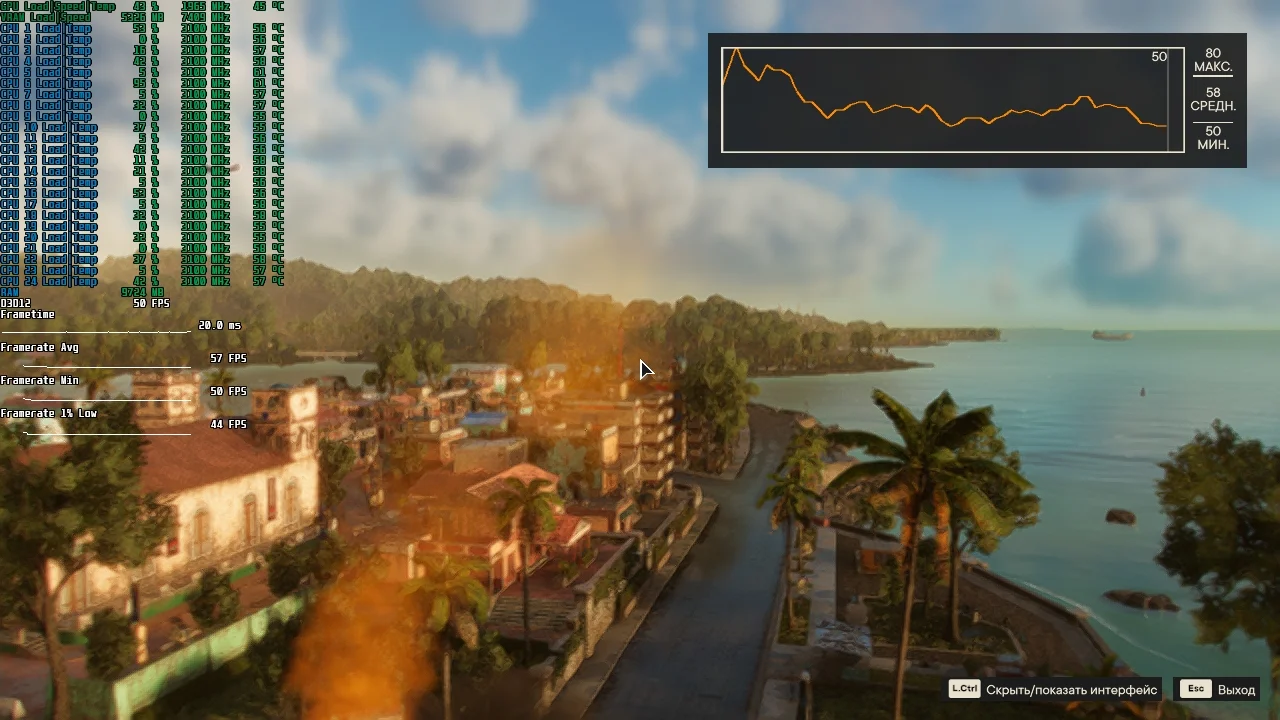
The reason for this decision is quite simple: during our experiments, we found that none of the games on our test list utilized all 24 threads. This often left more than half of the CPU cores idle, causing them to drop their frequency to 1200 MHz due to power-saving technologies. In turn, this led to significant performance drops in poorly optimized games like Far Cry 6, resulting in a substantial lag behind slower CPUs such as the E5-2630 v3.
To figure out if disabling virtual threads could help such a high-thread-count processor boost its gaming performance, we embarked on this additional experiment. You'll find out what the results were a little further down.
Assassin's Creed Valhalla
 ⤢ ВІДКРИТИ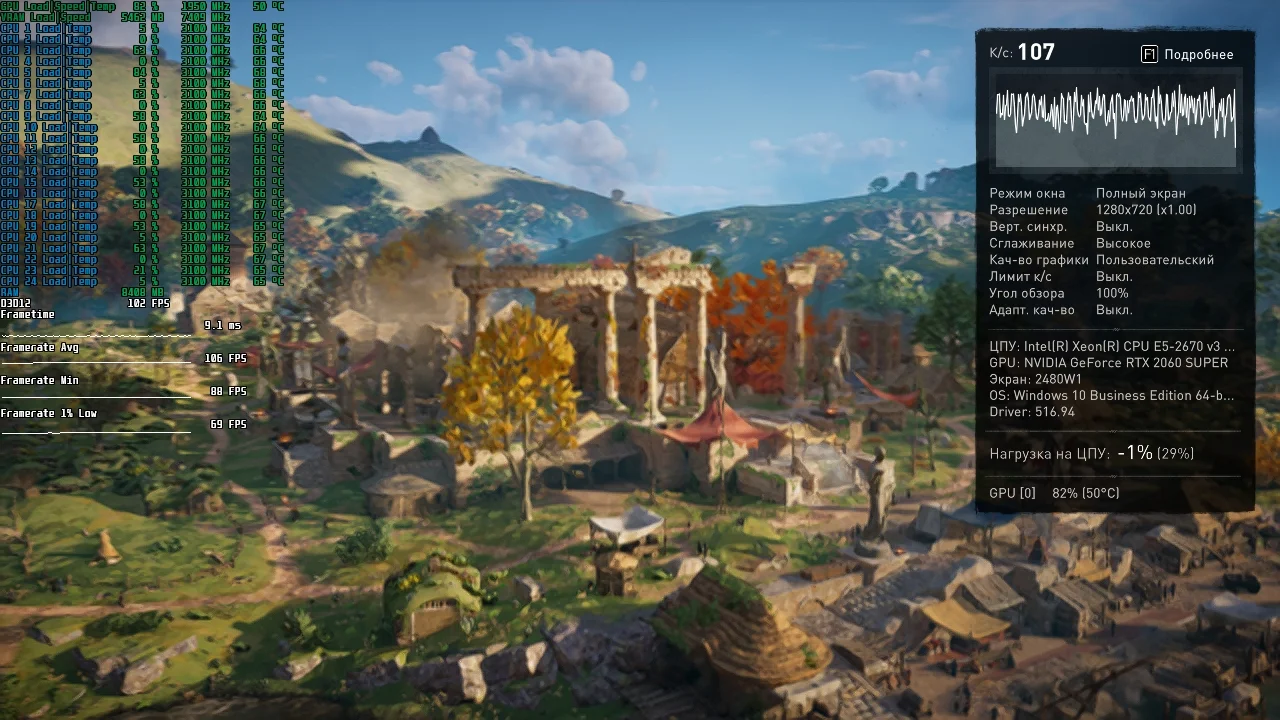
 ⤢ ВІДКРИТИ
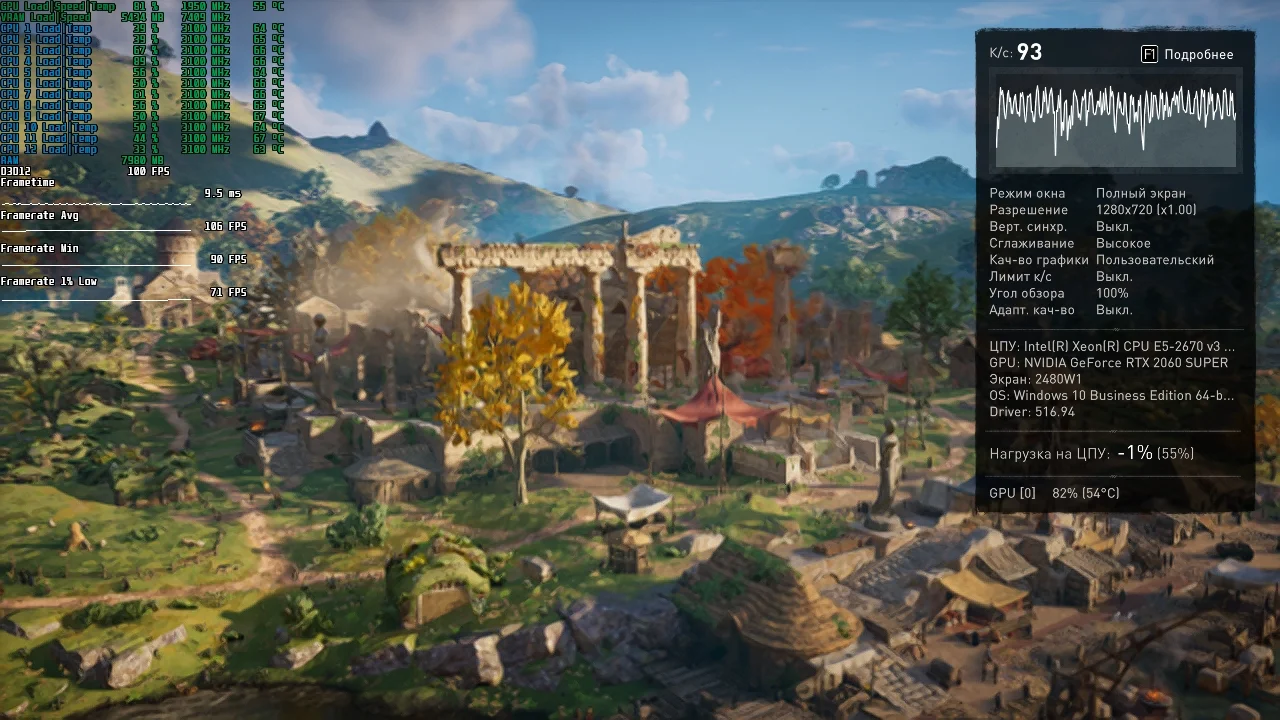
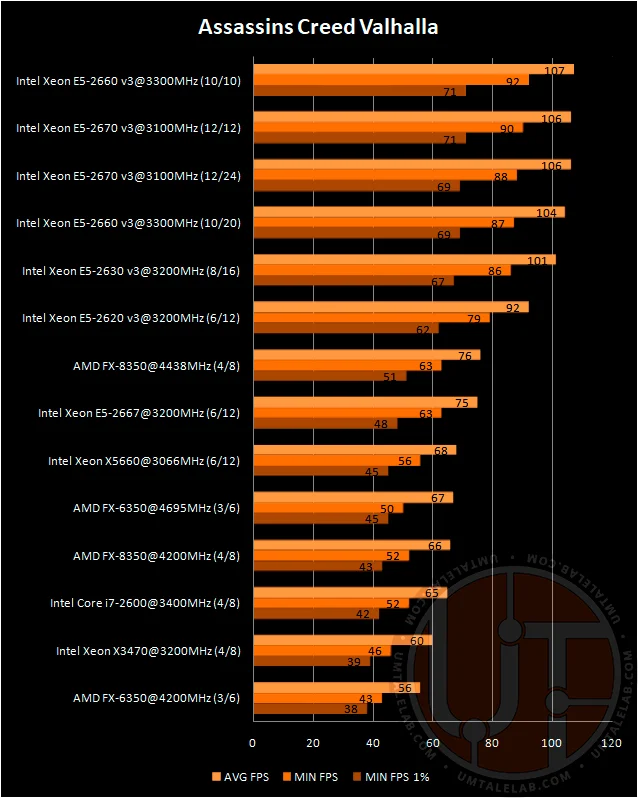
In the latest installment of the Assassin's Creed franchise, "Valhalla," the 12-core, 24-thread Haswell CPU shows only a slight edge over its 10-core, 20-thread sibling. With Hyper-Threading deactivated, it even falls slightly behind.
Similar to the 2660 v3 test, the conclusion for Valhalla is clear: while not a huge margin, those 12 extra threads actually hurt overall performance. The game runs a bit more stably on a "pure" 12-core configuration. Still, it's quite difficult to notice the FPS difference between the HT-enabled and HT-disabled versions by eye.
Battlefield 2042
 ⤢ ВІДКРИТИ
Ray tracing - ON
 ⤢ ВІДКРИТИ
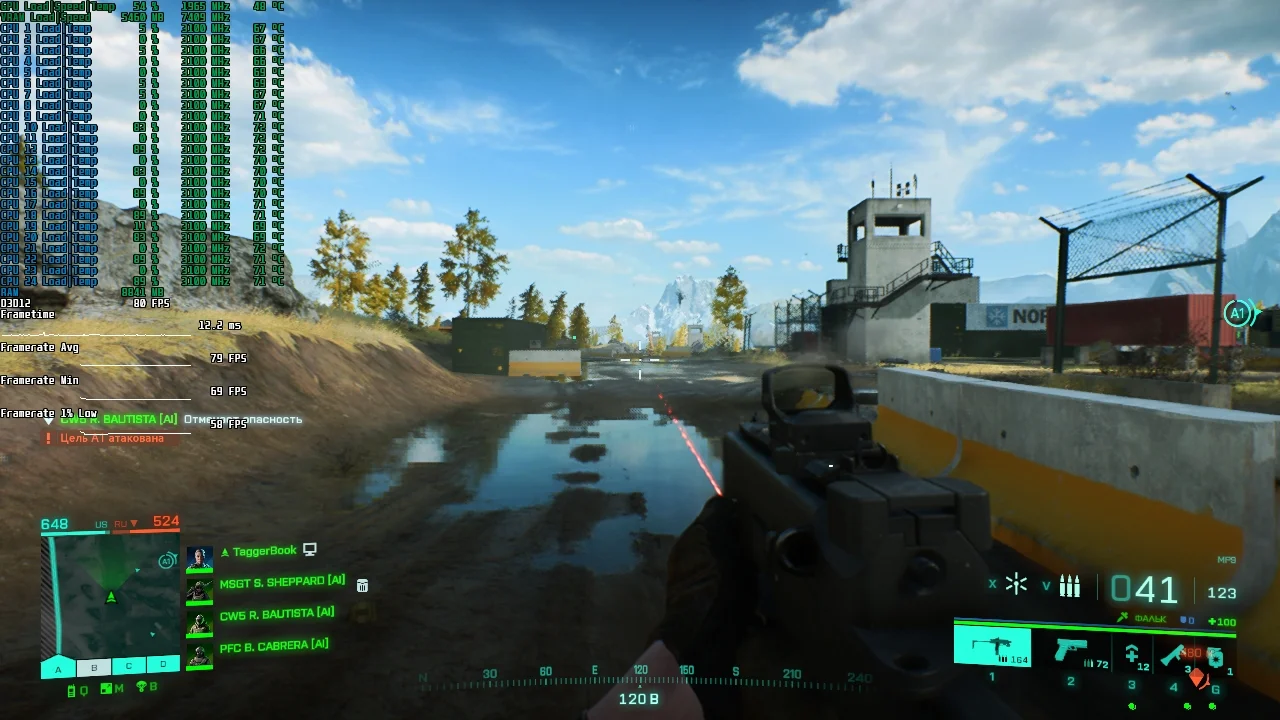
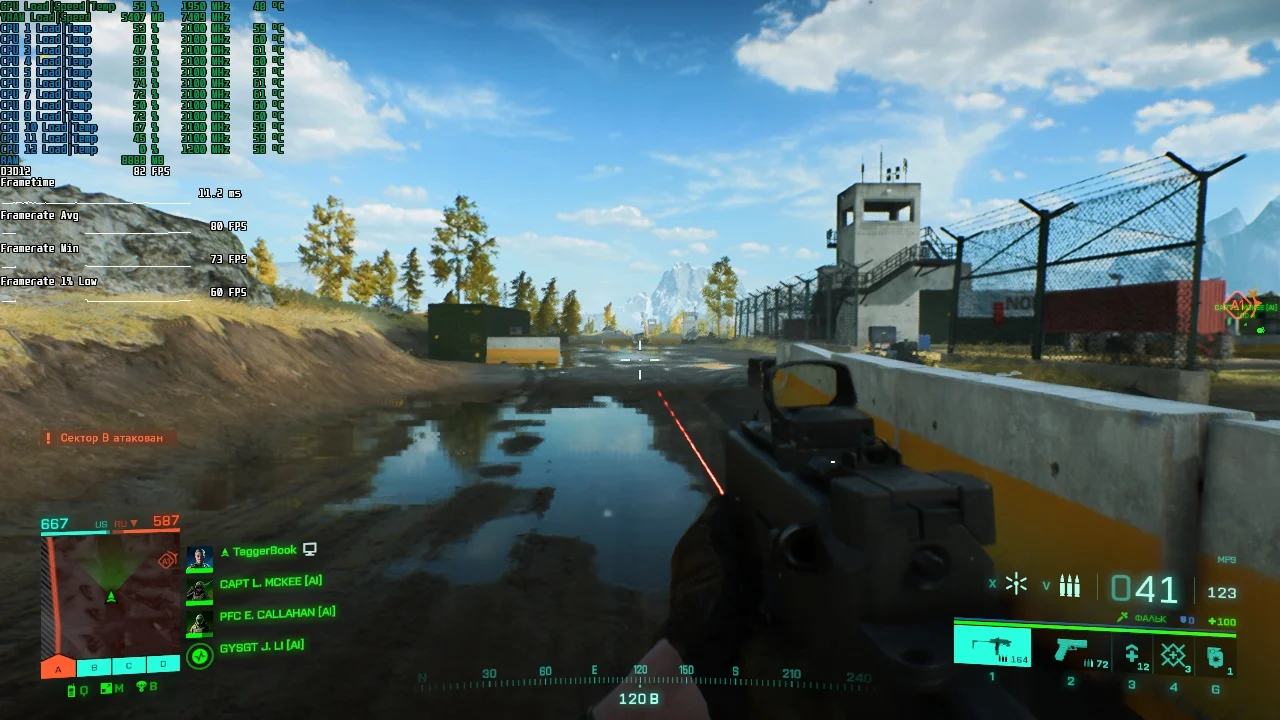
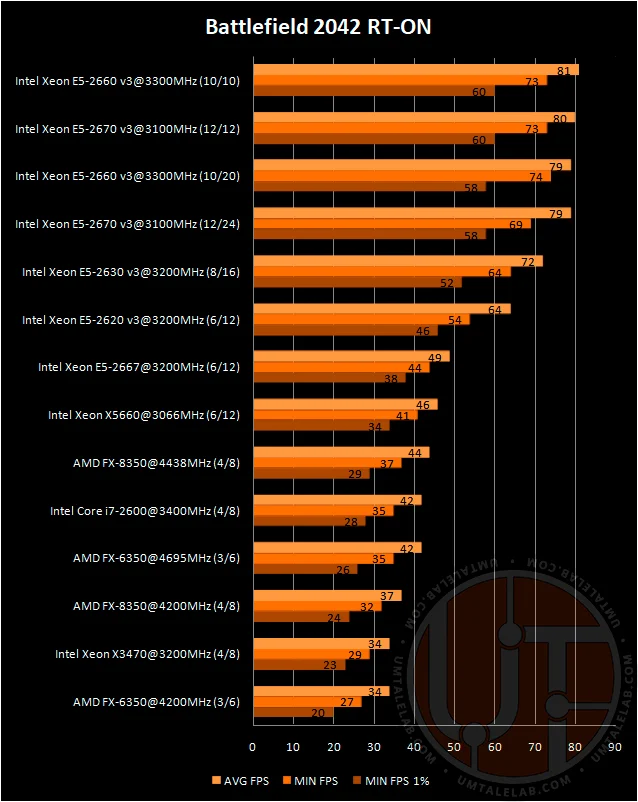
With ray tracing enabled, Battlefield 2042 couldn't establish a clear leader between the 12-core and 10-core CPUs. Since the game lacks a built-in benchmark, getting "laboratory" data is incredibly difficult. Therefore, any difference between such high-thread-count processors can be attributed to margin of error. However, it's worth noting that with RT enabled, BF2042 performs slightly better on CPUs without Hyper-Threading.
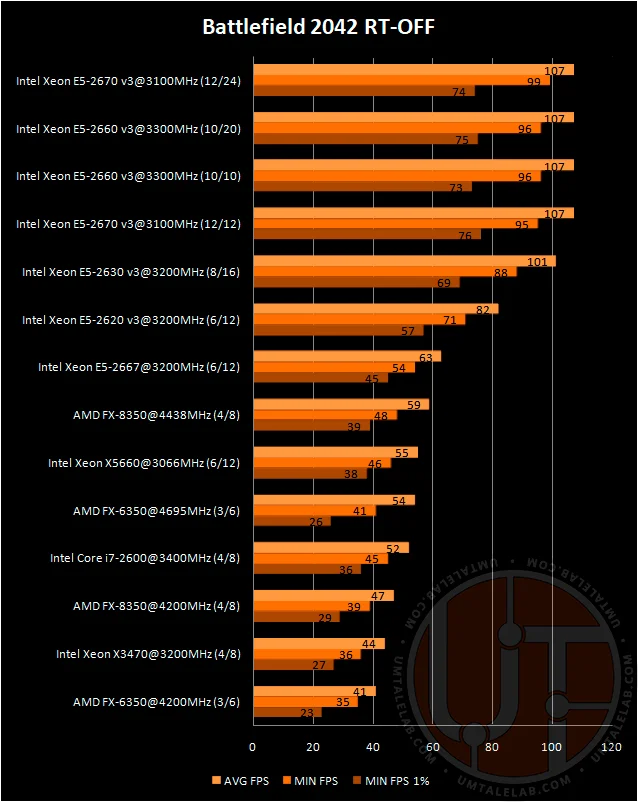
Ray tracing - OFF

 ⤢ ВІДКРИТИ
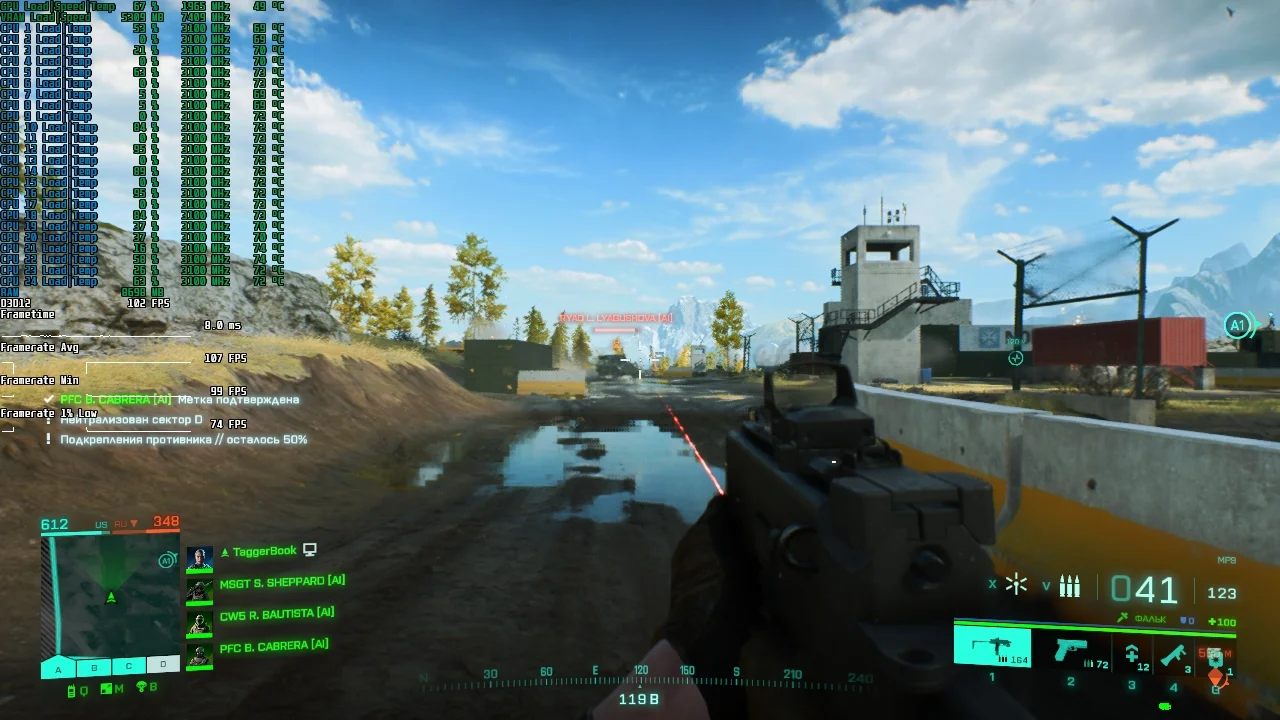
With ray tracing deactivated, the performance difference between the E5-2670 v3 and E5-2660 v3 completely vanished. Both CPUs delivered virtually identical frame rates and, surprisingly, handled DICE's extremely demanding and poorly optimized title remarkably well.
As for the matchup between the two versions of the 2670 v3, it was a tie: both the 24-thread and 12-core processors showed identical results, with differences in rare events falling within the margin of error.
Cyberpunk 2077
 ⤢ ВІДКРИТИ
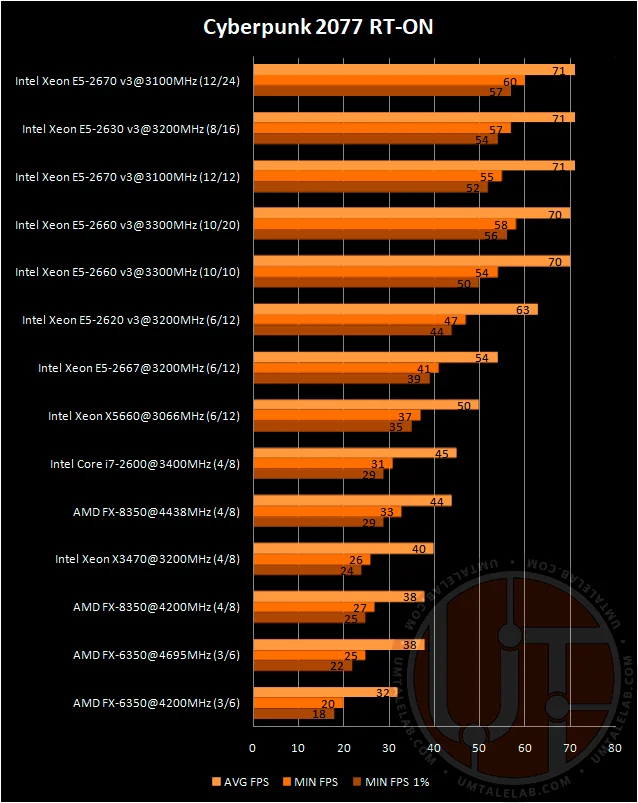
Ray Tracing - ON


 ⤢ ВІДКРИТИ
Cyberpunk 2077 with ray tracing enabled doesn't really need the extra four threads from the Xeon E5-2670 v3. However, disabling HT on the 12-core chip does negatively impact performance in CDPR's creation. Still, this is only noticeable on overlay graphs; during actual gameplay, it's incredibly difficult to spot any difference in frame rates.
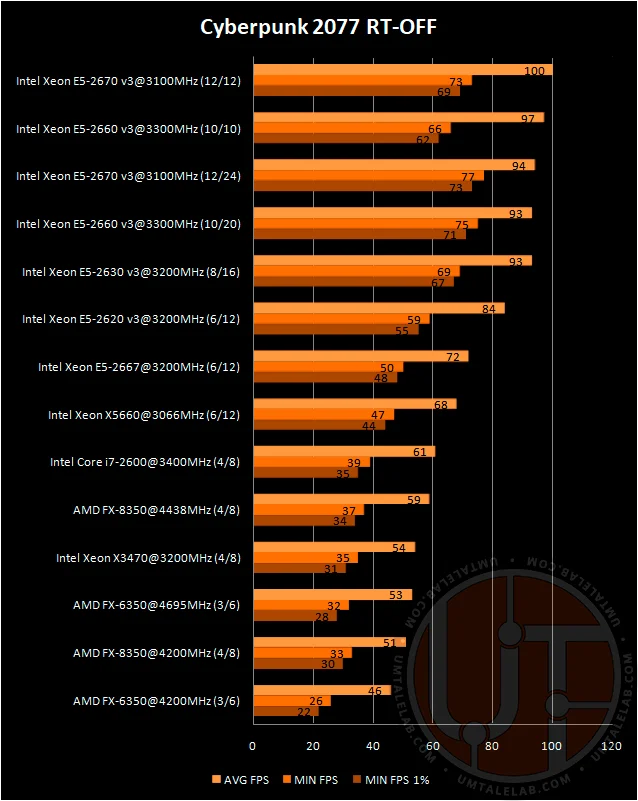
Ray Tracing - OFF


 ⤢ ВІДКРИТИ
Disabling the notorious ray tracing introduces some changes: the E5-2670 v3 now holds its ground much more firmly, especially the version with HT deactivated. But to be completely objective, the difference between the full E5-2660 v3 and E5-2670 v3 is so negligible that it's impossible to claim any 'victory' for the 12-core.
Destiny 2
 ⤢ ВІДКРИТИ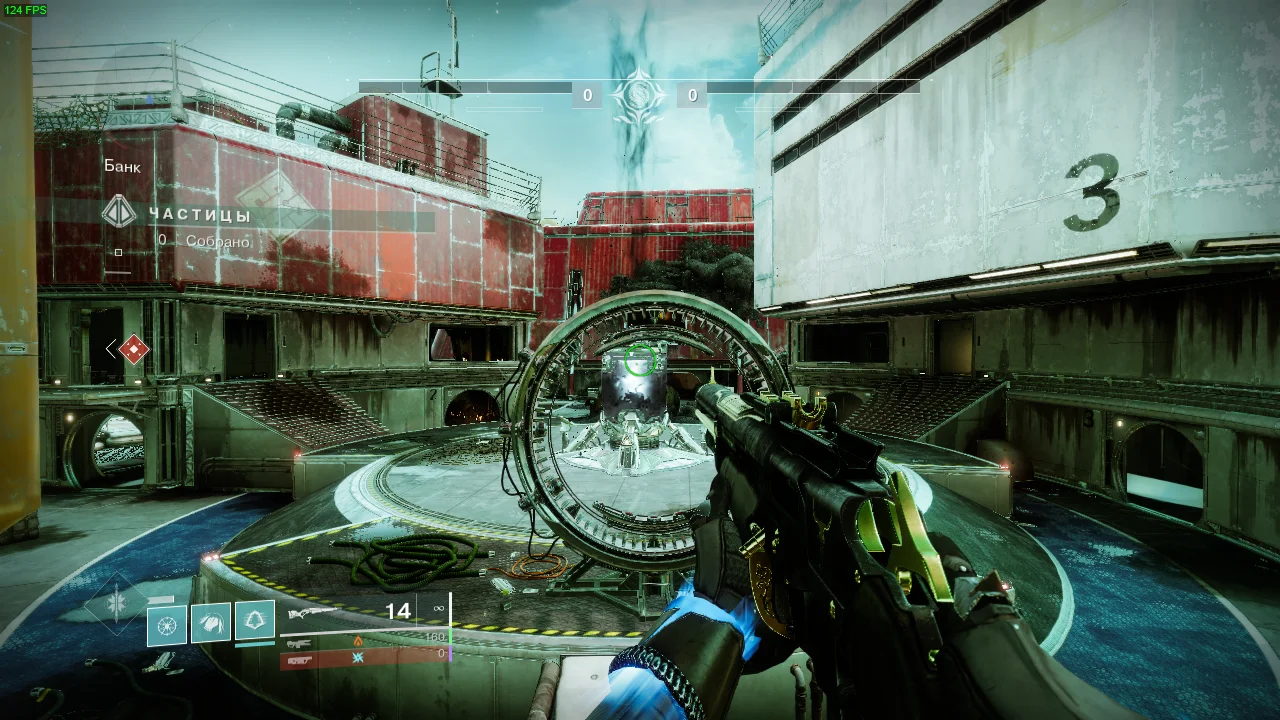

 ⤢ ВІДКРИТИ
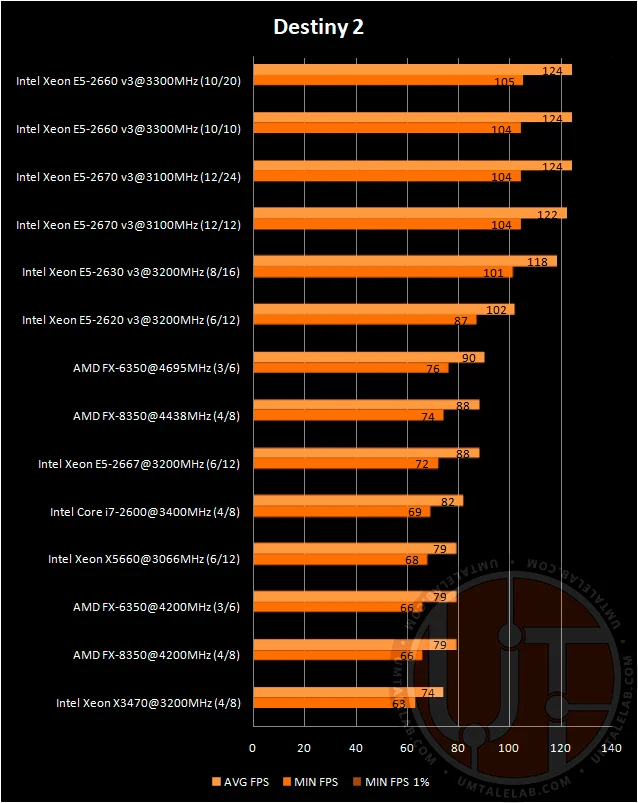
The multiplayer session shooter Destiny 2 actively uses up to 8 threads, making it almost impossible to gain an advantage from additional cores in this game. As a result, both the 12-core and 10-core chips show identical FPS figures, with any difference falling within the margin of error.
Elden Ring
 ⤢ ВІДКРИТИ
 ⤢ ВІДКРИТИ
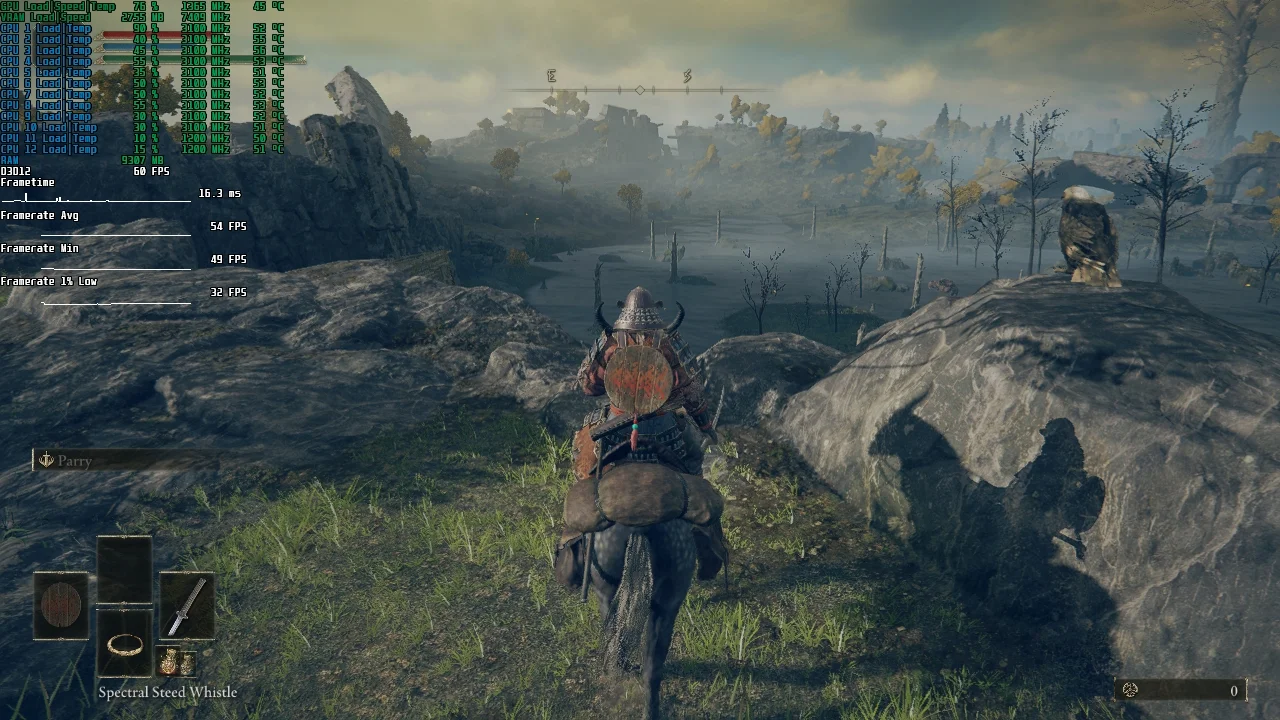
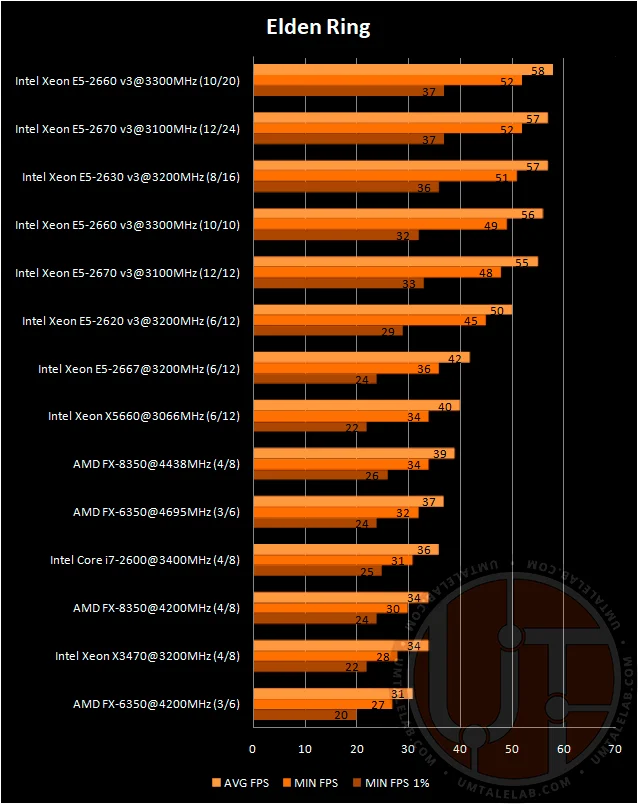
The situation in Elden Ring hasn't changed much since our last piece on the E5-2660 v3. This soulslike action RPG is poorly optimized; even on the 24-thread E5-2670 v3 with its ample 30MB L3 cache, minor stutters often occur, and the frame rate suffers from extreme instability. However, it's worth noting that the main subject of this article, paired with the Xeon E5-2660 v3, shows the best performance.
But that's not the most interesting part. Disabling Hyper-Threading significantly reduces the E5-2670 v3's performance, causing the 12-core chip to lose out to the 16-thread E5-2630 v3.
Far Cry 6
 ⤢ ВІДКРИТИ
Ray Tracing — ON
 ⤢ ВІДКРИТИ
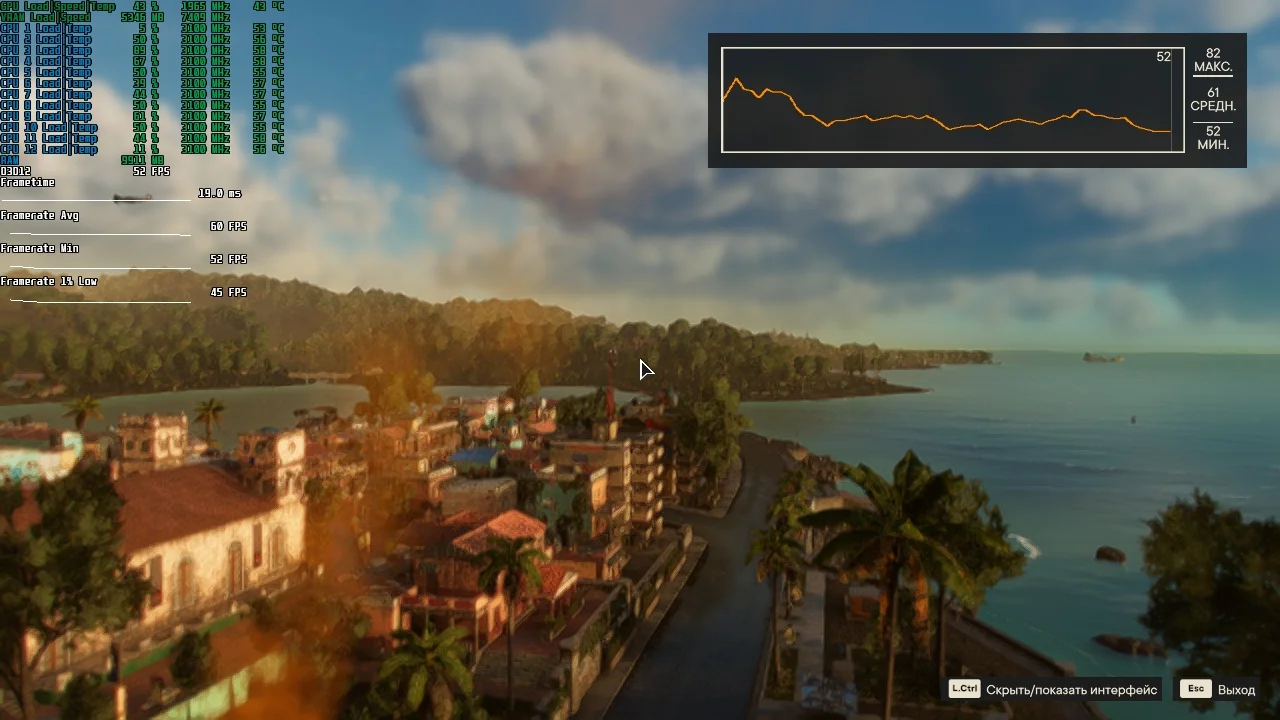
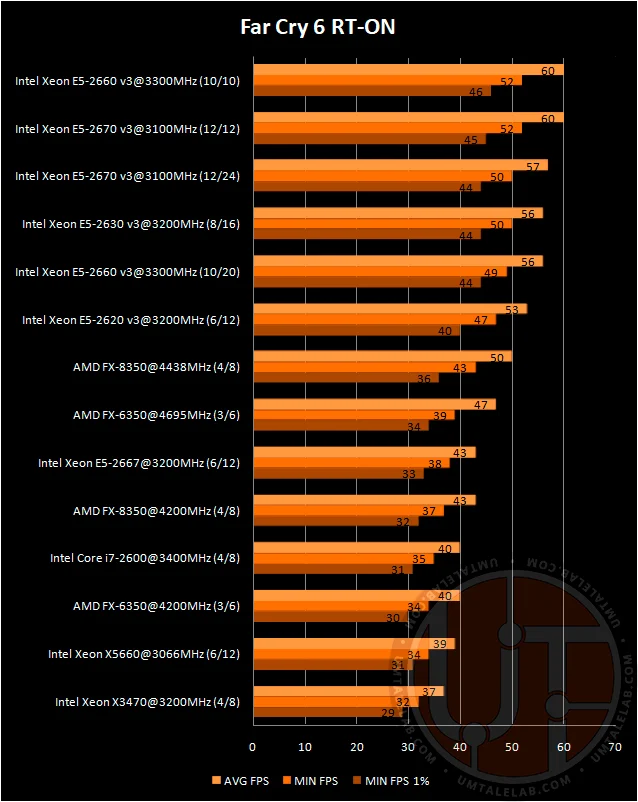
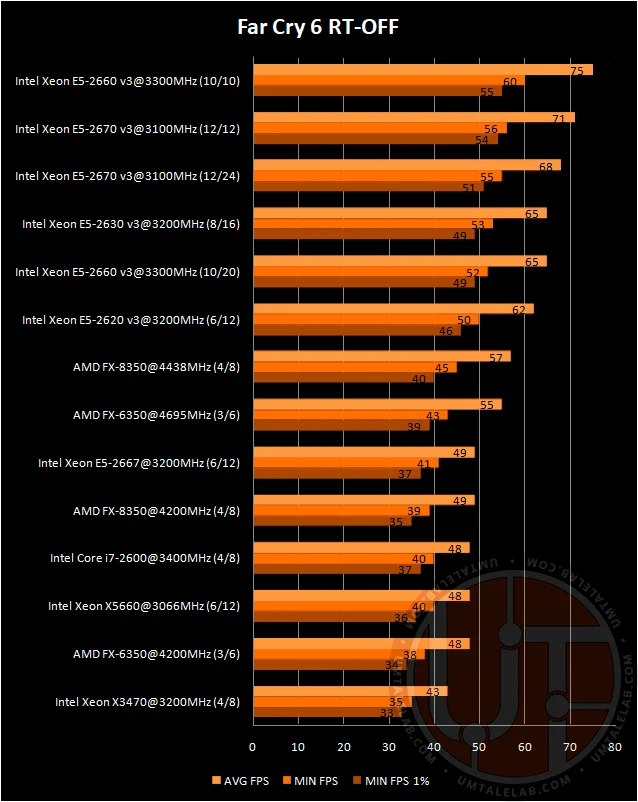
Far Cry 6 struggles to properly distribute CPU load when faced with more than 12 threads. This often means adding more execution units can actually hurt overall performance, a trend clearly visible in the graph above. With Hyper-Threading (HT) enabled, the E5-2670 v3 barely pulls ahead of the E5-2660 v3. However, disable HT, and the 'pure' 12-core chip dominates its younger counterpart, even hitting 60 frames per second in ray tracing mode. Interestingly, the same HT disablement on the 10-core E5-2660 v3 puts it in the lead.
Ray Tracing — OFF
 ⤢ ВІДКРИТИ
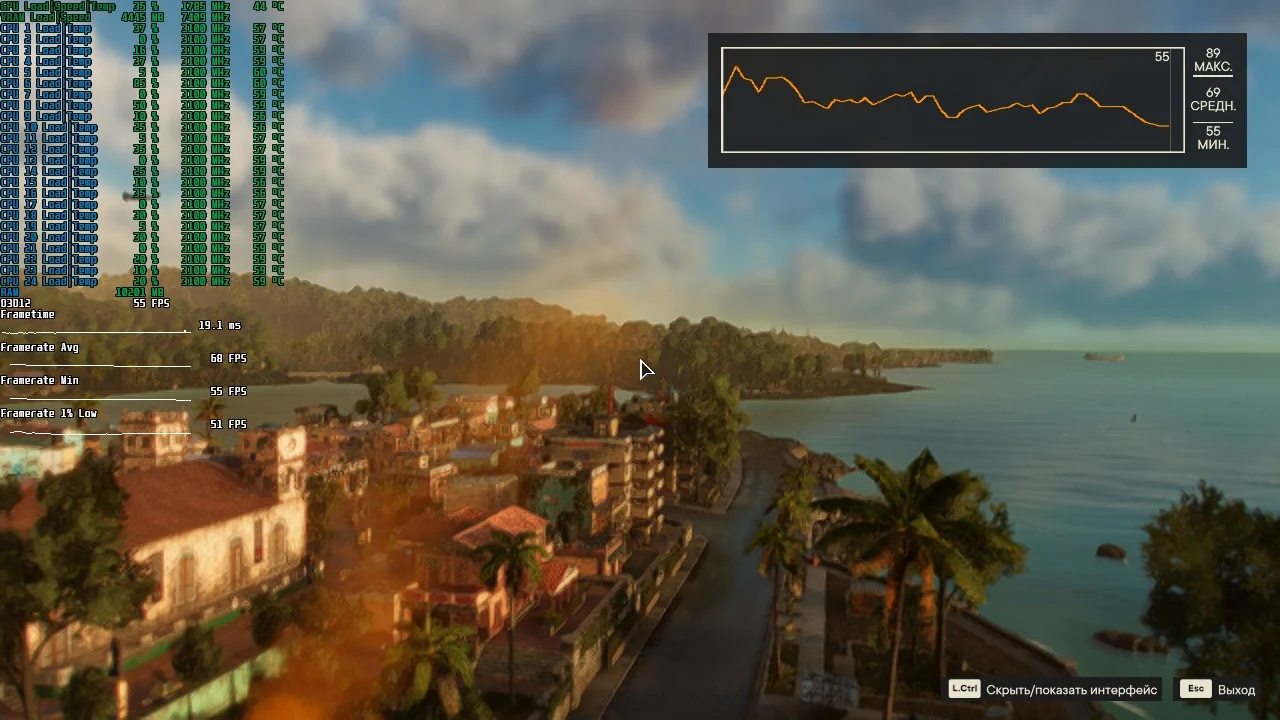
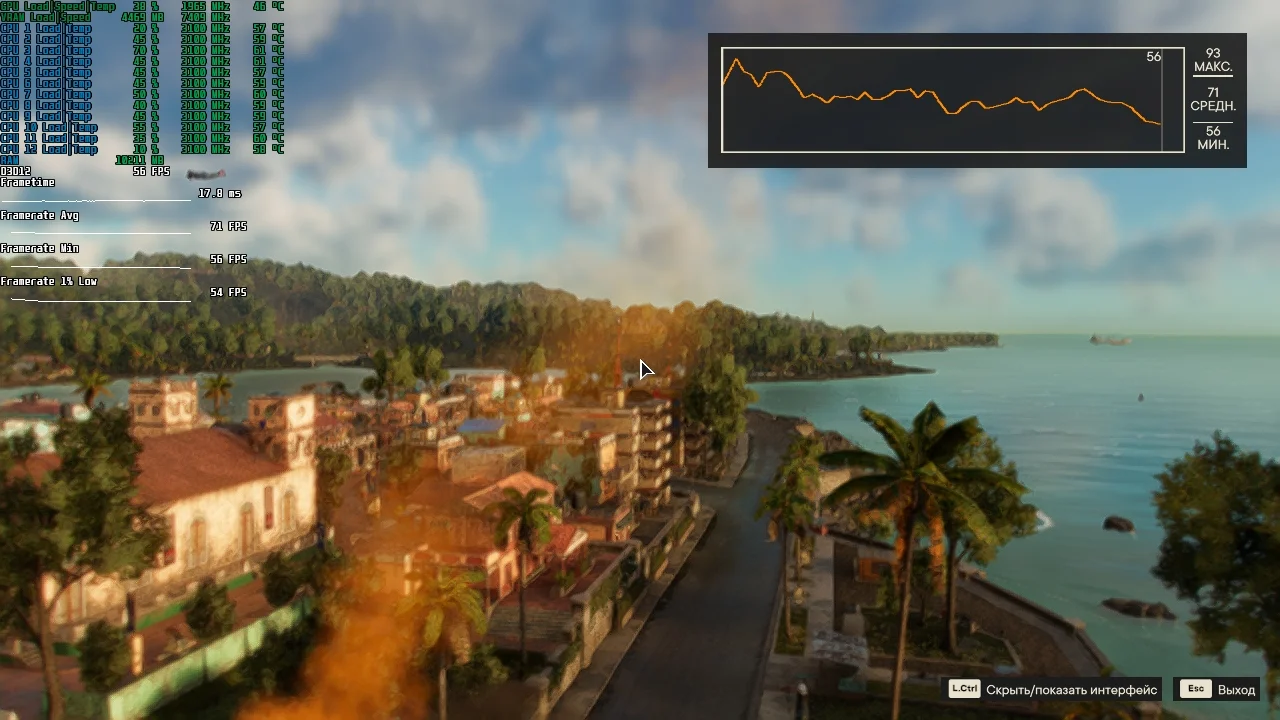
Disabling ray tracing didn't significantly alter the situation. The only exception was the Xeon E5-2660 v3 10/10, which extended its lead over the E5-2670 v3 12/12 to 5%. Looking at the graph, it's abundantly clear: Hyper-Threading has an extremely negative impact on Far Cry 6's performance. This is particularly evident in the rare event metrics, with micro-stutters occurring far more frequently on multi-core processors leveraging Hyper-Threading.
Marvel's Spider-Man Remastered
 ⤢ ВІДКРИТИ
Ray Tracing — ON


 ⤢ ВІДКРИТИ
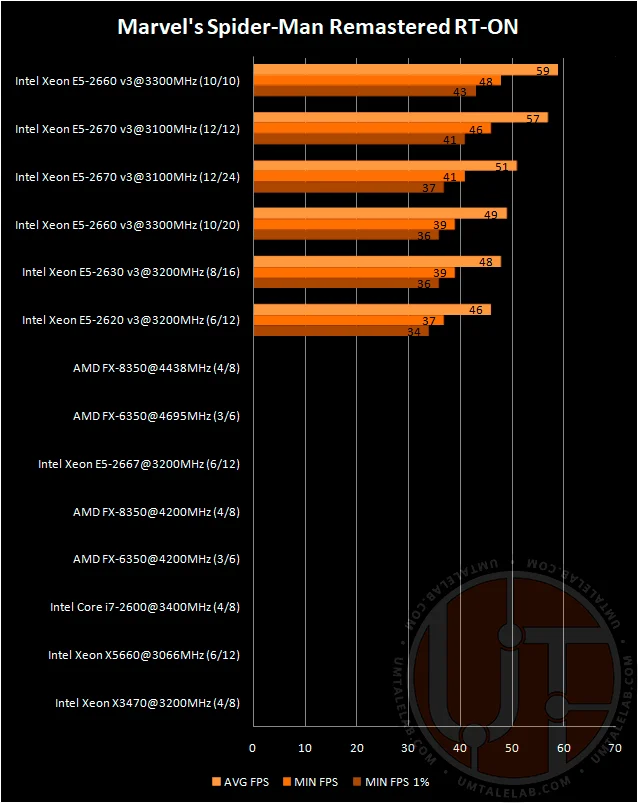
We see a similar scenario in Spider-Man Remastered with ray tracing enabled. Hyper-Threading once again plays a trick on the E5-2670 v3. Without HT, the 12-core CPU delivers 12% higher performance, getting much closer to a comfortable 60 FPS. Even so, the 2660 v3 10/10 still significantly outperforms its older sibling here. Of course, we shouldn't forget that clock speed also plays a crucial role.
Ray Tracing — OFF


 ⤢ ВІДКРИТИ
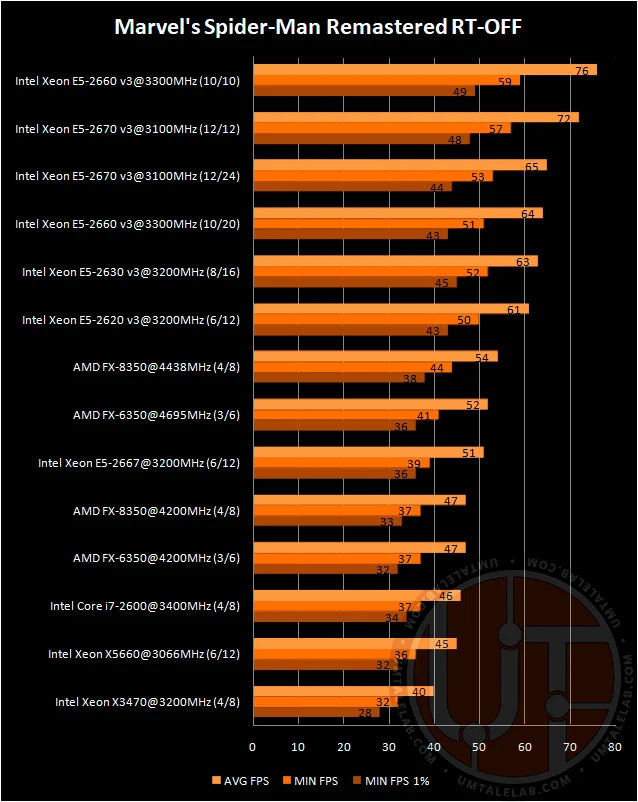
With RT disabled, nothing fundamentally changed: the E5-2670 v3 without Hyper-Threading still significantly outpaces its 12/24 counterpart and continues to trail the 2660 v3 10/10.
Marvel's Guardians of the Galaxy
 ⤢ ВІДКРИТИ
Ray Tracing — ON


 ⤢ ВІДКРИТИ
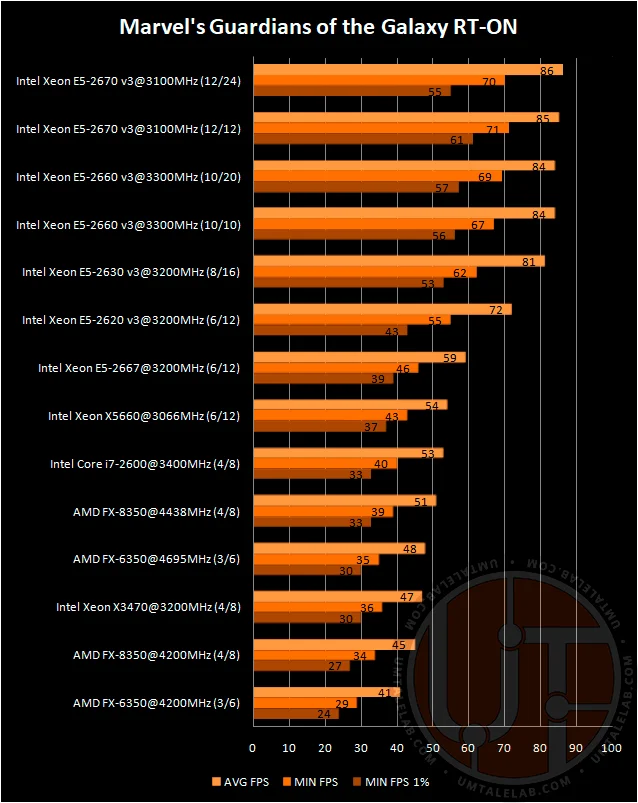
Marvel's Guardians of the Galaxy with ray tracing enabled is much better optimized for multi-threaded processors. However, even here, additional threads still hurt overall performance, and regarding rare events, the 2670 v3 even loses to the E5-2660 v3 10/10. Meanwhile, the 2670 v3 12/12 demonstrates a confident victory, outperforming both versions of the Xeon E5-2660 v3 in minimum FPS.
Ray Tracing — OFF


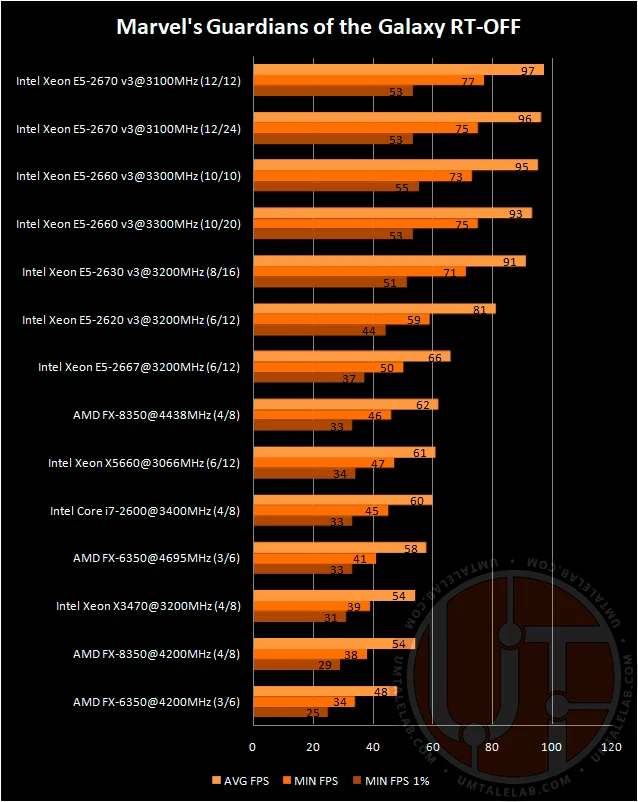 ⤢ ВІДКРИТИ
Without ray tracing, frame rates increase on all CPUs. The performance hierarchy and gaps remain largely unchanged.
Saints Row [2022]
 ⤢ ВІДКРИТИ
Ray Tracing — ON
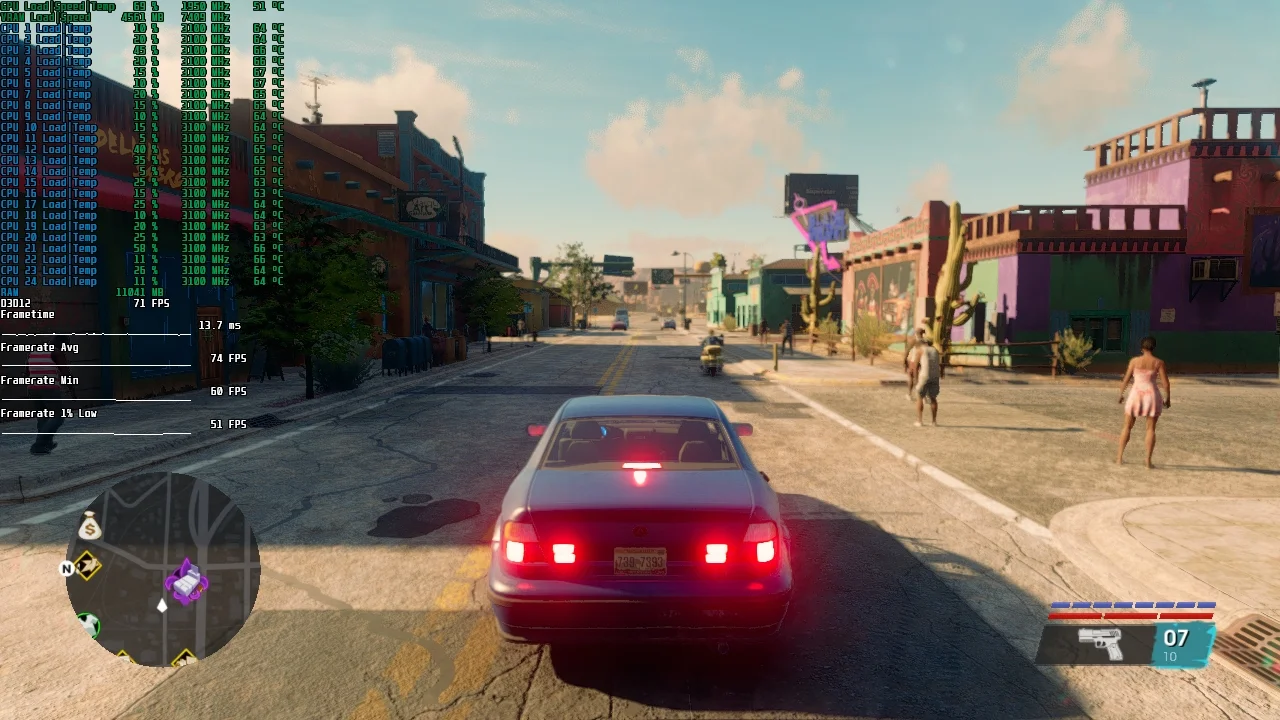

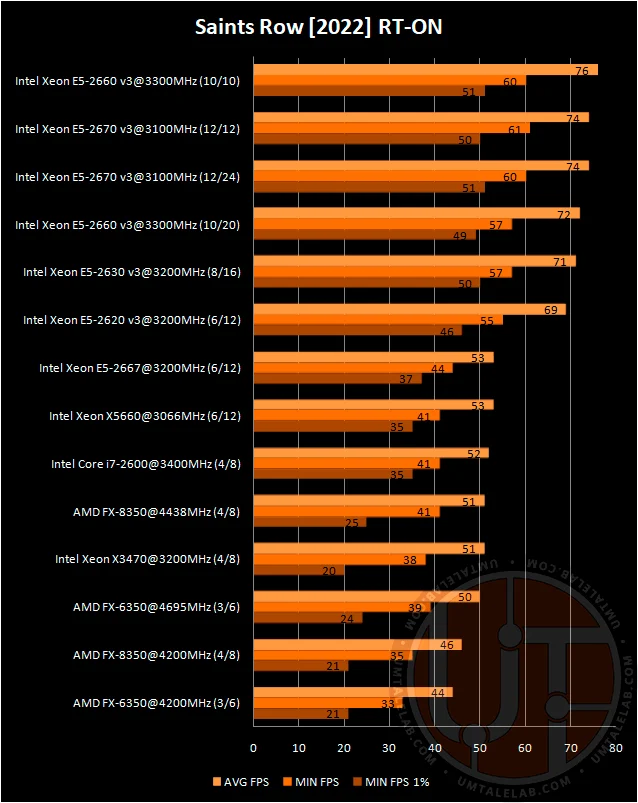 ⤢ ВІДКРИТИ
In the Saints Row reboot, with ray tracing enabled, the full E5-2670 v3 has a slight frame rate advantage over the E5-2660 v3. However, with Hyper-Threading disabled, the 10-core chip pulls ahead. Essentially, both CPUs perform at roughly the same level here.
Ray Tracing — OFF
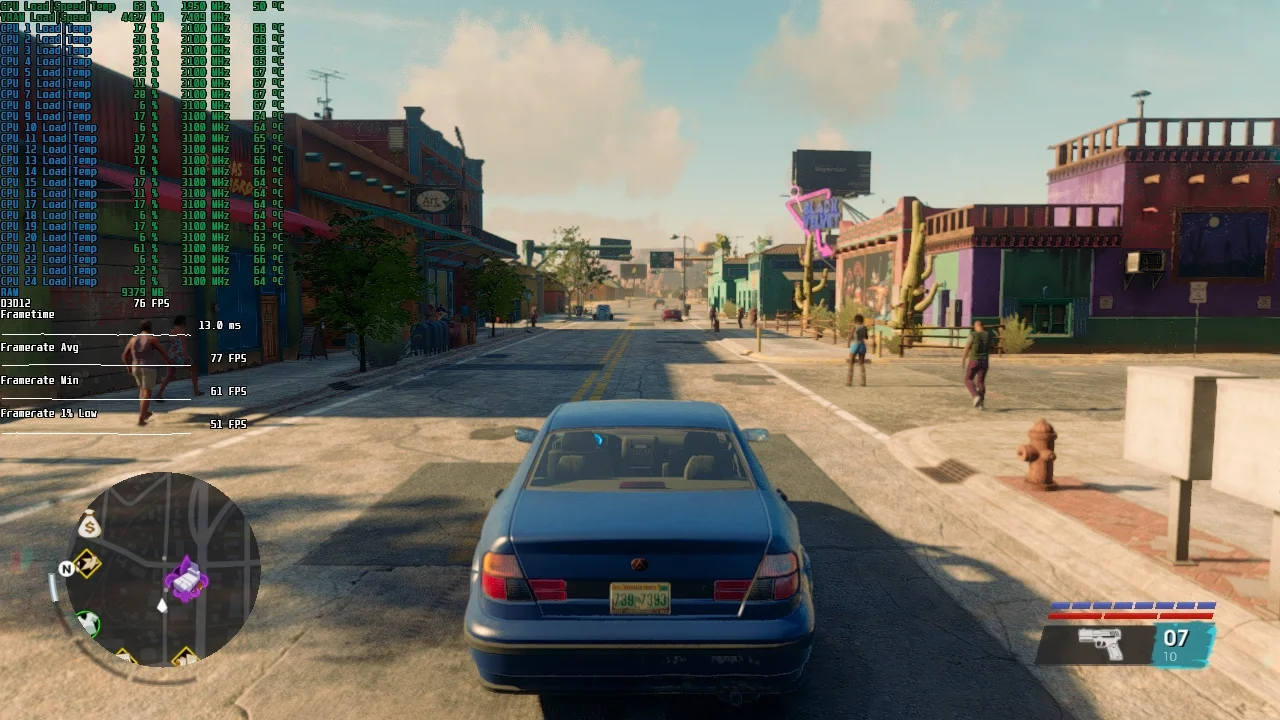
 ⤢ ВІДКРИТИ
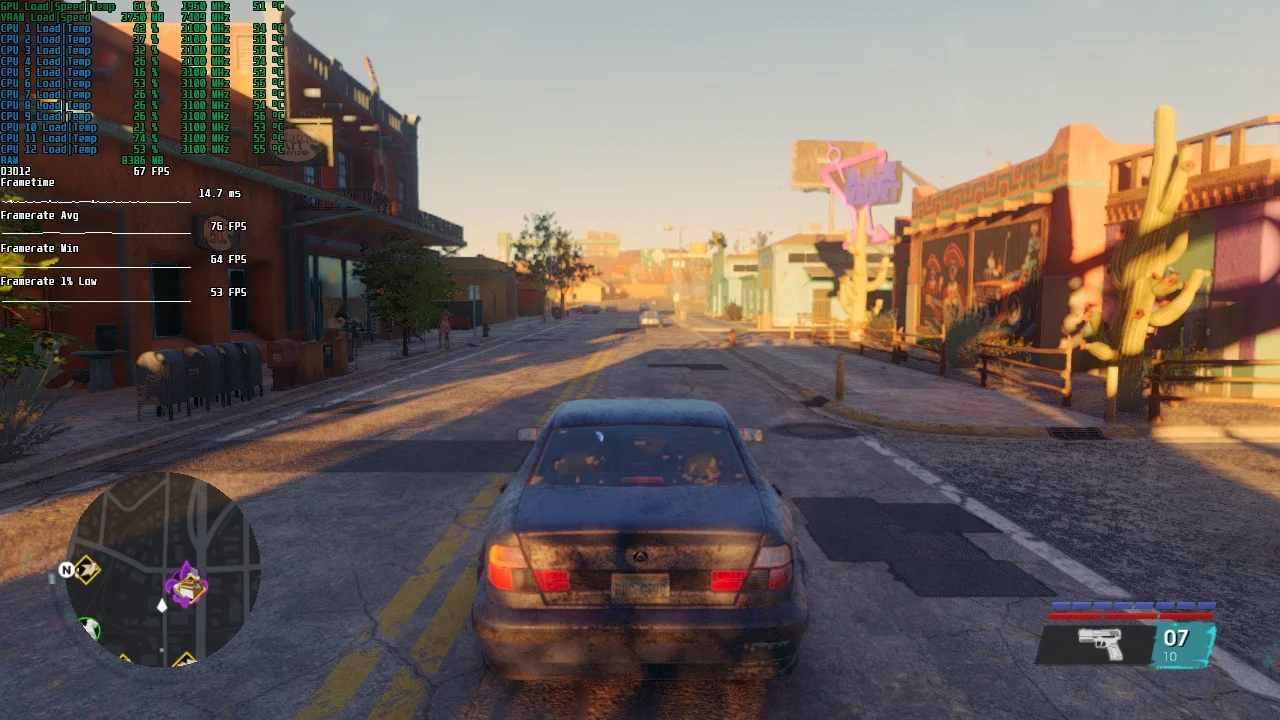
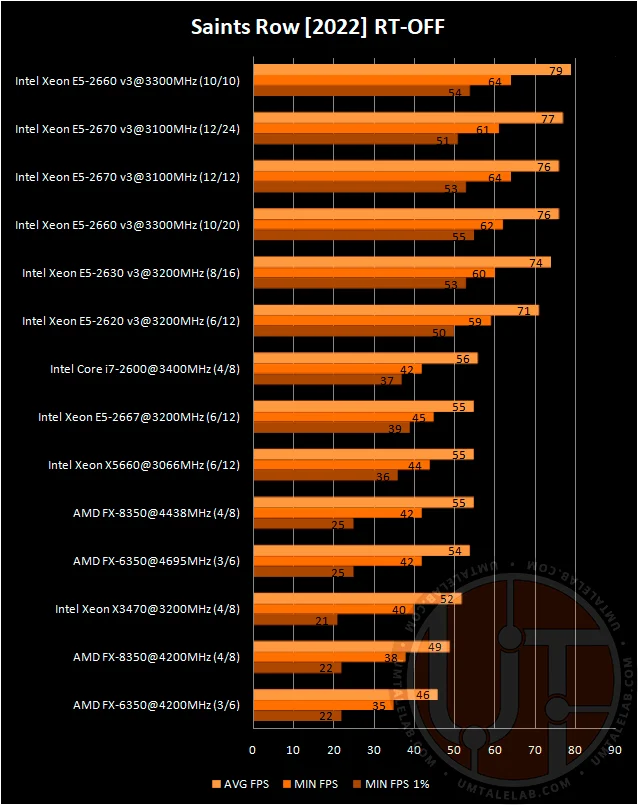
With RT deactivated, the pattern repeats: both E5-2670 v3 versions are still slightly behind the 2660 v3 10/10 configuration, while slightly outperforming the 10/20 setup.
Red Dead Redemption 2
 ⤢ ВІДКРИТИ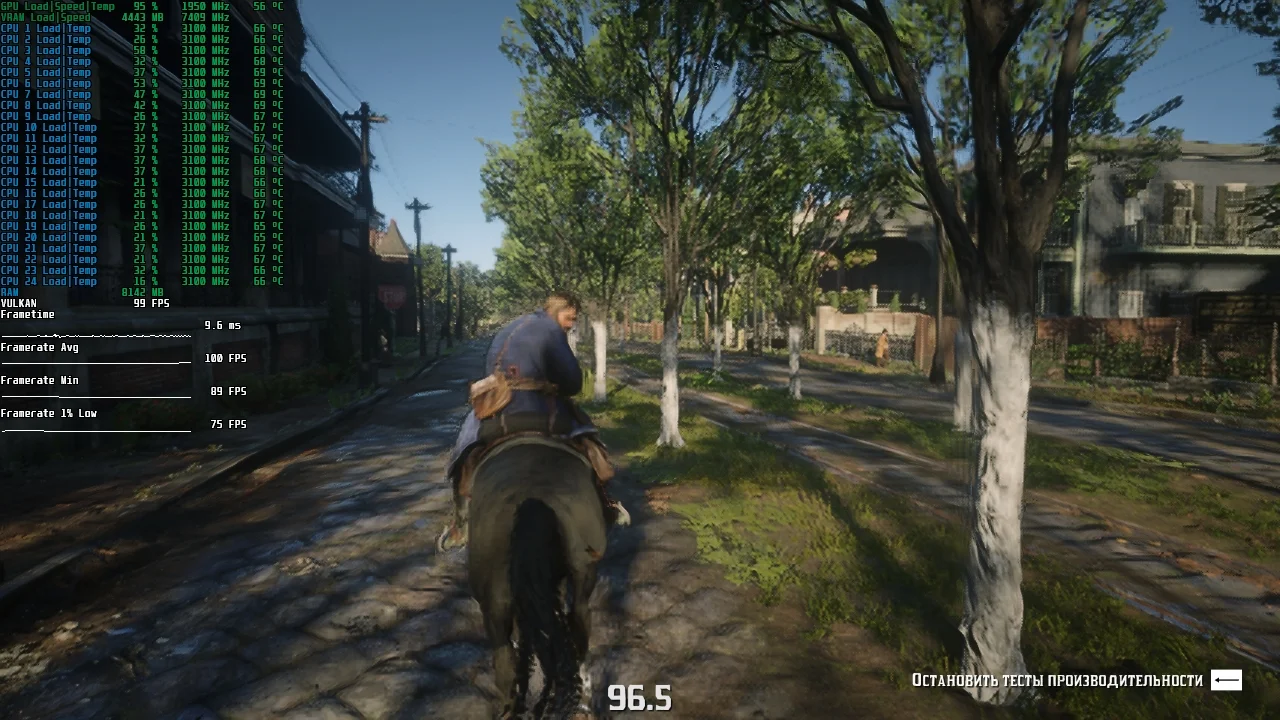
 ⤢ ВІДКРИТИ
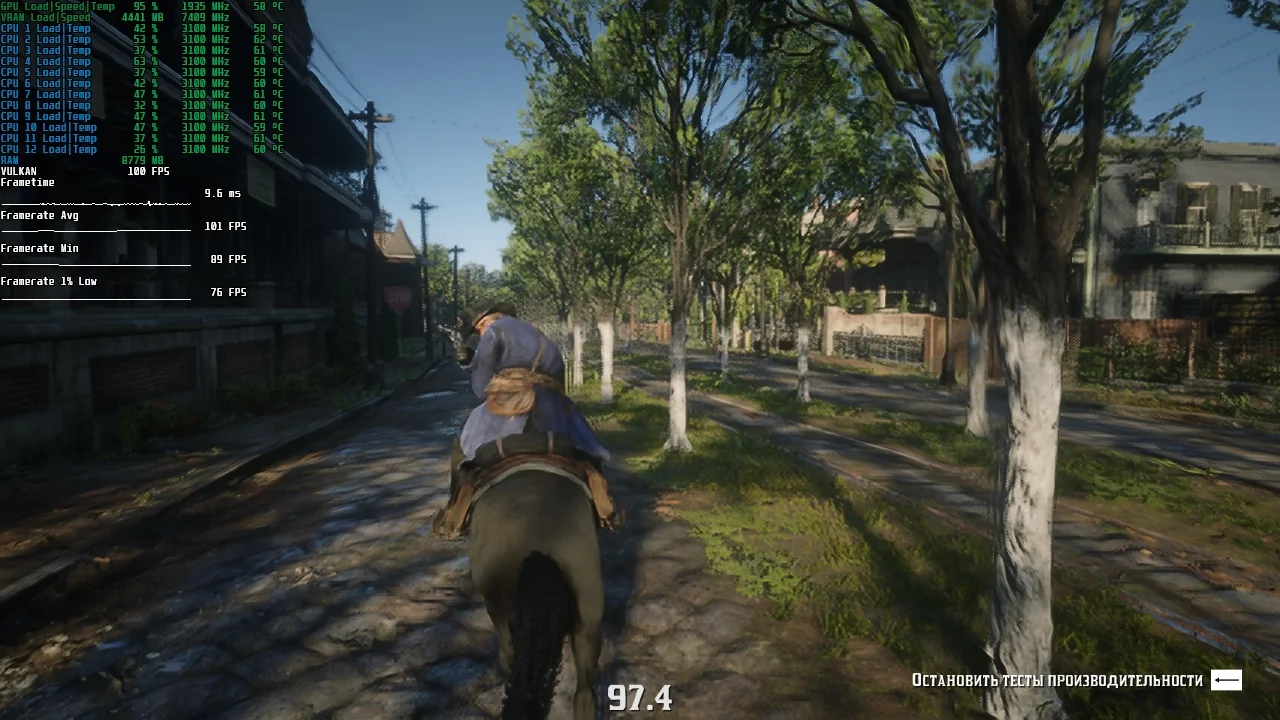
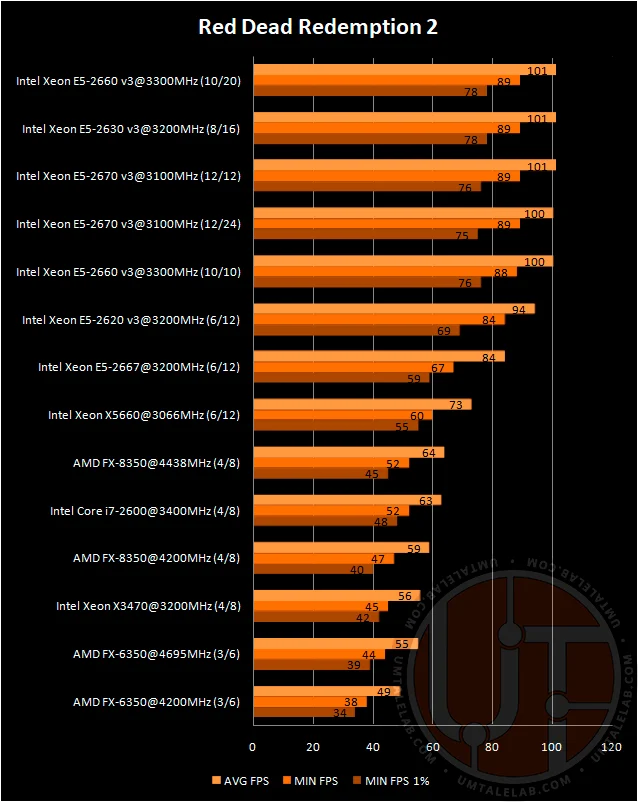
Unfortunately, even at 720p, the RTX 2060 SUPER isn't enough to adequately benchmark processors in the second installment of the legendary Red Dead Redemption franchise with max settings. Both the 2660 v3 and 2670 v3 show identical FPS.
Watch Dogs Legion
 ⤢ ВІДКРИТИ
Ray Tracing - ON


 ⤢ ВІДКРИТИ
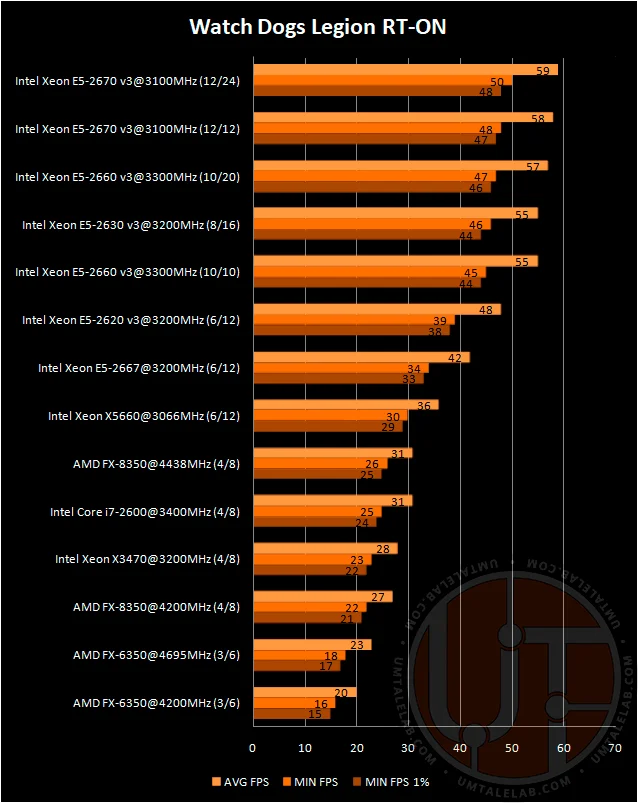
Finally, we've reached the most demanding game in our test suite: Watch Dogs Legion. This third installment in Ubisoft's popular series generally responds well to an increased number of CPU execution units, but this benefit plateaus after 8 cores and 16 threads. For instance, the 24-thread E5-2660 v3 only managed a 3.5% lead over the E5-2660 v3. Conversely, disabling Hyper-Threading in this game, while not a major factor, actually reduces the performance of the 12-core chip.
Ray Tracing - OFF


 ⤢ ВІДКРИТИ
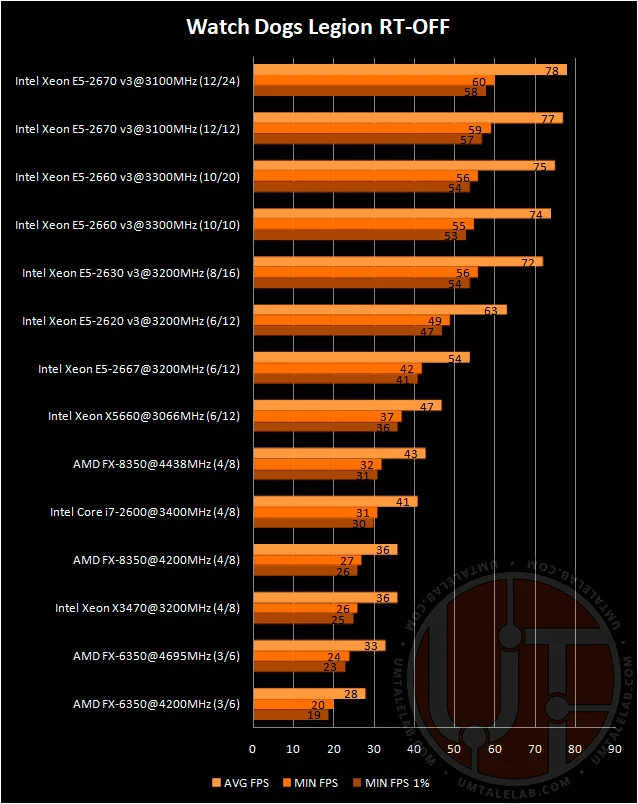
Without ray tracing, in less demanding scenarios, the performance difference between the E5-2670 v3 and E5-2660 v3 is almost imperceptible, making the higher-end chip largely meaningless for most users. That said, the 12-core, 24-thread chip still pulls ahead by a modest 4%.
Conclusion
After reviewing all the charts, a single conclusion becomes clear: gamers should steer clear of these heavily multi-threaded CPUs. A much more logical choice would be higher-frequency 8-core or 10-core processors, such as the 2640 v3 or 2660 v3. Other chips in this class are either prohibitively expensive or run exceptionally hot, demanding higher-quality motherboards to cope.
If you've already picked up a 12-core 2670 v3 and occasionally experience frustrating micro-stutters in certain games, we suggest experimenting with disabling Hyper-Threading. In some titles, disabling HT has been shown to unlock better performance from this CPU.