NEWS · HARDWARE
PUBLISHED
READING3 min
AMD unveils Radeon RX 5300 graphics card
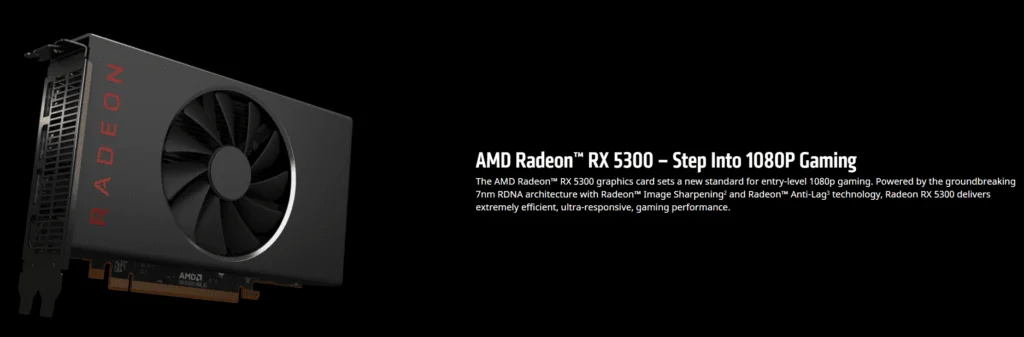
AMD has launched the Radeon RX 5300, a budget graphics card aimed at 1080p gaming. It features 3GB of VRAM, a 100W TDP, and is positioned against NVIDIA's GTX 1650.
Given NVIDIA's rapid announcement of its RTX 3000 series graphics cards, AMD should ideally be focusing all its energy on the upcoming RX 6000 series and its flagship "Big Navi" chip. However, it seems the red team has other plans:
Yesterday, AMD unveiled the Radeon RX 5300, an entry-level product designed for budget gaming systems.
 ⤢ ВІДКРИТИ
The AMD Radeon RX 5300 is built on the Navi 14 graphics processor. This is the same GPU found in the Radeon RX 5500 XT graphics card lineup, featuring the same 22 compute units, or 1408 stream processors. The primary difference between the RX 5300 and RX 5500 lies in the GPU clock speed and VRAM configuration.
The Radeon RX 5300 GPU has a "game clock" of 1448 MHz and a "boost clock" of 1645 MHz. These speeds are 18% and 12% lower, respectively, than those of the RX 5500 XT GPU.
Additionally, the Radeon RX 5300 graphics card comes with less video memory: 3GB compared to the RX 5500's 4GB. Consequently, the RX 5300's memory bus is also narrower at just 96-bit, which, thanks to the use of GDDR6 VRAM, delivers 168 GB/s of bandwidth.
As for power consumption, the Radeon RX 5300's peak TGP is just 100W, which is 30W lower than the RX 5500 XT, for example. The card only requires a single 8-pin connector for auxiliary power.
AMD Radeon RX 5000 series "RDNA" graphics card specifications table:
Graphics Card | Radeon RX 5700 XT | Radeon RX 5700 | Radeon RX 5600 XT | Radeon RX 5500 XT | Radeon RX 5300 |
|---|---|---|---|---|---|
GPU Architecture | 7nm Navi (RDNA 1st Gen) | 7nm Navi (RDNA 1st Gen) | 7nm Navi (RDNA 1st Gen) | 7nm Navi (RDNA 1st Gen) | 7nm Navi (RDNA 1st Gen) |
Stream Processors | 2560 SPs | 2304 SPs | 2304 SPs | 1408 SPs | 1408 SPs |
TMUs / ROPs | 160 / 64 | 144 / 64 | 144 / 64 | 88 / 32 | 88 / 32 |
Base Clock | 1605 MHz | 1465 MHz | 1130 MHz | 1670 MHz | TBD |
Boost Clock | 1905 MHz | 1725 MHz | 1560 MHz | 1845 MHz | 1645 MHz |
Game Clock | 1755 MHz | 1625 MHz | 1375 MHz | 1717 MHz | 1448 MHz |
Compute Power | 9.75 TFLOPs | 7.95 TFLOPs | 7.19 TFLOPs | 5.19 TFLOPs | 4.63 TFLOPs |
Video Memory | 8 GB GDDR6 | 8 GB GDDR6 | 6 GB GDDR6 | 4 GB / 8 GB GDDR6 | 3 GB GDDR6 |
Memory Bus | 256-bit | 256-bit | 192-bit | 128-bit | 96-bit |
Bandwidth | 448 GB/s | 448 GB/s | 288 GB/s | 224 GB/s | 168 GB/s |
TGP | 225W | 180W | 150W | 130W | 100W |
Price | $399 US | $349 US | $279 US | $169 US (4 GB) / $199 US (8 GB) | $129 US? |
Release Date | July 7, 2019 | July 7, 2019 | January 21, 2020 | October 7, 2019 | August 28, 2020 |
RX 5300 performance:
 ⤢ ВІДКРИТИ
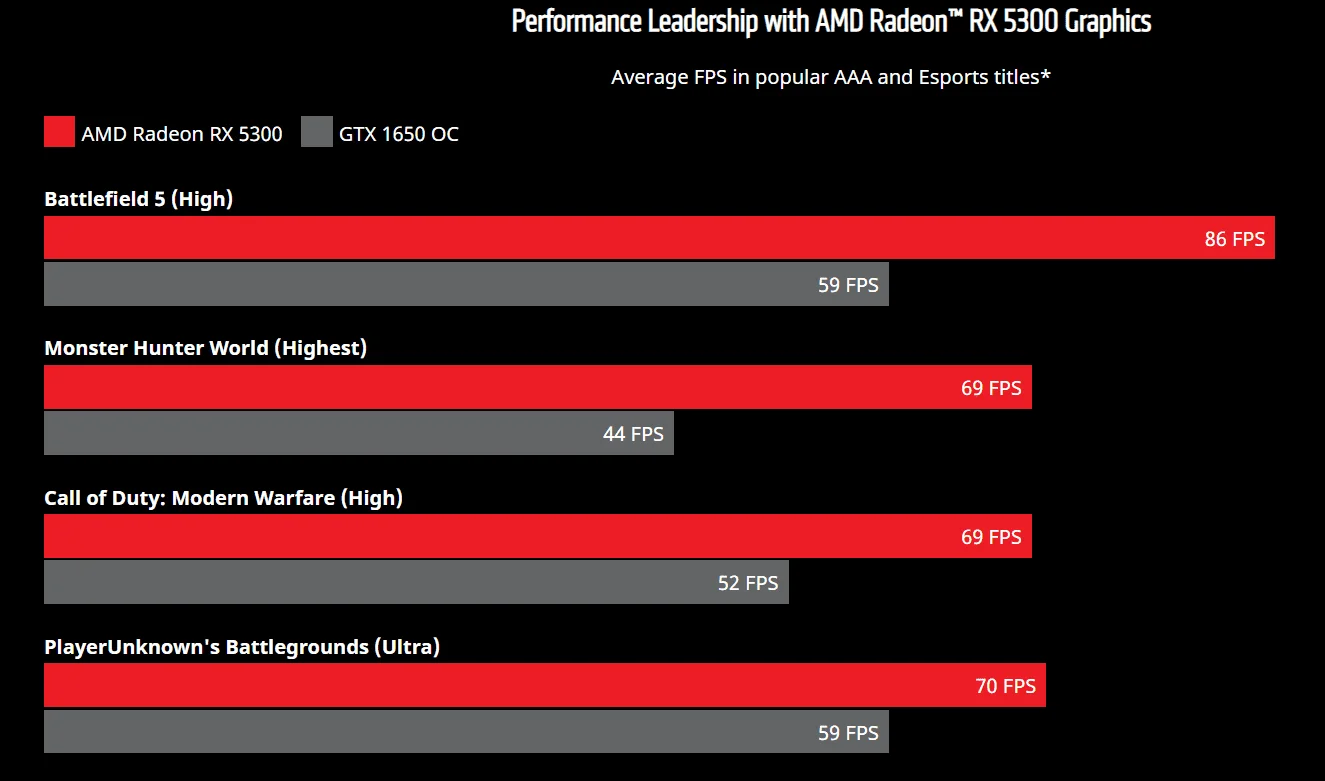
AMD itself positions the Radeon RX 5300 as an entry-level card for comfortable 1080p gaming. According to AMD's internal benchmarks, the Radeon RX 5300 significantly outperforms NVIDIA's GeForce GTX 1650 by 45% in the popular shooter Battlefield 5. However, it's worth noting that NVIDIA long ago replaced the standard GeForce GTX 1650 with the GTX 1650 "SUPER" variant, which offers similar pricing but much higher performance. Therefore, AMD's internal testing can hardly be called objective.
Pricing and release date for the RX 5300 graphics card are currently unknown. However, considering the Radeon RX 5500 XT (4GB) variant costs $169, the Radeon RX 5300 should be priced well under $150.