TESTS · CPU · INTEL
PUBLISHED
READING11 min
Wolfdale in 2012: Overclocking and benchmarking the Intel Core 2 Duo E8400, E6300, and Phenom II X2 545
We take a deep dive into overclocking the Intel Core 2 Duo E8400, E6300, and Phenom II X2 545. Can the Wolfdale architecture, even in 2012, still hold its own against newer chips?
Intel processors are a rare sight on our website. However, that doesn't mean we prefer AMD chips; there are other reasons. Most of you probably know the prices Intel (the 'blue giant') charges for its processors. To put it mildly, they're not exactly low. I can't say these prices are unjustified, as Intel's architecture is, in many ways, a cut above the competition. Still, exceptions exist. I doubt anyone would choose a Pentium Dual Core E5400 over an Athlon II X2 250, for example. Both have similar frequency potential, around 4GHz, making the premium for the Intel chip's lower stock frequency and more expensive motherboard an obvious waste. But that's the budget sector. At the high end, it's a completely different story. For instance, who would want a Phenom II X6 instead of a Core i5 2500K or Core i5 760? Yes, the Phenom has six physical cores, but is it worth it? Intel processors remain unmatched in performance-per-core right now!
We either buy hardware with our own money or borrow it from friends. Few can afford to buy, for example, a Core 2 Quad Q9xxx or a Core i7 2xxxK. (And there's little point in considering other options when AMD Phenom II processors offer better value for less money).
An review of the Core i5 2500 processor, with its locked multiplier, will appear on our website very soon. Yes, this is a drawback: overclocking will be dead on arrival. But how much does it really need overclocking?
Anyway, I've strayed a bit. This review focuses on the Core 2 Duo E8400, a processor that, while not new, I believe remains relevant. Its limited core count can't deliver the performance modern applications demand, but perhaps overclocking can rectify that?
Processors
Core 2 Duo E8400
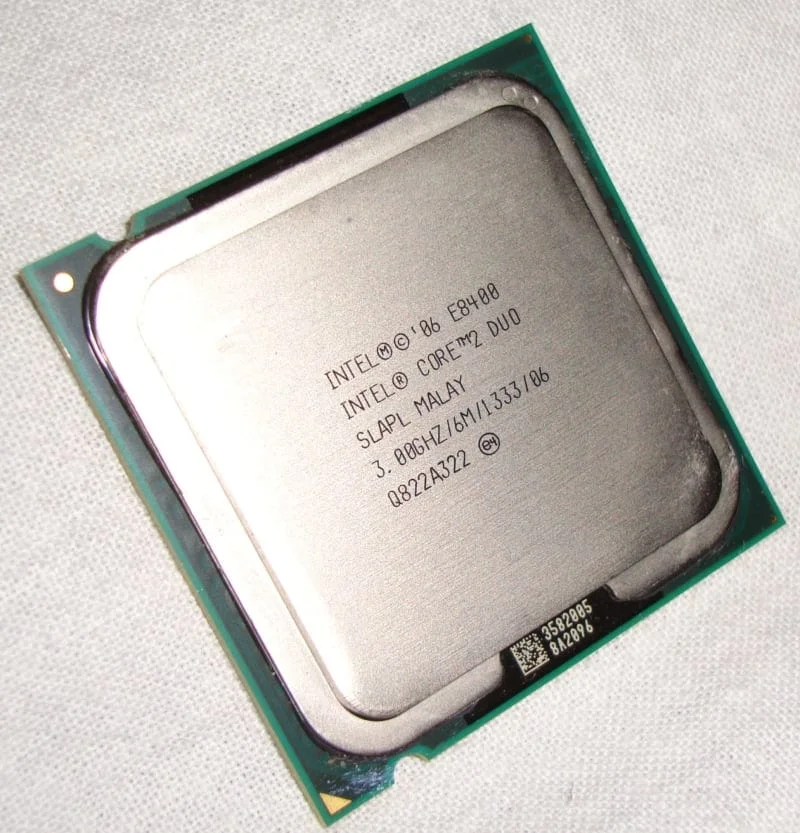
It's time to dive into the review of our test subject. First, let's take a look at its photo:
 ⤢ ВІДКРИТИ
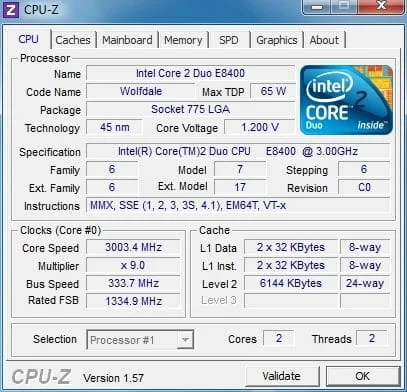
Our test sample's marking is SLAPL, manufactured in Malaysia. Here's a CPU-Z screenshot:
 ⤢ ВІДКРИТИ
This is a prime example of the 45nm Wolfdale core. It features 6MB of L2 cache and has a nominal core voltage of 1.200V. Its stock frequency is 3GHz, achieved by multiplying the system bus (333MHz) by a factor of 9. Our specific sample is a C0 revision, which isn't particularly exciting. Its typical TDP is 65W.
Core 2 Duo E6300
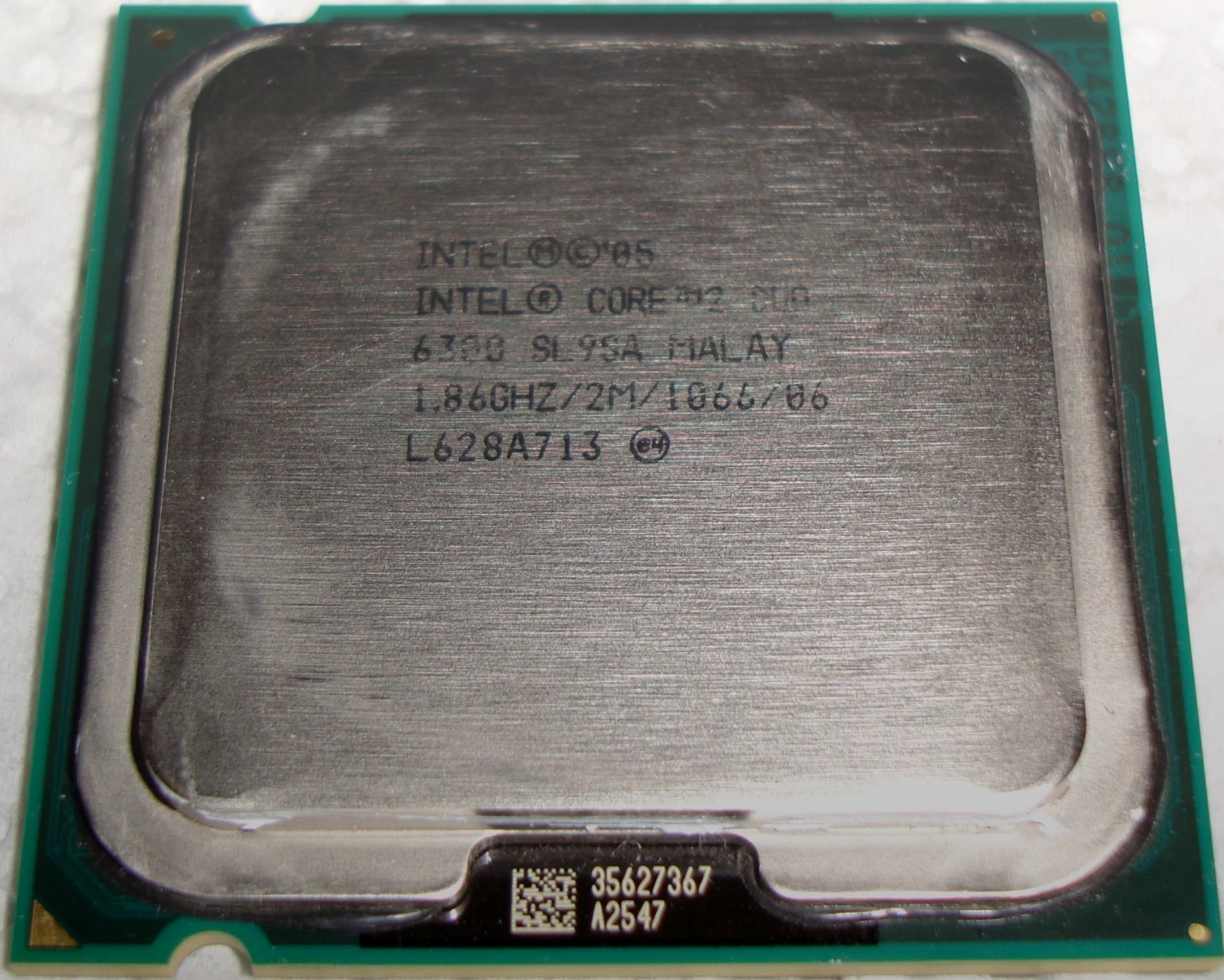
The test sample's marking is SL9SA (B2 revision), manufactured in Malaysia in 2006.
 ⤢ ВІДКРИТИ
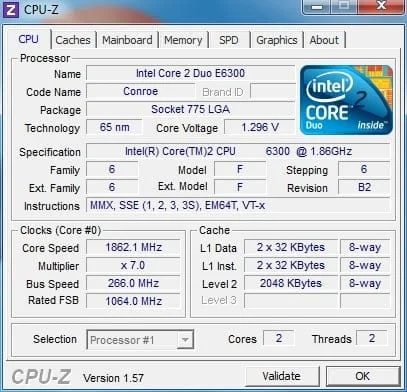
The E6300 is one of the most popular processors based on the 65nm Conroe core. Its main drawback is a very low multiplier, meaning you'll need a fairly robust motherboard to reach frequencies above 3GHz. This processor has 2MB of L2 cache, operates at a clock speed of 1866MHz (266x7) with a voltage of 1.300V, and its effective FSB frequency is 1066MHz. The core revision is B2, with a typical TDP of 65W.
 ⤢ ВІДКРИТИ
Important note: The B2 stepping corresponds to the 4MB Conroe die, which has a physical size of 143 mm². This means we're looking at a 2MB trimmed-down version of the flagship core. This is good news because, in theory, we can expect a very decent FSB overclocking potential. If this were the L2 revision, which is literally a different die with a physical size of 111 mm² and only 2MB of L2 cache, we would likely hit an FSB wall at just 400-420 MHz.
Phenom II X2 545
 ⤢ ВІДКРИТИ
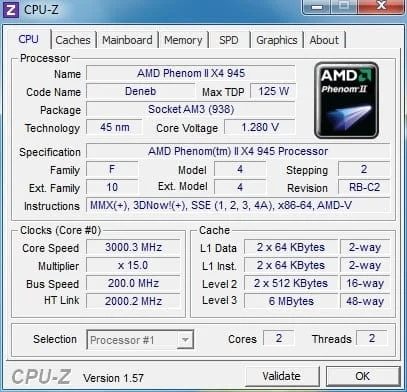
And finally, the last player in today's matchup. Since we couldn't find a Phenom II X2 545 in the lab, I decided to disable two cores of our existing Phenom II X4 945 via the motherboard BIOS, thus creating the necessary processor without any issues. This was successfully done. As you can see, the 'Cores' field shows '2,' confirming the successful disabling of two out of four cores. This processor is based on the 45nm Deneb C2 revision core, featuring 512KB of L2 cache per core and a total of 6MB of L3 cache. Its nominal chip frequency is 3000MHz (200x15), while the HT bus and CPU NB/L3 frequencies are 2000MHz. Its typical TDP is 95W (for two cores).
Test setup
Hardware
AM3 motherboard – ASUS M4A785TD-V EVO
LGA775 motherboard – Biostar P35D2-A7
Processors – Core 2 Duo E8400, Core 2 Duo E6300, Phenom II X4 945 (two cores disabled)
AM3 CPU cooler – Cooler Master Susurro (RR-KCT-T9E1)
LGA775 CPU cooler – Zalman 7700cu
RAM – 2GB Hynix PC6400 (5-5-5-16) - for testing and stable overclocking;
RAM – 512MB Hynix PC6400 (5-5-5-15) - for extreme testing
RAM – 2GB Corsair XMS3 PC10700 (9-9-9-34)
Graphics card – ASUS GeForce 9800GT@780/1900/2000MHz (GPU/SP/Mem)
PSU – FSP 400W
Hard drive – Samsung SP160GB
Software
Windows 7 x64 SP1
CPU-Z 1.57
CineBench 9.5 x64
CineBench 11.0 x64
Light Work - Renderbench
3D Mark 2006 v1.2.0 (CPU test only)
3D Mark Vantage v1.1.1 (CPU test only)
Hot CPU tester PRO
NVIDIA ForceWare 260.99
wPrime v1.55
Fritz Chess Benchmark
x264 Benchmark v4.0
SuperPi 1.4
PiFast
FRAPS v3.1.0/build11052
Games and graphics quality settings
GTA4
Resolution – 1280x1024
Textures – high
Reflection resolution – high
Water quality – very high
Shadow quality – high
Anisotropic filtering – x16
View distance – 100
Detail distance – 100
Traffic density – 100
Depth of field – on/on
V-sync – off/off
Prototype
Resolution – 1280x1024
Textures – high
Shadows – high
Anti-aliasing – 0x
CPU overclocking
Core 2 Duo E8400 overclocking
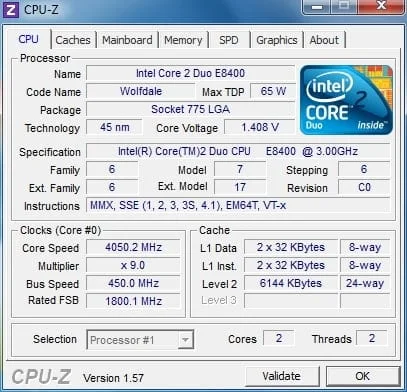
Knowing the excellent overclocking potential of the 45nm Wolfdale, I initially set the system bus frequency to 450MHz, targeting 4050MHz, without increasing the voltage. While the OS booted, the system immediately restarted during the first LinX run. Raising the voltage to 1.350V allowed it to complete a 20-minute test, but it still eventually restarted. Ultimately, the processor ran LinX for an hour without issues only after setting the voltage to 1.408V.
 ⤢ ВІДКРИТИ
Not much headroom. The hottest core still hit 72 degrees. RAM ran at 900MHz with 5-5-5-15 timings. We decided to move the test bench to the balcony, and things immediately improved:
 ⤢ ВІДКРИТИ
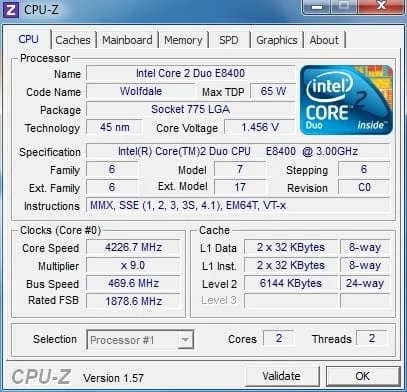
At 1.456V, we managed to hit 4226MHz.
 ⤢ ВІДКРИТИ
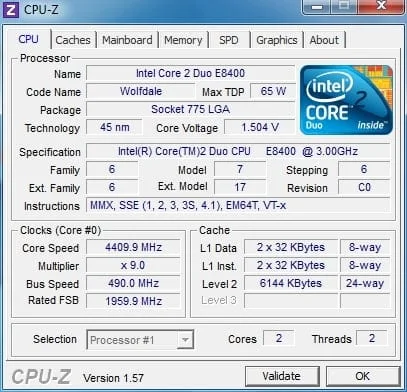
Pushing the voltage to 1.504V allowed us to reach 4409MHz, but stability was already out the window. Even with outdoor temperatures around 5 degrees Celsius, our 7700cu test cooler couldn't handle the E8400's increased heat output.
 ⤢ ВІДКРИТИ
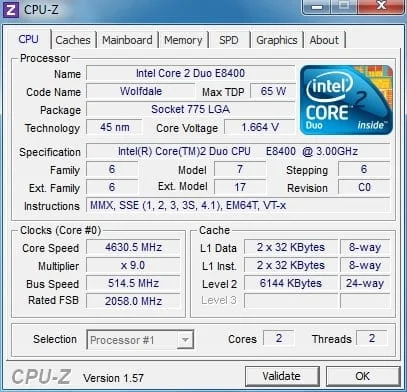
At this stage, the processor started to react poorly to further voltage increases. We hit 4630MHz at 1.664V, but this is already dangerous. It's best not to push the voltage above 1.550V without a liquid cooling system (LCS).
 ⤢ ВІДКРИТИ
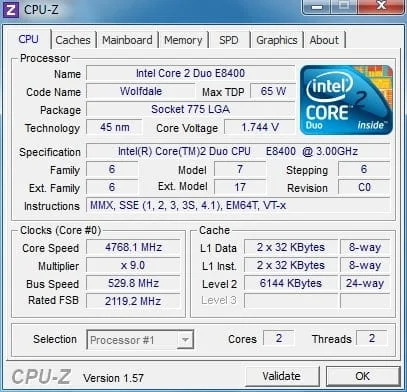
That was the limit. Our test chip topped out at 4768MHz, most likely throttled by the cooling system. We also had to push the voltage to a dangerous 1.744V. While such high voltage might be safe for brief periods, it's not something to abuse. The silicon can degrade, potentially preventing you from even hitting a stable 4GHz in the future.
Core 2 Duo E6300 overclocking
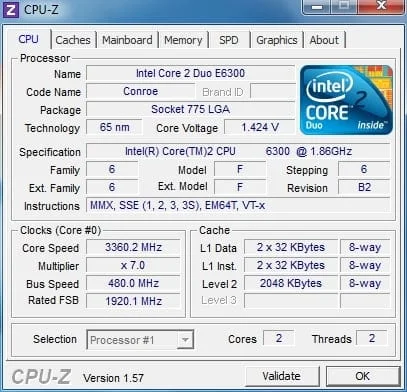
Now, let's look at overclocking the other contenders. The Core 2 Duo E6300, based on the older 65nm Conroe core, is typically limited to a stable 3600MHz overclock, or 3400MHz in most cases. For me, the results were even less promising:
 ⤢ ВІДКРИТИ
RAM ran at 960MHz with 5-5-5-15 timings. The only real upside to this overclock was being able to compare it against the E8400 at its stock frequencies. Perhaps I've simply grown accustomed to 45nm chips, but it's worth noting the E6300's frequency was still boosted by a respectable 80%!
Phenom II X2 945 overclocking
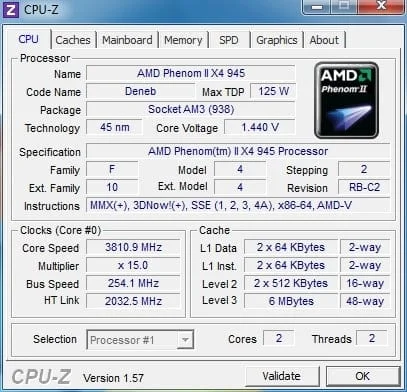
Overclocking AMD's chip delivered no surprises. We achieved stable operation at 3810MHz with a voltage of 1.440V.
 ⤢ ВІДКРИТИ
The low overclocking potential is immediately clear from the CPU-Z screenshot, which shows an older C2 revision. The memory controller and L3 cache ran at 2540MHz, while RAM hit 1651MHz with 9-9-9-24 timings. Now that overclocking is out of the way, let's dive into processor performance.
Processor testing
Rendering
 ⤢ ВІДКРИТИ
 ⤢ ВІДКРИТИ
 ⤢ ВІДКРИТИ
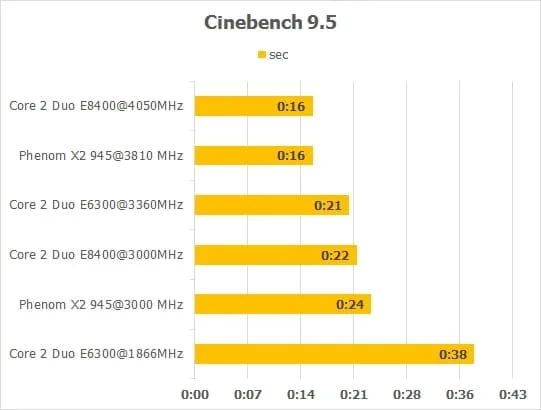
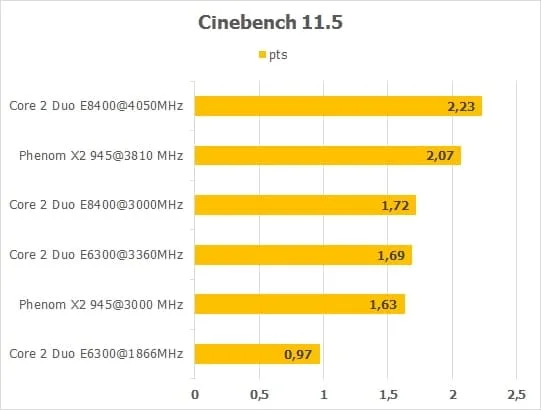
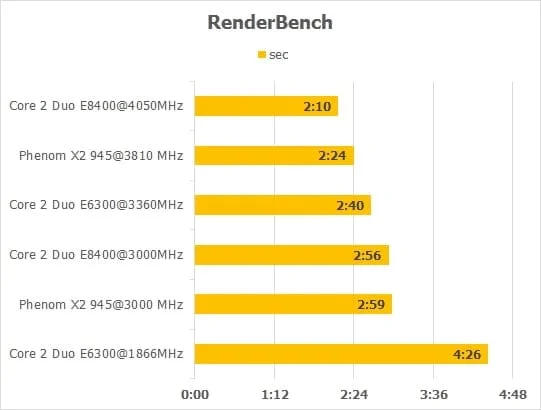
In our rendering benchmarks, the Core 2 Duo E8400 consistently took the lead, performing strongly both at stock speeds and when overclocked. The E6300, initially an underdog, managed to overtake its stock-clocked rivals once overclocked. As for the Phenom II X2 945, it couldn't quite surpass its competitor. However, considering its overclock didn't even reach 4000MHz, calling this a complete defeat would be unfair.
Overall performance
 ⤢ ВІДКРИТИ
 ⤢ ВІДКРИТИ
 ⤢ ВІДКРИТИ
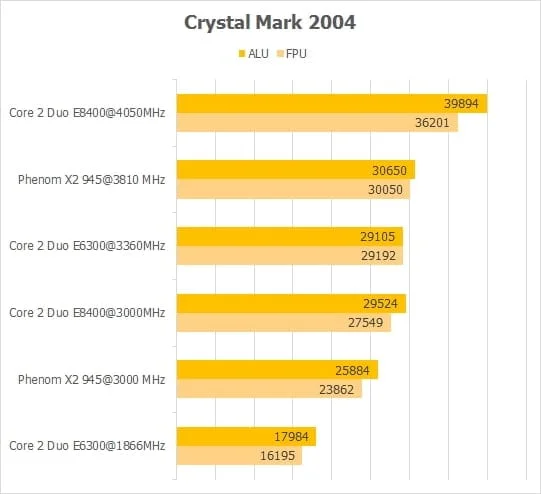
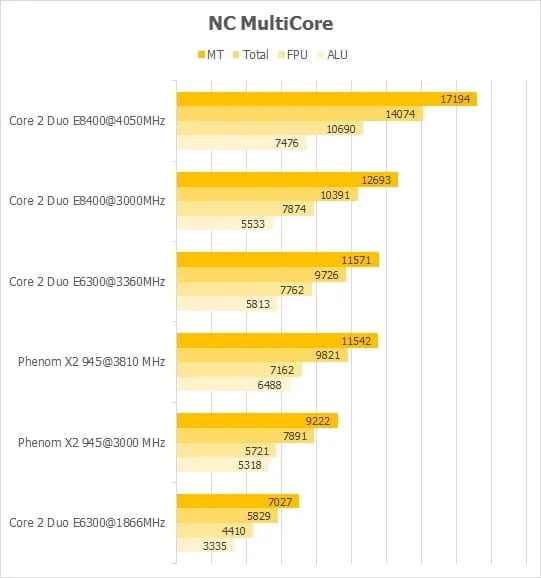
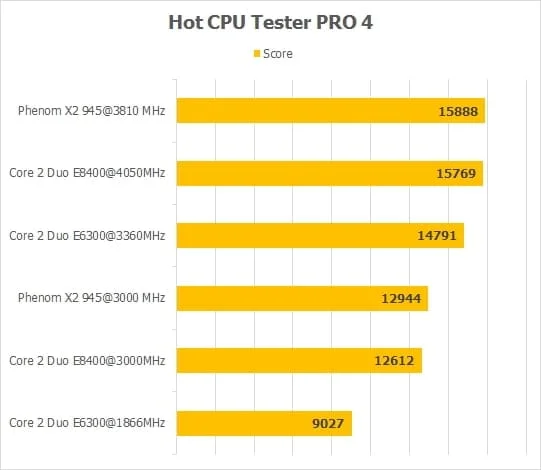
The E8400 took first place in the first two benchmark suites, showing a significant lead at both stock and overclocked speeds. The third test, Hot CPU Tester PRO 4, favored the Phenom II X2 in both nominal and overclocked configurations. Surprisingly, the E6300 held its own, and when overclocked, it even outperformed the E8400 and Phenom X2 running at their stock frequencies, despite its smaller L2 cache.
Calculations
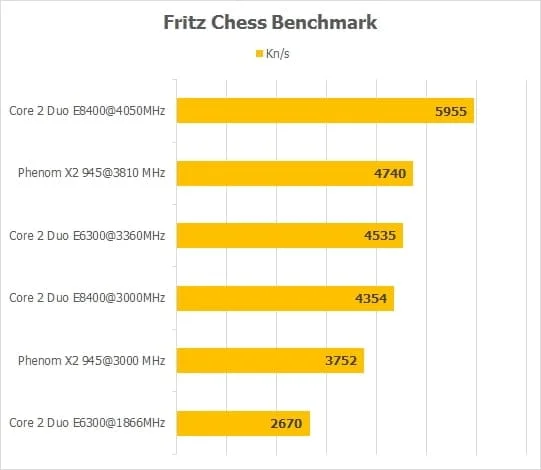 ⤢ ВІДКРИТИ
Intel processors clearly excel at calculating chess moves. Even an overclocked Phenom II X2 945 barely managed to surpass the E6300 and E8400.
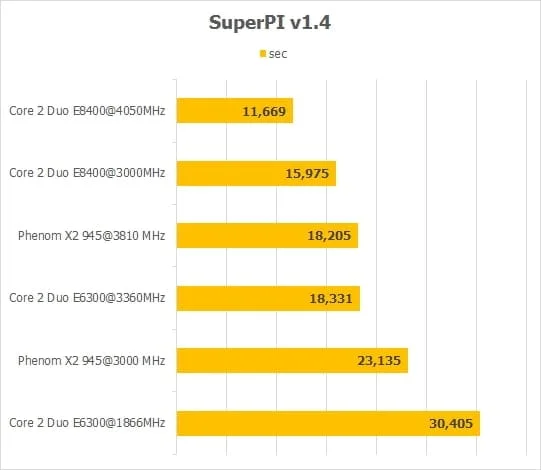 ⤢ ВІДКРИТИ
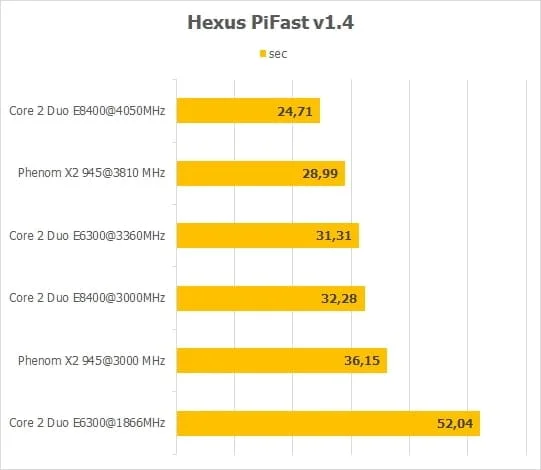 ⤢ ВІДКРИТИ
Intel processors have always computed Pi faster than their rivals, and today's test, unfortunately, is no exception.
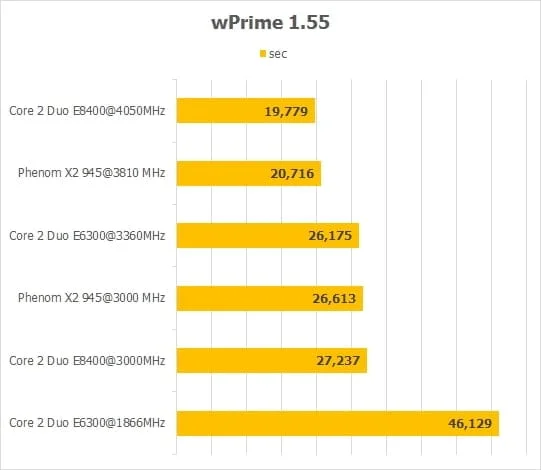 ⤢ ВІДКРИТИ
wPrime, however, brought a surprise. At stock frequencies, the Phenom II X2 945 actually outperformed the E8400. Of course, overclocking quickly put things back in order, with the higher clock speed allowing the E8400 to reclaim its lead.
Encoding
 ⤢ ВІДКРИТИ
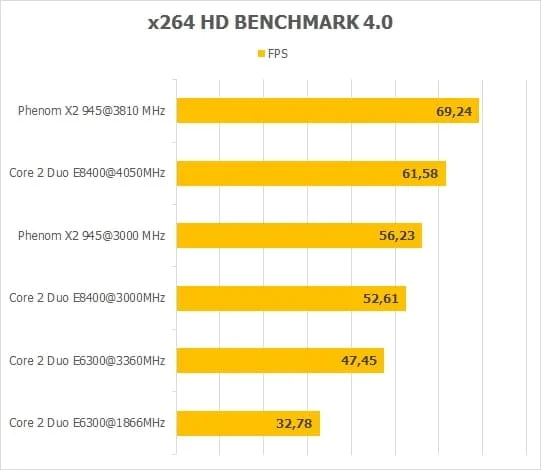
Is x264 video encoding your forte? Then you can't go wrong with a Phenom II X2. Even overclocking the E8400 to 4050MHz wasn't enough to beat the Phenom II X2 running at 3810MHz.
Archiving
 ⤢ ВІДКРИТИ
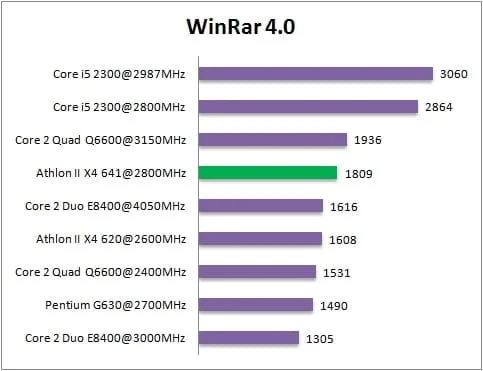
If you frequently archive files, the Phenom II X2 will also be a more interesting choice than the Core 2 Duo E8400.
Gaming: synthetic benchmarks
 ⤢ ВІДКРИТИ
 ⤢ ВІДКРИТИ
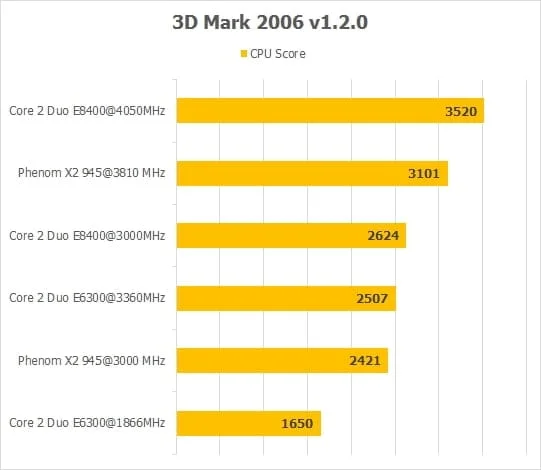
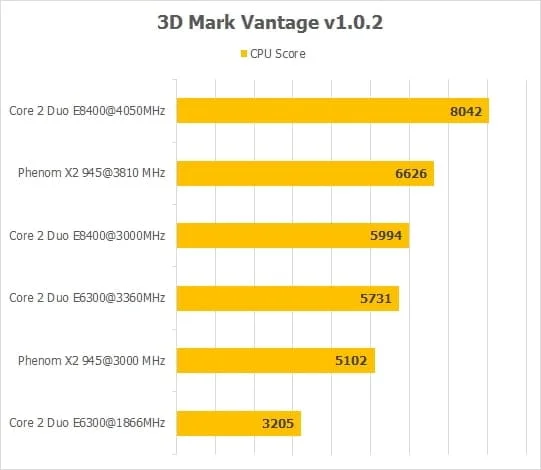
Oh, how well things started for Phenom... The Core 2 Duo E8400 showed a complete advantage, both at stock and overclocked speeds, with the lead widening even further when overclocked.
Gaming
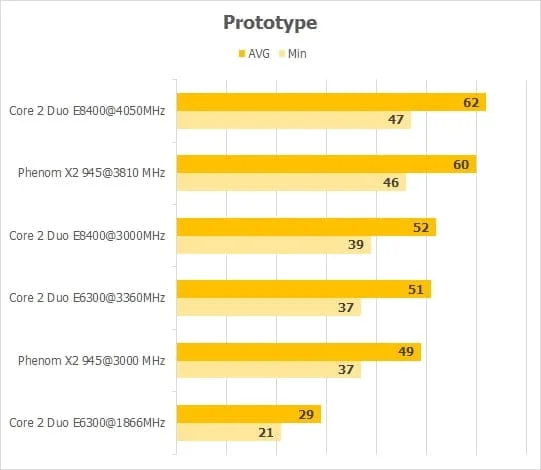 ⤢ ВІДКРИТИ
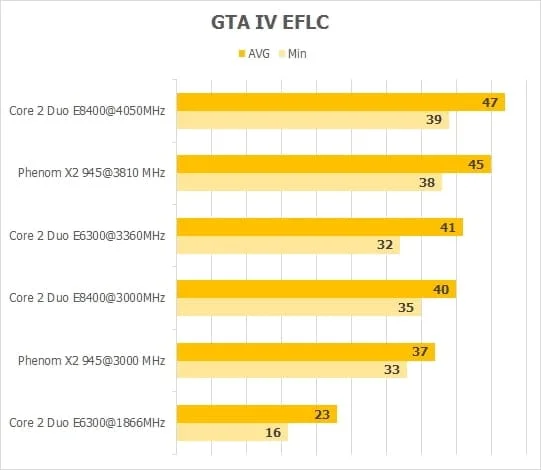 ⤢ ВІДКРИТИ
It's long been known that games thrive on large caches, especially those running at high frequencies. However, this isn't the case for the Phenom II X2 945; its L3 cache doesn't operate at the core clock speed like Core 2 processors do, but rather at the memory controller's frequency. We couldn't even increase its frequency beyond 2500MHz. As a result, it lost out at both stock and overclocked speeds.
Conclusion
The Core 2 Duo E8xxx series processors generated a lot of buzz in their time. They shattered numerous records and were frequently chosen by leading tech sites as the go-to 'processors for gaming'.
So, what's the final tally? It's 11:4 in favor of the Core 2 Duo E8400. This truly legendary processor proved it still has some fight left, at least until AMD's Bulldozer and Intel's Ivy Bridge hit the market.
P.S. The Core 2 Duo E6300 performed admirably throughout the entire test, and when overclocked, it repeatedly surpassed its rivals running at stock speeds. Quite commendable for an aging processor.