BLOGS · OVERCLOCKING
PUBLISHED
READING10 min
Retro overclocking: Overclocking an Intel Pentium 4 631 CPU
A deep dive into the overclocking potential of the single-core retro Intel Pentium 4 631 CPU (D0 revision, Cedar Mill).
Column revival
It's been a while since we covered CPU overclocking. I really hope you've missed old hardware benchmarks as much as I have. We've finally managed to find a replacement for our trusty Biostar P35D2-A7 lab motherboard, which faithfully served our site since 2011. This means the somewhat forgotten "Retro Overclocking" column will make its return to our site, and I'll be using two motherboards for it:
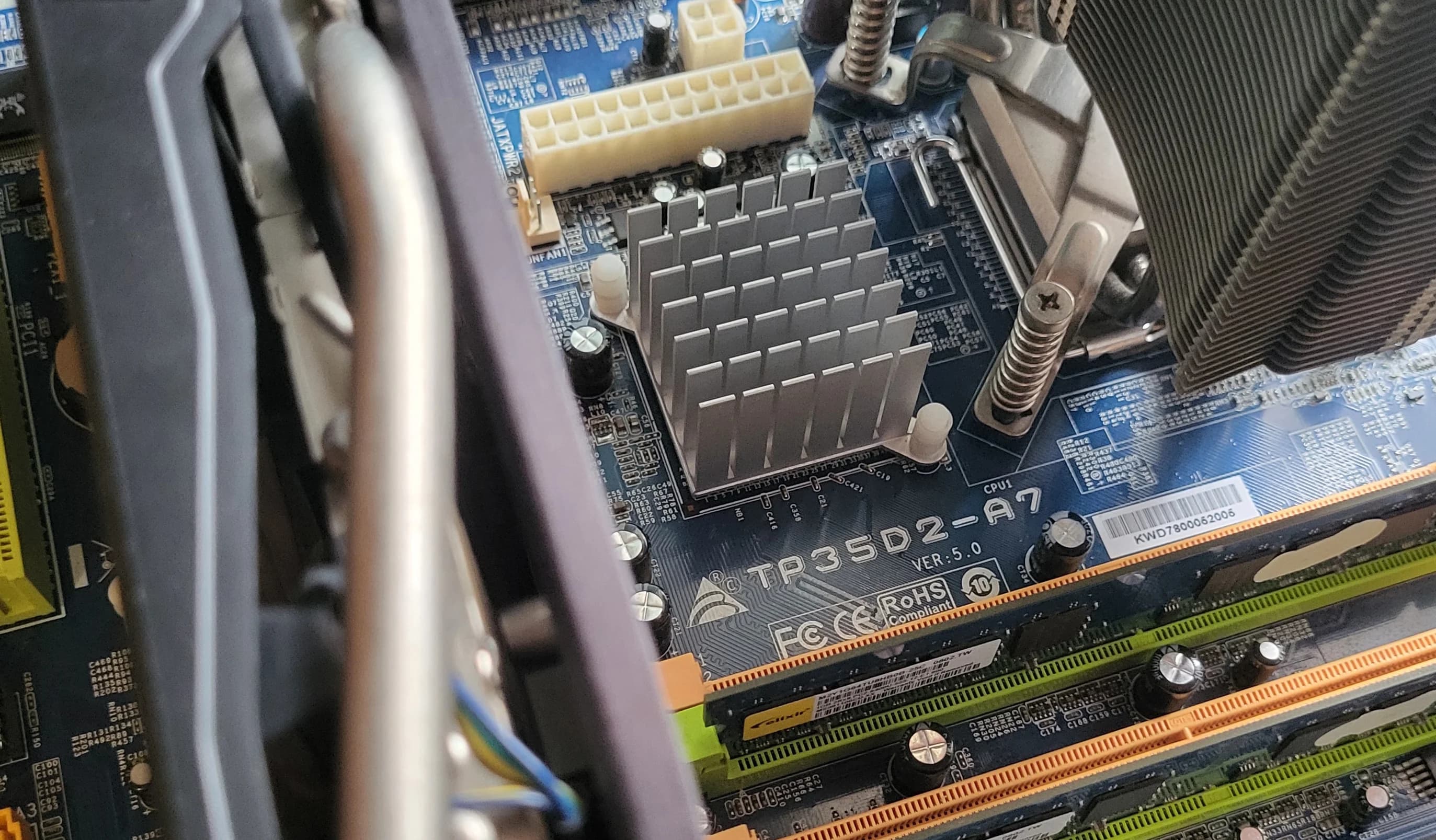
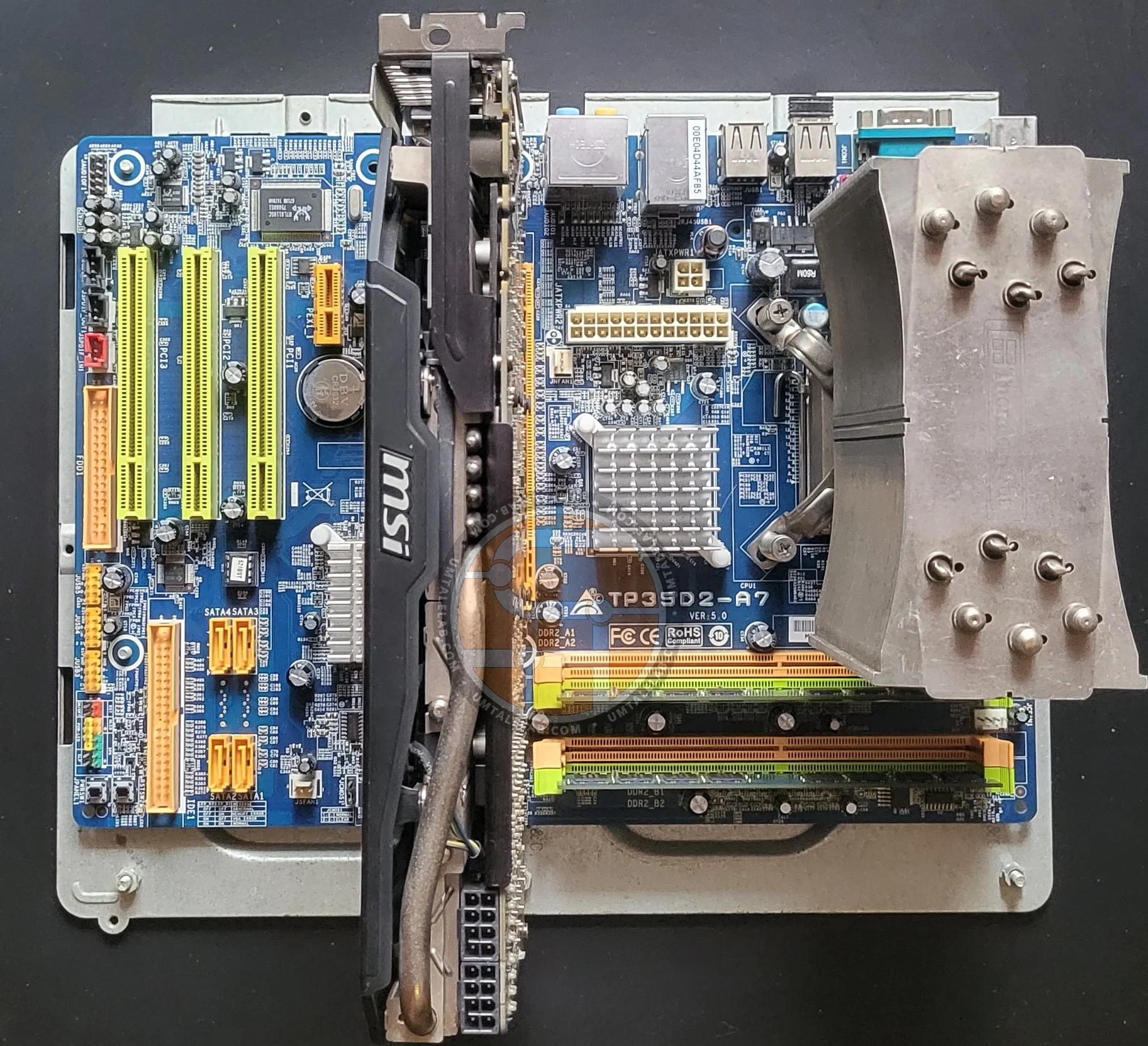
You'll never guess, but the first one is the Biostar TP35D2-A7 — the older sister of our previous test bench board. Forgive me for bragging, but this is an incredible stroke of luck: finding a working specimen in near-perfect condition.
The second board I managed to get is the far more legendary ASUS P5B. However, it's essentially a backup board, as it significantly underperforms the TP35D2-A7.
Currently, our test bench features a classic chip from an era when the Pentium brand was at the bottom of Intel's food chain. This was when the NetBurst architecture was nearing its end, and Core chips were just being shipped to warehouses, awaiting their official announcement. So, let's take a closer look at our "new" test subject.
Processor
Our test sample is marked SL9KG, and the chip was packaged in Malaysia.
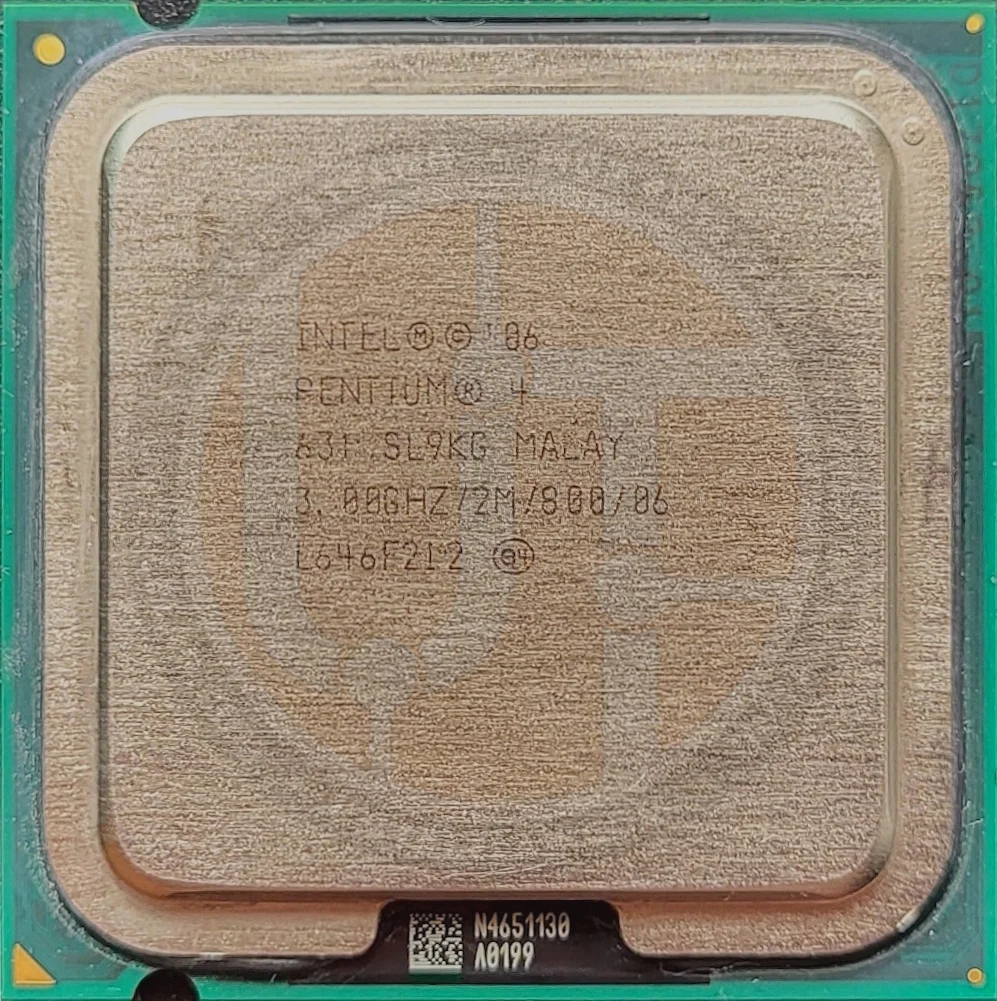
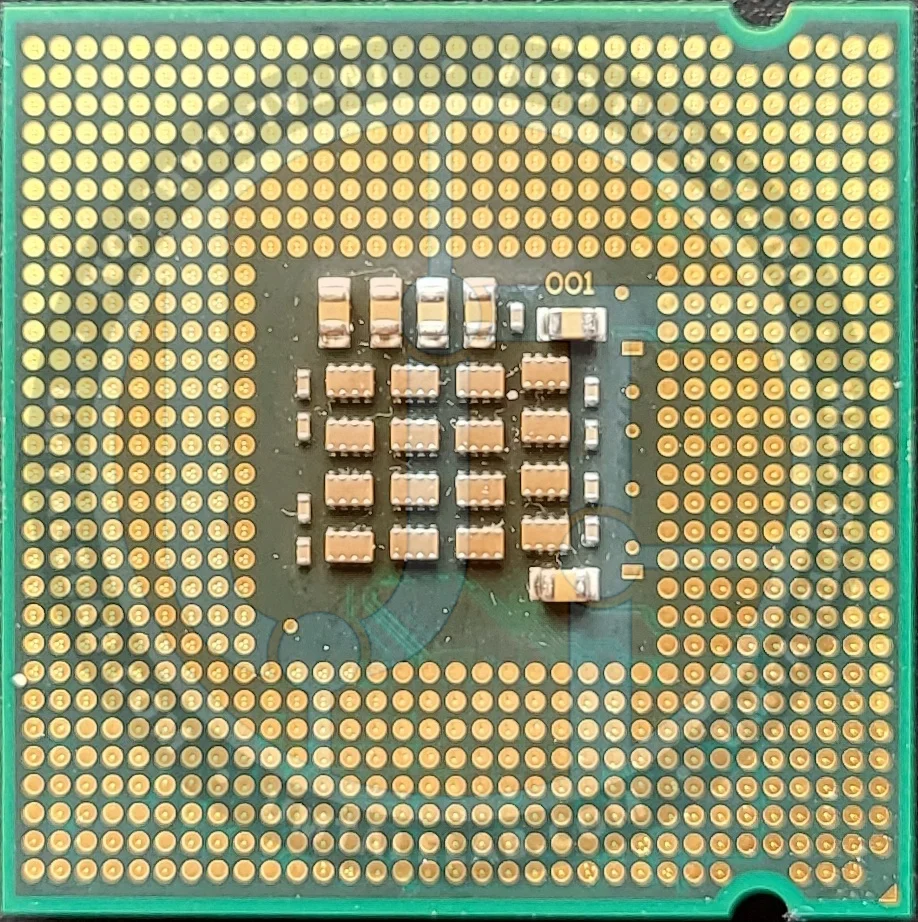
The Intel Pentium 4 631 chip's codename is Cedar Mill (NetBurst architecture). Underneath its integrated heat spreader, this CPU houses a single 65nm, monolithic single-core die in the 2M modification.
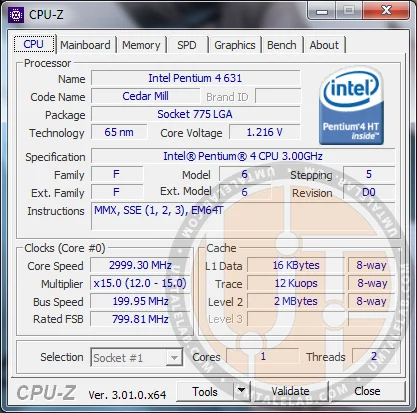
Our test sample is a D0 revision, which is great news, as D0 is the best possible stepping. This directly relates to the processor's overclocking potential; while C1 and B1 revisions also exist, they are based on slightly hotter and less capable dies.
 ⤢ ВІДКРИТИ
The Pentium 4 631 processor features a single core with Hyper-Threading technology, allowing it to process two threads simultaneously. It runs at a nominal frequency of 3000 MHz, achieved with a multiplier of 15 and a 200 MHz bus frequency, leading to an 800 MHz effective frequency for core-to-chipset communication. The chip comes with 2048 KB of L2 cache and a default CPU voltage of 1.260 volts. The 631 'Pentium's' TDP is rated at 65 watts, but this is a bit complicated: the 65-watt rating only applies to the D0 stepping. For C1 or B1 revisions, the TDP increases to 86 watts.
RAM support for our test processor is also quite interesting. In practice, the P4 631 itself doesn't have an integrated memory controller on its die, so memory management falls to the motherboard's chipset. Our setup uses DDR2, but a more modern board, such as one with a P45 or X48 chipset, could feature DDR3 slots as well.
An obvious drawback of the Pentium 4 631 processor is its lack of support for the now-essential SSE4.1/SSE4.2 instruction set. This is a serious disadvantage, as this limitation means the chip simply won't run many modern programs or games you might need.
Test bench
 ⤢ ВІДКРИТИ
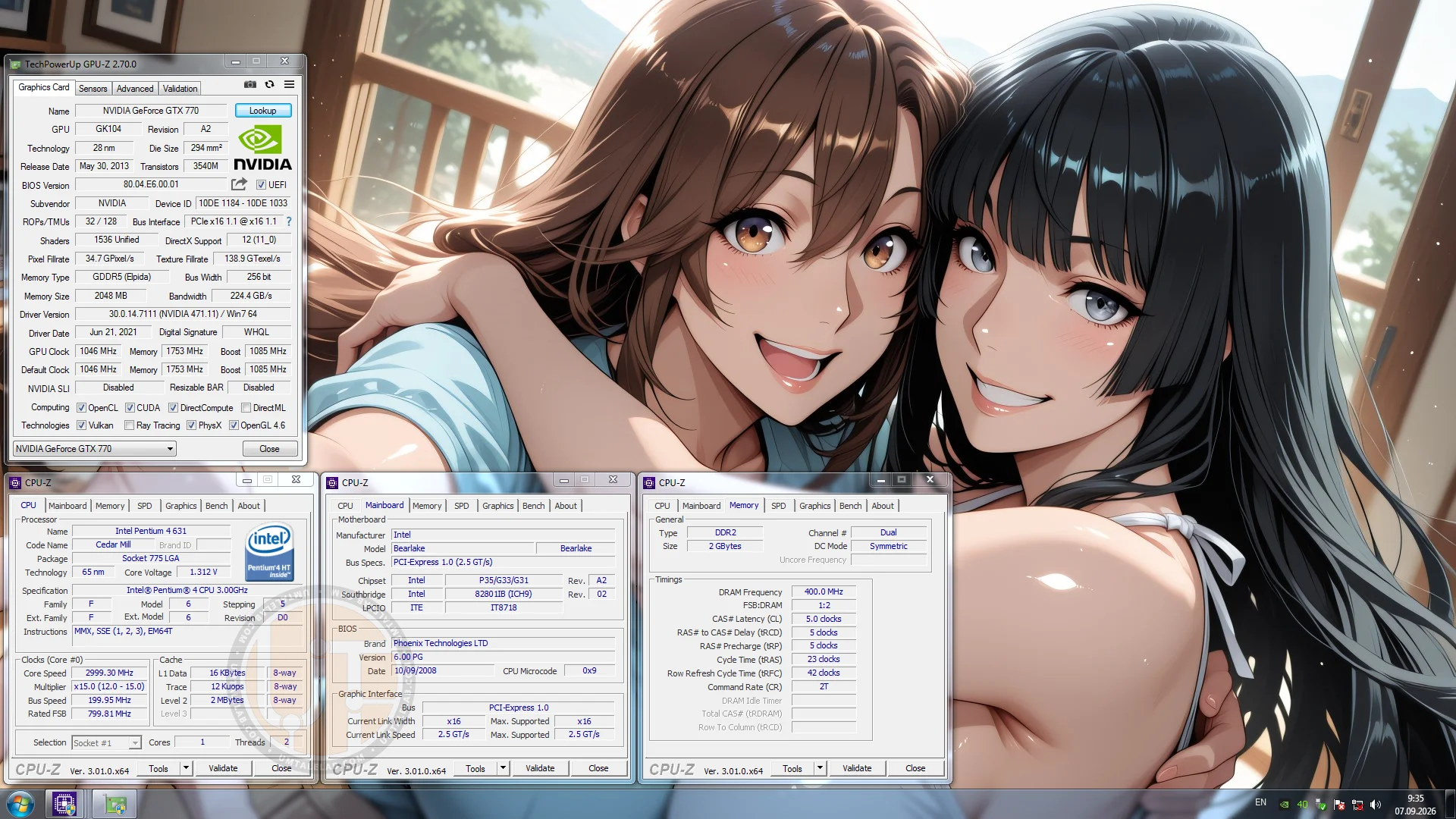
Processor — Pentium 4 631;
Cooling — Thermalright Ultra-120 eXtreme;
RAM — Two 1GB Nanya Technology sticks, totaling 2GB;
Motherboard — Biostar TP35D2-A7;
Graphics card — MSI GTX 770 Gaming OC 2GB (~1085/7000 MHz, Power Limit 115%);
SSD — KINGSTON 120GB SA400S37120G (Windows 7/Software);
HDD — Seagate 2TB ST2000DM008-2FR102 (Games);
Power supply — Chieftec GPS-1250C.
 ⤢ ВІДКРИТИ
Overclocking the Pentium 4 631
At stock voltage, the chip managed to hit 3800 MHz. While that's a decent result, it's frankly not what we're truly interested in. Without further ado, let's jump straight to increasing the vCore.
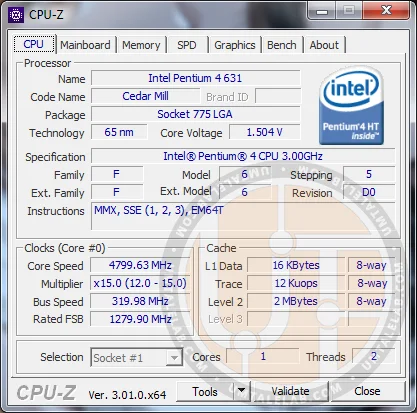
If you've read my previous overclocking articles, you know how I explore a chip's potential. For this test, I settled on a relatively safe 1.5 volts and attempted to boot at 4800 MHz. Surprisingly, the system not only booted but was also stable.
 ⤢ ВІДКРИТИ
Pentium 4 631 overclocking settings for 4800 MHz in BIOS:
Core voltage — 1.500 volts (+0.270 above nominal, multimeter showed a physical 1.48 volts);
Bus frequency — 320 MHz;
Bus multiplier — 15;
Bus voltage — 1.250 volts (+0.000 above nominal);
RAM multiplier in BIOS — 400 MHz (with overclocking, the effective memory frequency was 640 MHz);
RAM voltage — 1.950 volts (+0.000 above nominal).
This is a pretty good result. However, a word of caution: while I said 1.5 volts is a relatively safe operating voltage for a 65nm core, that doesn't mean the chip will run 24/7 in this mode for years. The silicon in these older chips is already quite aged and can quickly degrade from elevated voltages. In short, remember that anything you do to your hardware is at your own risk.
Meanwhile, I pushed further. The logical next step was to simply raise the FSB frequency, but I quickly encountered instability: at just 323 MHz, the chip couldn't complete stress tests at 1.5V. This was quite predictable, as we're already at the upper limits of typical overclocking for 65nm Cedar Mill dies.
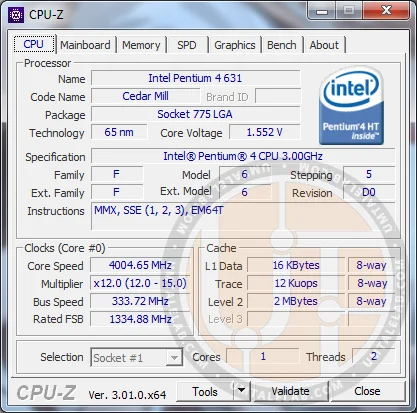
Just to be sure, I checked for an FSB wall – a limitation in chip overclocking specific to the system bus, caused by internal chipset-to-processor latencies. But this proved to be moot: our 631 sample easily passed stress tests at 4 GHz with a 333 MHz system bus.
 ⤢ ВІДКРИТИ
So, the CPU core voltage was the limiting factor. Alright, time to push it further. But 'further' is already beyond rational overclocking and essentially enters extreme territory. If you're unsure what you're doing, don't supply your processor with more than 1.5V; for newer CPUs, this figure is even lower (1.25-1.35V, depending on architecture and manufacturing process).
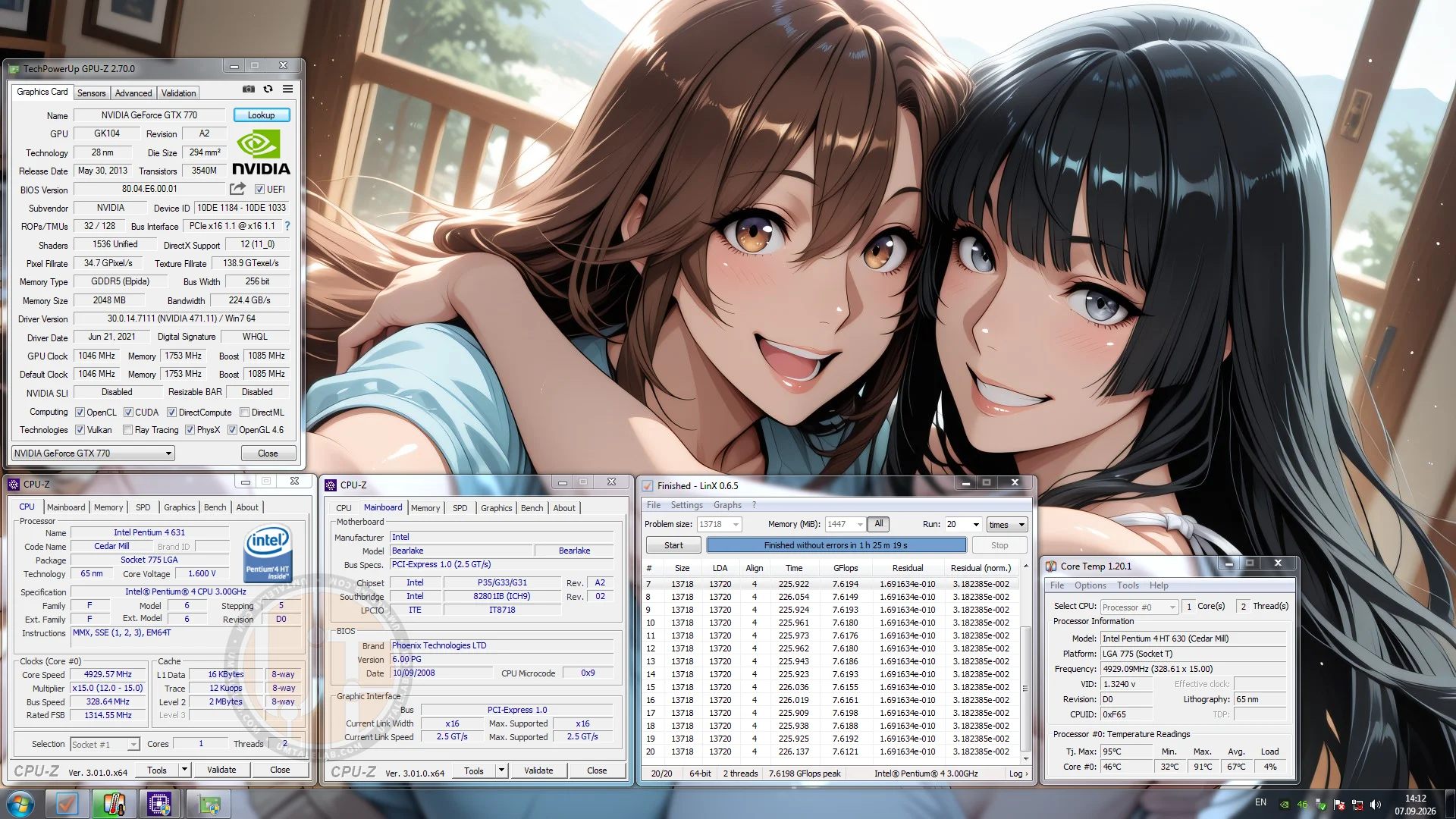
But I digress. At 1.6 volts (my multimeter showed the motherboard physically supplying 1.57V to the cores), our little Pentium managed to hold on and remain stable at 4930 MHz.
 ⤢ ВІДКРИТИ
Pentium 4 631 overclocking settings for 4930 MHz in BIOS:
Core voltage — 1.6 volts (+0.370 above nominal, multimeter showed a physical 1.57 volts);
Bus frequency — 328 MHz;
Bus multiplier — 15;
Bus voltage — 1.250 volts (+0.000 above nominal);
RAM multiplier in BIOS — 400 MHz (with overclocking, the effective memory frequency was 656 MHz);
RAM voltage — 1.950 volts (+0.000 above nominal).
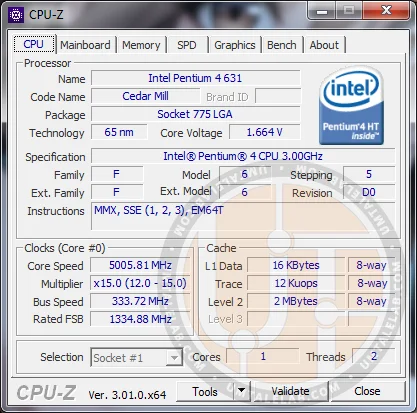
And unfortunately, that was it. No matter how much I tweaked the BIOS settings, I couldn't achieve a stable 5 GHz. The system would boot and pass simple tests, but the chip consistently failed to complete LinX or Prime95.
 ⤢ ВІДКРИТИ
Even 1.67 volts wasn't enough to hit 5000 MHz. This is, of course, quite disappointing, as finding a Cedar Mill that can stably operate at the iconic 5 GHz frequency is literally a dream. Unfortunately, it wasn't meant to be this time.
However, I decided to slightly expand our usual retro overclocking content by adding a few benchmarks. This should give you an idea of the overall performance improvement.
Quick benchmarking
CPU-z benchmark
CPU-z benchmark 17.01.64
Single Core Score
Multi Core Score
Pentium 4 631@3000MHzPentium 4 631@4930MHz
// SOURCE · UMTALE LAB BENCHMAX 215
The CPU-Z benchmark presented some surprisingly interesting results. It's been 12-15 years since I last benchmarked Pentium 4 chips with Hyper-Threading, and I was genuinely surprised by how well this technology - simultaneously processing two threads per core—still works on NetBurst-architecture processors!
At stock frequencies, the Pentium 4 631 scored 62 points in single-threaded tests and 130 in multi-threaded tests. That's a 109% performance gain, and it's quite odd. There are two possible explanations: either HT actively harms single-threaded performance, or it genuinely boosts multi-threaded performance. Frankly, I lean towards the former.
But I'm getting sidetracked again. So, what do we get from overclocking the chip from 3GHz to 4.9GHz? An 83% increase in single-threaded performance and 65% in multi-threaded. Not bad at all.
LinX
LinX 0.6.5
GFlops
Pentium 4 631@3000MHzPentium 4 631@4930MHz
// SOURCE · UMTALE LAB BENCHMAX 7.61
In LinX, the overclocking acceleration is slightly lower—only 61%. This is because the benchmark responds quite well to RAM frequency, which was lower on the overclocked 'old P4' (650 MHz vs. 800 MHz) compared to the stock chip.
Metro: Last Light
Benchmark settings:
Resolution: 1280 x 1024;
DirectX: DirectX 11;
Quality: Low;
Texture filtering: AF 4X;
Advanced PhysX: Disabled;
Tesselation: Off;
Motion Blur: Low;
SSAA: OFF;
Metro: Last Light
Built-in Game Benchmark (D6 scene)
FPS AVG
FPS LOW
Pentium 4 631@4930MHzPentium 4 631@3000MHz
// SOURCE · UMTALE LAB BENCHMAX 15.26
Metro: Last Light, the only game in our test suite, responded quite well to the 631's increased frequency. The average framerate jumped by 71%, and the minimum FPS saw an impressive 84% increase! Now "that's" what I call a 'real overclocking boost'! This isn't like modern Intel chips, where you'd be lucky to squeeze out even 10-20% from an overclock—and that's assuming it's even possible, as the 'blue giant' currently renders the vast majority of its CPUs 'impotent' with locked buses and multipliers.
In Conclusion
Back in the day, enthusiasts, gamers, and professionals had distinctly different opinions about NetBurst-architecture chips. These CPUs ran hot, featured a long, multi-stage pipeline, and unlike their competitor, lacked an integrated memory controller. Yet, they always had, and still have, a unique vibe.
I personally adored the AMD Athlon XP/64 lineup: great speed, ultimate efficiency, and—surprisingly enough—you could truly 'install and forget' those chips from the red giant back then. There wasn't much need for special tuning (apart from RAM selection, but that's a different story).
However, I've always been frank: then as now, Athlon XP/64 couldn't deliver the same overclocking thrill as, say, a Celeron D or Pentium 4. Anyone could conquer their first 3GHz on a Northwood, 4GHz on a Prescott, and a then-incredible 5GHz on a Cedar Mill. And it didn't matter if those megahertz were just for show - to overclockers, they felt utterly real. Unfortunately, no AMD processor of that era could achieve such feats (without liquid nitrogen, of course).
So, if you're looking to experiment with CPU overclocking, I recommend starting with those NetBurst-architecture 'bricks'.