BLOGS · OVERCLOCKING
PUBLISHED
READING3 min
Overclocking the AMD Athlon 64 X2 4200+ processor
We overclock the budget AMD Athlon 64 X2 4200+ processor, boosting its frequency from 2200 MHz to 3000 MHz for a 36% performance increase.
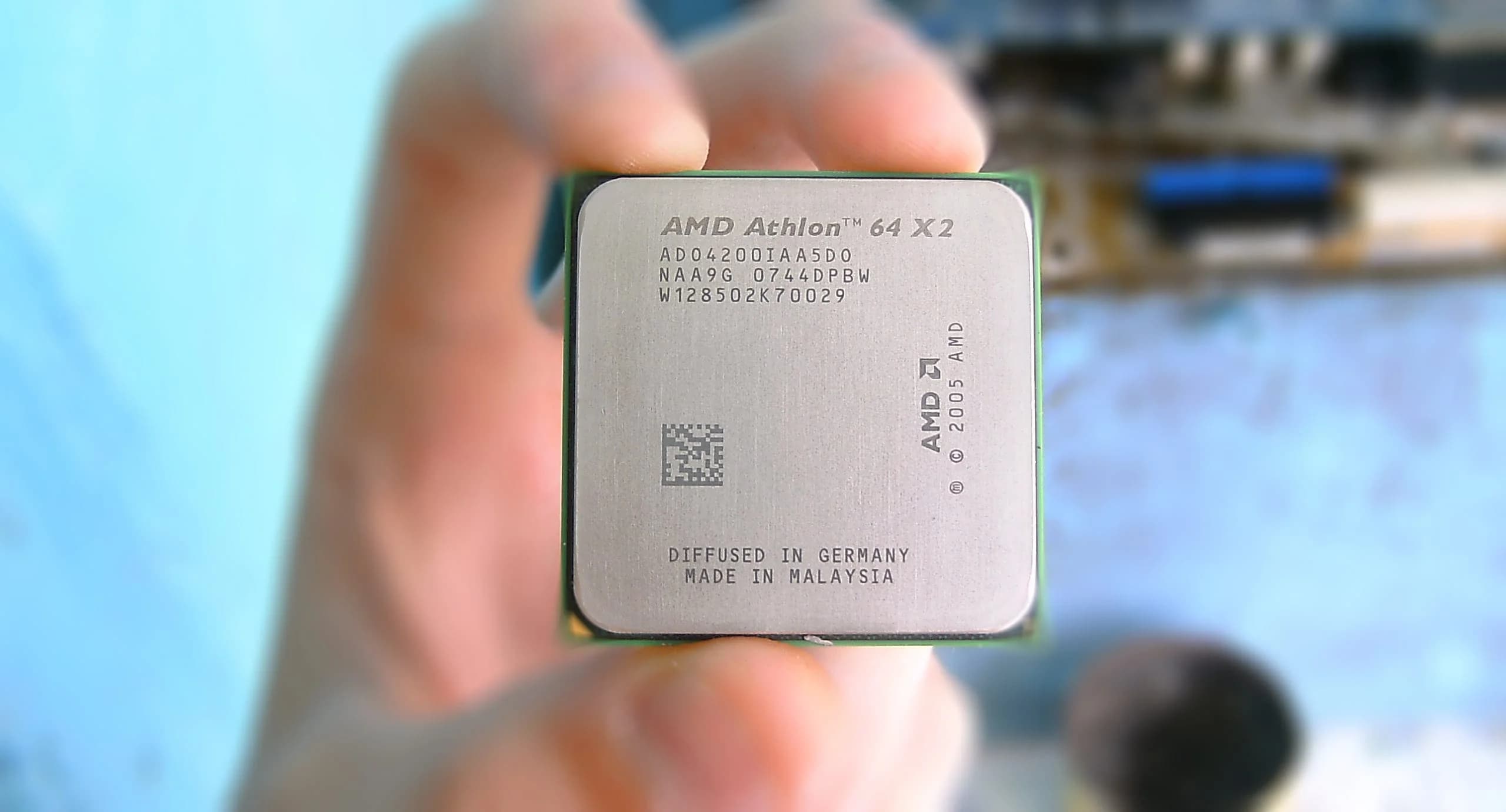
The Athlon 64 X2 processor's story began way back in 2002. Even then, AMD already knew it wouldn't achieve much by chasing high clock speeds. The K8 architecture was designed for multi-core from its very first silicon. This made AMD pioneers, as they were the first to develop and release a dual-core processor. While 2005 marked AMD's most successful year, subsequent years saw a string of missteps... But today, we won't discuss the company itself. Instead, we'll try to overclock one of its budget processors, the Athlon 64 X2 4200+.
 ⤢ ВІДКРИТИ
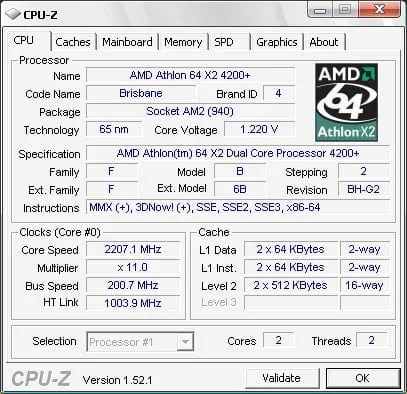
The chip is based on a 65nm process. This model has a nominal frequency of 2200 MHz, an HT (HyperTransport) bus speed of 1000 MHz, and an FSB frequency of 200 MHz. The core voltage is 1.220 volts.
Initially, I picked an ASUS M2N68-AM SE2 motherboard for overclocking, but it turned out it couldn't change the HT bus multiplier. Rummaging through my collection of AM2 motherboards, I found an ASUS M2V, which seemed to have damaged capacitors in the CPU power delivery circuit. Nothing complex — a simple recap quickly and reliably brought the board back to life. After checking its BIOS overclocking capabilities, I decided to use it for today's article.
Test setup:
Motherboard – ASUS M2V
Cooler – Scythe Ninja B2
RAM – 2xPQI PC-6400 1Gb
Graphics card – nVidia GeForce 8600GT 256Mb
Power supply – FSP 400W
Operating System – Windows XP SP3
Overclocking
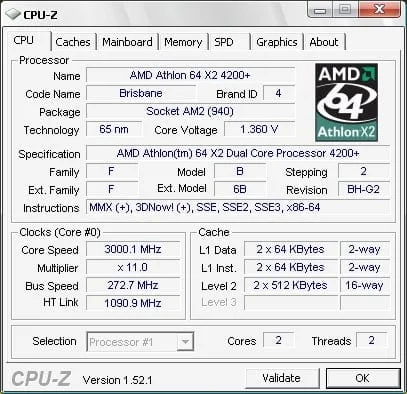
Overclocking involved reducing the HT frequency to 600 MHz and increasing the CPU voltage to 1.45 volts. I gradually raised the frequency until the RAM became the bottleneck. I then increased the DDR2 voltage to 1.95 volts and pushed further. However, this didn't help achieve much more. The processor stopped responding to voltage increases, and even 1.5 volts wouldn't allow it to boot at 3200 MHz. Temperatures hovered around 43 degrees, so that wasn't the issue. Ultimately, this benchmark session resulted in a rather modest, yet respectable 3000 MHz frequency for an AMD K8 architecture chip:
 ⤢ ВІДКРИТИ
What's more, this was achieved with a voltage of just 1.360 volts!
Conclusion
Overclocking successfully increased the Athlon 64 X2 4200+ processor's clock speed by 36%. While this might not seem impressive compared to overclocking results for AMD K10 or Intel Core processors, the performance boost is quite linear with clock speed, meaning application speeds will undeniably increase. Therefore, even this level of overclocking remains a viable option.