TESTS · CPU · AMD
PUBLISHED
READING8 min
AMD Phenom X3 8450 vs. Athlon II X3 435: Review, benchmarks, and overclocking
A review of the AMD Phenom X3 8450 and Athlon II X3 435. We compare their performance and overclocking in benchmarks and games. The Athlon II X3 often comes out ahead.
Until recently, Phenom X3 processors weren't particularly attractive, to put it mildly. This wasn't so much due to their relatively low gaming performance (the triple-cores were always quite good for professional tasks) as it was to their high power consumption and demanding motherboard requirements. But let's not jump to conclusions; it's been about a year and a half since the Phenom X3 lineup launched. Perhaps the situation has changed, at least for gaming? Any owner of an older triple-core Phenom, whether an enthusiast or a casual user, would likely consider upgrading to a newer Phenom II X3 or an Athlon II X3. The newer CPUs offer significant advantages: a fresh 45nm process, a higher multiplier, lower heat output, and less demanding power delivery requirements for motherboards. We won't consider upgrading to a Phenom II X3 for a simple reason: while logical, this CPU is now practically unavailable on the market. However, the Athlon II X3 can currently be found in the price lists of almost any store. Let's look at the pricing for CPUs that could compete with the Phenom X3 8450. We can't evaluate competing Intel solutions right now because our lab lacks an LGA775/1156 motherboard. For this reason, we chose the Athlon II X3 435 ($75-90) for our tests, which we'll benchmark in four modes:
at the same frequency as the Phenom X3 8450, specifically 2100MHz. This step is crucial to determine how much better the updated K10.5 architecture performs against the older one, considering the Athlon II lacks L3 cache, while the older, hotter Phenom has 2MB;
at the frequency of an overclocked Phenom X3 8450;
at its native frequency of 2900MHz;
and at its maximum overclock.
Processors
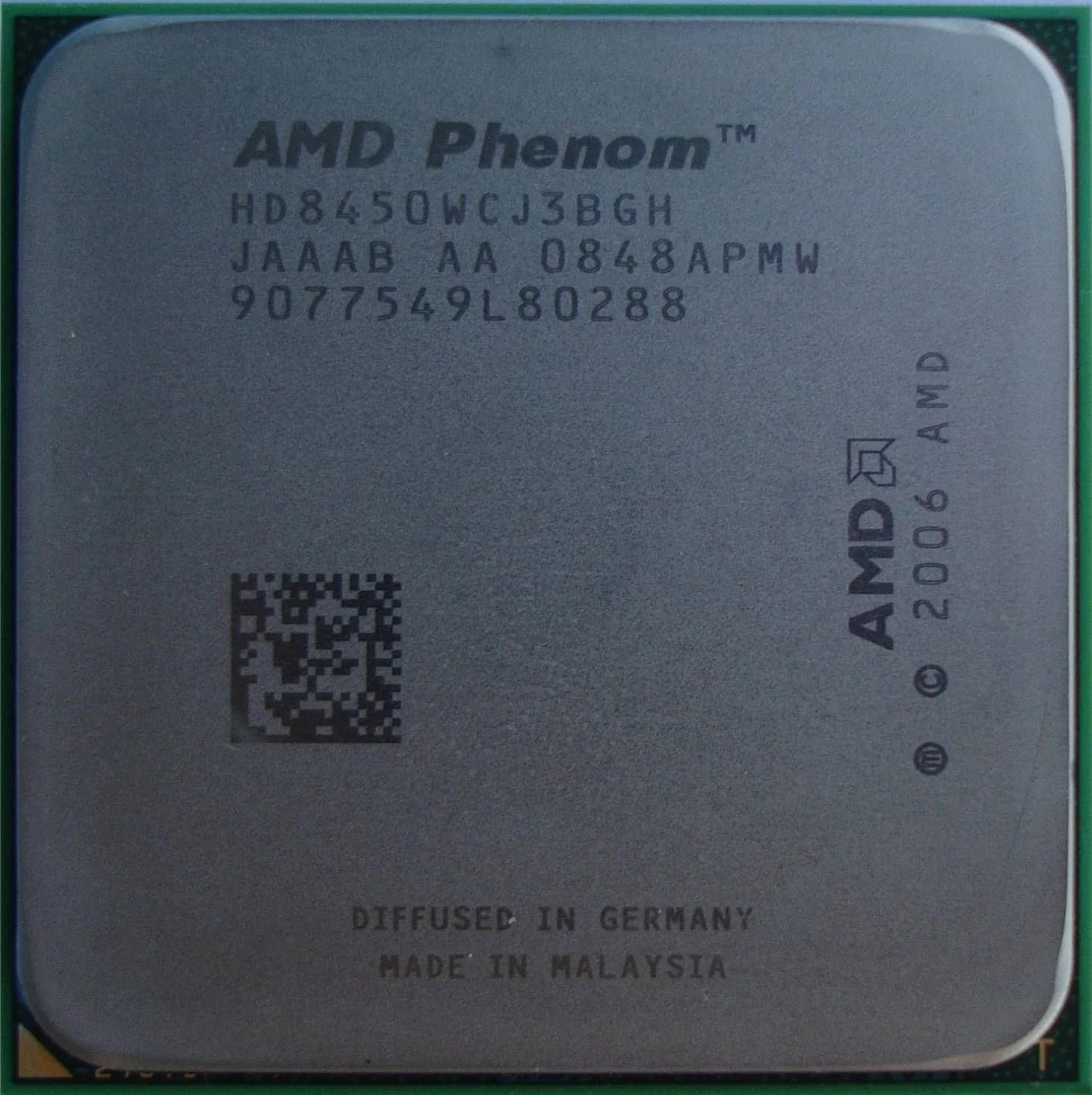
Let's take a look at the star of today's review:
 ⤢ ВІДКРИТИ
This specimen's markings indicate the following: The processor is based on AMD's K10 architecture for workstations; Processor rating 8450 – a triple-core Phenom X3 with the TLB bug fixed; The processor's thermal design power (TDP) is up to 95W at a supply voltage of up to 1.25V; Critical temperature is 70°C; The processor is packaged in a 940-pin OµPGA (Socket AM2+) case; The L2 cache is 3 x 512KB; The L3 cache is 2048KB. The processor is based on a Toliman B3 revision core.
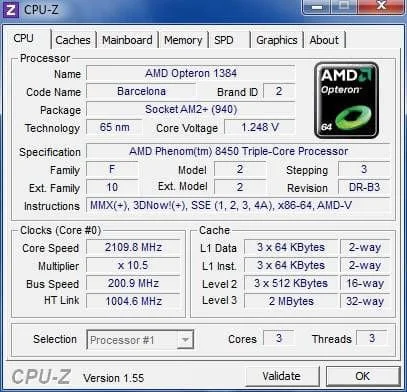
The latest version of the CPU-Z utility currently reports that we have an Opteron 1284 with a Barcelona core, not a Phenom X3 8450:
 ⤢ ВІДКРИТИ
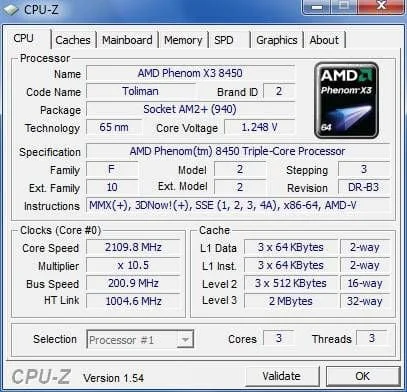
Running an older version of CPU-Z, we were able to confirm the authenticity of our test sample (which was somewhat perplexing):
 ⤢ ВІДКРИТИ
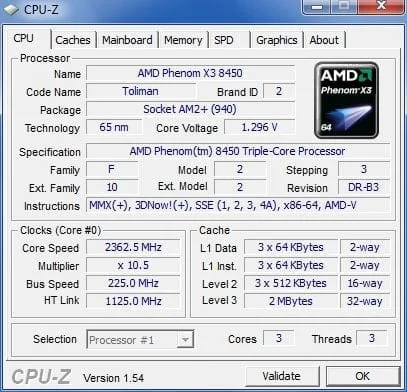
The utility confirmed that we indeed have an AMD Phenom X3 8450. It's based on the Toliman core, manufactured on a 65nm process. The chip's nominal clock speed is 2100MHz, and it features 2MB of L3 cache. The HT frequency is 1000MHz (in our case), and the integrated memory controller runs at 1800MHz.
With our main subject covered, let's turn to its opponent, the Athlon II X3 435:
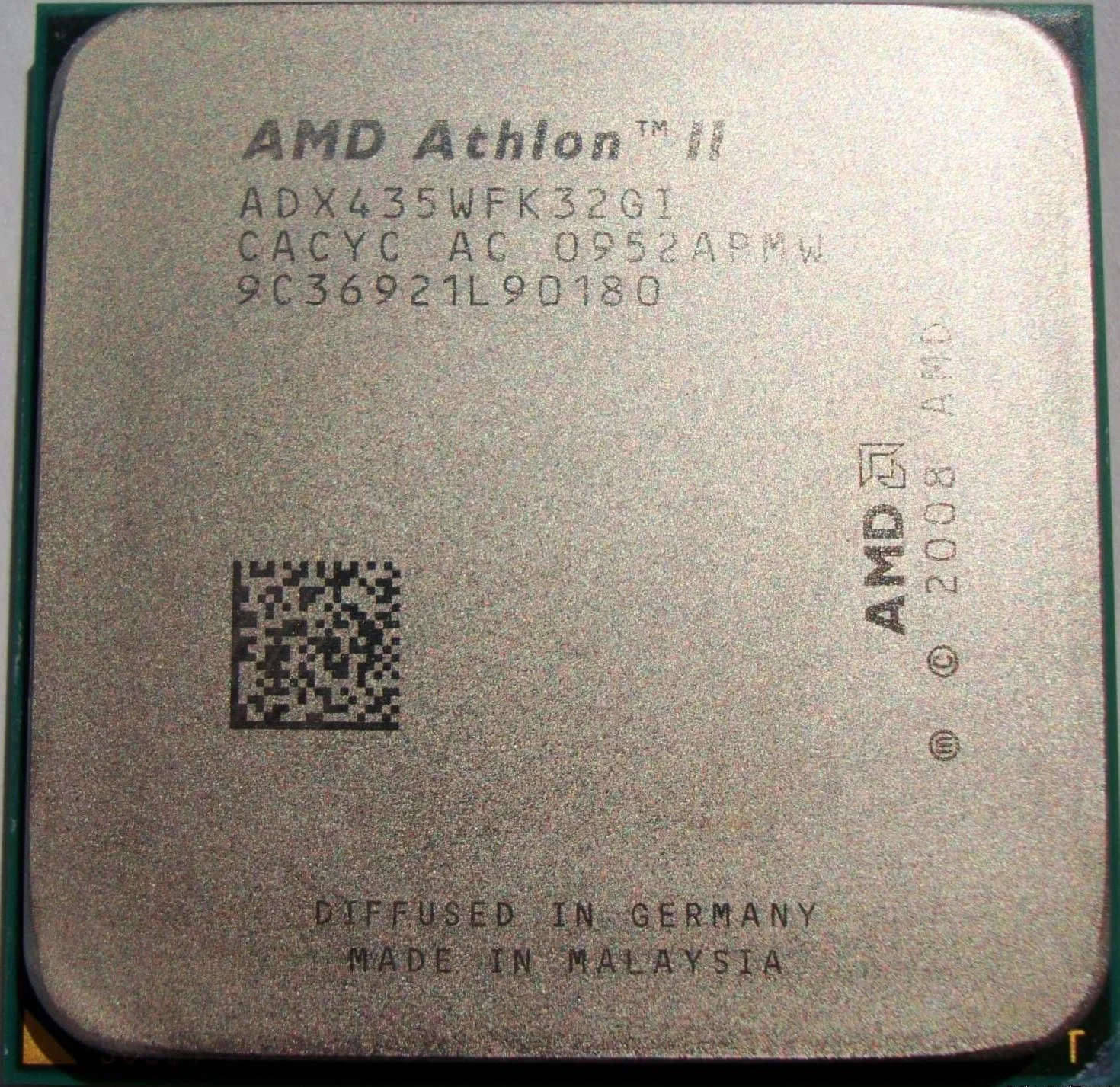 ⤢ ВІДКРИТИ
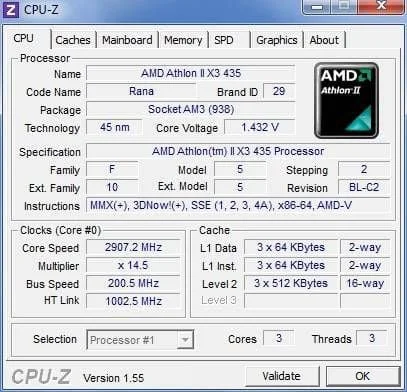
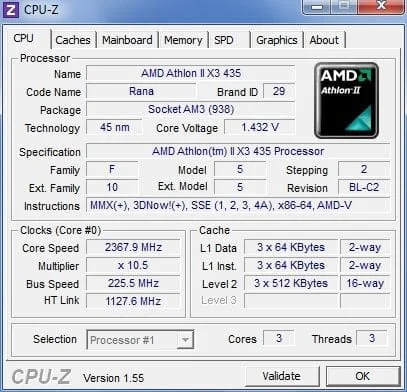
You can find all the details of its specifications in our recent review. Here, we'll limit ourselves to the CPU-Z readings:
 ⤢ ВІДКРИТИ
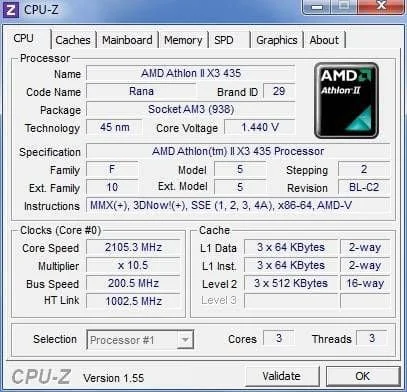
Next, we need to set our Athlon II to the same frequency as the Phenom. With a simple adjustment, I lowered the multiplier to 10.5, effectively creating a Phenom X3 8450 equivalent (in terms of core count and frequency, of course):
 ⤢ ВІДКРИТИ
Overclocking processors
To say that first-generation Phenom chips ran hot would be an understatement. Overclocking these 65nm AMD processors came with a host of problems and risks. It wasn't uncommon for motherboard power delivery circuits to fail during stress tests with AMD Phenom CPUs.
Given this information and a colleague's bitter experience, I promised myself to be as cautious as possible when overclocking the Phenom X3 8450. However, we didn't reach serious frequencies because our test sample barely responded to voltage increases from the start.
At 1.296 volts, we managed to overclock the Phenom X3 8450 to 2362MHz. While certainly not a record, this overclock didn't require us to replace the cooling system; the Cooler Master Hyper 212 Plus was already working at its limit.
 ⤢ ВІДКРИТИ
To match the Phenom X3's frequency, we only needed to set the HTT bus on the Athlon II X3 435 to 225MHz:
 ⤢ ВІДКРИТИ
Achieving maximum overclocking, however, required a bit more effort. Unfortunately, our test lab only had a sample of the first and relatively unsuccessful C2 revision. Moreover, as we later discovered, this chip was essentially a "failed" Phenom II processor. In other words, beneath its IHS lies a full Deneb die with 6MB of L3 cache. Consequently, it ran very hot and was only minimally responsive to frequency increases from voltage bumps.
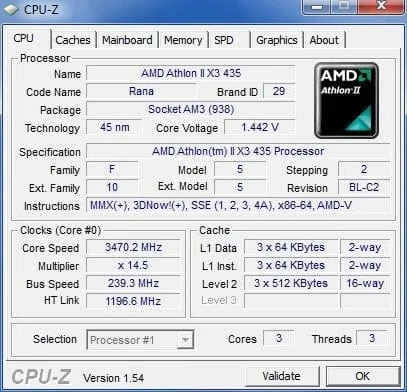
After extensive experimentation, our Athlon II X3 435 sample proved capable of stable operation at 3470MHz with 1.442 volts. Further voltage increases yielded no benefits, and we couldn't squeeze any more megahertz out of the chip.
 ⤢ ВІДКРИТИ
With this overclock, the RAM operated at an effective frequency of 956MHz with 5-5-5-16 timings.
Test system:
Processors - Athlon II X3 435, Phenom X3 8450
CPU cooler - Cooler Master Hyper 212 Plus
Motherboard - ASUS M2N68 AM-SE2
Graphics card - GAINWARD GeForce GTX280 (stock clocks)
RAM - 2x 1GB PQI PC6400 (5-5-5-15 timings)
Hard drive - Samsung HD161HJ 160GB
Power supply - Cooler Master Silent Pro M500
Software:
Windows 7 x64 SP1
CPU-Z 1.55
CineBench 9.5 x64
CineBench 11.5 x64
Light Work — Renderbench
3D Mark 2006 v1.2.0 (CPU test only)
3D Mark Vantage v1.1.1 (CPU test only)
Hot CPU tester PRO
wPrime v1.55
Fritz Chess Benchmark
SuperPi 1.4
WinRar 3.9
FRAPS v3.1.0/build11052
NVIDIA ForceWare 257.15 (BETA)
Games:
Prototype
Grand Theft Auto IV
Colin McRae: DiRT 2
Need for Speed: Shift
Average and minimum frames per second were recorded using the Fraps utility.
For all games, the resolution was set to 1024x768, which is highly CPU-dependent. All other graphics settings were maxed out.
Let's move on to the CPU testing.
Rendering
 ⤢ ВІДКРИТИ
 ⤢ ВІДКРИТИ
 ⤢ ВІДКРИТИ
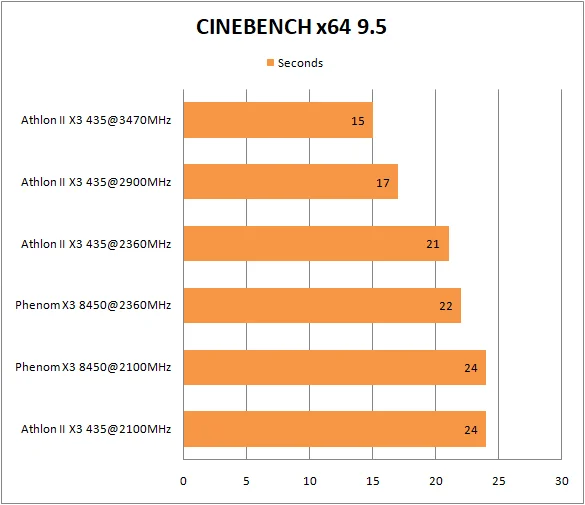
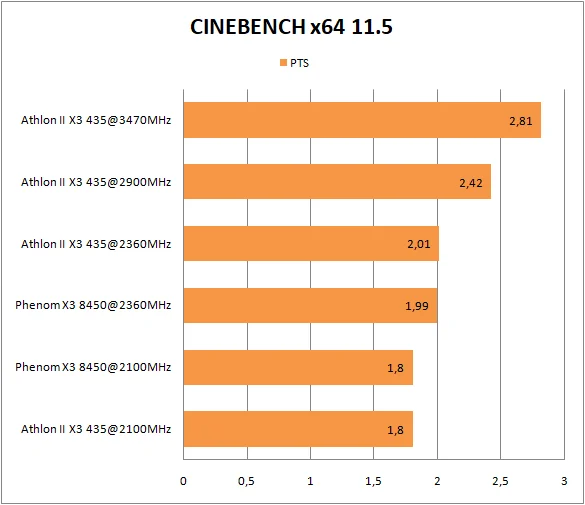
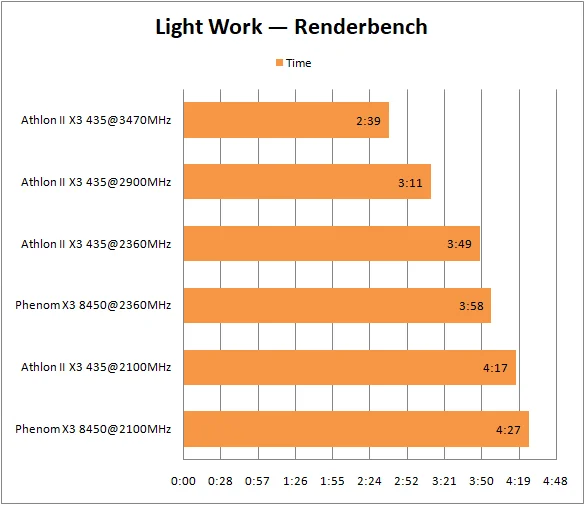
In rendering tasks, cache memory doesn't play a significant role. Therefore, the more technologically advanced Athlon II surpasses the Phenom even at identical clock speeds, let alone when overclocked.
Calculations
 ⤢ ВІДКРИТИ
 ⤢ ВІДКРИТИ
 ⤢ ВІДКРИТИ
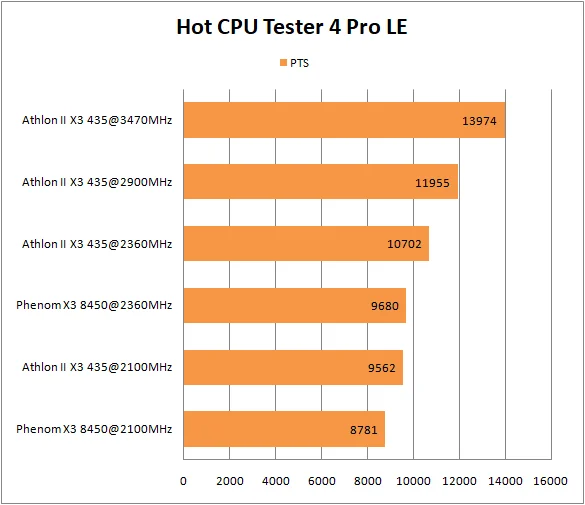
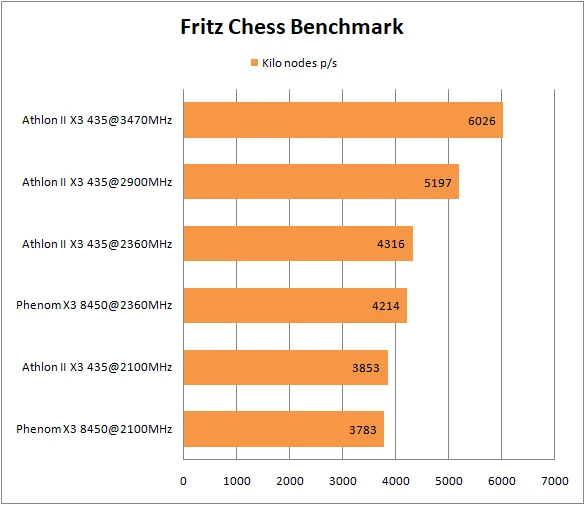
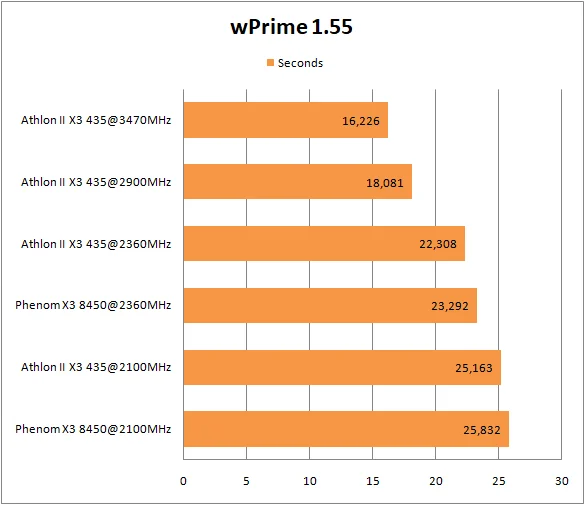
In wPrime, the architectural improvements of the Athlon II X3 prove more beneficial than the Phenom II X3's L3 cache, even at identical frequencies.
Overall performance
 ⤢ ВІДКРИТИ
Archiving
 ⤢ ВІДКРИТИ
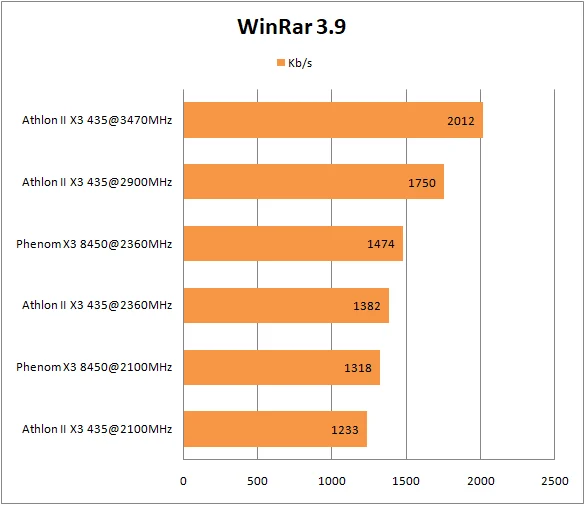
Here, the old Phenom X3 benefits significantly from its 2MB L3 cache. However, even with that advantage, it can't quite catch the Athlon II X3 running at its nominal frequencies.
Gaming, Synthetic
 ⤢ ВІДКРИТИ
 ⤢ ВІДКРИТИ
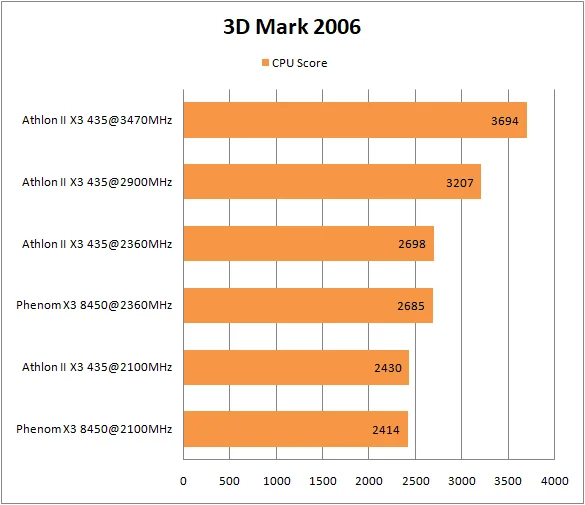
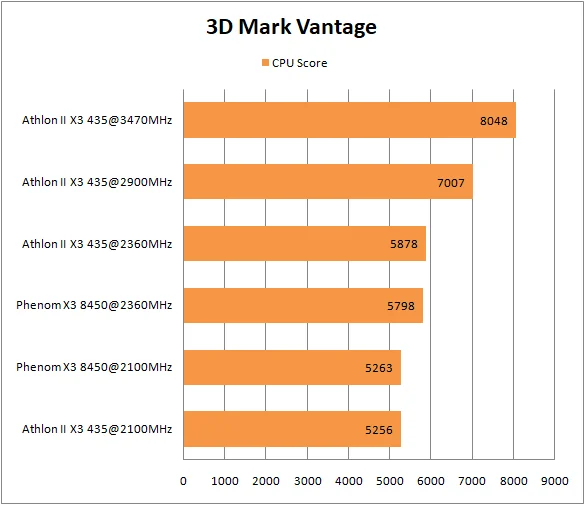
Testing in synthetic gaming benchmarks showed the Phenom X3 8450 going neck and neck with the Athlon II X3 435, but only when both ran at identical frequencies. The Phenom X3 8450 couldn't compete with the Athlon II X3 at its nominal operating mode, much less its overclocked version.
 ⤢ ВІДКРИТИ
 ⤢ ВІДКРИТИ
 ⤢ ВІДКРИТИ
 ⤢ ВІДКРИТИ
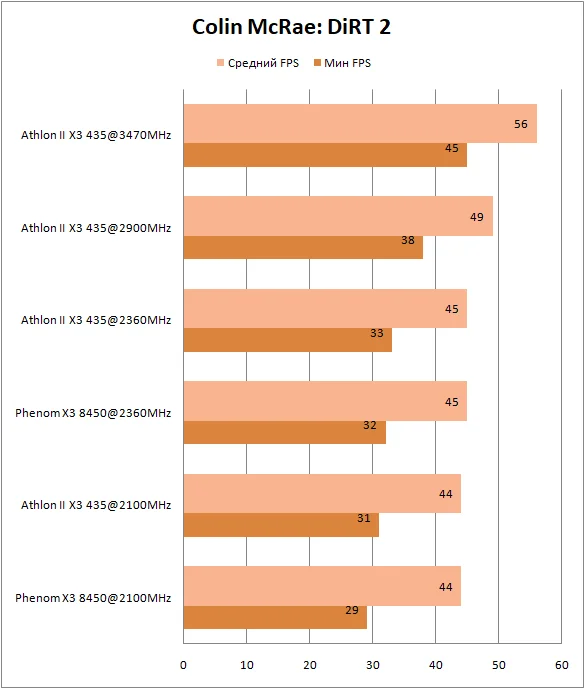
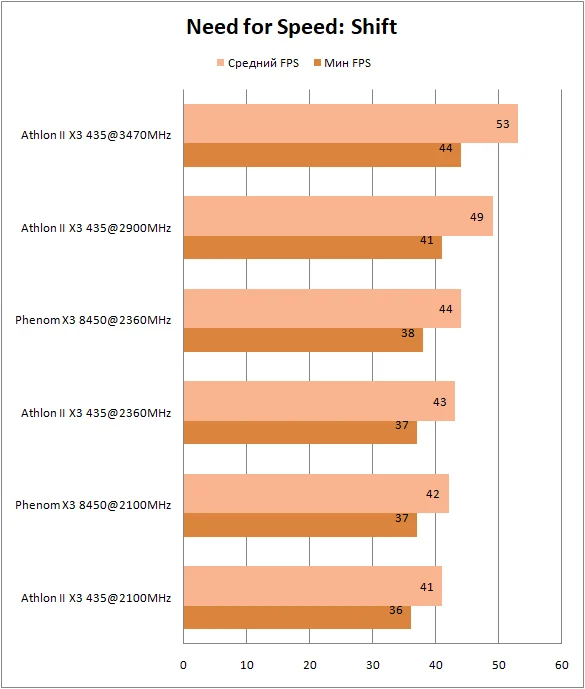
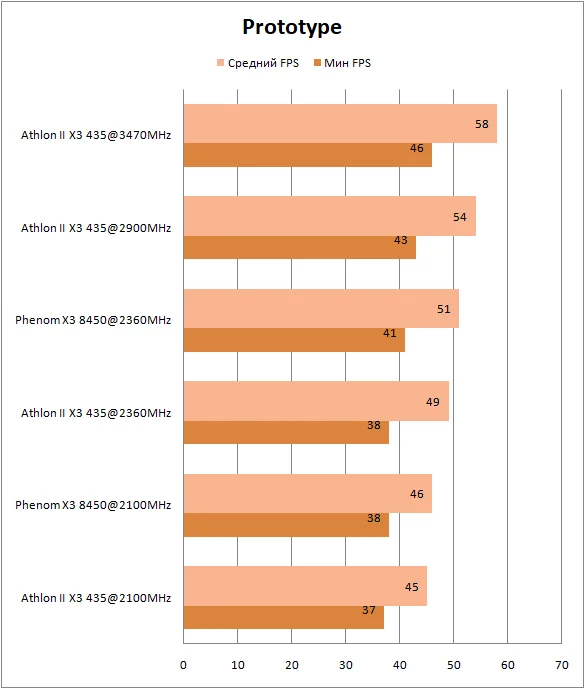
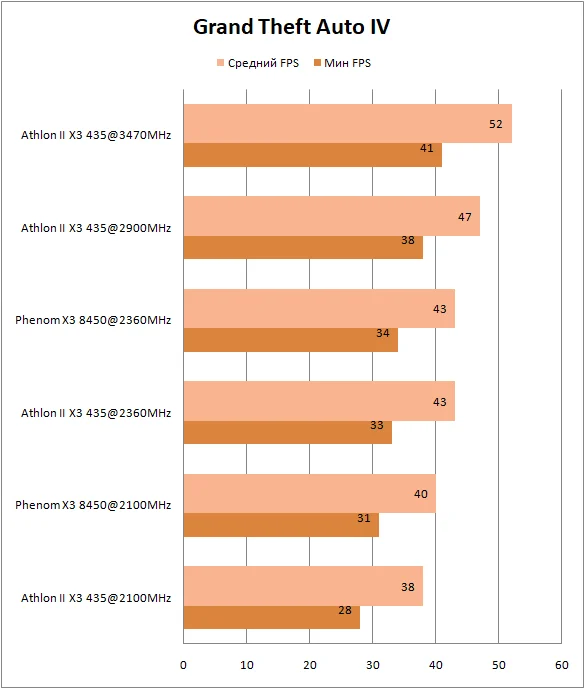
In actual games, the situation is different. The Phenom X3 8450 features L3 cache, which is quite important for these types of titles. Consequently, neither the microarchitectural improvements nor the faster memory controller help the Athlon II X3 win at identical frequencies. However, the 45nm chip has an ace up its sleeve: a high nominal frequency and the ability to push it up to 3500MHz. In that scenario, the old Phenom X3 8450 simply can't compete with the Athlon II X3 435.
Conclusion
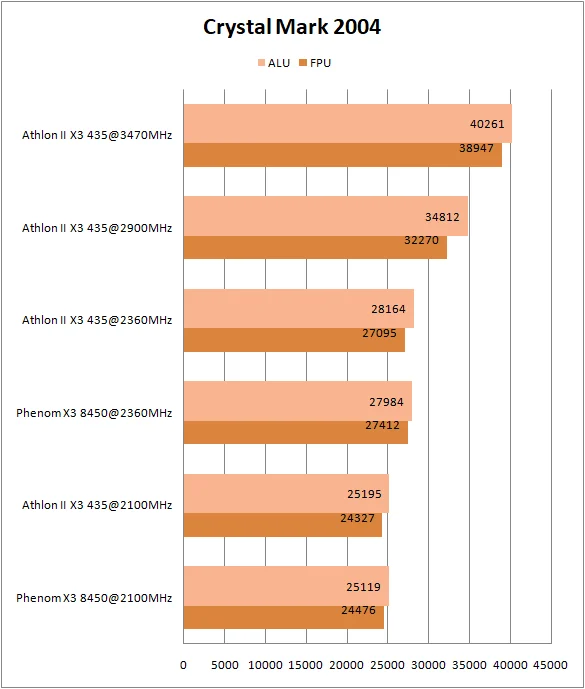
The Phenom X3 8450 processor delivers almost the same performance as the newer Athlon II X3 at identical frequencies. Furthermore, in some tests, like games, it can even outperform the Athlon. However, a major downside of the Phenom X3 is its terrible power consumption and heat output. Achieving a high overclock, around 2700MHz+ (which is considerable for a 65nm Agena core), requires an expensive, high-quality motherboard and replacing the stock cooling with a more efficient solution. In contrast, overclocking the Athlon II X3 to similar frequencies can be done without replacing the cooler, even with an inexpensive motherboard running a budget chipset.
Components for the test bench provided by: DENIM, Jester, MTPZP
Last updated and supplemented on 22.05.2020: Improved chart quality.