TESTS · CPU · AMD
PUBLISHED
READING4 min
AMD Phenom II X6 1055T in-game quick test: do we really need six cores?
Quick test of the AMD Phenom II X6 1055T in games: comparing 2, 4, and 6 cores. Significant gain from 2 to 4 cores, marginal from 4 to 6. Do games need six cores?
I think everyone's curious to see how AMD's new six-core processor performs in games. But are there even any games right now that genuinely boast multi-threading support? First up, probably GTA 4, then Assassin's Creed II, Lost Planet, and a small handful of other titles. But if you think about it, only GTA truly needs it. Huge open worlds, countless objects, and, of course, a terrible console port — these factors explain the game's high CPU dependency. Ideally, GTA 4 runs best on a CPU like the Phenom II X4 955, or if you're looking at the blue team, a Core i5-750 is a better fit.
In this article, we'll try to determine how much AMD's new six-core chip benefits from those two extra cores.
Discussing the Phenom II X6's architecture in detail is probably unnecessary; the only real difference from its quad-core sibling is the core count.
Test setup and configuration
CPU - Phenom II X6 1055T
Motherboard - ASUS M4A785TD-V EVO
RAM - DDRIII 2GB NCP PC10600 (9-9-9-24)
Graphics card - Gainward GeForce GTX280
Hard drive - Seagate ST31000528AS 1000GB
PSU - Cooler Master 600W
Rather than using three separate CPUs for testing, we simply disabled cores on our existing AMD Phenom II X6 1055T. This gave us the following configurations:
Phenom II X6@2800MHz (six active cores)
Phenom II X4@2800MHz (four active cores)
Phenom II X2@2800MHz (two active cores)
For the games, we selected these settings:
GTA 4 DX9
Resolution - 800x600
Textures - High
Reflection Resolution - Very high
Water Quality - low
Shadows - off
Night Shadows - off
Anisotropic Filtering - x16
View Distance - 30
Detail Distance - 100
Vehicle Density - 100
Testing was conducted during night gameplay, which puts even more strain on the CPU. Experience showed that daytime in-game frame rates were roughly 5-10 FPS higher. We used Fraps for benchmarking, averaging data from four runs.
Assassin's Creed II DX9
All settings maximized.
AA-0
AF-0
Resolution - 800x600
Frame rates in this game were also recorded using Fraps.
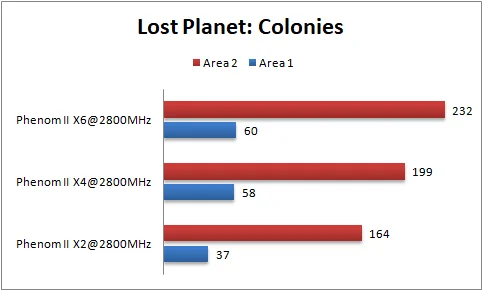
Lost Planet Colonies DX10
Low
AA-0
AF-0
1280x720
This once-popular game utilized its built-in benchmark, which showed the game still has some life left in it.
Let's move on to the benchmarks:
Benchmarks
 ⤢ ВІДКРИТИ
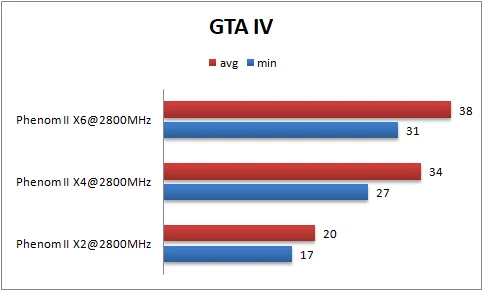
The performance boost going from two to four cores is simply massive, but while moving to six cores did push the bar slightly higher, it still couldn't quite reach 40 FPS.
 ⤢ ВІДКРИТИ
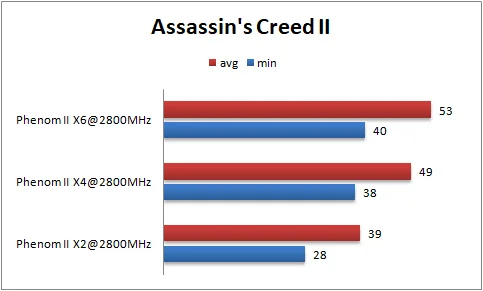
Surprisingly, Assassin's Creed II managed to utilize all six threads! Of course, the performance gain from adding two more cores was only marginal, and the jump from 2 to 4 cores offered a much bigger boost. But you have to admit, it's nice to see those cores actually working in-game instead of sitting idle.
 ⤢ ВІДКРИТИ
A long time ago, this older title gave many gamers hope that all games would soon be perfectly optimized for quad-core CPUs. That hasn't quite happened yet. However, the chart above shows that this 'older title' actually works quite well with six-core processors.
Conclusion
Yes, as you may have noticed, this article didn't include any CPU overclocking, and our test suite was rather small. However, keep in mind that we only had the processor in the lab for a single day, and we had a choice:
Benchmark the chip in synthetic tests, or compare the performance of two, four, and six cores across a few games. I hope we made the right choice. What do you think? Let us know in the comments!