BLOGS · HARDWARE BLOGS
PUBLISHED
READING5 min
Quick review of the AMD Ryzen 5 3400GE
Benchmarking the rare AMD Ryzen 5 3400GE to see how unlocking its TDP limit to 65W boosts performance in 720p gaming.
The 35W AMD Ryzen 5 3400GE is a relatively rare find in retail stores. That's because this APU is essentially an OEM-only chip, meaning it is intended for system integrators rather than general retail sale.
Unfortunately, I only had my hands on the 3400GE for a brief moment, leaving no time for a full-scale review of this interesting, rare CPU. Nevertheless, I managed to run a few quick benchmarks to see what this AMD Ryzen 5 3400GE chip can do. But first things first: let's take a closer look at the chip itself:
The processor
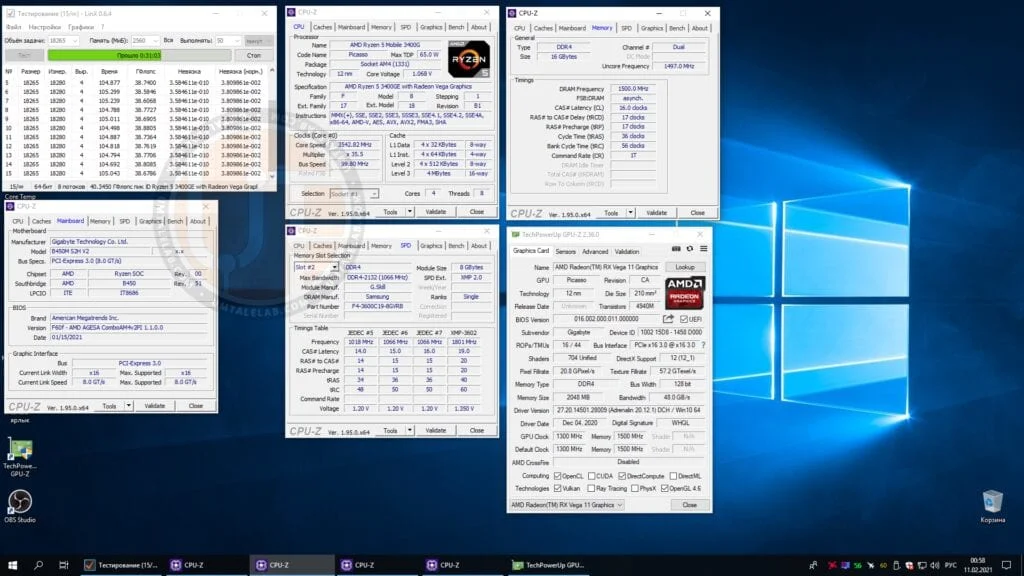
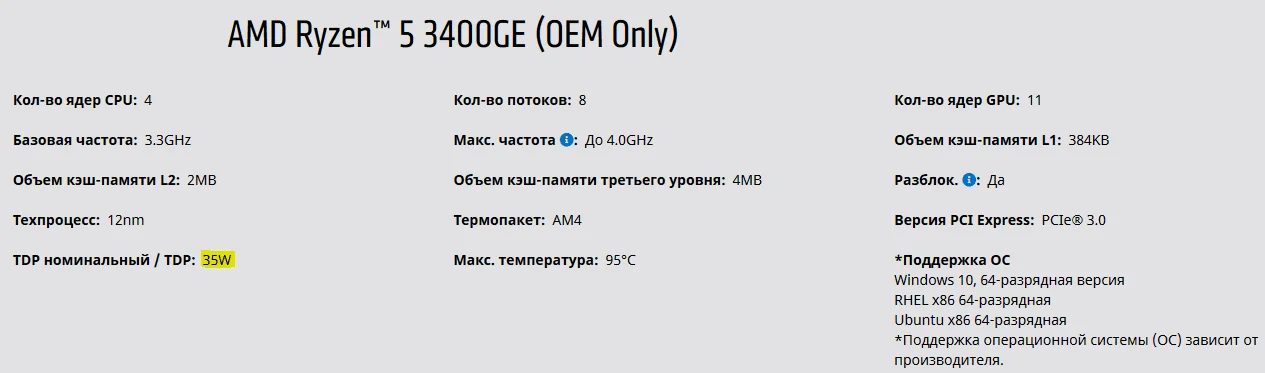
The 35W Ryzen 5 3400GE APU features 4 cores and 8 threads based on the Zen+ architecture, paired with 11 Vega compute units (GPU configuration: 16 ROPs, 44 TMUs, and 704 stream processors).
The Ryzen 5 3400GE has 512 KB of L2 cache per core and a shared 4 MB L3 cache buffer, which is quite small by Zen standards. According to official specs, the base CPU clock is 3300 MHz with a boost of up to 4000 MHz, while the GPU can reach up to 1300 MHz.
 ⤢ ВІДКРИТИ
Keep in mind that this is strictly a 35W processor:
 ⤢ ВІДКРИТИ
To fit into such a tight power envelope, the Ryzen 5 3400GE rarely, if ever, runs at its maximum CPU and GPU frequencies simultaneously.
For example, in The Witcher 3, the CPU cores stayed below 2500 MHz, while the GPU clock hovered between 700 MHz and 900 MHz. This actual performance is far below the specs listed on AMD's website, and this clock speed reduction obviously takes a massive toll on the APU's overall performance.
This quirk of the AMD Ryzen 5 3400GE is highly frustrating. Fortunately, there is a workaround (at least, it worked flawlessly on our test motherboard):
To lift the power limit on the 3400GE, enter your motherboard BIOS (we used a GIGABYTE B450M S2H V2), navigate to the "AMD CBS" section, and change the "System Configuration" option from "Auto" to "65W POR Configuration". Once done, the chip's clock speed under combined CPU and GPU loads will stay above 3300-3500 MHz, and the integrated graphics will finally hit its rated 1300 MHz.
While this specific tweak might only apply to GIGABYTE motherboard owners, it at least shows you where to look if your APU's clock speeds are falling short of their rated specs.
To illustrate the real-world performance gains of raising the TDP limit: with "System Configuration" left on default, the 3400GE averaged 28 FPS in The Witcher 3. After switching it from "Auto" to "65W POR Configuration", the average framerate jumped to 39 FPS. In other words, we got a 35% performance boost just by increasing the TDP limit.
Test setup and software
Motherboard - GIGABYTE B450M S2H V2;
RAM - 2x 8 GB DDR4 G.SKILL F4-3600C19-8GVRB;
SSD - 240 GB Kingston M.2 UV500 (SUV500M8/240G);
HDD - Seagate 2 TB ST2000DM008-2FR102;
Power supply - Chieftec GPS-1250C;
OS - Windows 10;
Drivers - AMD Adrenalin 20.12.1.
Benchmark software - MSI Afterburner 4.6.2.
We tested the Ryzen 5 3400GE in the following games:
Assassin's Creed Odyssey (Benchmark) - Low settings, 1280x720 resolution;
Death Stranding (Free roam, delivery) - Low settings, 1280x720 resolution;
The Witcher 3: Wild Hunt (Free roam, Novigrad) - Medium settings, 1280x720 resolution;
Horizon Zero Dawn (Free roam, early game) - Low settings, 1280x720 resolution;
Shadow of the Tomb Raider (Benchmark) - Low settings, 1280x720 resolution;
World of Tanks (Replay playback) - Medium settings, 1600x900 resolution.
Testing specifics:
We tested the AMD Ryzen 5 3400GE processor in 65W mode, paired with DDR4 3000 MHz RAM running at timings of 16-17-17-36.
AMD Ryzen 5 3400GE CPU benchmark results in several applications:
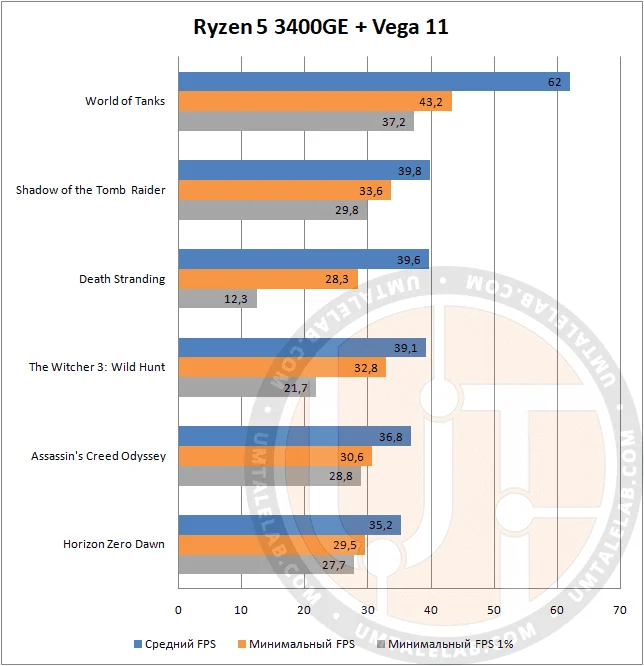
AMD Ryzen 5 3400GE CPU and Vega 11 GPU gaming benchmark results:
 ⤢ ВІДКРИТИ
The Ryzen 5 3400GE APU handled all tested games at 720p, and in World of Tanks, we even managed a playable frame rate at 900p. That is a very solid result. Just think about it: today, even an integrated GPU can pull off playable frame rates in The Witcher 3: Wild Hunt at 720p with medium settings!
The only real drawback is the rather weak 1% low performance in Death Stranding. During gameplay on the 3400GE, there were periodic stutters that didn't occur on dedicated graphics cards like the Radeon RX 470 or GeForce RTX 2060. Still, if you just want to experience the game, the Vega 11 gets the job done.
Verdict
As I mentioned at the very beginning, it is a real shame I couldn't keep the Ryzen 5 3400GE for longer. Its niche appeal and rarity make it a fascinating chip, though we have to admit that TDP limitations make it highly specific and not for everyone.
Unfortunately, this processor couldn't deliver decent performance at 1080p, which is why I didn't bother recording Full HD benchmarks. That's hardly surprising. What is truly impressive, however, is that despite some caveats, the 3400GE handled every single tested game at 720p without major issues.