BLOGS · HARDWARE BLOGS
PUBLISHED
READING15 min
GeForce GTX 470 vs. Radeon HD 5870 in modern games
See a detailed comparison of the GeForce GTX 470 and Radeon HD 5870 in current 2025 games. Discover which veteran graphics card delivers better performance today.
Admittedly, I'm quite late with this kind of material. However, I still need to fulfill the promise I made in the GeForce GTX 470 blog post, which I wrote back in the now distant, and as it turned out, quite carefree 2021.
In this particular case, a classic prelude to the benchmarks doesn't make much sense. We already have comprehensive articles on our site covering the graphics cards featured here, detailing their clock speeds, PCB layouts, and more. So, I propose we dive straight in.
Welcome to a showdown of past graphics monsters in the realities of 2025!
Test Bench
Processor: Core i5-12400F;
CPU Cooler: Cooler Master Hyper 212 Black Edition (RR-212S-20PK-R1);
RAM: 2 sticks of 8 GB Corsair Vengeance RGB PRO (CMW16GX4M2C3600C18), totaling 16 GB (Micron E-Die chips);
Motherboard: MSI PRO Z690-A DDR4 (MS-7D25);
Graphics Cards: GeForce GTX 470 (GV-N470SO-13I), Radeon HD 5870 (GV-R587OC-1GD)
SSDs: 2 x KINGSTON SUV400S37120G 120.0 GB (AMD/Intel Windows 11), SAMSUNG 870 EVO 1 TB (Games/Applications);
Power Supply: Chieftec GPS-1250C.
Before discussing the results, it's worth noting that for stock testing, both graphics cards had their frequencies reduced to the reference values set by AMD and NVIDIA engineers.
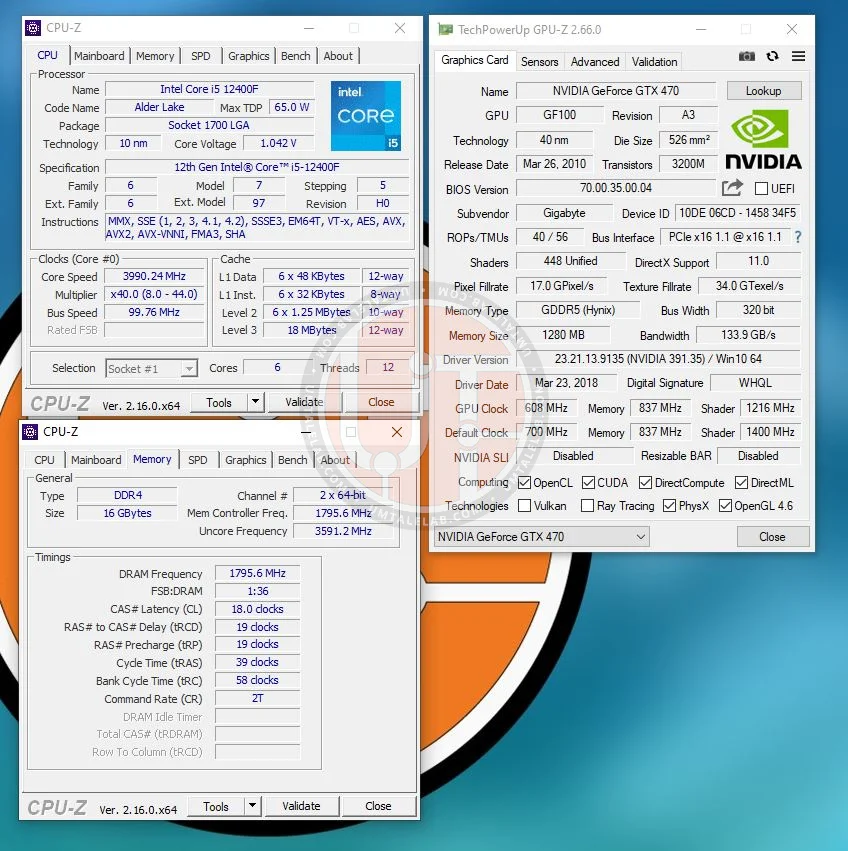
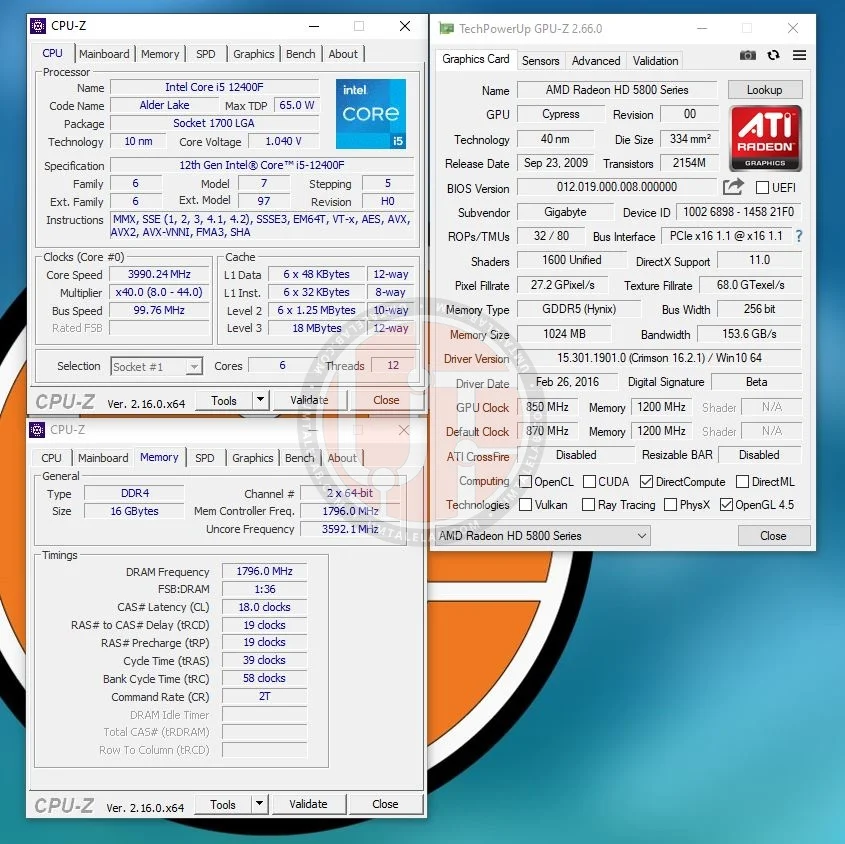
Specifically, the GeForce GTX 470 operated at 608/1216/3348 MHz (core/shader domain/video memory), while the Radeon HD 5870, in turn, ran at 850/4800 MHz (core/video memory).
Test Results
Unigine Superposition benchmark
 ⤢ ВІДКРИТИ
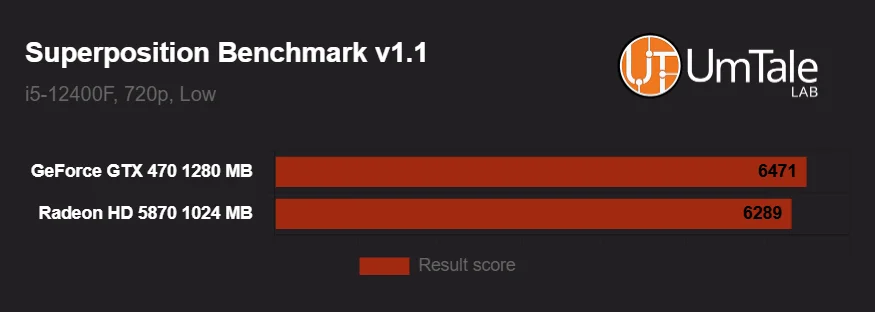
Kicking off our test suite is the classic Superposition benchmark. Here, both graphics cards show similar performance, but the GTX 470 snags the first win with a slight 3% advantage.
Unreal Engine 4
 ⤢ ВІДКРИТИ
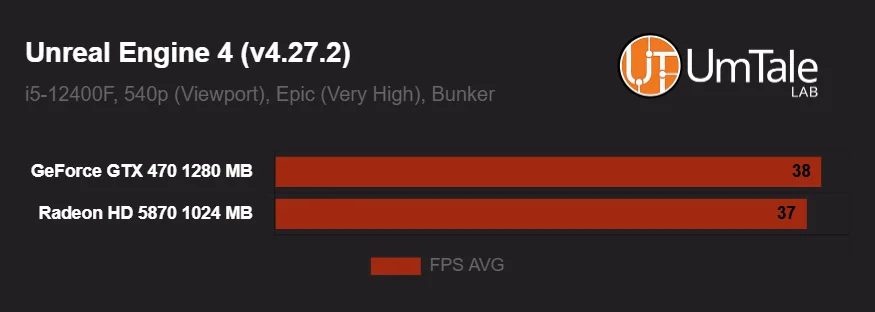
Next, somewhat unexpectedly, we move on to game development using the somewhat outdated UE4 engine. When using the scene
Baldur’s Gate 3
 ⤢ ВІДКРИТИ
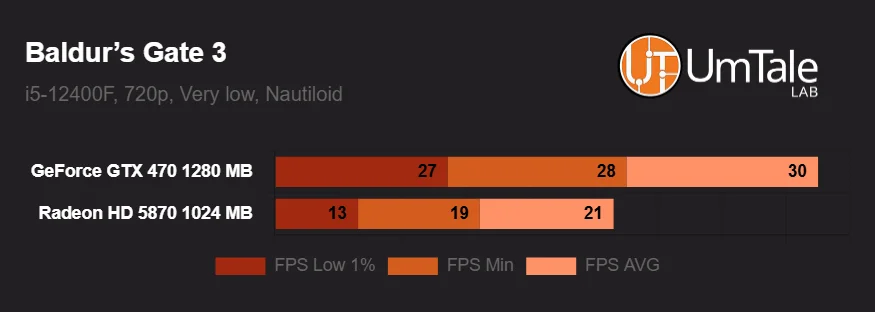
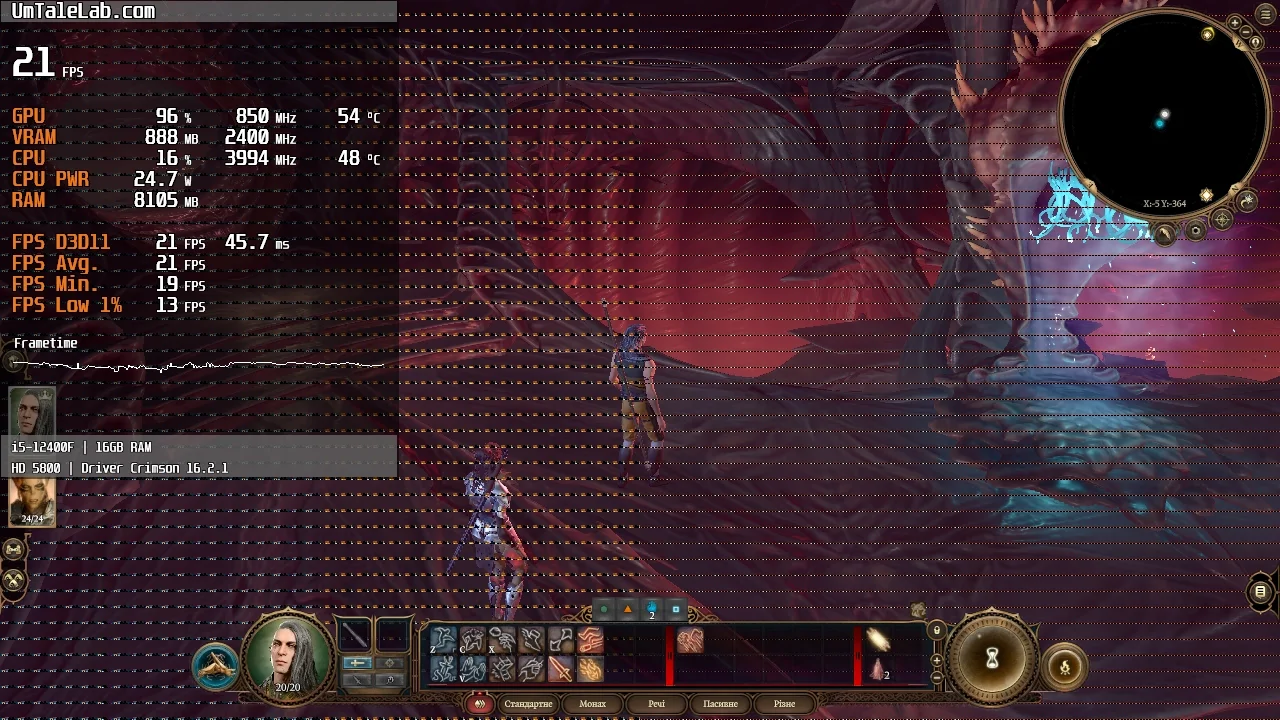
The first full game on our test list brings the Radeon HD 5870 crashing back down to earth, and perhaps even below it. Not only does the game on
 ⤢ ВІДКРИТИ
And yes, the moment I launched BG 3 on the HD 5870, I tensed up a bit. Card failure is a common occurrence with such old graphics cards. But thankfully, everything was fine; the graphics accelerator was okay. These visual artifacts only appeared in Baldur’s Gate 3. And let's be frank: support for TeraScale 2 architecture GPUs ended way back in 2015, so it's a miracle the HD 5870 even launched this game.
The GTX 470 performed significantly better. Not only was the image crystal clear (if such a description can even apply to 720p resolution in 2025), but it also managed to provide a minimally acceptable FPS in the test scene.
To the reasonable question, "Why didn't you use the classic Baldur's Gate city scene?" the answer is simple: neither the GTX 470, let alone the HD 5870, could load such a detailed and NPC-rich scene. Both crashed to the desktop with an error. Still, 3-0.
Sid Meier’s Civilization VI
 ⤢ ВІДКРИТИ
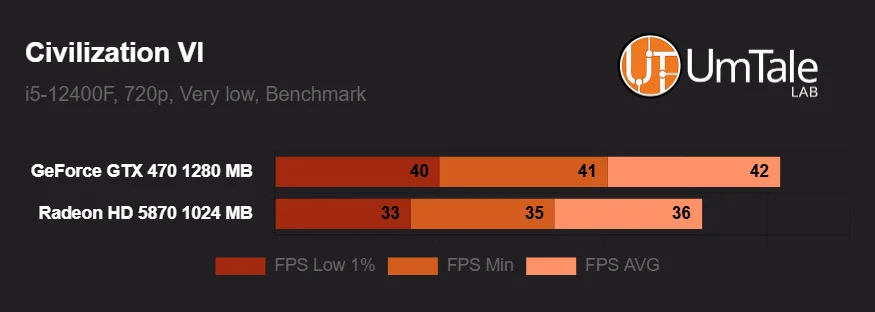
In this turn-based strategy game, the GTX 470 holds a noticeable 16% advantage, ultimately bringing the score to 4-0 in favor of NVIDIA's accelerator.
Counter-Strike 2
 ⤢ ВІДКРИТИ
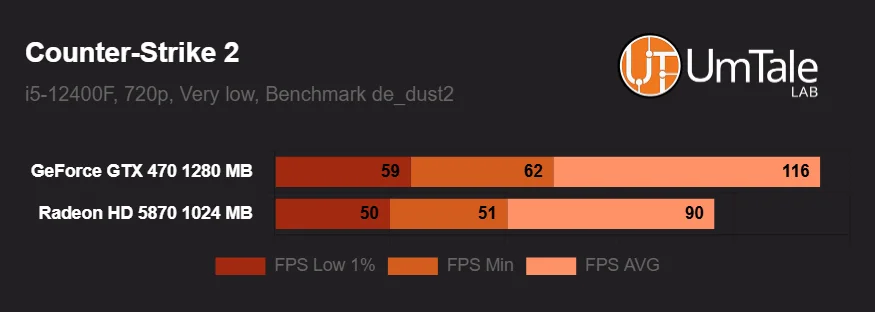
Valve's most popular shooter sequel, Counter-Strike 2, reported a 29% lead for NVIDIA's 'green' cards over AMD's 'red' ones — a decisive 5-0 victory. Frankly, it's surprising CS2 even launched on such ancient GPUs without any special tricks.
Destiny 2
 ⤢ ВІДКРИТИ
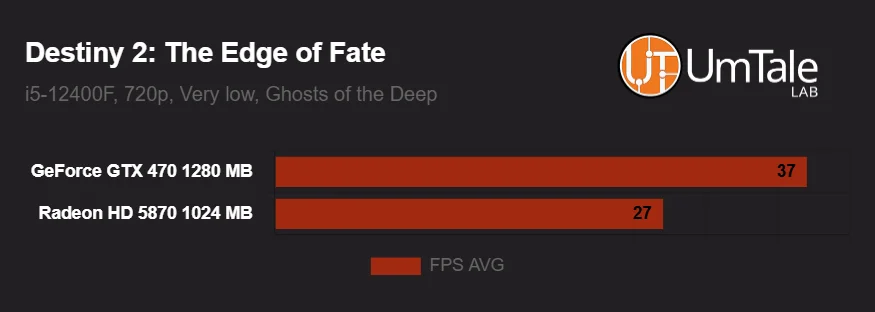
Unfortunately, third-party overlays are forbidden in the looter-shooter Destiny 2. At least, the ones I'm aware of simply wouldn't initialize. This forced me to rely on Steam's updated built-in performance monitor. However, the Radeon HD 5870 wasn't properly supported, rendering Valve's integrated software largely unhelpful. Ultimately, I had to record multiple playthroughs of the 'Ghosts of the Deep' dungeon to gather any usable results.
To my surprise, the GTX 470 was quite capable of delivering acceptable frame rates even in demanding situations. On the green card, frame rate dips were extremely rare and negligible; minimums of 29-33 FPS are perfectly playable. Moreover, I navigated challenging dungeons without any discomfort whatsoever.
The Radeon HD 5870, however, performs terribly. In the same dungeon, frame rates easily plummeted to critical lows of 17-20 FPS — something even a base PlayStation 4 avoids. While playing on the GTX 470 felt genuinely positive, especially after being locked to 30 FPS on the base PlayStation 4 (I even replayed 'Ghosts of the Deep' on the console before testing the GPUs for comparison), the HD 5870 proved to be a significant downgrade from the PS4 experience. That's 6-0 in Jensen Huang's favor.
Devil May Cry 5
 ⤢ ВІДКРИТИ
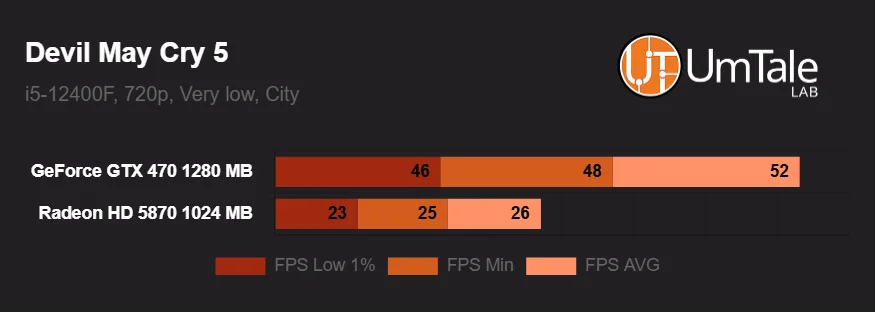
The GTX 470 held a 100% advantage over the HD 5870 in DMC 5. There's nothing more to say; it was a total rout, putting the score at 7-0.
Dota 2
 ⤢ ВІДКРИТИ
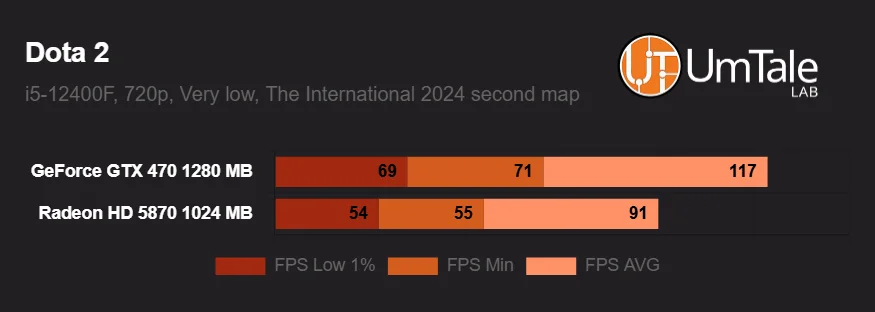
Valve's MOBA wasn't quite as harsh on the HD 5870. The HD 5870 lagged behind the GTX 470 by about 28%. Still, that pushes the score to 8-0.
Dark Souls 3
 ⤢ ВІДКРИТИ
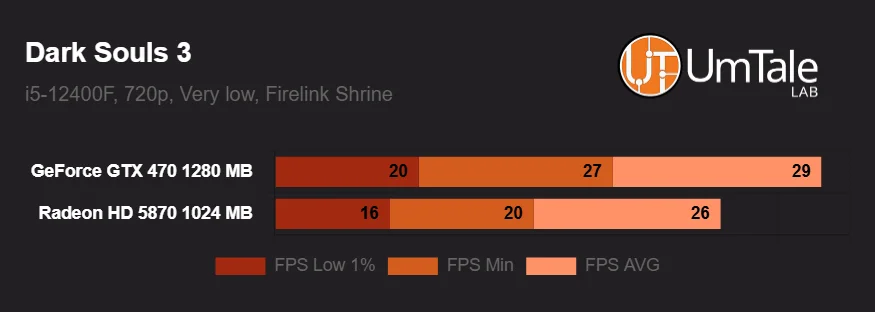
As a fan of Miyazaki's games, I was incredibly curious to see how well these 2009-2010 era graphics cards would handle Dark Souls 3. Frankly, I grew tired of searching for a suitable testing location. In some areas, the GTX 470 would hit the 60 FPS cap, while in others, the HD 5870 managed to as well. I spent a considerable amount of time fast-traveling between various bonfires, but I couldn't find a consistently demanding area. With a sigh, I decided to return to the Firelink Shrine. Lo and behold, that was exactly what I needed! For some strange reason, both GPUs were most heavily stressed in the hub area. Ultimately, the GTX 470 proved 10% faster than the HD 5870 in Dark Souls 3, contributing to a crushing 9-0 lead.
Fallout 4
 ⤢ ВІДКРИТИ
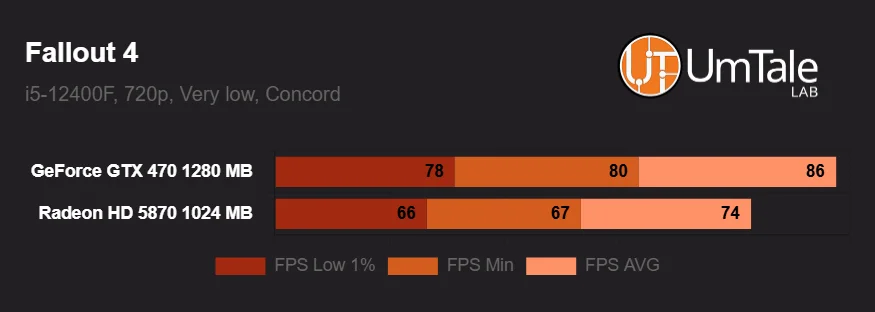
The fourth main installment of the Fallout series performed quite decently on both graphics cards. However, once again, the GTX 470 came out on top. 10-0.
Far Cry 5
 ⤢ ВІДКРИТИ
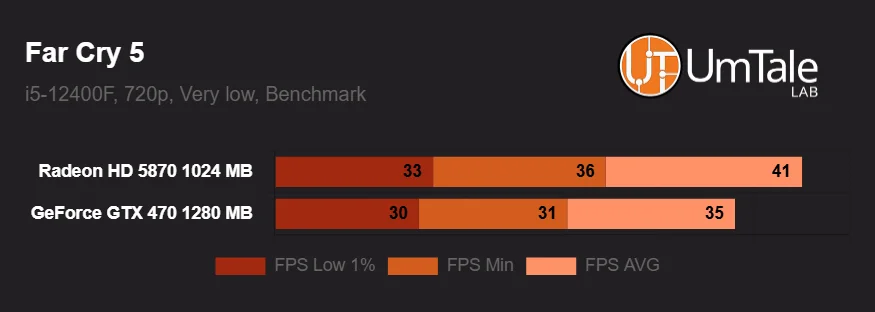
A completely unexpected situation arose in Far Cry 5. Surprisingly, the Radeon HD 5870 actually outperformed the GTX 470 by a significant 17%! The shutout is over – it's 10-1.
Frostpunk
 ⤢ ВІДКРИТИ
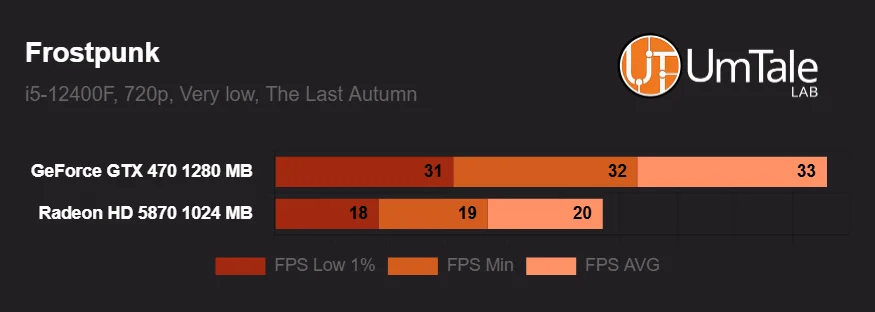
Yet another Unreal Engine 4 title set things straight. In Frostpunk, the GTX 470 outpaced the HD 5870 by 65%. That brings the score to 11-1.
Mafia: Definitive Edition
 ⤢ ВІДКРИТИ
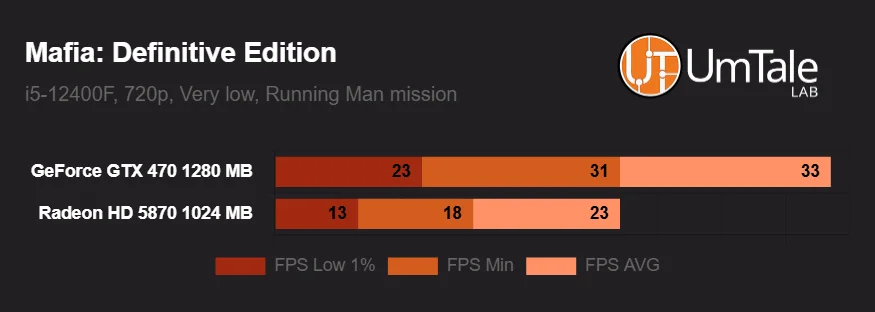
The remake of the original Mafia demonstrated the HD 5870's complete inability to cope. NVIDIA's card held a 44% lead, securing another win and adding one more point to the final tally. 12-1.
Metro: Last Light Redux
 ⤢ ВІДКРИТИ
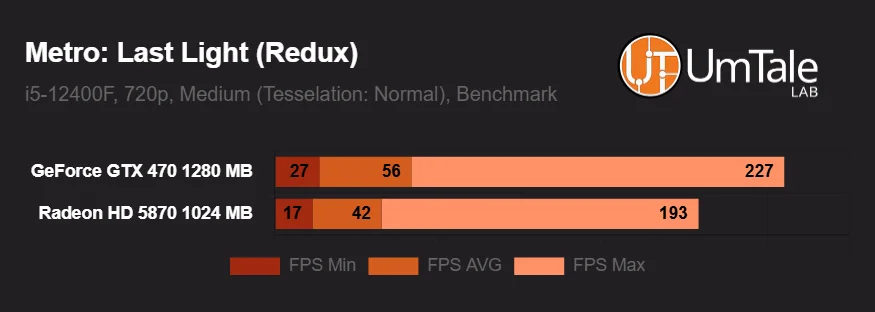
The Metro sequel remaster also favors NVIDIA's card. On average, the GTX 470 delivers 33% more frames than the HD 5870. For minimum FPS, that gap widens to 59%. A definitive 13:1.
The Lord of the Rings: Return to Moria
 ⤢ ВІДКРИТИ
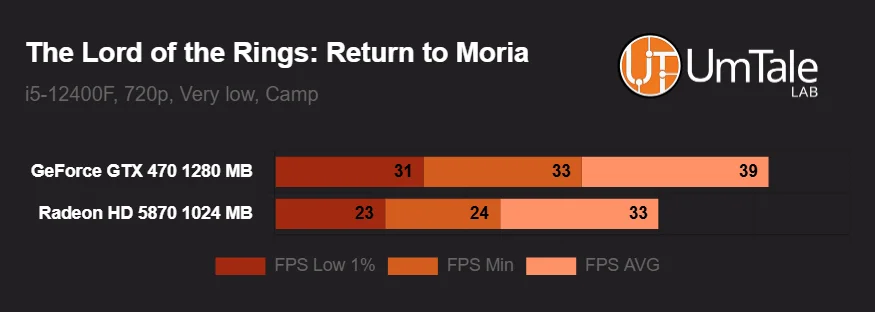
The 'Return to Moria' building sandbox performs relatively well on our test subjects. I specifically chose a demanding location: the bonfire, or a custom-built hub. This spot allows for numerous light sources and literally tons of resources, significantly stressing the GPU with various effects and post-processing. Simply running through the mines won't produce such low FPS.
In this scenario, the GTX 470 outperforms its competitor by 18%. The score stands at 14:1.
The Elder Scrolls V: Skyrim Special Edition
 ⤢ ВІДКРИТИ
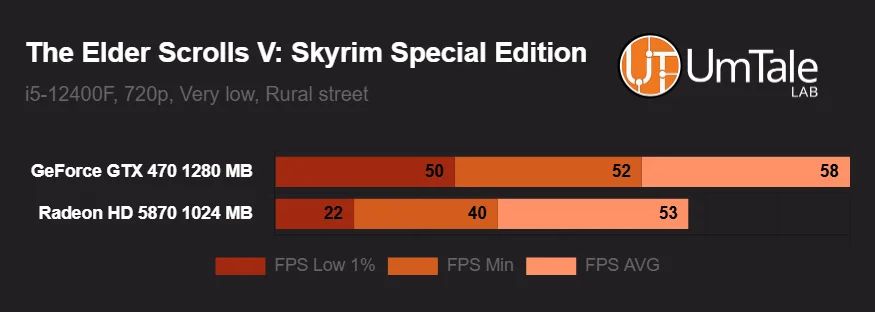
Todd Howard... Todd Howard never changes, always optimizing his games for green team graphics cards. Let me explain: while the average FPS on both GPUs doesn't differ significantly, the minimum recorded FPS on the HD 5870 is simply depressing. The red card is plagued by constant micro-stutters, making gameplay feel choppy even without an active FPS counter overlay. This behavior in the legendary action RPG brings our score to 15:1.
Stray
 ⤢ ВІДКРИТИ
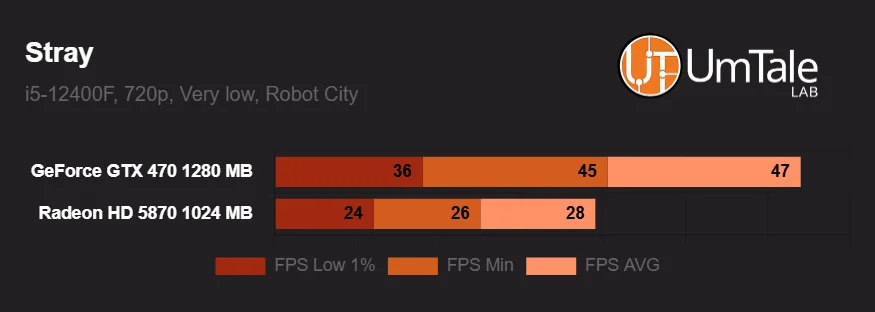
The melancholic journey of the cute cat progresses noticeably better on the GTX 470. The green monster from the past holds a 68% lead, and its average FPS allows for a smooth playthrough from start to finish. Unfortunately, the HD 5870 can't boast the same. That brings the score to 16:1.
The Witcher 3: Wild Hunt - Complete Edition
 ⤢ ВІДКРИТИ
I should clarify immediately: I intentionally chose the remaster of The Witcher 3 because there are tons of benchmarks for the original version with our tested cards already available online.
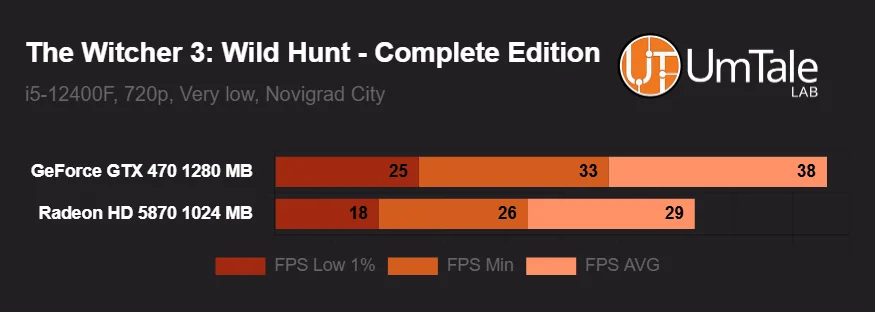
In one of the project's most demanding locations, namely Novigrad, the GTX 470 delivers 31% more frames per second, thereby providing its owner (if any are left) with a console-like gaming experience. This is perfectly acceptable for the third installment.
The final score stands at 17:1 in favor of the green monster from the past.
GPU overclocking
Our previous articles have mentioned that both graphics cards support voltage boosting. However, in those reviews, their stock cooling systems prevented us from pushing the cards to their limits. That situation has changed dramatically. Both cards now feature a cooling system from an ASUS GTX 580 DirectCU II, which, of course, positively impacted their thermal performance and significantly raised the frequency ceiling for both GPUs.
It's worth noting here that the DirectCU II cooling system is indeed quite good. However, due to its topology, including the placement of large heat pipes directly contacting the GPU and its 5-pin fan connector, recommending it as a replacement for any stock cooler is extremely difficult.
We don't need to look far for examples. If you install this cooler on, say, a GTX 670, whose die is significantly smaller than GF100 or RV870, you'll see a critical drop in heat pipe efficiency. The reason is simple: half of them won't make contact with the GPU surface.
GeForce GTX 470
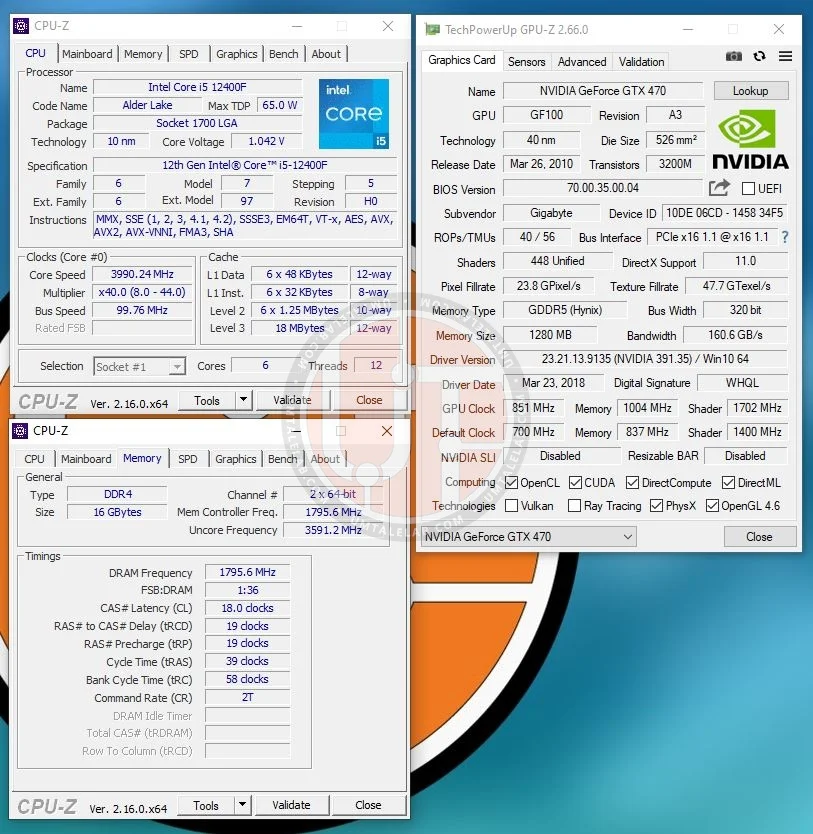
Let's move directly to overclocking. We managed to overclock the GeForce GTX 470 to a significant 851/1702 MHz for the core and 4016 MHz for the GDDR5 video memory:
 ⤢ ВІДКРИТИ
To achieve this, we had to raise the GPU voltage to 1.087 volts (1087 millivolts). The achieved frequencies are truly impressive: a 40% gain for the core and 20% for the memory. Don't forget that NVIDIA's factory settings are 608/1216/3348 MHz.
Radeon HD 5870
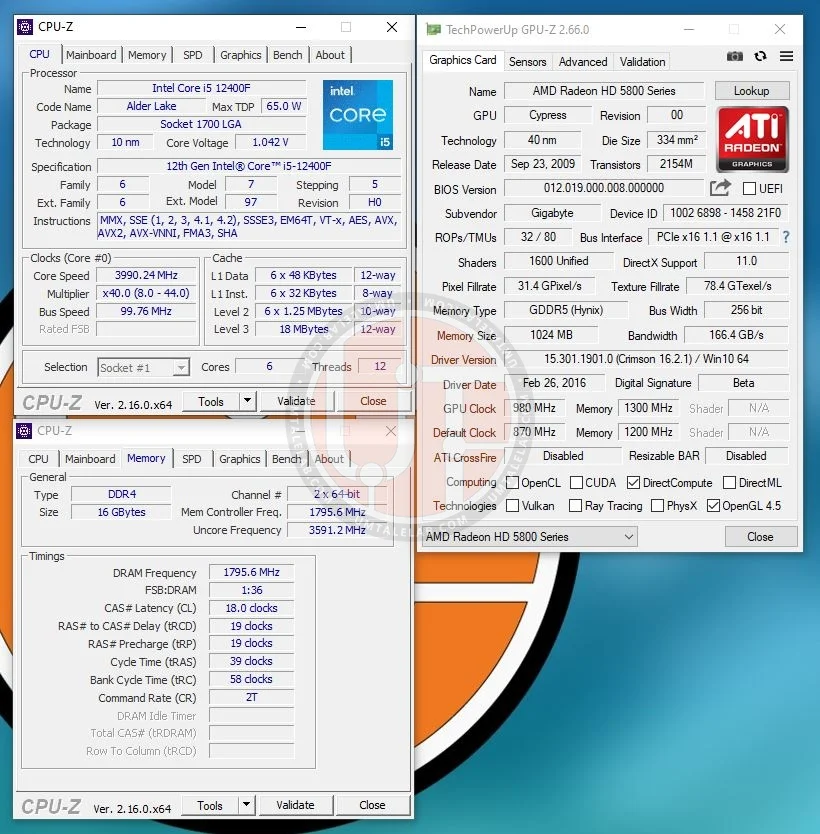
The Radeon HD 5870 didn't overclock as impressively. What's more, we had to significantly increase the GPU voltage to a critical 1.29 volts. The final clock speeds were 980 MHz for the core and 5200 MHz for the video memory:
 ⤢ ВІДКРИТИ
The clock speed increase was 15% and 8% respectively. It should be noted that these overclocking figures for the HD 5870 don't represent the typical overclocking potential of similar graphics cards. Usually, an RV870 can hit 1 GHz at a noticeably lower voltage. I lean towards the idea that the chip on our test sample has suffered degradation, which is a perfectly natural outcome after 16 years.
Bonus: GeForce GTX 560 Ti 2GB GDDR5 and its overclocking
In my review of the aforementioned graphics card, I once mentioned wanting to upgrade it from 1GB to 2GB of VRAM. This operation was actually performed the very day that article went live. But I got sidetracked; I then had to start working on full reviews for Xeon chips on LGA 2011 v3. So, the 2GB GTX 560 Ti's testing ended up on the back burner.
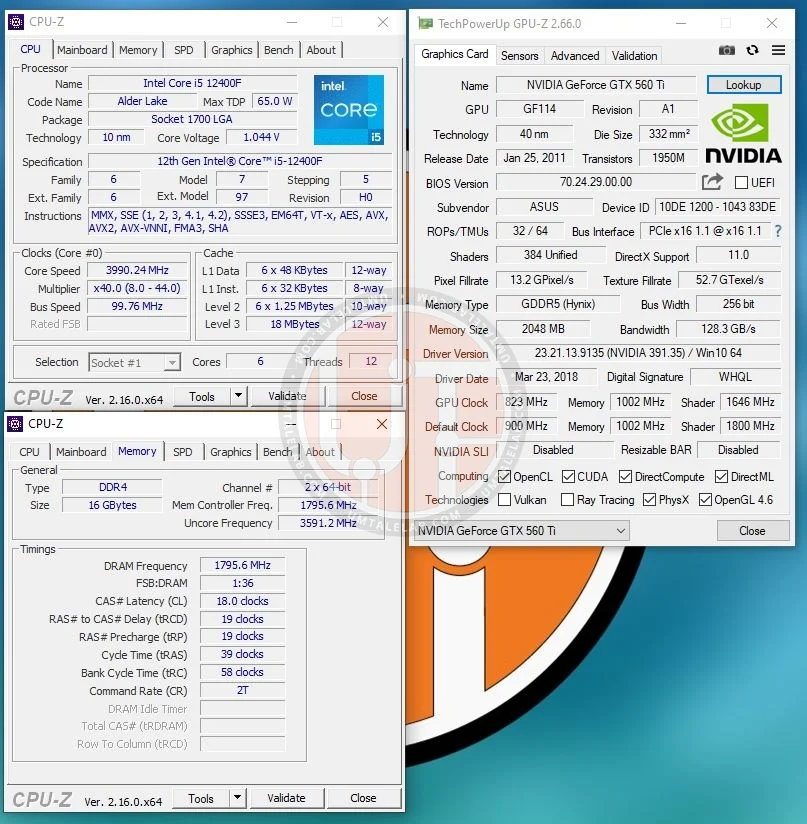
Nevertheless, promises must be kept. So, meet the GeForce GTX 560 Ti with 2GB of GDDR5:
 ⤢ ВІДКРИТИ
Just like with the other cards in today's testing, the 'Ti' card's frequencies were set to factory specifications for stock benchmarking.
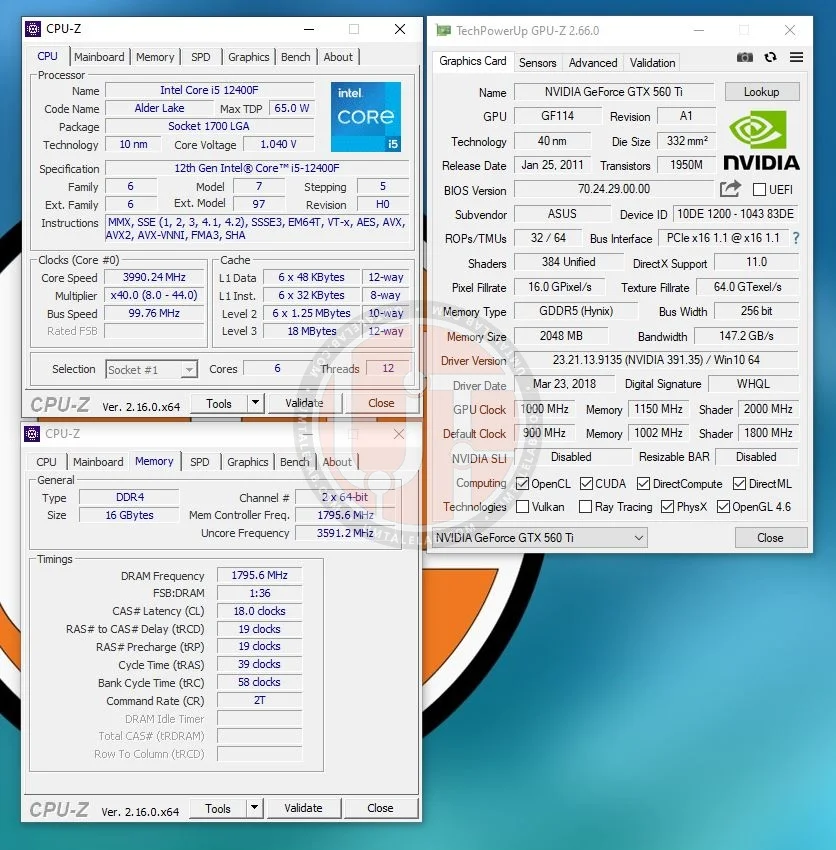
What about overclocking? Things got pretty interesting here. First, I had to completely remove the heat spreader from the GPU. Second, I swapped out the cooler's standoffs for shorter ones, allowing the heatpipes to make direct contact with the bare GPU. And third, the chip voltage was boosted to 1.2 volts. These modifications allowed it to hit 1000/2000 MHz for the GPU and 4600 MHz for the GDDR5.
 ⤢ ВІДКРИТИ
The clock speed increase was 21% and 15% respectively. As with the HD 5870, the conclusions about this overclock aren't particularly impressive. Typically, at 1.2 volts, you can usually reach around 1050/2100 MHz.
Graphics card overclocking benchmark results
Unigine Superposition benchmark
 ⤢ ВІДКРИТИ
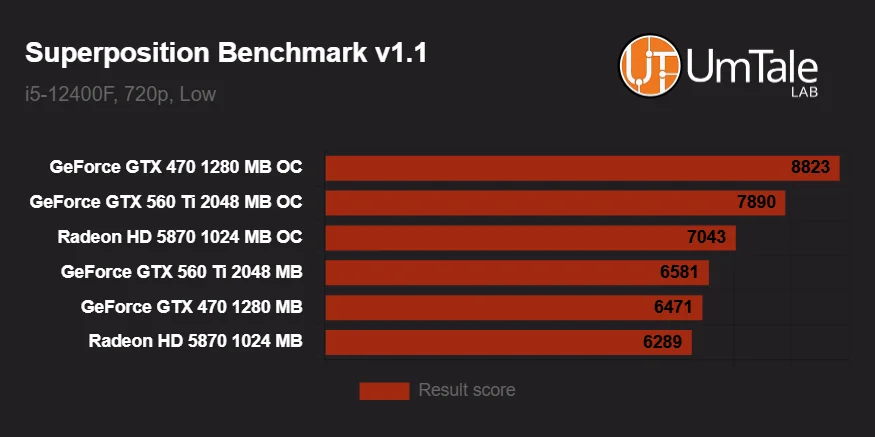
In this classic graphics card benchmark, overclocking the GTX 470 delivered a significant 36% performance boost over stock frequencies, propelling the green card into an entirely different league. The HD 5870 saw only a 12% acceleration from its overclock, securing third place. However, the GTX 560 Ti was a disappointment: while it certainly managed to outperform both the GTX 470 and HD 5870 at base frequencies, its overclocked performance lagged behind its older sibling by a noticeable 11%.
Counter-Strike 2
 ⤢ ВІДКРИТИ
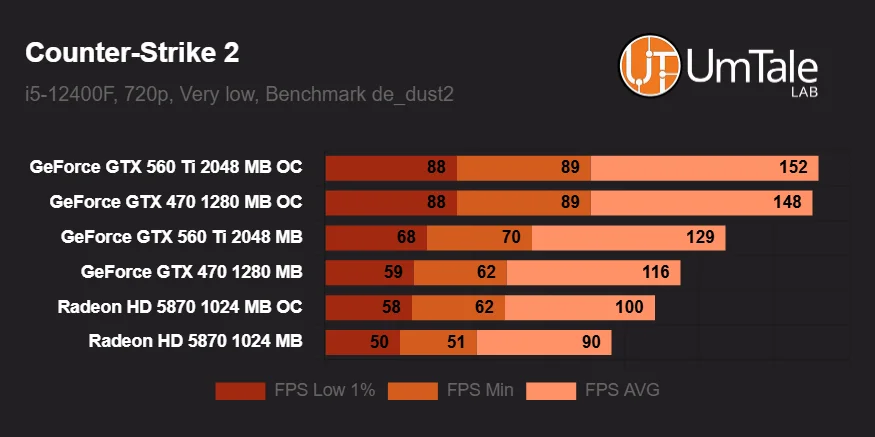
The boosted GTX 560 Ti leads in CS2, which isn't surprising: its 2GB GDDR5 buffer proved invaluable here, as even at minimum settings in 720p, the game consumes around 1700 MB. Following closely behind is the overclocked GTX 470, which gained a 28% performance increase from its overclock and surpassed the similarly clocked HD 5870 by 48%. The red card, after overclocking, only managed an 11% boost and couldn't even beat its green counterpart running at stock frequencies.
Destiny 2
 ⤢ ВІДКРИТИ
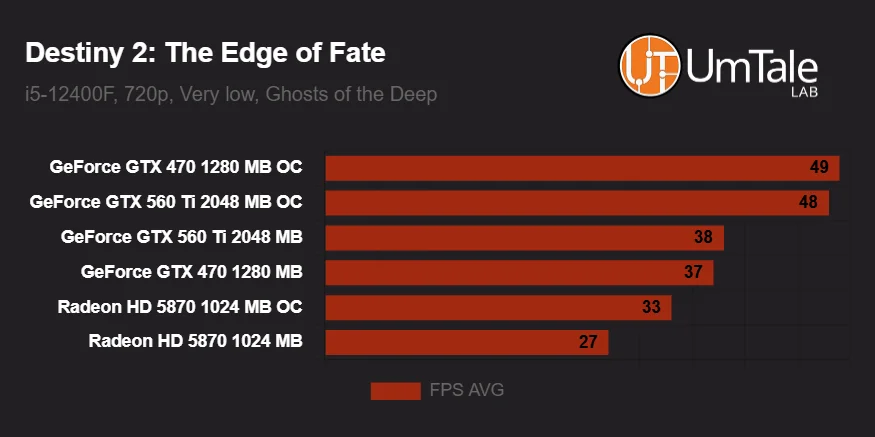
The 2GB VRAM buffer doesn't help the GTX 560 Ti here. The GTX 470 remains the leader in Destiny 2, adding an incredible 37% to its frame rate from overclocking. With an overclock, the HD 5870 finally reaches console-level FPS, gaining about 22% performance. However, it still can't catch its stock competitor.
Far Cry 5
 ⤢ ВІДКРИТИ
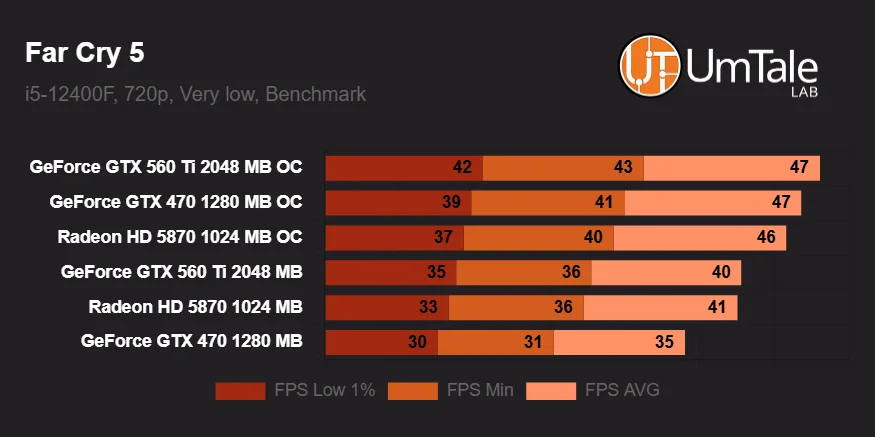
The fifth installment of this popular open-world shooter was the only game where the HD 5870 managed to outperform the GTX 470. But overclocking put everyone in their place. The GTX 560 Ti topped the chart, as 2GB of GDDR5 is a critical advantage in such a detailed project. Next up is the GTX 470, which saw a 35% frame rate increase from its overclock. Only then does the boosted HD 5870 follow, with a 12% overclocking gain.
Metro: Last Light Redux
 ⤢ ВІДКРИТИ
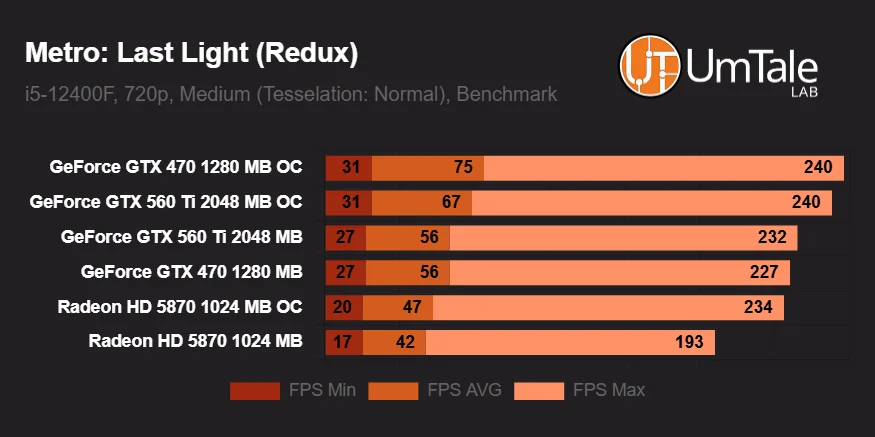
In the soft remaster of the second Metro installment, the overclocked GTX 470 delivered a familiar 34% frame rate boost, securing the top spot on the charts. The HD 5870 only managed a 12% gain from its overclock, which wasn't enough to move the red monster from last place.
Summary
I have quite fond memories of the Radeon HD 5870. In its day, this graphics card gave me a lot of positive emotions, but even then, there was no denying the obvious. Compared to Fermi, TeraScale was a less refined architecture, and unfortunately, graphics cards based on it were already dated at launch. They suffered from tessellation issues, general DirectX 11 performance problems, sometimes unstable drivers, and relatively short software support from the manufacturer (especially compared to Fermi). All of the above ultimately plagued the aging HD 5870 in this particular testing scenario. Ultimately, we saw the GTX 470 totally dominate at stock frequencies, completely annihilating the HD 5870 after overclocking.
However, the red monster did have some significant advantages: namely, reliability (HD 5870s failed noticeably less often than GTX 470s), low power consumption, and consequently, lower heat output.