NEWS · HARDWARE
PUBLISHED
READING2 min
Intel Tiger Lake-U engineering sample significantly faster than current Ice Lake-U chip
Intel Tiger Lake-U engineering samples significantly outperform Ice Lake-U, showing up to a 60% advantage in benchmarks and strong potential against AMD Ryzen.
Details about Intel's upcoming 10nm++ Tiger Lake processors are surfacing daily. One of the latest leaks appeared on the Chinese tech resource Zhihu, where a verified user posted performance benchmarks and some specifications for Intel Tiger Lake-U engineering samples.
The leaked Intel chip is based on the currently refined 10nm++ process. This 4-core, 8-thread processor uses the Tiger Lake architecture, which is set to launch in the second half of 2020.
According to the information, the tested CPU is part of the power-efficient Tiger Lake-U platform, bearing the ES2 designation. This suggests it's a second-revision chip. The engineering sample's clock speeds are 4300MHz for a single core and 4000MHz for all 4 cores/8 threads.
Unfortunately, the cache size and integrated graphics processor details remain unknown. However, our Chinese counterparts were able to compare the Tiger Lake-U sample with the current power-efficient Core i7-1065G7 processor (Ice Lake-U, 4 cores, 8 threads, single-core boost 3900MHz, all-core boost 3500MHz).
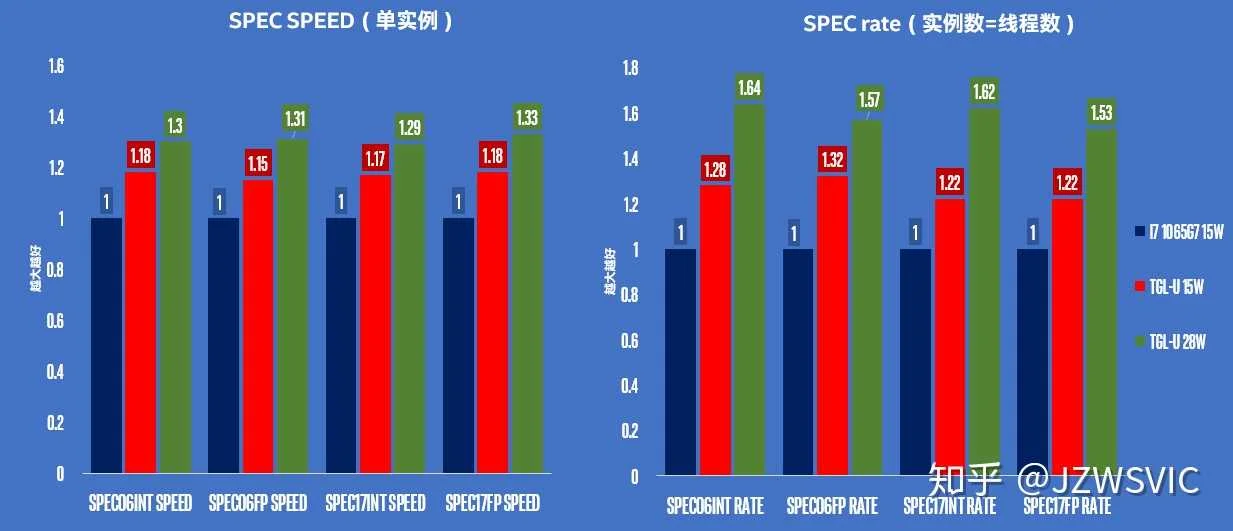
Intel Tiger Lake engineering samples were tested with both 15-watt and 28-watt power limits:
 ⤢ ВІДКРИТИ
In SPEC Speed tests, the 15-watt Tiger Lake-U version was 17% faster than the Ice Lake-U chip. The 28-watt TDP version showed a 31% advantage over the current Ice Lake-U processor and approximately an 18% advantage compared to the 15-watt Tiger Lake-U.
SPEC Rate presented a somewhat different picture: The 15-watt Tiger Lake-U variant surpassed Ice Lake-U by 26%, while the 28-watt version of the same Tiger Lake-U outperformed Ice Lake-U by about 60%.
It's worth noting that a 60% advantage can't be explained solely by the engineering sample's higher clock speeds. Based on our colleagues' results, it's highly probable that Tiger Lake will give Intel, if not a clear victory, then at least a slight edge over current and, most importantly, future 4th-gen AMD Ryzen processors.
In any case, we won't have to wait long for more information. Moreover, if these leaked samples are indeed second revision, then detailed information on cache size and integrated GPU specs could arrive soon.
Source: WccfTech
Also follow us on our Telegram channel, Facebook, Instagram and Twitter